The Eye of Fire: Tan Mu's Gulf of Mexico and the Aesthetics of Ecological Crisis
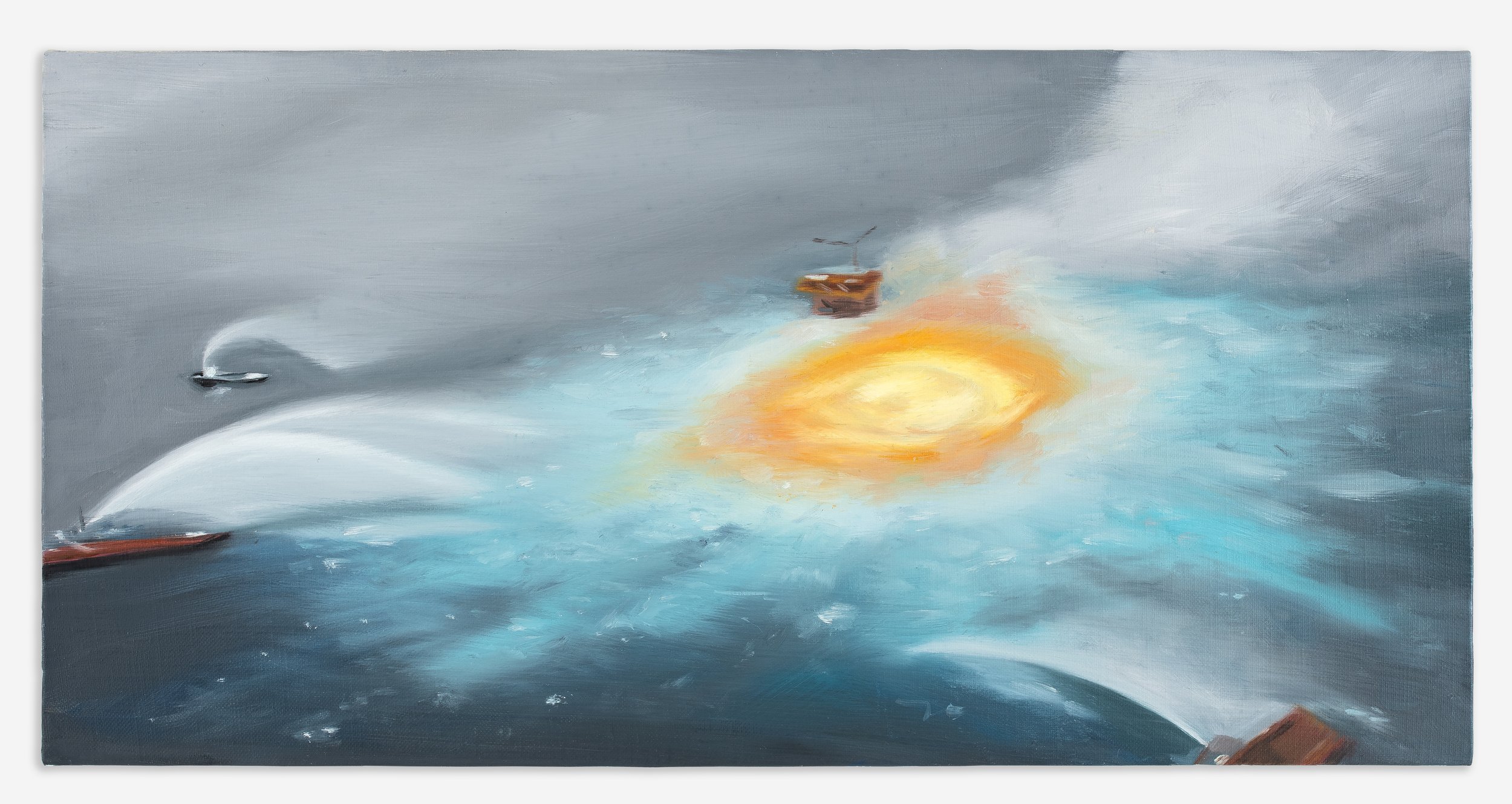
There is a specific, terrifying beauty in the sight of an ocean on fire. It is a visual contradiction that defies the basic logic of nature: water, the universal solvent and extinguisher, becomes the stage for a roaring, incandescent vortex. On July 3, 2021, this contradiction became a reality in the Gulf of Mexico, where an underwater gas leak erupted into a swirling pillar of flame dubbed the eye of fire. Tan Mu's Gulf of Mexico (2021) is an immediate response to this event. She began painting the moment she saw the breaking news, completing the work just as the blaze was extinguished. The painting is not a retrospective reflection but a real-time act of witness, a desperate attempt to capture the ephemeral violence of a disaster as it unfolds. It is a meditation on the fragility of the environment and the volatile nature of the energy systems that sustain modern civilization, a visual record of a moment when the subterranean secrets of the earth erupted into a blinding, public spectacle.
The artist states the subject with a combination of journalistic urgency and personal resonance. The work depicts the 2021 offshore gas leak and the resulting fire vortex in the Gulf of Mexico. For Tan Mu, the image is a collision of natural forces and human intervention, a crystallization of the tension between the earth's raw energy and the industrial structures built to extract it. The painting is an exploration of immediacy, reclaiming the role of painting as a medium of record in an age of disposable digital media. By translating helicopter footage into oil on linen, Tan Mu transforms a fleeting news clip into a permanent historical anchor. The work is also deeply tied to her personal history, recalling the offshore platforms she saw growing up in Yantai and encountering during her freediving expeditions. The burning rig is not just a distant disaster, but a monument to a lifelong fascination with the industrial landscapes that bridge the surface of the sea and the depths of the ocean.
Gulf of Mexico is oil on linen, 31 x 61 cm (12 x 24 in). The elongated horizontal format captures the vast, oppressive expanse of the ocean, emphasizing the isolation of the burning rig within the void of the sea. The surface is built with a dynamic interplay of thick, impasto strokes and thin, atmospheric glazes, mirroring the chaotic energy of the fire. The palette is a violent clash of deep cobalt and indigo blues against searing oranges, yellows, and brilliant whites at the core of the vortex. The brushwork in the center of the painting is frantic and circular, creating a sense of centrifugal force that pulls the viewer into the heat of the blaze. In contrast, the surrounding water is rendered with long, sweeping strokes that suggest a cold, indifferent distance. The painting is a study in temperature and texture, a visual battle between the liquid cold of the Gulf and the gaseous heat of the eruption, where the physical presence of the oil paint serves as a surrogate for the viscous nature of the spill itself.
The choice of a 12 by 24 inch format allows for a cinematic perspective, treating the canvas as a wide-angle lens that documents the scale of the disaster. The material choice of linen provides a subtle, organic tooth that resists the smoothness of the industrial subject, adding a layer of human fragility to the depiction of mechanical failure. The lighting in the painting is not naturalistic but dramatic, with the fire serving as the sole, blinding light source that casts the rest of the ocean into a deep, menacing shadow. This chiaroscuro effect heightens the sense of crisis, transforming the scene from a technical report into a psychological landscape. The painting does not just show a fire; it shows the feeling of watching a world burn in real time, the helplessness of the observer in the face of a systemic collapse. The texture of the paint, in places almost sculptural, evokes the charred remains of the rig and the bubbling surface of the contaminated water, making the environmental tragedy a tactile experience.
The comparison with J.M.W. Turner's The Slave Ship (1840) is inevitable and profound, given the shared interest in the sublime power of the ocean and the horrific cost of industrial ambition. Turner's painting depicts a churning, apocalyptic sea where the human tragedy of the slave trade is subsumed by the overwhelming forces of nature. Tan Mu's work operates on a similar frequency, presenting the fire vortex as a contemporary sublime, a terrifying spectacle that is both beautiful and monstrous. Both artists use a swirling, atmospheric composition to evoke a sense of instability and dread, suggesting that the elements are reclaiming the space occupied by human greed. Where Turner used the sea to critique the moral bankruptcy of the empire, Tan Mu uses the fire to critique the ecological bankruptcy of the energy age. The vortex in Gulf of Mexico is a modern version of Turner's storm, a visual manifestation of the tipping point where human intervention triggers an uncontrollable natural response.
Turner's work is often seen as a precursor to abstraction, with his focus on light and atmosphere over precise form. Tan Mu's painting shares this tendency, allowing the fire to dissolve the structural integrity of the oil rig into a blur of incandescent energy. This dissolution mirrors the way that the disaster itself erased the boundary between the industrial and the natural, as the rig became a fuel source for the fire. Both painters are interested in the way that catastrophe strips away the veneers of civilization, leaving only the raw, elemental struggle for survival. In Gulf of Mexico, the rig is no longer a tool of extraction, but a sacrificial altar to the god of combustion. The painting is a record of this transformation, a visualization of the moment when the machine is consumed by the very energy it sought to control. Turner's sea and Tan Mu's fire are both indifferent to human life, serving as reminders of the insignificance of our structures in the face of planetary forces.
Anselm Kiefer's The Rhine (1981) provides a second, more material parallel. Kiefer's work often deals with the weight of history, using thick layers of lead, ash, and straw to create paintings that feel like archaeological ruins. Tan Mu's painting, while smoother in execution, shares Kiefer's interest in the land as a witness to human failure. The Gulf of Mexico is not just a location, but a site of repeated trauma, from the Deepwater Horizon spill to the 2021 gas leak. Both artists treat the landscape as a repository of memory, a place where the scars of industry are permanently etched into the earth. Where Kiefer's ruins are silent and grey, Tan Mu's ruin is screaming and bright, a sudden eruption of history that demands immediate attention. The use of oil paint in Gulf of Mexico is particularly poignant here, as the medium itself is a derivative of the very substance causing the disaster, creating a reflexive loop where the material of the art is the material of the catastrophe.
Kiefer's work is deeply concerned with the concept of the scorched earth, the idea that the land remembers the violence inflicted upon it. Tan Mu's painting operates on a similar premise, suggesting that the ocean is not a void, but a living system that reacts to the intrusion of industrial extraction. The fire vortex is a fever, a biological response of the planet to a foreign infection. Both artists use the scale of the landscape to evoke a sense of cosmic irony, where the attempt to dominate nature only leads to a more spectacular form of defeat. The painting is a meditation on this irony, a visualization of the hubris of the Anthropocene. By documenting the event in real time, Tan Mu aligns her work with Kiefer's quest for a historical truth that transcends a single moment, turning a news cycle into a timeless lament for the damaged earth.
Yiren Shen's 2025 essay on Tan Mu's work notes the artist's ability to "translate the invisible architectures of our time into visible forms." Gulf of Mexico is a prime example of this translation. The painting makes visible the hidden flow of energy, the way that subterranean gas is harnessed and, in this case, unleashed. Shen argues that Tan Mu's work is not just a representation of environmental disaster, but a critical engagement with the social and ethical implications of our dependence on fossil fuels. The painting is a lens through which we can see the world anew, a world where the boundaries between the industrial and the natural are dangerously porous. Shen's insight helps us to understand the painting not just as a beautiful object, but as a critical tool, a way of thinking about our place in the network of global energy. The painting is a reminder that the fire in the Gulf is not an isolated incident, but a symptom of a systemic crisis that requires a fundamental shift in our relationship with the planet.
The painting sits within a larger series of works by Tan Mu that explore the theme of energy, environment, and volatility. From the urban fires of Philadelphia (2020) to the cosmic energy of Trinity Testing (2020), she has been documenting the moments when energy escapes control and becomes a force of destruction. Gulf of Mexico is a pivotal work in this series, bridging the gap between the social unrest of the city and the geological unrest of the ocean. It is a work that is both specific and universal, a document of a particular leak that speaks to the enduring fragility of our ecological balance. The painting is a testament to the power of art to illuminate the unseen, to make the invisible systemic failures visible, and to help us understand our place in a warming world. It is a work that reminds us that we are not just observers of the disaster, but participants in the system that creates it, shaped by the energy we consume and the waste we leave behind.
This connection to her childhood in Yantai is significant. Growing up along the coast, Tan Mu observed the offshore natural gas platforms that dotted the horizon, massive steel structures that transported energy through pipelines and altered the spatial relationship between industry and nature. These early encounters with the machinery of extraction left a deep impression, one that continues to surface in her work. As a freediver, she has continued to encounter similar industrial landscapes underwater, witnessing the dual presence of these facilities above and below the surface. In Gulf of Mexico, this personal archaeology of the industrial is compressed into a single, catastrophic image. The burning rig is not just a news event, but the culmination of a lifetime of observation, a painting that contains the weight of every platform she ever watched from the shore and every pipeline she swam past in the deep. The work is a testament to the power of personal memory to shape the way we document history, to transform a distant disaster into an intimate confrontation with the systems that have always surrounded us.
The reflexive relationship between the medium and the subject in Gulf of Mexico deserves further attention. The painting is executed in oil on linen, a medium whose primary ingredient is derived from the same fossil fuels that powered the offshore rig and fueled the fire. This material irony creates a closed loop where the art object becomes complicit in the disaster it depicts, a paradox that deepens the viewer's engagement with the work. Tan Mu is not just painting about oil; she is painting with oil. This self-aware use of material connects the work to broader debates in contemporary art about sustainability, carbon footprints, and the ethical responsibilities of the artist. By refusing to sanitize her materials, she forces the viewer to confront the uncomfortable truth that the tools of our creative expression are inseparable from the systems of extraction that are destroying the planet. The painting becomes a document of this entanglement, a mirror that reflects not just the fire in the Gulf, but the fire that burns in every gallery, every studio, every home that depends on the combustion of fossil fuels for its light, its heat, and its art.
Ultimately, Gulf of Mexico is a painting about witness. It is about the way that we process the overwhelming scale of modern disaster, the way that a flickering video on a screen is transformed into a tangible, physical record on canvas. It is a celebration of the power of painting to slow down time, to force the viewer to sit with the horror and the beauty of the vortex. But it is also a warning about the cost of our blindness, a reminder that the eye of fire will return if we continue to treat the earth as an infinite resource. The painting is a call to action, a call to move beyond the spectacle of the disaster and toward a sustainable future. It is a work of beauty and of truth, a work that reminds us of the power of art to heal and to transform. The fire is not just a disaster; it is a signal, a warning, and a prayer. The painting is a testament to this signal, a celebration of our capacity for empathy in the face of catastrophe, and a vision of a world where we no longer have to burn the ocean to survive. It is a work of hope, a work of peace, a work of love. It is a work that will continue to inspire and to challenge us all for many more years to truly come, a reminder that the flames we ignite today are the history we leave for tomorrow, and that the burning eye of fire watches us still.