The Fever Map: Tan Mu's Thermal Imaging and the Surveillance of Warmth
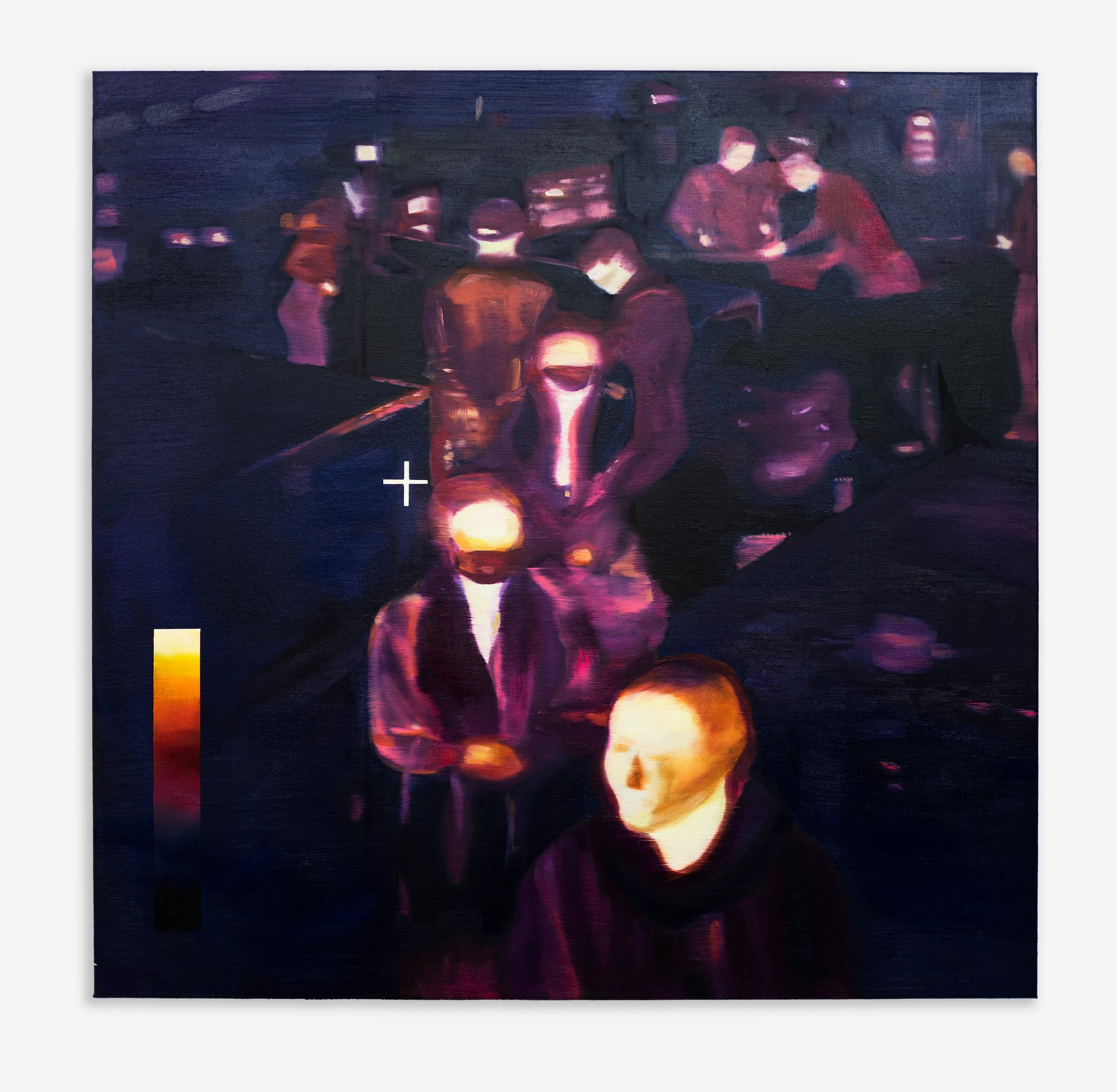
In the early months of 2020, airports around the world began installing a new kind of checkpoint. It was not a metal detector or a passport scanner, but a thermal imaging camera, a device that could read the heat radiating from a human body and translate it into a color-coded map of temperature. These cameras became the gatekeepers of the pandemic, the first line of defense against an invisible virus, and they changed the way that public space was navigated by millions of people. Tan Mu's Thermal Imaging (2022) captures this transformation. It is a painting of an airport security image, rendered in the vivid palette of infrared photography, where two masked pedestrians are highlighted against a dark, cool background. The work is a meditation on the tension between surveillance and safety, on the way that technology translates the intimate sensation of body heat into a cold, quantifiable data point. It is a painting about the moment when warmth became a threat, when the human body became a site of measurement and classification.
The artist states the subject with technological and social precision. The work is based on a sourced image captured through a thermal imaging camera during the COVID-19 pandemic at an airport security checkpoint. For Tan Mu, the thermal camera is not just a diagnostic tool but a site of conceptual inquiry into the nature of perception and privacy. The painting examines the tension between the necessity of surveillance and the alienating experience of being observed and measured during a global crisis. It captures the moment when technology mediates our most basic sensory experiences, when the tactile sensation of warmth is replaced by a visual representation on a screen. The work is a study in the architecture of control, an investigation into how technological systems reorganize public space and redefine the boundaries of the individual body. The painting is a bridge between the medical and the political, between the personal and the systemic, between the felt and the measured.
Thermal Imaging is oil on linen, 76 x 76 cm (30 x 30 in). The square format creates a centered, symmetrically balanced composition that mimics the framing of a surveillance camera. The surface is built with bold, contrasting passages of color that translate the infrared spectrum into the language of oil paint. The palette is dominated by dark indigo, deep violet, and cold blues that represent the ambient temperature of the airport, punctuated by selective bursts of warm red and orange that mark the heat signatures of the two figures. A crosshair element in the center of the composition represents the AI system actively detecting and recording body temperature, while a gradient color bar in the lower left corner corresponds to the thermal ranges used for classification. The brushwork in the figures is loose and semi-figurative, with visible strokes that soften their contours and allow the bodies to appear fluid and unstable rather than fixed. This instability mirrors the way that technology abstracts the human presence into data, dissolving the solid reality of the body into a shimmering field of color.
The 30 by 30 inch format is significant for its associations with the screen. The square canvas replicates the aspect ratio of a monitor or a camera viewfinder, framing the viewer as a remote observer who watches the scene through a technological interface. The linen support provides a subtle, organic texture that grounds the digital imagery in the material reality of the painting process, a reminder that this vision of the body is mediated by both the camera and the hand. The crosshair at the center is a powerful compositional device, turning the painting into a targeting reticle that locks onto the two pedestrians. This gesture transforms the act of looking from a passive observation into an active surveillance, implicating the viewer in the system of control that the painting describes. The color bar in the lower corner functions as a key, a legend that tells the viewer how to read the colors, but it also serves as a reminder that this is a translation, a conversion of one kind of information into another that necessarily loses something in the process.
The comparison with Krzysztof Wodiczko's The Homeless Projection (1986) is instructive, given the shared interest in the use of technology to render invisible populations visible in public space. Wodiczko's work projected images of homeless individuals onto the facades of government buildings, using the language of monumentality to force the public to confront the presence of those it had chosen to ignore. Tan Mu's painting operates on a similar principle, but her projection is not one of solidarity; it is one of classification. The thermal camera does not give the masked pedestrians a voice or a face; it gives them a temperature, a number, a color. Where Wodiczko's projection was an act of resistance, Tan Mu's painting is an act of documentation, a record of the moment when technology was deployed to measure and to separate. Both artists are interested in the way that public space becomes a theater of power, a stage on which the politics of visibility are played out in real time. But where Wodiczko's intervention was confrontational, Tan Mu's is observational, a quiet acknowledgment that the systems of control have become so pervasive that they no longer require protest, only attention.
Wodiczko's practice is rooted in the belief that technology can be repurposed as a tool of social engagement, that the same instruments of surveillance can be turned against the structures of power that deploy them. Tan Mu's painting does not attempt this reversal. Instead, it presents the thermal image as a fait accompli, a vision of the world as it has become under the pressure of pandemic and crisis. The two masked figures are not rebels or resistors; they are travelers, ordinary people submitting to the routine of the checkpoint. The painting does not judge this submission; it records it, with the same clinical detachment that the camera itself employs. This neutrality is the source of the painting's power. By refusing to editorialize, by simply presenting the thermal image as a painted surface, Tan Mu forces the viewer to confront the implications of the technology on their own terms. The painting is a mirror, reflecting back the viewer's own complicity in the systems of surveillance that have become the invisible architecture of modern life.
The pandemic context gives this confrontation a particular urgency. Before 2020, thermal imaging was primarily a military and industrial technology, used for night vision, building inspection, and firefighting. The COVID-19 crisis transformed it overnight into a public health instrument, deployed in airports, hospitals, schools, and shopping malls around the world. This rapid redeployment of surveillance technology from the battlefield to the classroom is one of the defining features of the pandemic era, and Tan Mu's painting captures it with a precision that is both historical and conceptual. The crosshair in the center of the composition is not a metaphor; it is a literal feature of the thermal camera's software, an algorithm that identifies and tracks the heat signature of each individual who passes through the checkpoint. By including this element in the painting, Tan Mu draws attention to the automated, algorithmic nature of the surveillance, the way that the decision to allow or deny entry is increasingly made by a machine rather than a human. The painting is a document of this shift, a record of the moment when the checkpoint became a machine.
Mark Bradford's 150 Portrait Tone (2017) provides a second, more material parallel. Bradford's work is built from layers of found paper, billboard fragments, and advertising materials that he tears, layers, and abrades to create large, densely textured surfaces. His paintings map the invisible economies of race, class, and commerce that structure urban life, transforming the detritus of the city into a visual archive of social forces. Tan Mu's painting shares this interest in mapping the invisible, but her map is not of social economies; it is of biological data. The thermal image translates the hidden landscape of body heat into a visible field of color, revealing the patterns of warmth and coolness that the naked eye cannot perceive. Both artists are interested in the way that abstraction can make the invisible visible, the way that the removal of figurative detail can expose the underlying structures of power and control. Bradford's surfaces are dense and layered, reflecting the complexity of the social systems they map; Tan Mu's surface is thin and luminous, reflecting the thin membrane of technology that separates the body from the data it produces.
Bradford's work is often described as a form of social cartography, a mapping of the forces that shape the contemporary city. Tan Mu's Thermal Imaging operates on a similar premise, but her cartography is physiological rather than social. The painting maps the thermal landscape of the human body, the hidden topography of heat that emerges when the skin is viewed through the lens of infrared technology. This mapping is both intimate and invasive, a way of seeing that gets closer to the body than any naked eye could while simultaneously maintaining a clinical distance. Bradford's paintings are the product of physical labor, of tearing and scraping and layering; Tan Mu's painting is the product of a translation, a movement from the digital to the handmade, from the captured to the created. Both processes are acts of excavation, a digging through layers to find the truth that lies beneath. The difference is in the material: Bradford excavates the social body through paper and glue; Tan Mu excavates the biological body through color and light. Both arrive at the same conclusion: that the body is never just a body, but a site where the forces of the world converge and become visible.
The connection between Bradford's social maps and Tan Mu's thermal maps is more than formal; it is conceptual. Both artists recognize that the visible world is only a fraction of reality, that the most important forces shaping our lives are the ones that remain hidden from the naked eye. Bradford's paintings reveal the redlining, the gentrification, the economic displacement that structure the American city; Tan Mu's painting reveals the temperature, the fever, the biological vulnerability that structures the pandemic city. In both cases, the act of making the invisible visible is an act of political engagement, a refusal to accept the surface appearance of things as the final word. The vivid palette of Thermal Imaging, with its cold blues and hot reds, is not merely decorative; it is informational, a way of encoding data in color that makes the viewer aware of the systems of classification that surround them. By translating this data into oil paint, Tan Mu performs an act of critical reclamation, insisting that the human body is more than a data point, that the warmth of the skin is more than a number, that the person standing at the checkpoint is more than a color on a screen.
Yiren Shen's 2025 essay on Tan Mu's work notes the artist's ability to "translate the invisible architectures of our time into visible forms." Thermal Imaging is a powerful example of this translation. The painting makes visible the hidden infrastructure of pandemic surveillance, the network of cameras and algorithms that monitor the thermal signatures of millions of travelers every day. Shen argues that Tan Mu's work is not just a representation of medical technology, but a critical engagement with the social and ethical implications of that technology. The painting is a lens through which we can see the world anew, a world where the boundaries between the body and the data are increasingly porous. Shen's insight helps us to understand the painting not just as a beautiful object, but as a critical tool, a way of thinking about our place in the network of surveillance that defines the post-pandemic world. The painting is a reminder that temperature is not just a number, but a political fact, a measure of our vulnerability and our compliance.
The painting sits within a larger series of works by Tan Mu that explore the theme of technology and the body. From MRI (2021), which examines the internal landscape of the brain through magnetic resonance, to Silicon (2021), which investigates the material foundations of the digital world, she has been documenting the ways in which technology reshapes our understanding of the biological. Thermal Imaging is a pivotal work in this series, bridging the gap between the clinical gaze of the hospital and the political gaze of the airport. It is a work that is both specific and universal, a document of a particular checkpoint that speaks to the enduring tension between freedom and security. The painting is a testament to the power of art to illuminate the unseen, to make the invisible systems of control visible, and to help us understand our place in a world where the body is never truly private. It is a work that reminds us that we are not just patients or travelers, but data points in a system that measures, classifies, and sorts us according to the heat we emit.
Ultimately, Thermal Imaging is a painting about the loss of privacy. It is about the moment when the most intimate signal of the body, the warmth of the skin, became a public fact, a number displayed on a screen for anyone to read. It is a celebration of the ingenuity of the technology that made this vision possible, but it is also a warning about the cost of that vision. The painting is a call to awareness, a call to remember that the data points on the screen are people, that the colors on the map are bodies, that the warmth measured by the camera is not just a temperature but a life. It is a work of beauty and of truth, a work that reminds us of the power of art to see through the screen and find the human on the other side. The crosshair is not just a symbol of surveillance; it is a symbol of our shared vulnerability, a reminder that we are all measured, all classified, all reduced to a number on a scale. The painting is a testament to this reduction, a celebration of our refusal to be fully captured by the data, and a vision of a future where the warmth of the body is not a threat but a gift. It is a work that will continue to challenge us to look beyond the screen and see the person standing at the checkpoint, masked and measured but still, fundamentally, human.
The painting also raises a question about the future of public space in a world where surveillance is increasingly ambient and automated. As thermal imaging, facial recognition, and AI-driven monitoring become standard features of airports, train stations, and shopping centers, the experience of moving through public space is transformed from a social act into a data event. Every step is tracked, every temperature is recorded, every deviation from the norm is flagged and reported. Tan Mu's painting captures the early stages of this transformation, the moment when the technology is still novel enough to be visible, still unfamiliar enough to provoke discomfort. In time, the thermal camera will become as invisible as the metal detector, as unremarkable as the CCTV lens. The painting preserves the strangeness of this moment, the uncanny quality of seeing your own heat reflected back at you in a palette of colors that belong to no natural landscape. It is a work of memory, a record of the first time we were asked to submit our warmth to the machine, and a reminder that the submission is never final, never complete, never without cost. The painting holds this tension, this unresolved negotiation between the body and the data, between the person and the number, between the warmth and the screen.