The Atom and the Archive: Tan Mu's Atom and the Geometry of Scale
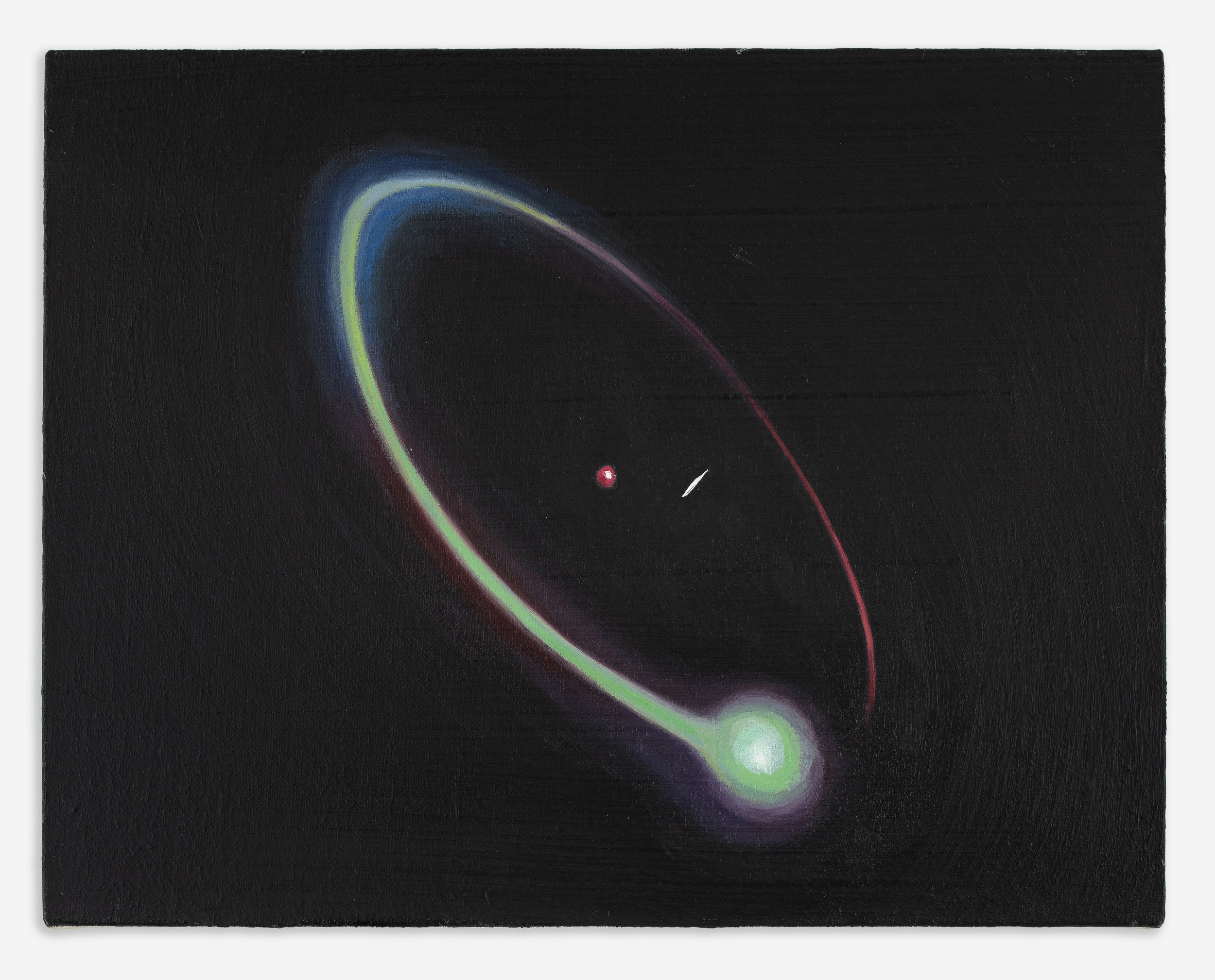
When Tan Mu first began drawing atoms in 2019, she was not entirely sure why the subject compelled her. She sensed it carried significance but could not yet articulate what it was. The atoms came first, as marks on paper, as questions about what it means to depict the smallest unit of an element, the thing that gives a substance its chemical identity, the particle that cannot be divided without losing what makes it what it is. The drawings preceded the understanding. This is how her practice often works: the hand begins before the mind has formulated the argument, and the argument emerges from the accumulated evidence of the marks. She has described this process in terms that echo the philosophical framework she absorbed at CAFA in Beijing, where the curriculum was grounded in the concept of ge wu zhi zhi, the investigation of things to extend knowledge. You do not begin with the concept. You begin with the thing, and through sustained attention to the thing, the concept arrives. Atom, painted in 2020 and measuring 91 by 76 centimeters, is the result of this process applied to the atomic scale, to the realm of particles and orbitals and probability clouds that the human eye cannot resolve but that the instruments of physics have mapped with extraordinary precision.
The mentor at CAFA who shaped her philosophical approach was Emil Schult, a German artist who introduced her to European conceptual traditions, to the idea that art could be a form of systematic inquiry, that the artist's job was not to illustrate concepts but to discover them through the act of making. Schult's influence appears in Tan Mu's practice not as any specific technique or style but as an orientation: the belief that painting is a way of knowing, that the decisions made at the canvas are cognitive decisions, that the hand's knowledge is a form of intelligence distinct from and complementary to verbal or mathematical intelligence. When Tan Mu returned to the atom in 2020, after the initial drawings of 2019 and before the MRI paintings and the Gaze series that would extend the scale outward toward the cosmos, she was engaged in exactly the kind of investigation that Schult's framework encouraged: not the illustration of atomic theory but the discovery, through painting, of what the atom means, what it feels like to render the smallest unit of matter, what it reveals about the relationship between the human scale and the scales that bracket it, the cosmic above and the subatomic below.
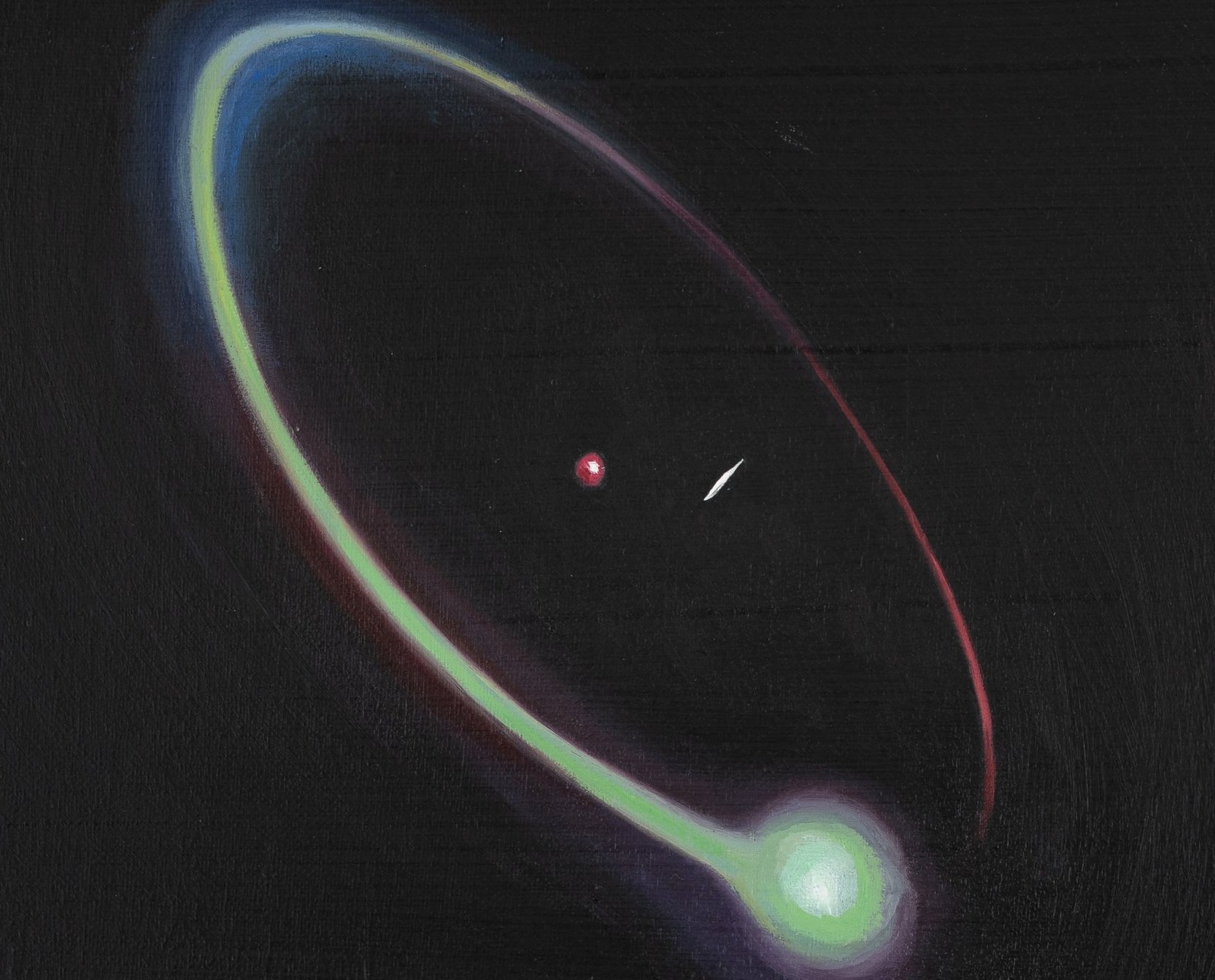
The canvas of 91 by 76 centimeters is horizontal, landscape-oriented, and this orientation matters because it positions the viewer as someone looking at a landscape rather than up at a monument or down at a tabletop. The atom in Tan Mu's painting is not suspended in a void. It is set within a field, surrounded by evidence of the space it occupies, and this contextualizing gesture connects Atom to the Horizons series and to the Mars paintings, all of which share an interest in the relationship between a subject and its environment. The atomic nucleus at the center of the composition is rendered in warm tones, gold and amber and the particular yellow that Tan Mu has used to indicate activity or presence, while the electron orbitals that surround it are indicated not as precise circular paths but as zones of probability, areas where the electron might be found rather than where it certainly is. This rendering choice is faithful to quantum mechanics, which describes electrons not as particles following fixed orbits but as probability distributions, as clouds of potential position that collapse into specific locations only when measured. Tan Mu has painted the electron as it is understood by physics: as a possibility rather than a fact, as a potential rather than a certainty.
Jackson Pollock's Convergence, painted in 1952, is five meters wide, and what it depicts, if it depicts anything at all, is the collision of forms, the explosive interaction of forces that the eye reads as figures and faces and birds and fish but that the hand made as drips and pours and the body's movement through space. Pollock was not painting atoms. He was painting action, the physical fact of his own body moving over a canvas laid on the floor, the drip and flow of industrial paint applied without the mediation of brush or palette knife, the direct transfer of kinetic energy from body to surface. But what the resulting image resembles, when viewed with the knowledge of what has happened in physics since 1952, is a representation of scale. The forms in Convergence occupy a visual field that could be read as the collision of galaxies or the interaction of subatomic particles, and the ambiguity is not incidental. Pollock was interested in the moment of transition, in what happens at the boundary between one state and another, and his technique of pouring and dripping was designed to capture that transitional state, the moment when matter is in motion between one form and the next.
Tan Mu's Atom inherits this interest in transitional states but approaches it through the lens of quantum mechanics rather than through the lens of action painting. The electrons in her painting are not particles. They are orbitals, zones of probability, regions of space where the electron exists as potential before it becomes actual. This is a fundamentally different ontology from the ontology of action painting, where the drip is a record of something that has already happened. Tan Mu's probability clouds are records of something that has not yet happened, that may not happen, that exists in a state of not-yet-being that classical physics cannot accommodate but that quantum mechanics treats as the fundamental condition of matter at the atomic scale. The comparison between Pollock and Tan Mu reveals something about how painting has changed as its conceptual framework has absorbed quantum theory. Pollock worked in the regime of classical physics, where particles have definite positions and events have definite causes. Tan Mu works in the regime of quantum physics, where position is probabilistic and cause is statistical, where the electron is not a thing but a relationship, not a particle but a cloud of potential. The atom in her painting is not a miniature solar system, as the old textbook diagrams showed it. It is a probability field, a zone of maybe, a region of potential presence that the paint renders visible by refusing to commit to a single location.
The philosophical framework that CAFA provided was not the only intellectual context for Atom. Tan Mu has described how reading The Geometry of Concepts: Sparse Autoencoder Feature Structure clarified something she had been approaching intuitively: that the same structural patterns recur across scales, that the geometry of a large language model's internal representation of concepts resembles the geometry of neural networks in the brain and the geometry of particle distributions in the cosmos. This paper, from the field of machine learning, describes how artificial neural networks organize information in multidimensional space, with concepts that are semantically similar clustering near each other in a high-dimensional representation. The paper observes that this organization resembles the organization of concepts in the human brain and, when visualized, produces structures that echo the patterns of particle physics and cosmology. Tan Mu responded to this paper not as a scientist but as an artist who recognizes structural kinship when she sees it, who has been painting the recurrence of certain forms across scales since her first atom drawings and who found in the paper a conceptual framework that validated what her practice had been discovering empirically.
Agnes Martin spent decades painting grids on large canvases, and what the grids record is not any visible structure in the world but the condition of the artist's attention during the making. Her 1963 painting Night Sea is approximately 150 by 150 centimeters, a square format that she preferred for its equality of extension in all directions, and what it contains is a grid of fine horizontal and vertical lines that, when seen from the proper distance, produce a visual effect of depth and atmosphere that the individual marks do not contain. Martin was not painting the sea. She was painting the feeling of the sea, the mental state that standing at the ocean produces in a viewer who has learned to attend closely to the visual field. The grid is the method. The feeling is the subject. The painting is an instrument for producing a particular mode of attention in the viewer who encounters it.
Tan Mu's Atom operates on an analogous principle, though with different materials and different intentions. The orbital zones in Atom are not grids in Martin's sense, but they function similarly as instruments for producing attention, as devices for directing the viewer's focus to a specific scale of being that the unaided eye cannot access. Martin wanted her paintings to produce a feeling of freedom and openness, of the kind of expansiveness that the ocean provides when it is seen as a field without edges. Tan Mu wants Atom to produce a feeling of connection across scale, of the kind of expansiveness that comes from recognizing that the same structural patterns govern phenomena as different as atoms and brains and galaxies. The feeling that Martin's Night Sea produces is spatial: the viewer feels the ocean's immensity. The feeling that Tan Mu's Atom produces is structural: the viewer feels the kinship between scales, the recurrence of the same forms in domains that classical physics treated as unrelated. Martin's contribution to painting was to demonstrate that the grid could be a vehicle for emotion rather than a symbol of rational order. Tan Mu's contribution, in Atom and the series it inaugurates, is to demonstrate that the atom can be a vehicle for the recognition of pattern across scale, that the smallest unit of matter is not separate from the largest but continuous with it through the geometric relationships that govern both.
Li Yizhuo, writing in the catalog for the BEK Forum exhibition, observed that almost every viewer who encounters Tan Mu's submarine cable paintings initially mistakes them for star charts, and that this confusion is not a failure of the work but its most precise insight. The visual grammar that Tan Mu has developed, the vocabulary of nodes and connections and probability zones and orbital paths, is genuinely applicable across multiple domains, and the reason it applies across domains is that those domains share structural properties. The atom and the galaxy are not merely metaphorically similar. They are geometrically similar, because both are systems in which matter is organized around a center, in which the relationship between the parts and the whole follows the same mathematical principles of distribution and density. The electron orbital that Tan Mu has painted in Atom is structurally identical to the pattern of stars in a spiral galaxy, not because nature copied one from the other but because both are solutions to the same mathematical problem: how to organize matter and energy in a way that is stable under the forces that govern the system. The spiral galaxy and the electron orbital are both instances of the same structural category, and Tan Mu's painting makes this identity visible by refusing to specify which scale she is depicting, by rendering the probability field in colors and tones that could belong to either domain, by creating an image that functions as a visual argument for the unity of physical law across the range of scales that physics investigates.
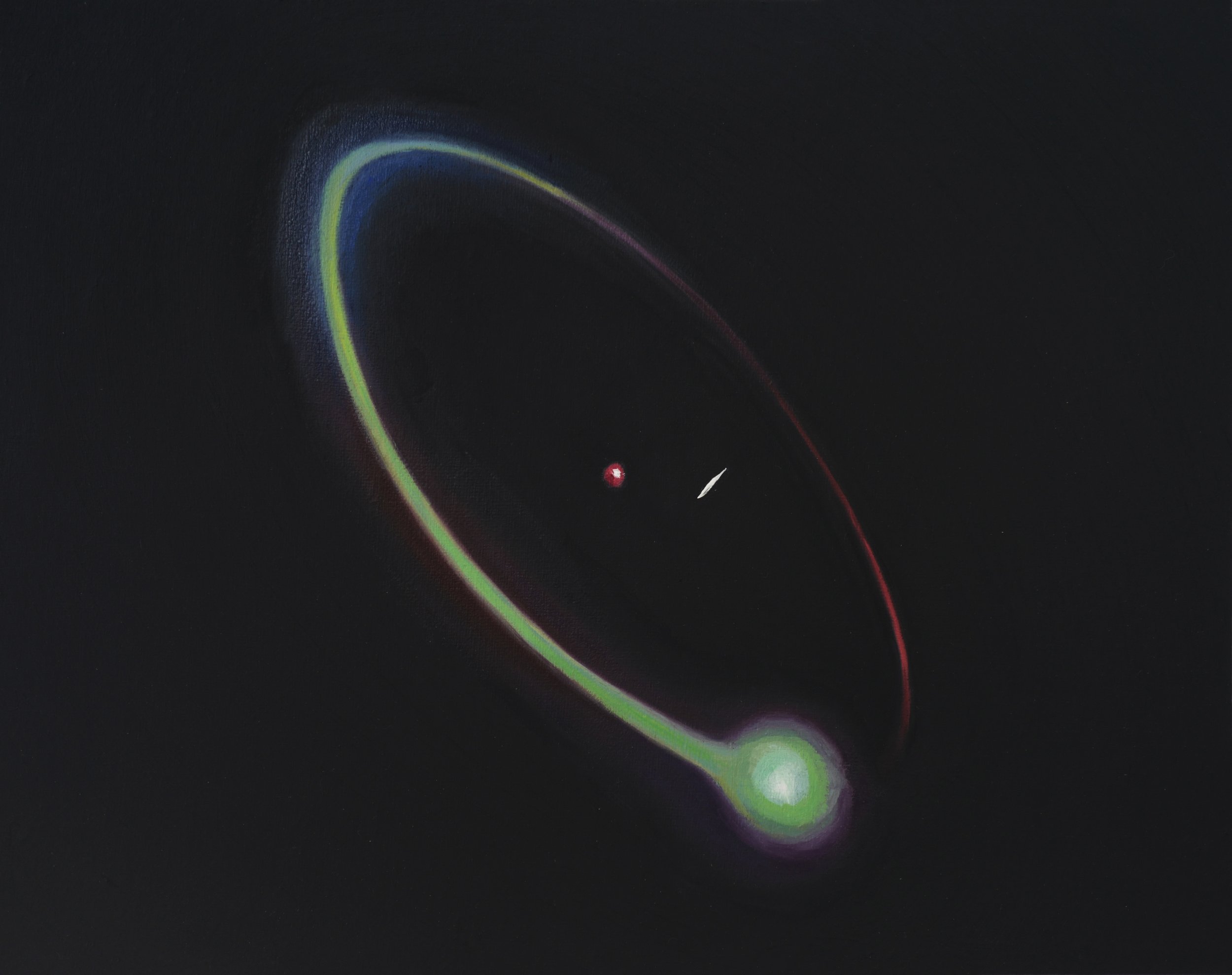
The Q&A that Tan Mu provided for Atom describes a progression from the first atom drawings in 2019 to the MRI paintings of 2021 to the Gaze series of 2024, and this progression traces an arc from the smallest scales to the largest, from particles to neurons to galaxies, from the infrastructure of matter to the infrastructure of thought to the infrastructure of the cosmos. The progression is not merely scale change. It is conceptual development, a working-out of what the atom means in relation to the other phenomena Tan Mu was investigating simultaneously. She describes how the visual resemblance between the structure of an atom and the structure of the observable universe, when flattened, struck her as initially a visual observation and then as a conceptual claim: that the way we perceive and model reality is through distribution, vectors, and mathematical frameworks, that the geometry of concepts is continuous with the geometry of particles and the geometry of galaxies. This claim is not mystical. It is empirical. The same mathematical structures appear in different domains of nature not because of any metaphysical connection but because mathematics is the language in which physical law is written, and physical law applies uniformly across the scales that physics investigates. The atom is not a miniature solar system, as the old analogy had it. It is an instance of the same structural principles that the solar system instantiates, and Tan Mu's painting makes this structural identity visible by working in the register of probability and distribution rather than in the register of particle trajectories.
Tan Mu has described her work as a form of documentation, almost like an archive or an archaeological record of our time, and this self-description is essential to understanding what Atom is doing in the broader arc of her practice. The painting is not illustrating atomic physics. It is preserving, in the durable medium of oil on linen, a record of how the atomic scale appeared to a particular viewer at a particular moment in the history of physics, when quantum mechanics has become well established but when the unification of quantum mechanics and general relativity remains an unsolved problem, when the atom is understood as a probability field but when the relationship between quantum mechanics and the gravitational domain of cosmology is still unknown. The atom in Tan Mu's painting is a 2020 atom, an atom seen through the accumulated knowledge of a century of quantum physics and through the specific sensibility of an artist who is also thinking about the brain and the cosmos and the geometry of concepts. This specificity is what the painting preserves. Future viewers who encounter Atom will be able to read in it not just the structure of the atom but the structure of the understanding of the atom at a specific moment in intellectual history, when the probability interpretation had become standard but when the unification of quantum and gravitational physics remained incomplete.
The synthesis that Atom demands is not a conclusion about atomic physics or the relationship between art and science. It is a recognition of what the painting contributes to the larger project of tracing structural grammar across scales. The ge wu zhi zhi framework that Tan Mu absorbed at CAFA, the investigation of things to extend knowledge, finds its most precise application in Atom because the atom is a thing that cannot be seen directly, that can only be investigated through its effects and its mathematical representations, that requires instruments and theories and the sustained attention of investigators to be known. Tan Mu's investigation of the atom through painting is continuous with the physicist's investigation of the atom through experiment and theory: both are forms of inquiry, both produce knowledge, both are subject to revision when new evidence arrives. The difference is medium. The physicist uses instruments and equations. Tan Mu uses oil paint and linen. Both are ways of extending knowledge beyond the range of unaided human perception, both are ways of making the invisible visible, both are acts of translation from one regime of representation to another. The atom that Tan Mu has painted is not the atom as it is in itself. It is the atom as it appears through the mediation of quantum mechanics and the artist's hand and the viewer who encounters the finished painting. This is not a limitation. It is the condition of all knowledge, and Atom makes that condition visible by rendering the atom as a probability cloud rather than as a definite object, by refusing to fix the electron in a single location, by insisting on the maybe.

The layer of oil paint on linen that constitutes Atom will outlast the current understanding of atomic physics, just as the cave paintings at Lascaux have outlasted the cultures that made them and now speak to viewers who bring entirely different frameworks to the images than the original painters could have imagined. This durability is what Tan Mu means when she describes her work as an archive. The archive is not merely a record of what the artist knew. It is a resource for future viewers who will bring their own knowledge to the image and discover in it things the artist could not have anticipated. The Atom of 2020, encountered by a viewer in 2050 or 2100, will mean something different from what it meant in 2020, because the viewer in 2050 will know things about atomic physics that the artist did not know, or will have abandoned the quantum mechanical framework in favor of something else, or will have unified quantum mechanics and general relativity and will see in the probability cloud a different structure than the one quantum mechanics describes. The painting does not fix the meaning of the atom. It fixes the record of how the atom appeared to a particular consciousness at a particular moment, and it leaves the meaning open to revision by future viewers who bring different knowledge to the encounter. This is what archives do. They preserve the evidence of the past for future readers who will interpret it according to their own present, who will see in the record what their own frameworks allow them to see, who will extend the knowledge that the archive began.
Tan Mu has said she does not usually collaborate directly with scientists, that her approach is mainly intuitive and conceptual, that she reads scientific texts and follows scientific developments but treats them as points of departure rather than fixed frameworks. This distance from direct scientific collaboration is what makes her paintings useful to scientists as well as to artists. A scientist who collaborated directly with a physicist would be constrained by the physicist's knowledge, would see what the physics allows them to see. Tan Mu approaches atomic physics as an artist, which means she approaches it with a different set of questions than the physicist would ask. She is not asking how the atom works. She is asking what the atom means, what it feels like to encounter the atomic scale, what the recurrence of structural patterns across scales tells us about the nature of physical law. These are not questions that physics can answer, because they are not questions in the language of physics. They are questions in the language of feeling and meaning, questions that require the intervention of art to be asked and questions that art is uniquely equipped to investigate, because art operates in the register of feeling and meaning while physics operates in the register of measurement and prediction. Atom is a painting that investigates the atom through feeling, that renders the probability cloud not as a mathematical abstraction but as a visual experience, that makes the atomic scale available to the viewer as a domain of wonder rather than as a domain of calculation. The wonder is not less true than the calculation. It is different in kind, and it is continuous with the wonder that the cosmos inspires and that the brain inspires and that the pattern-recognition capacity of the human mind inspires when it discovers, in the atom, the same geometry it finds in the galaxy and in the neural network. The synthesis is that these wonders are one wonder, and Atom is one of the places where Tan Mu has painted its presence.