Building the House That Has Not Been: Tan Mu's 3D-Printing House and the Architecture of Extraterrestrial Settlement
In 2015, a Chinese company demonstrated a construction method that would eventually allow buildings to be printed on site using robotic arms and cement-based composite materials, the layers of material deposited by the printer building up the walls and foundations of a structure without any human hand touching the material during the construction process. The demonstration video showed a small structure being printed in real time, the robotic nozzle tracing the building's plan in smooth continuous passes, and this image of a house being built by a machine without human labor became, within a few years, one of the standard icons of the technological optimism that characterized the mid-2010s. Ten years later, the same principle is being adapted for extraterrestrial construction, with space agencies testing whether regolith from the lunar or Martian surface can be used as the raw material for 3D-printed habitats that would shelter human beings from the hostile environment of another world. Tan Mu's 2022 painting 3D-Printing House takes this adaptation as its subject, depicting the prototype of a house that does not yet exist on any planet in our solar system.
The painting is based on a demonstration video that Tan Mu encountered and that struck her as a particularly clear example of the way digital tools can directly shape physical matter, which she has identified as a central concern across her practice. The video showed a prototype construction in progress, the robotic printer laying down layer after layer of material to build up the walls of a habitat that was designed to be constructed on the surface of Mars or the Moon using locally sourced regolith rather than materials that would have to be transported from Earth at enormous cost. The house in the painting is not a real house. It is a demonstration of a principle, an illustration of a possibility, and Tan Mu has described being drawn to this conditional quality: the house exists in the video as evidence of what could be built but has not yet been built, what might be built on another planet but will require a human presence on that planet to receive it.
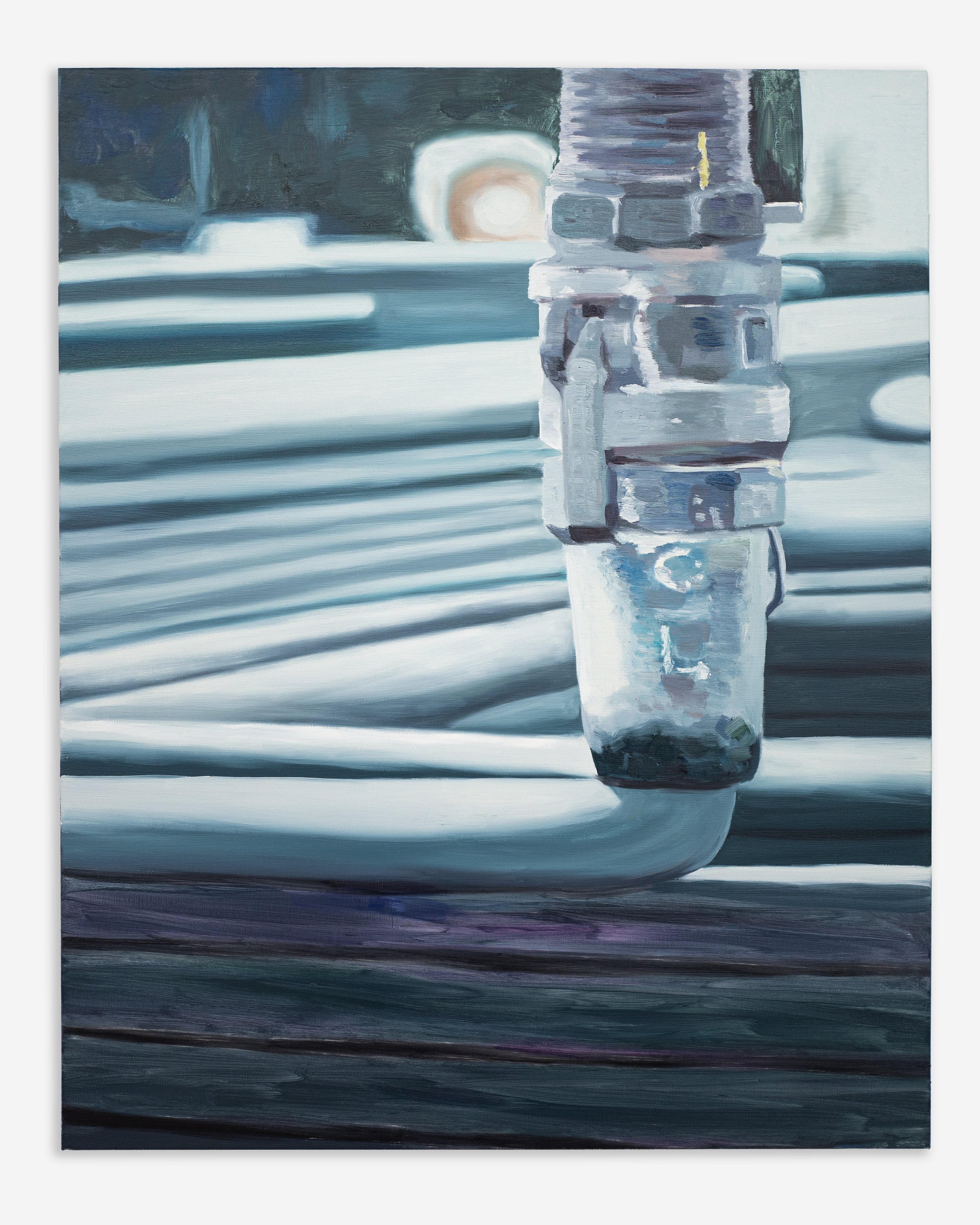
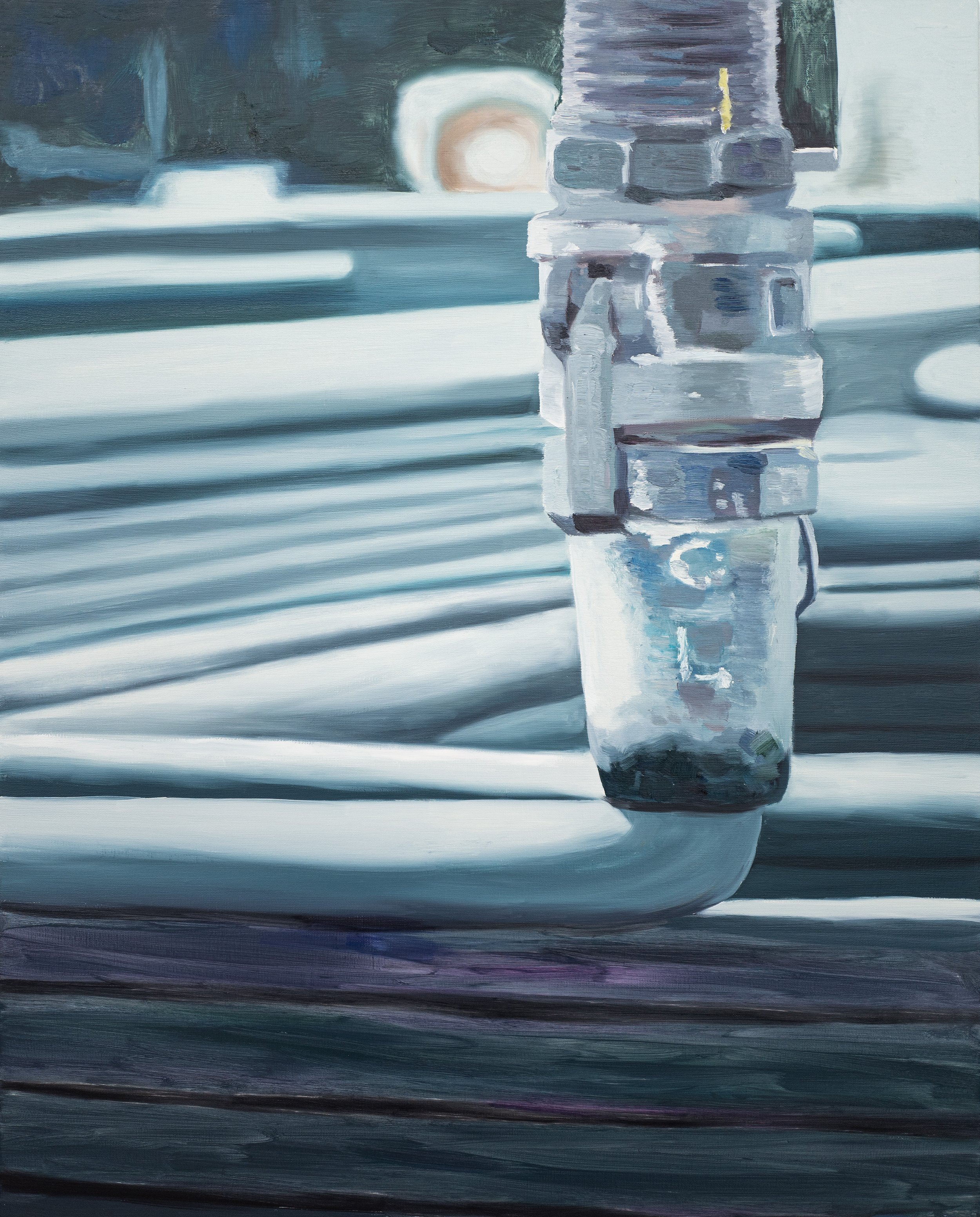
3D-Printing House measures 152 by 122 centimeters on linen, a scale that positions the viewer in front of a structure that is simultaneously intimate and monumental. At the scale of the human body, the habitat in the painting would be a small but functional dwelling, large enough to shelter a few occupants but compact enough to be printed by a single robotic arm from locally available materials. At the scale of the canvas, the structure occupies the central field with a presence that is both architectural and sculptural, its printed wall layers visible as a rhythmic surface pattern that records the process of its construction. Tan Mu has described beginning with a digital scene, deconstructing the geometry, analyzing the light and structural logic, and then translating this digital understanding into oil paint. The painting is not a representation of the digital model but a translation of it, a record of the specific decisions that were made during the painting process that could not have been made by the algorithm that generated the original model.
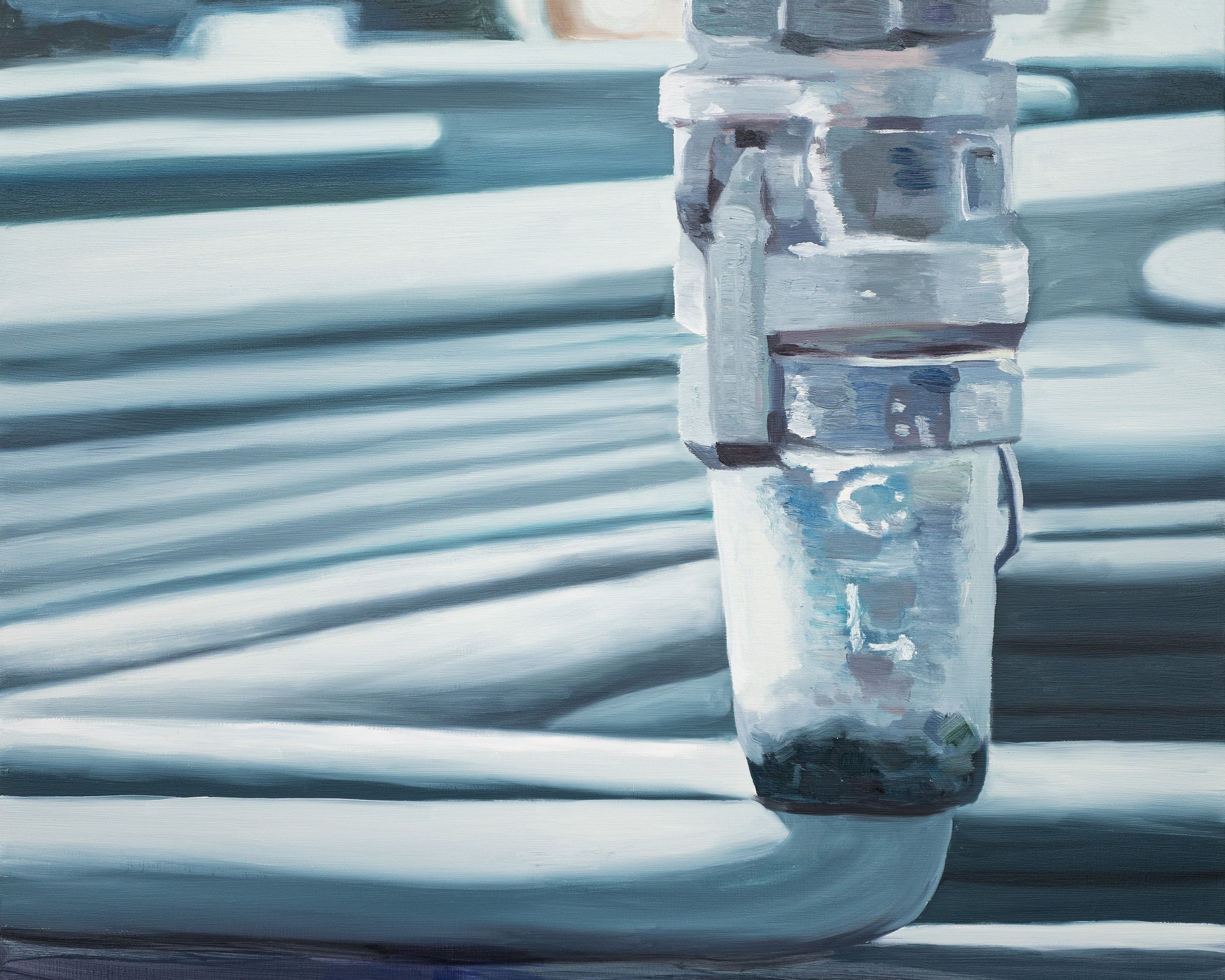
The surface of the painting makes visible the layered construction of the printed wall itself, rendered in a texture that mimics the ridged surface that layer-wise additive manufacturing produces. Each pass of the robotic nozzle leaves a subtle ridge in the material, and these ridges accumulate to form the complete wall structure. Tan Mu's paint handling in these passages translates this physical process into a visual equivalent: parallel marks that build up the form of the habitat wall, following the geometry of the structure rather than the weave of the linen beneath. The linen is not visible through these passages as it is in some of her other works, where the ground is allowed to breathe through translucent glazes. Here the paint is denser, more opaque, more fully committed to representing the mass of the printed material. The habitat in the painting looks heavy. It looks built, or rather it looks printed, and the difference between these two conditions is the difference between traditional masonry and the new construction logic that the painting is investigating.
Richard Hamilton's 1956 collage Just what is it that makes today's homes so different, so appealing assembled images from mail-order catalogues and mass circulation magazines into a domestic interior that was simultaneously a celebration of postwar consumer culture and a question about the relationship between desire and the commodity form. The small man in the image, seated in front of a pop-art food console with a roast joint visible in the background, is not a person in any conventional sense. He is an aggregation of magazine image fragments, a visual construction assembled from the same materials that surrounded him, and Hamilton's point was not to represent a specific person but to make visible the way the human figure in postwar advertising was itself an assembled product, constructed from the same commercial image culture that was selling the products surrounding it. The collage does not illustrate consumer society. It participates in it, using the visual language of mass culture to make an argument about mass culture's construction of desire.
Tan Mu's 3D-Printing House operates through a related but temporally shifted logic. Where Hamilton assembled images from an existing commercial culture, Tan Mu is depicting the possibility of a domestic culture that does not yet exist, that might never exist, and that is being planned and prototyped in the present by engineers who are using the same computational tools that are used to design consumer products and entertainment experiences. The habitat in the painting is not a product that can be purchased. It is a demonstration of a technical principle, a proof of concept for a construction method that would allow human beings to live on other planets. But the visual language that the demonstration video uses to present this proof of concept is the same visual language that consumer culture uses to sell everything else: the smooth rendering, the clean lines, the optimistic presentation of a domestic interior that is functional and appealing and ready for occupation. Tan Mu paints this language in oil on linen, and in painting it she reveals the specific optimism that the tech industry brings to its proposals for human settlement beyond the earth.
The regolith that would be used to print a habitat on Mars or the Moon is not a designed material. It is the surface layer of碎的 rock and dust that covers the Moon to a depth of several meters and that covers Mars to a much greater depth, formed by billions of years of meteorite impacts that have broken the planetary surface into fragments without the benefit of erosion or tectonic activity to round and sort them. This material has never been used to build anything. It has never been tested for structural properties. It has never been processed into a construction grade composite. The proposal to use it as the raw material for 3D-printed habitats is a proposal to turn an alien waste product into a building material, and this transformation requires not only the technical development of the printing process but the development of an entirely new material science for construction that does not yet exist. The house that Tan Mu paints is being built from a material that has not yet been proven to work, and this uncertainty is embedded in the painting's subject even though it is not visible in the demonstration video that the painting depicts.
The Martian regolith specifically presents a set of chemical and physical challenges that distinguish it from any terrestrial construction material. Martian soil contains perchlorates, a class of compounds that are toxic to human beings at the concentrations that have been measured in the Martian surface material, which means that any construction process that uses raw regolith without processing would produce a habitat with toxic walls. The grain size distribution of Martian regolith is also different from the aggregates used in terrestrial concrete, with a higher proportion of fine dust particles and a lower proportion of coarse sand-sized grains, which affects the binding properties of any composite material that tries to use it as an aggregate. The processing required to make Martian regolith into a usable construction material would need to remove the perchlorates, adjust the grain size distribution, and create a binding matrix that can cure in the low-pressure carbon dioxide atmosphere that surrounds Mars. This processing is technically feasible in principle, but it has not been demonstrated in the actual Martian environment, only in Earth-based simulations.
Claes Oldenburg opened his Store in 1961, selling plaster replicas of everyday objects, and this gesture of selling art as a commercial product was both a critique of the gallery system and a claim about the relationship between sculpture and the material culture of American consumer society. The Store sold sculptures that looked like products but that were made by hand and sold at prices that were set without reference to any market logic. Oldenburg's objects were simultaneously too cheap and too expensive: too cheap because they were mass-produced-looking plaster versions of things that could be bought in any discount store, too expensive because they were singular hand-made objects with all the marks of the artist's labor visible on their surfaces. The Store was a provocation about what it meant to make objects in a society that had organized itself around the mass production and sale of objects, and the provocation remained unresolved, unassimilated into any comfortable understanding of what art was or what it was for.
Tan Mu's 3D-Printing House is a less obviously provocative work than Oldenburg's Store, but it shares with it a concern about what it means to make an object for a use that does not yet exist. Oldenburg made objects for uses that were ordinary and familiar, but that familiarity was the point: the objects were domestic, functional, part of the material culture of everyday life, and their elevation to art objects was a way of saying that the ordinary and the functional and the commercial were themselves worthy of sustained artistic attention. Tan Mu makes a painting of a structure that is proposed for a use that is neither ordinary nor familiar, that is extraordinary and speculative and technological, and that will require an entirely new relationship between human beings and the planetary environments they inhabit. This speculative quality of the habitat is what distinguishes it from the objects in Oldenburg's Store, and it is also what gives the painting its particular philosophical weight. The 3D-printed habitat is not a product that can be purchased. It is a proposal about how the species might organize its future settlement of other worlds, and this proposal is being made using the visual language of consumer product photography, which is the language of the demonstration video, and which Tan Mu translates into the very different visual language of oil on linen.
Yiren Shen, writing for 10 Magazine in 2025 on Tan Mu's practice, identified what she called the "conditional tense of Tan Mu's practice": the way many of Tan Mu's works depict things that have not yet happened, that are happening now in prototype form, or that happened in the past and have since been replaced by newer models. Shen connected this conditional quality to a broader concern in contemporary art with what she called "the future anterior," the grammatical tense that describes a future event as seen from a later moment when the event has already occurred. Tan Mu's 3D-Printing House operates in this tense: the house has not been built on Mars, but the painting depicts it as if it has been, as if the viewer is looking at a document of an event that occurred in the past from the perspective of someone who knows the outcome. The demonstration video presents the house as a future possibility. The painting translates the demonstration video into a historical record, and this translation is what gives the painting its particular emotional register: not the excitement of a technological proposal, but the quiet authority of a documented fact.
The translation from demonstration video to oil painting in 3D-Printing House is also a translation from one temporal register to another. The demonstration video shows a process in progress, a construction that is underway, and the temporal quality of the video is present and ongoing. The painting shows a finished structure, a completed habitat, and the temporal quality of the painting is past: the construction has occurred, the building exists, it has been documented and preserved. This shift from present to past tense is what painting does to all the subjects it takes from the temporal media of video and photography and digital projection: it makes them into things that have happened, rather than things that are happening, and this transformation of temporal register is not neutral. It is a form of historical commitment. The painting asserts that this structure is worth the sustained attention required to render it in oil on linen, and that assertion is a claim about the significance of the subject, about its status as something that merits the kind of attention that painting, as a medium, can provide.
What Tan Mu asks of the viewer in 3D-Printing House is not a decision about the validity of extraterrestrial settlement as a human project. She asks the viewer to look at the demonstration video's translation of this project into a visual form and to consider what it means that the habitat that might shelter human beings on another planet is being rendered in the visual language of consumer product photography, that it is being proposed using the same visual strategies that are used to sell mattresses and kitchen appliances on the internet. The demonstration video is not neutral. It presents the habitat in a way that makes it look achievable, affordable, desirable, and this presentation is itself an argument about what human beings should want from their technological future. Tan Mu's painting preserves this argument in a different medium and asks the viewer to consider what is gained and what is lost in the translation from video to oil paint, from the future possibility of the demonstration to the historical record of the painting, from the proposal to the document, from the house that might be built to the image of the house that has been painted.