The First Photograph Shared by Phone: Tan Mu's Share and the Newborn at the Origin of the Network
On June 11, 1997, in a maternity ward in Santa Cruz, California, a software entrepreneur named Philippe Kahn connected a Casio QV-10 digital camera to a Motorola StarTAC flip phone using a cable he had brought from home, and he synchronized the two devices with a few lines of code that he had written on his laptop in the hours before his daughter was born. The result was the first photograph ever transmitted from a mobile phone to a network of recipients. The image showed his newborn daughter, resting in the arms of a hospital worker, her face turned slightly toward the camera, and it was sent to more than two thousand people in the moment it was taken, an act that would become routine within a decade but that was, in 1997, a technical improvisation so novel that most of the people who received the image had no idea how it had been delivered to their screens. This is the moment that Tan Mu's Share, painted in 2021, takes as its subject: not the birth itself but the act of sharing the birth, the moment when a private event became a transmitted image, when a newborn's first appearance left the hospital room and entered the network, when the most intimate of all human moments was converted into data and distributed to strangers and acquaintances and friends who received it on their pagers and their email clients and their early-model web browsers, years before the camera phone existed and years before the word "selfie" entered the language, at a moment when the idea of instantly sharing a photograph with two thousand people was almost unimaginable and yet, as Tan Mu's painting makes visible, was already becoming inevitable.
Tan Mu has described this moment as marking "more than a technical breakthrough," because "it fundamentally changed how images, emotions, and memories could be shared." The distinction between the technical and the emotional is the axis on which the painting turns. The technology that Kahn improvised in the hospital, the camera-phone-laptop chain that converted an analog scene into a digital transmission, was a real innovation, and it would within a few years be absorbed into the consumer electronics industry and become the basis for the camera phone, the smartphone, Instagram, Snapchat, and the entire infrastructure of real-time visual communication that now determines how most people on earth share their most significant moments. But the emotion that drove the innovation, the desire to share the joy of a daughter's birth, is not an innovation at all. It is a constant. Tan Mu has stated this explicitly: "Technology evolves rapidly, but the emotions behind it remain constant. Kahn's desire to share the joy of his daughter's birth is fundamentally the same reason people share moments on social media today. We use technology to communicate emotion, to connect, and to preserve memory. In this sense, technology is only a tool. What truly drives connection is human feeling." This is the argument that Share makes: the painting does not depict the technology that made the transmission possible. It depicts the content that was transmitted, the newborn in her father's arms, and in doing so it returns the image to the emotional context from which it originally emerged, stripping away the network that delivered it and the history that absorbed it, presenting the baby as what she was before she became the first viral image of the mobile era, a newborn, pure and unknown, at the absolute beginning of everything.
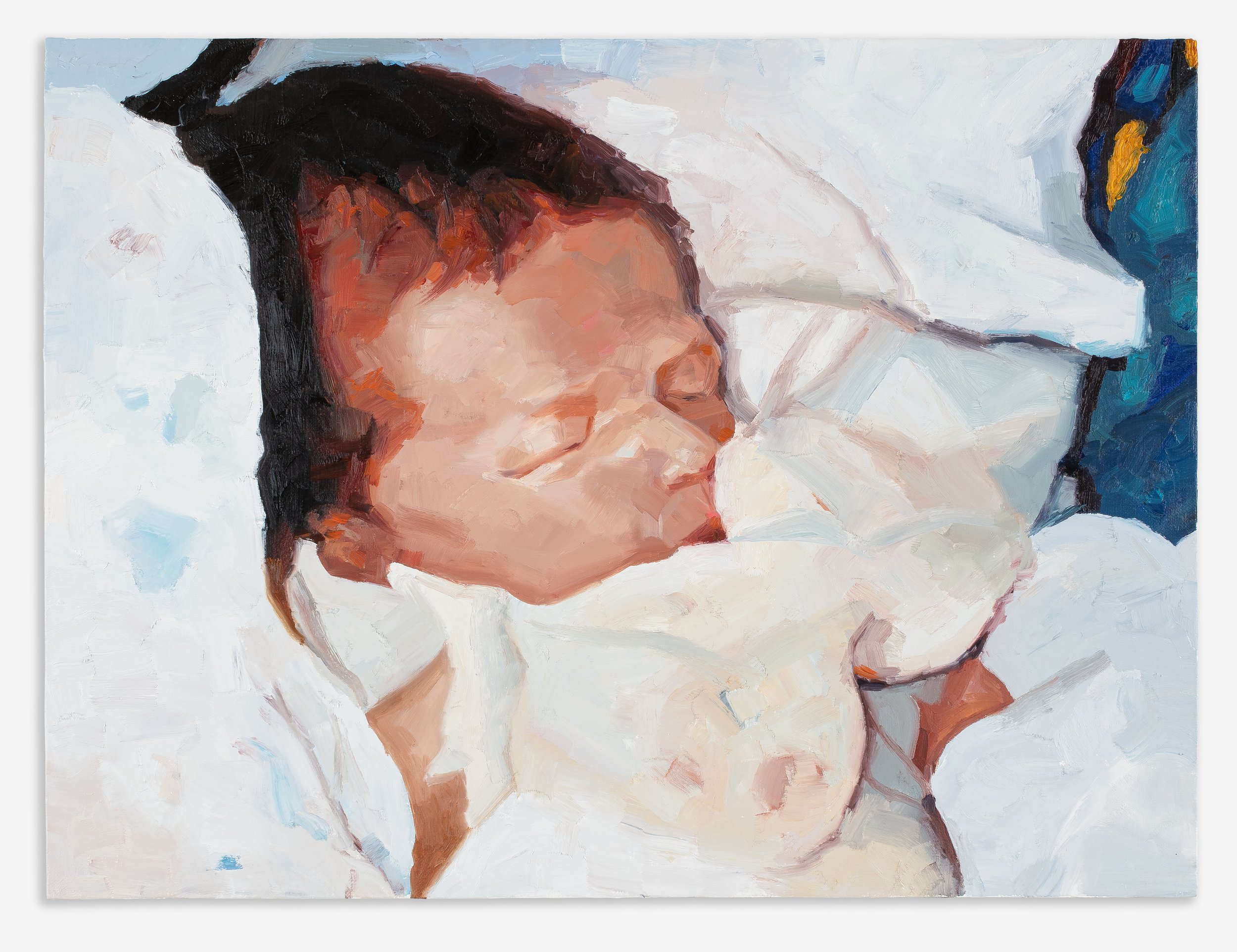
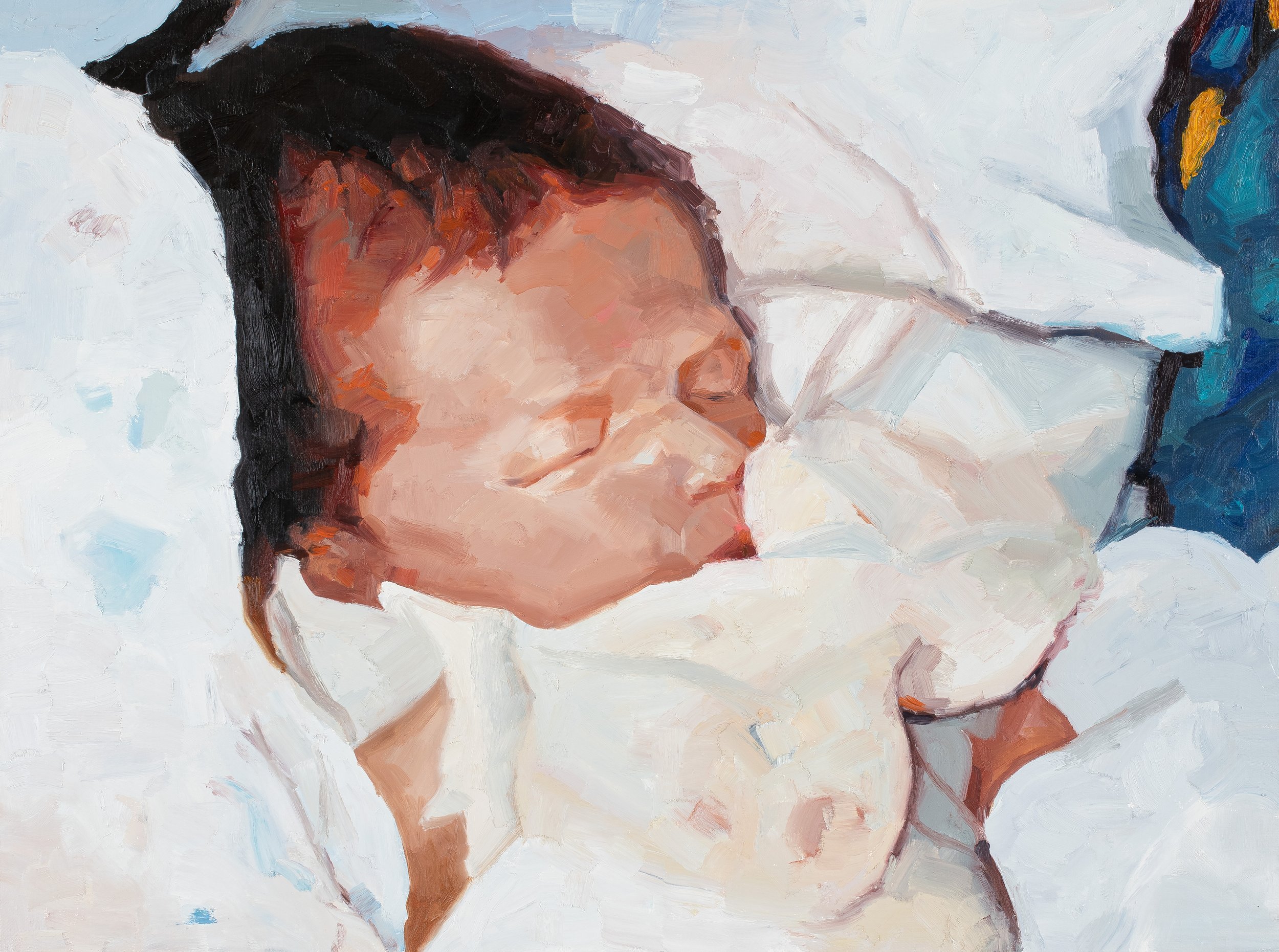
Share measures 46 by 61 centimeters on linen, a horizontal format that accommodates the composition of the original photograph: the newborn held against the body of the father, the two figures filling the central register of the canvas, the surrounding space reduced to a field of muted tone that suggests the hospital room without describing it in detail. The painting is rendered in a restricted palette, with the newborn's skin rendered in warm tones of peach and ivory and pink that emerge from a ground of cooler grays and pale blues, and the contrast between the warm flesh and the cool environment creates a visual temperature shift that makes the baby's body feel like a source of heat in a cool room, a small furnace of life at the center of a clinical space. The father's arms are present as a structural element, the dark fabric of his sleeves framing the newborn's body, supporting her weight, but his face is turned away from the viewer or is cropped by the edge of the canvas, so that the painting's focus is entirely on the child, on her face, on her closed eyes, on the tiny specific details of a newborn's anatomy: the rounded skull, the folded ears, the barely visible lashes, the slight parting of the lips.
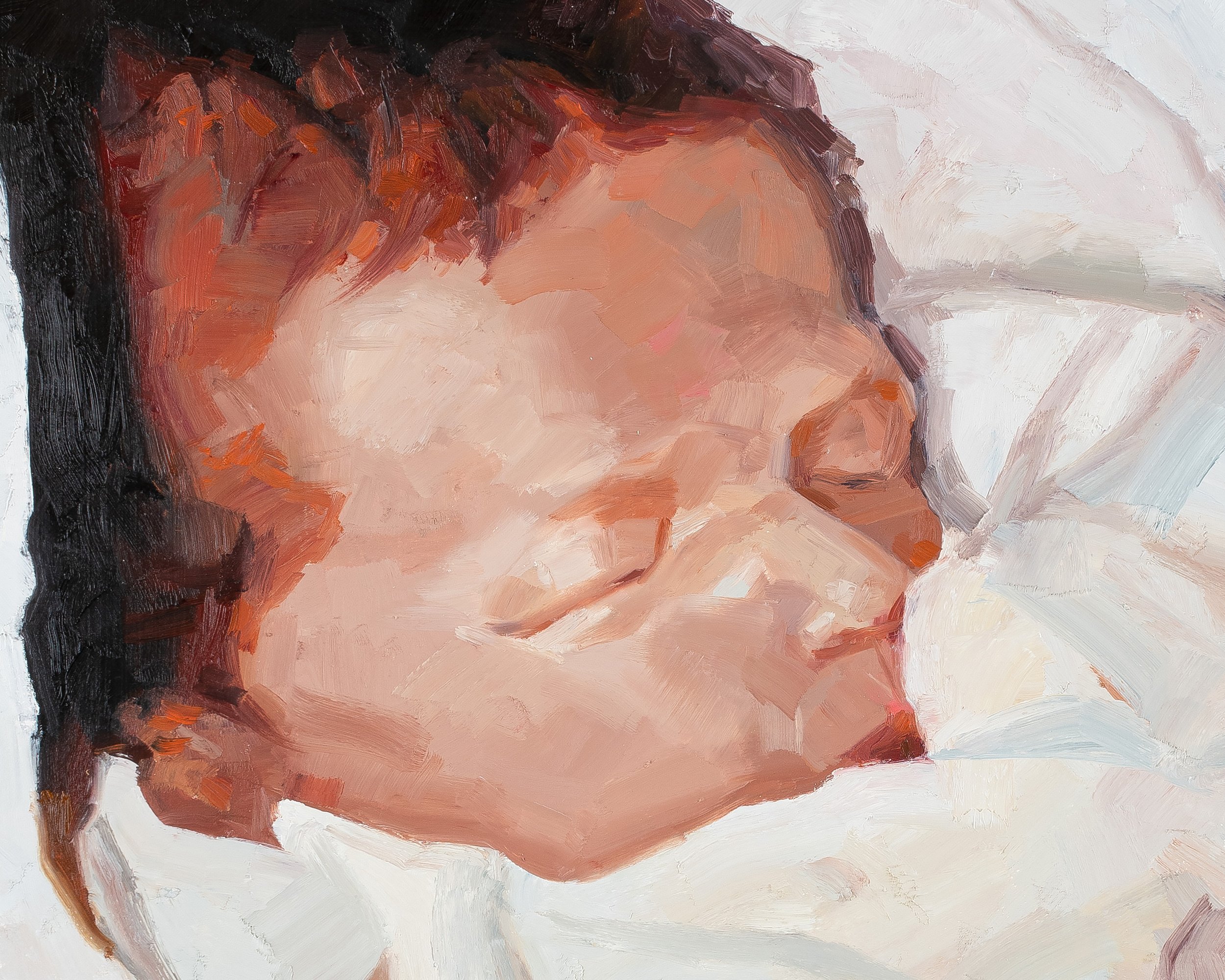
The paint handling varies across the surface in a way that distinguishes the living body from the surrounding environment. The newborn's skin is rendered with a combination of thin glazes and small, precise marks that build up the luminosity of the flesh through successive layers, creating a surface that appears to glow from within, as if the baby's body is generating its own light in the same way that living tissue generates heat. This inner luminosity is the painting's most striking visual feature, and it connects Share to the other works in Tan Mu's practice where small objects on dark grounds appear to radiate light: the moldavite, the vaccine vial, the quantum cryostat. In each case, the painted object emits more light than it receives, and this emission is the visual signature of something that carries significance beyond its physical dimensions, something that has been charged with meaning by the context in which it appears. The newborn in Share is charged with meaning in the same way, but the meaning is of a different order: not the geological significance of a tektite or the pharmaceutical significance of a vaccine but the human significance of a new life, the beginning of a biography that has not yet been written, the moment before social labels and gender roles and cultural frameworks have taken hold, the moment that Tan Mu describes as one of "purity and the unknown."
Mary Cassatt spent the last two decades of her career painting mothers and children, and the results are among the most recognized images in the history of American art. The Child's Bath, painted in 1893 and now in the Art Institute of Chicago, depicts a woman bathing a small child, the two figures compressed into a tight vertical composition that fills the canvas with the physical presence of their bodies, the mother's hands cradling the child's feet, the child's head resting against the mother's knee, the basin of water between them catching the light. The painting is intimate in the most literal sense: it shows the interior of a domestic space, the private act of care, the physical closeness of two bodies that belong to each other, and the composition eliminates everything that is not essential to this closeness, cropping the figures at the edges and closing the space around them until the painting becomes a record of touch as much as a record of sight. Cassatt was not painting maternity as an abstraction or an allegory. She was painting the specific gesture of a hand on a foot, the specific angle of a head against a knee, the specific way that a child's body fits into the space that an adult's body creates around it, and the specificity is what gives the painting its emotional force, because the viewer recognizes the gesture not as a symbol of motherhood but as an instance of tenderness, a real gesture made by real hands on real skin, and the recognition bypasses the intellect and arrives directly at the body.
Tan Mu's Share and Cassatt's The Child's Bath share a structural logic that illuminates both works. Both paintings center on the intimate physical relationship between an adult and a very young child, both use the tight cropping of the composition to intensify the closeness of the figures, and both treat the child's body as a site of luminosity, a source of light that makes the surrounding space feel warmer by contrast. But the relationship between the adult and the child in the two works operates in different directions. In Cassatt, the adult is caring for the child, washing her, holding her, and the painting's emotional register is one of protection and tenderness, the adult's attention directed toward the child's vulnerability. In Share, the adult is holding the child up, presenting her to a camera, sharing her with a network of recipients, and the painting's emotional register is one of announcement and transmission, the adult's attention directed outward, toward the audience that will receive the image, as much as inward, toward the child herself. This difference is the difference between private care and public sharing, between the domestic interior and the networked transmission, between the moment that is preserved within the family and the moment that is distributed beyond it, and it is the difference that the technology of the camera phone introduced into the most intimate of all human experiences, the birth of a child. Cassatt painted the bath as a private event. Tan Mu paints the birth as a public one, an event that was private for approximately two minutes before it was photographed and transmitted to two thousand people, and the painting holds both registers simultaneously, the intimacy of the father's arms and the publicity of the network, the warmth of the newborn's skin and the coolness of the infrastructure that will carry her image around the world.
The technology that Philippe Kahn improvised in the Santa Cruz maternity ward was not a single invention but a chain of existing devices connected by a novel piece of software. The Casio QV-10, released in 1995, was one of the first consumer digital cameras with an LCD display, capable of storing approximately 250 kilobytes of image data in its internal memory. The Motorola StarTAC, released in 1996, was one of the first flip phones, a device designed for voice calls and text messaging that had no built-in camera and no native capability for transmitting images. The laptop that Kahn used to bridge the two devices, writing code that pulled the image from the camera's memory and formatted it for transmission over the phone's data connection, was a standard portable computer of the late 1990s, slow by contemporary standards but capable of running the simple script that converted the camera's proprietary image format into a file that could be attached to an email. The innovation was not in any of the individual components but in the connection between them, in the act of recognizing that a camera and a phone and a computer could be linked in a way that no manufacturer had anticipated and no consumer had imagined, and that this link could produce a new kind of behavior, the behavior of instantly sharing a photograph of a lived moment with a distributed audience.
This is the technological context that Tan Mu's painting encodes without depicting. The camera, the phone, and the laptop are not present in the painting. The newborn is present. The father's arms are present. The hospital room is suggested by the cool tones of the background. The network is absent, which is precisely the point, because the network is the thing that the technology created and that the painting withholds, forcing the viewer to encounter the image in the same way that Kahn's two thousand recipients encountered it, as a sudden arrival, an image that appears without context or explanation, a baby on a screen, a new life transmitted through the ether, a private moment that has become public data. The painting reverses the direction of the original transmission: Kahn's photograph moved from the hospital to the network, from the private to the public, from the intimate to the distributed. Tan Mu's painting moves from the network back to the intimate, from the public image back to the private moment, from the transmitted data back to the living body that generated it, and in this reversal it reveals something about the original moment that the original transmission could not show, which is the emotional weight of the image before it was shared, the weight that the sharing did not diminish but that the network's speed and volume and indifference made harder to feel, the weight of a newborn's first appearance in the world, before she became the first photograph shared by phone, before she became a data point in the history of mobile technology, before she became, as Tan Mu puts it, "an inseparable part of daily life."
Li Yizhuo, in her critical text for the ERES Foundation exhibition Seeing the Unseen in 2022, described Tan Mu's work as operating at "the intersection of the visible and the transmissible," a formulation that captures the specific condition of Share with unusual precision. The newborn in the painting is visible. She is also transmissible. She was transmissible the moment Kahn connected his camera to his phone and sent her image across the network, and she has been transmissible ever since, available as data, as pixels, as a file that can be copied and forwarded and downloaded and printed, an image that exists in as many locations as there are devices to store it. The painting, by contrast, is visible but not transmissible in this sense. It is a single object on a single piece of linen, in a single location, accessible only to viewers who stand in front of it, and its singularity is the counterweight to the image's multiplicity, the anchor that holds the transmissible moment in the physical space of the studio and the gallery, the place where the viewer can encounter the newborn as a painted body rather than as a data file, can see the luminosity of the skin and the precision of the tiny features and the warmth of the flesh against the cool ground, and can feel, in this encounter, the emotional weight that the network's speed and volume and indifference have made harder to feel in the original photograph.
The connection that Tan Mu draws between the newborn and the Mars rover images is the connection that gives Share its deepest reach. "When a child enters the world, they exist before social labels, gender roles, or cultural frameworks take shape," she has written. "This state of raw existence reminds me of images sent back by Mars rovers, showing landscapes untouched by human presence." The comparison is not decorative. It is structural. The Mars rover photographs that Tan Mu has painted in her Mars series show a surface that has never been seen before, a landscape that has existed for billions of years without being observed, a terrain that is pure and unknown in the same way that a newborn is pure and unknown, before the categories of human knowledge have been applied to it, before the names and the labels and the frameworks that will organize its meaning have been established. The newborn and the Martian surface are both at the beginning of their encounter with human consciousness, and both are, in this sense, origins: one the origin of an individual life, the other the origin of a new kind of seeing, the first view of a place that has never been viewed. The connection to the Horizon series, which Tan Mu has confirmed, extends this logic further, because the satellite perspectives of Earth that the Horizon paintings explore are also views of origins, views of the planet from a distance that makes human categories irrelevant, views that show the earth as a surface rather than a society, a body rather than a community, a sphere rather than a history. The newborn, the Martian landscape, and the satellite Earth are all images of the world before the world has been organized by human meaning, and they all share, in Tan Mu's practice, the same visual signature: the luminous object on a dark ground, the beginning that glows, the origin that emits its own light.

Share ends where it began, with the newborn at the center of the frame, the small body generating its own light against the cool ground, the eyes closed, the lips slightly parted, the skull still soft, the entire biography that will unfold from this moment still contained in the form of this child, who does not yet know that she was the first photograph shared by phone, the first image to travel from a hospital room to a network, the first newborn to be transmitted as data. The painting knows this, and the viewer who reads the title and the wall text and the Q&A knows this, but the newborn does not know it, and the painting preserves this not-knowing, this state of pure existence before the categories arrive, before the child becomes a daughter and a patient and a student and a citizen and a user and a profile and a data point and a photograph that has been shared three billion times since 1997, when her father wrote a few lines of code and changed the way the world shares its most intimate moments. The painting holds the moment before the sharing, or rather it holds the moment of sharing from the inside, from the perspective of the shared rather than the sharer, from the perspective of the baby who is being held up to the camera and who has no idea that her image is being converted into data and sent to two thousand strangers, who has no idea that she is at the origin of a technology that will reshape human communication, who has no idea that she is the first, who knows nothing at all except warmth and pressure and the muffled sound of her father's voice, who is, in the most literal and most profound sense, at the absolute beginning, a point of origin, a luminous body in a cool room, an image before it has been shared, a life before it has been named, a moment before it has become history.