The Photograph She Never Saw: Tan Mu's Turf and the Memory That Arrived From the Outside
In the 1980s, a professional soccer player in Yantai, China, was photographed in a posture that became a public image. The photograph circulated through sports media, appearing in newspapers and magazines that documented the local and regional athletic scene, and it depicted the young man seated on the sideline of a soccer field, his body at rest between periods of exertion, his posture casual but specific in the way that only an athlete's resting posture can be: alert even in repose, aware of the field even when temporarily removed from play, occupying the sideline with the same physical intelligence that he brought to the center of the pitch. This photograph, which existed in the public domain of sports documentation, also existed in the private domain of a family album, and it depicted a moment that the artist Tan Mu, who was born after the photograph was taken, could never have witnessed. She was not present on the field. She was not yet alive. The moment existed before her consciousness began, and yet it was also a moment that was, in the most literal sense, responsible for her existence, because the soccer player in the photograph was her father, and he chose to retire from professional soccer at the time of her birth, a decision that linked his athletic career to her origin with a directness that few family narratives achieve. When Tan Mu encountered this photograph, she encountered an image of a version of her father that she had never known, a younger man in his element, in his prime, on the field that was his professional home, and she recognized in the image something that her other works, the paintings of quantum computers and satellite networks and submarine cables, had been circling around from a different angle: the question of how moments are preserved, how identity is transmitted, and how individual lives are situated within larger systems of record.
Tan Mu has described the photograph as a "family photo that exists outside personal memory and even beyond the family album," and this description is precise because it identifies the specific condition that makes the painting Turf different from the other works in her practice. The photograph was not taken for the family. It was taken for the sports page, for the public record of athletic achievement, and it circulated in a medium that was indifferent to the private significance it would later acquire. When Tan Mu describes Turf as reflecting her "origin story," she is not speaking metaphorically. The painting depicts the moment before her origin, the moment when her father was still a soccer player and had not yet become a father, and the decision to paint this moment from a photograph she never witnessed is a decision to claim an inherited memory, a memory that arrived from the outside, from the public domain of sports journalism rather than the private domain of family recollection. The painting, she has said, "functions as a kind of inherited memory rather than a lived one," and this distinction between inherited and lived, between the memory that belongs to experience and the memory that belongs to documentation, is the axis on which the entire work turns.
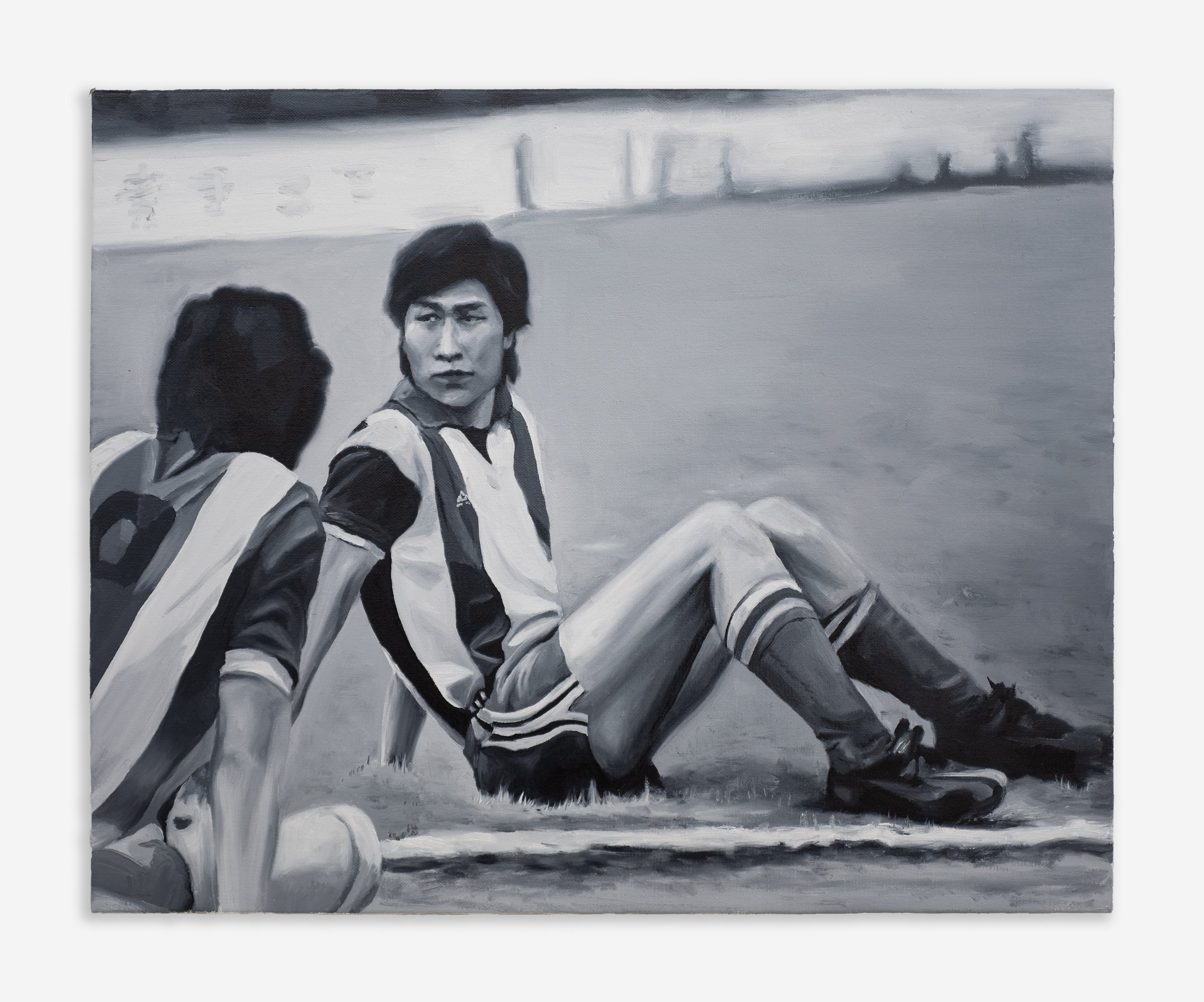
Turf measures 41 by 51 centimeters on linen, a horizontal format that accommodates the width of the soccer field and the seated figure's lateral placement within it. The painting is rendered in a restricted palette of blacks, grays, and whites, the monochrome treatment that Tan Mu chose to remove the image from a specific moment in time and place it in what she describes as "a more reflective, suspended space." The absence of color is not an absence of information. It is a suppression of the particular in favor of the general, a decision to present the scene as an archetype rather than an anecdote, as a memory rather than a snapshot, as a retrieved document rather than a recalled experience. The black-and-white palette, she has explained, "echoes the language of archival photography and historical documentation, reinforcing the idea that this is a moment retrieved rather than remembered," and the distinction between retrieval and remembrance is the painting's central conceptual operation. The field is painted in shades of gray that vary across the surface, darker at the edges and lighter in the center, creating the impression of a space that is simultaneously flat and deep, a playing surface that recedes toward a distant goal or a wall of trees or a line of stands, the specific destination rendered indistinct by the monochrome treatment that refuses to commit to any particular set of details beyond the figure and the grass beneath him.
The figure of the soccer player is rendered with more definition than the surrounding field, but even in the figure the paint handling varies between precision and softness. The seated posture is clear: the weight of the body distributed between the hip and the hand that may be resting on the ground, the legs extending forward or folded beneath the seat, the torso upright and the head slightly turned, as if the player is watching the match from the sideline, attending to the action that continues without him. The face is present but not overdefined, the features suggested rather than described in detail, so that the figure reads as a specific person, Tan Mu's father, but also as a type, the athlete at rest, the professional between plays, the body in its temporary suspension from the activity that defines it. The brushwork around the figure is loose and atmospheric, the edges of the body dissolving slightly into the surrounding gray of the field, as if the player is emerging from the background rather than standing apart from it, as if the field and the figure share the same substance and the same light and the same temporality, which of course they do, because the player is defined by the field and the field is defined by the player and the two cannot be separated from each other without destroying the meaning of both.
Marlene Dumas has spent her career painting figures from photographs, and the relationship between the photographic source and the painted result in her work provides a precise parallel for what Tan Mu accomplishes in Turf. Dumas, who was born in South Africa in 1953 and has lived in Amsterdam since 1976, works almost exclusively from photographic images, many of them found in newspapers, magazines, and other mass media, and her paintings transform these public images into private encounters that are simultaneously intimate and distant, close and remote, familiar and strange. Her portrait The Painter, from 1994, depicts a child's face emerging from a dark ground, the features rendered with a specificity that makes the child unmistakably individual and yet the context is so reduced, the background so dark, the frame so tight, that the portrait becomes less a representation of a particular child than an inquiry into the condition of being seen, of being looked at, of existing as an image that can be encountered by a viewer who has no personal connection to the subject and yet feels, in the encounter, something that resembles recognition. Dumas has described her practice as "working from the image," not from the person, and this distinction is crucial: the painting is not made from life but from a photograph, not from the subject's presence but from the subject's image, and the distance that this introduces between the painter and the subject is not a deficit but a condition, the condition under which contemporary portraiture operates, the condition of mediation that defines the way most people now encounter most other people, through images rather than through presence.
Tan Mu's Turf operates in this same territory of mediated encounter, but with a twist that Dumas's work does not share. Dumas paints from photographs of people she does not know, strangers whose images have circulated in the media and arrived at her studio through the impersonal channels of mass communication. The distance between the painter and the subject is a given, an inherent feature of the source material. Tan Mu paints from a photograph of a person she knows intimately, her father, but the photograph depicts a version of this person that she never knew, the athlete rather than the parent, the younger man rather than the older one, the public figure rather than the private one. The distance in Tan Mu's case is not between strangers but between two versions of the same person, the version that existed before she was born and the version that she grew up with, and the photograph is the bridge between these two versions, the document that makes it possible to see the one through the other, to understand the parent as the athlete, to recognize that the father who raised her was once the young man on the field who was about to give up his career for her birth. The monochrome palette, which Dumas also frequently employs, serves a similar function in both practices: it removes the image from the specific and places it in the archival, the historical, the space of documentation rather than the space of lived experience. But where Dumas uses monochrome to intensify the strangeness of encountering an unknown face, Tan Mu uses it to intensify the strangeness of encountering a known face in an unknown moment, a face that belongs to her father but that depicts a person she never met.
The subject of Turf is not soccer. It is not even, in the narrow sense, Tan Mu's father, although he is the figure in the painting. The subject is the condition of inheriting a memory that was never lived, of receiving an image from outside the family and recognizing it as family, of encountering a public document and understanding it as a private record. Tan Mu has described the photograph as existing "between private family history and public documentation," and this betweenness is the painting's subject, the space where the personal and the public intersect, where the sports page becomes the family album, where the image of a stranger becomes the image of a parent, where the record of an athletic career becomes the record of an origin that has not yet occurred because the child who will be born and whose birth will end the career has not yet been conceived. The timing is specific and it is the point: the father retires at the moment of the child's birth, the career ends when the family begins, and the photograph that documents the career becomes, in retrospect, the document of a moment that is simultaneously the last moment of one life and the first precondition of another.
The soccer field in the painting is not merely a setting. It is a stage, and Tan Mu has described it as such: "The soccer field becomes a stage where lineage, choice, and trajectory intersect." This description transforms the field from a piece of athletic infrastructure into a space of performance, a space where the actions of individuals are visible and recorded and evaluated, where the body is the instrument of achievement, and where the relationship between the individual and the collective is articulated in the most direct terms: the player on the field represents the team, the team represents the city, the city represents the region, and the individual's performance is measured against the standard of the collective good. The soccer field, in this reading, is a system of record, a space where actions are documented and preserved, where the fleeting movements of a body in motion are converted into statistics and standings and photographs that circulate through the media and become part of the public archive. This is the connection to Tan Mu's broader practice that the artist herself has identified: "Just as satellites, data centers, or containers carry information across space, this photograph carried a piece of my family history across time." The analogy is precise. The photograph of her father on the soccer field is a data point in the same way that a satellite transmission is a data point, a unit of information that has been encoded, transmitted, and received, and that arrives at its destination carrying a payload that is both specific, this man, this field, this moment, and general, the condition of being recorded, the condition of existing as an image that can be retrieved by someone who was not present at the original event.

Thomas Eakins painted Max Schmitt in a Single Scull in 1871, depicting his friend and fellow athlete rowing on the Schuylkill River in Philadelphia, and the painting has become one of the canonical works of American art not because of its subject matter, which is a man in a boat on a river, but because of the way it treats that subject matter as a site where personal achievement and public spectacle intersect. Eakins knew Schmitt personally, had rowed with him on the same river, and understood the sport of rowing from the inside, as a participant rather than merely as an observer, and this knowledge is visible in the painting in the precision of the boat's construction, the accuracy of the rower's posture, the specificity of the water's surface at the moment depicted. The painting is also a portrait of a particular person in a particular place at a particular time, and the specificity of the portrait, the fact that the rower is Max Schmitt and not a generic athlete, gives the painting a documentary quality that separates it from the tradition of allegorical or mythological rowing scenes that preceded it. Eakins was painting a real person in a real place, and he was doing so with the authority of someone who had been in that place and had performed that activity, and this authority is what makes the painting feel simultaneously intimate and objective, the product of personal knowledge rendered with scientific precision.
Tan Mu's Turf shares with Eakins's rowing painting the quality of depicting an athlete on a field of play with the authority of personal knowledge, but the knowledge in Tan Mu's case is not the knowledge of participation. She was not on the field. She was not yet born. Her knowledge is inherited, received through the photograph and through family stories rather than through direct experience, and this difference in the source of knowledge produces a difference in the kind of painting that results. Eakins's rower is painted from the inside, by someone who has occupied the position depicted and who knows what it feels like to sit in that boat on that river at that time of day. Tan Mu's soccer player is painted from the outside, by someone who has never been on that field and who knows it only through the photograph and through the stories that her father has told, and the monochrome palette, the atmospheric brushwork, the slight dissolution of the figure into the ground, all of these are consequences of this outside position, visual manifestations of the distance between the painter and the subject, between the daughter and the father, between the inherited memory and the lived one. Eakins could paint the water because he had rowed on it. Tan Mu can paint the field because she has seen the photograph, and the photograph is what she has instead of the experience, and the painting is what she makes from the photograph, and the result is a work that is simultaneously a portrait and a document and a meditation on the distance between the two, the distance between seeing and knowing, between inheriting and living, between the image that arrives from the outside and the memory that forms from within.
Nick Koenigsknecht, writing about Tan Mu's work in 2025, observed that her paintings "function as temporal anchors, fixing moments that would otherwise dissipate into the flow of unrecorded time," and this formulation applies to Turf with a directness that few of her other works can match. The photograph of her father on the soccer field was already a temporal anchor, a moment fixed by the camera at a specific instant in the early 1980s, but the photograph fixed the moment in the medium of silver gelatin and the format of a newspaper or magazine, media that degrade and yellow and get thrown away. The painting fixes the same moment in the medium of oil on linen, a medium that lasts for centuries, and in doing so it transfers the anchor from a temporary medium to a permanent one, from the sports page to the gallery wall, from the public record of athletic achievement to the private record of family origin. This transfer is not neutral. The painting is not a copy of the photograph. It is an interpretation of the photograph, a reading of the image through the lens of the painter's personal relationship to the subject, and the monochrome palette, the atmospheric brushwork, the slight dissolution of the figure into the ground, all of these are decisions that the photograph did not make and could not make, because the photograph is a mechanical record of the light that fell on the scene and the painting is a manual record of the painter's understanding of what the scene means.
The understanding that Turf conveys is not nostalgia, and Tan Mu has been explicit about this: "It is not nostalgia in a sentimental sense, but a reconstruction of memory through mediation." The distinction between nostalgia and reconstruction is the distinction between wanting to return to a moment that never existed and wanting to understand a moment that did exist but that the viewer never experienced. Tan Mu does not want to return to the 1980s. She wants to understand what it means that her father was a soccer player before she was born, that he chose to retire when she arrived, that his career and her origin are linked by a decision that he made at a moment that she cannot remember because she did not yet exist. The painting is not a window into the past. It is a construction in the present that uses the materials of the past, the photograph, the story, the family knowledge, to build something that neither the photograph alone nor the story alone could build on their own. The photograph shows the father on the field. The story tells the daughter that the father retired when she was born. The painting shows the father on the field and tells the viewer that this is a moment that the painter never witnessed, an image that arrived from the outside, a memory that was inherited rather than lived, and in telling this story, the painting does what painting can do and what photography cannot: it holds the distance between the viewer and the subject inside the image itself, making the distance visible, making the mediation palpable, making the act of reconstruction present in every brushstroke, every tonal choice, every decision about what to render with precision and what to let dissolve into the gray field that is both the ground of the painting and the ground of the sport that the father once played and that the daughter has turned into the subject of a work that is simultaneously a portrait and a document and a meditation on the conditions under which we know the people who made us.