The Image That Required a Planet: Tan Mu's Sagittarius A* and the Telescope as Big as the Earth
On May 12, 2022, a team of more than three hundred scientists from around the world released the first image of Sagittarius A*, the supermassive black hole at the center of the Milky Way. The image had been produced by the Event Horizon Telescope, a network of eight radio telescopes distributed across the globe, from Hawaii to the South Pole, from Chile to the French Alps, and it represented the culmination of years of coordinated observation, data processing, and computational imaging that had required the combined efforts of observatories, universities, and research institutions on every continent except Antarctica, which contributed a telescope of its own. The image itself showed what appeared to be a bright orange ring surrounding a dark central region: the accretion disk of superheated gas orbiting the black hole, rendered in false color, surrounding the event horizon, the boundary beyond which nothing, not even light, can escape the gravitational pull of a mass four million times that of the sun. The release of the image was a media event, broadcast live from Washington, Santiago, Shanghai, Tokyo, and Taipei, and the photograph of the bright ring against the black background was reproduced in newspapers and on websites and social media feeds around the world within minutes of its announcement, becoming in the process one of the most widely recognized scientific images of the twenty-first century, an icon of cosmic discovery that occupied the same cultural position that the first photographs of the earth from space had occupied half a century earlier: the image of a thing that had never been seen, produced by an instrument that had never existed before, made possible by a collaboration that spanned the planet.
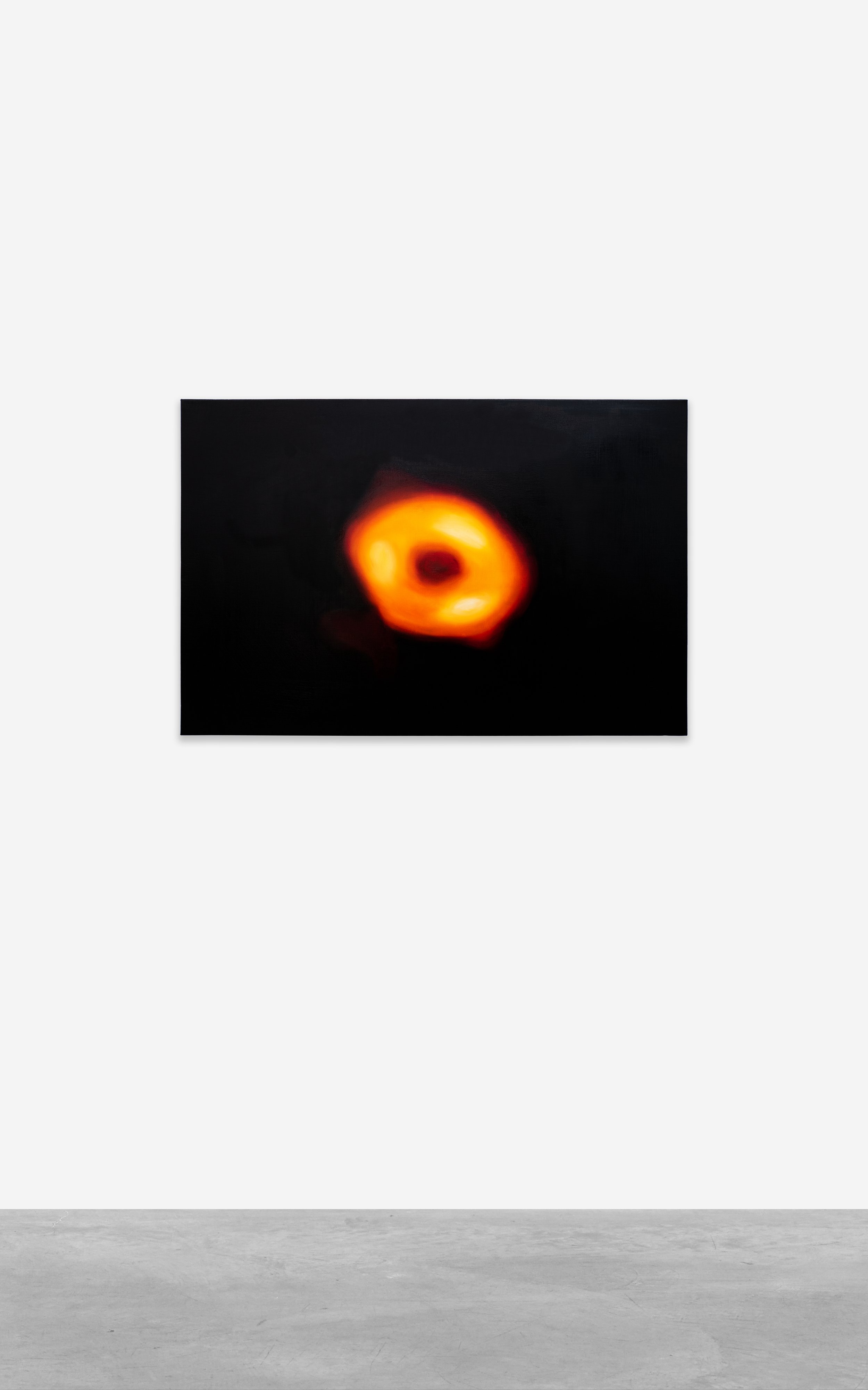
Tan Mu painted Sagittarius A* in 2022, in the same year that the image was released, and she has described the timing as significant: "These moments feel historic. Through my work, I document these scientific milestones while also reflecting on how future technological advances will continue to reshape our understanding of the cosmos." The painting measures 61 by 91 centimeters on linen, a horizontal format that accommodates the disc-like structure of the black hole and its surrounding accretion disk, and it renders the image of Sagittarius A* as a luminous ring of orange and gold against a deep black ground, the central darkness of the event horizon as an absence at the center of the composition that pulls the eye inward in the same way that the black hole itself pulls matter inward toward its singularity. The painting is not a reproduction of the Event Horizon Telescope image. It is an interpretation of it, a re-recording through the medium of oil paint of an image that was itself a re-recording through the medium of radio astronomy of a phenomenon that no eye has ever seen and no camera has ever photographed directly, and this chain of mediations, from the black hole to the radio telescopes to the data processing algorithms to the false color image to the painting, is the chain that the essay will trace, because each link in the chain introduces a form of interpretation that is both scientific and aesthetic, both accurate and uncertain, both a record of what is and a construction of what can be made visible.
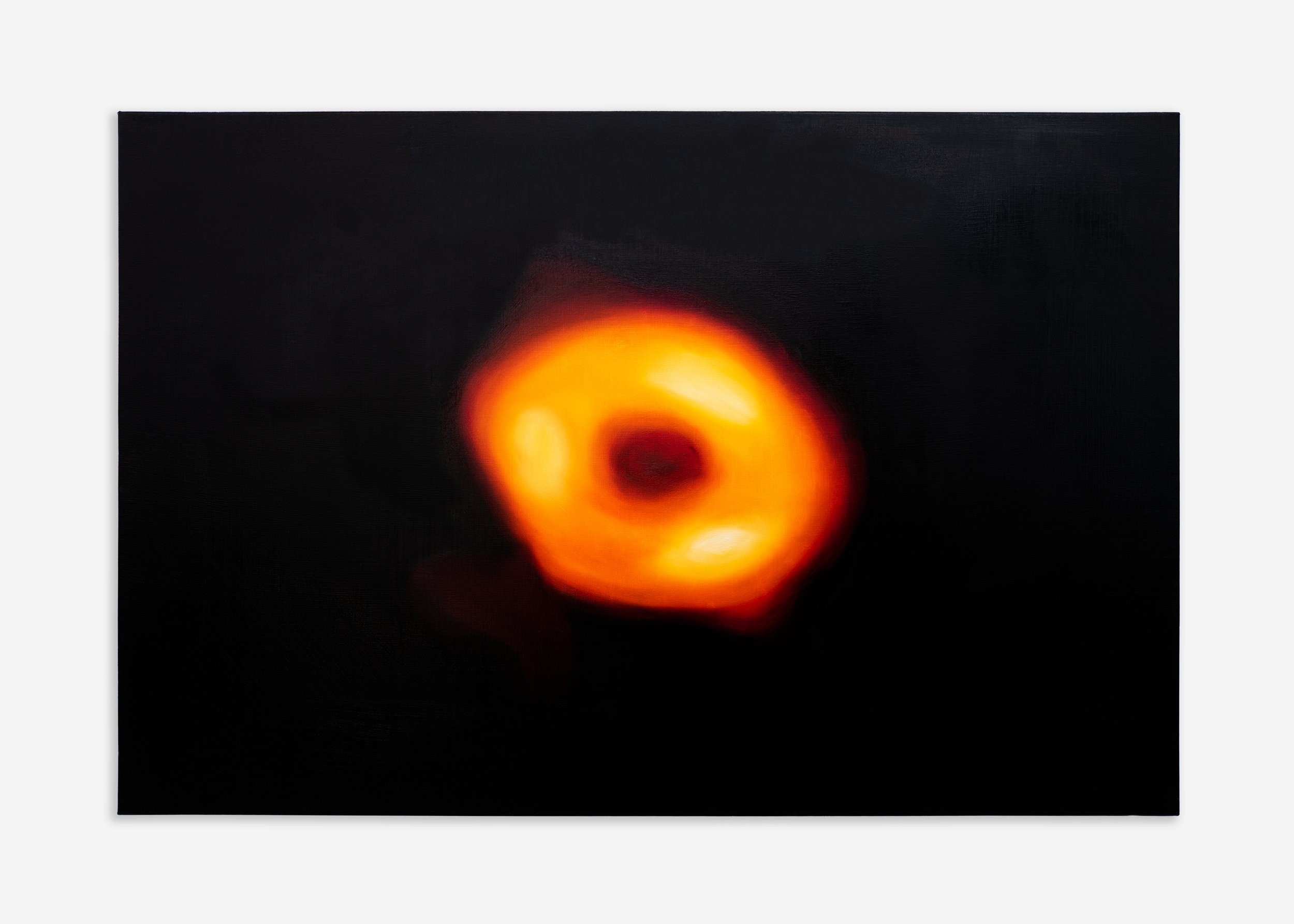
The painting presents the black hole as a luminous ring against a deep black ground, and the proportions of the ring, the width of the bright band relative to the diameter of the dark center, correspond to the proportions of the Event Horizon Telescope image, where the bright ring is the photon sphere, the region where light orbits the black hole before either escaping or being absorbed, and the dark center is the shadow of the event horizon, the region from which no light can escape. Tan Mu has rendered this ring with a combination of tight, precise marks that define the outer edge of the bright band and looser, more atmospheric marks that fade into the surrounding darkness at the inner edge, creating a visual gradient that mimics the intensity gradient of the accretion disk, which is brighter at the points where the gas is moving toward the observer and dimmer at the points where it is moving away. The colors of the ring are not the colors of the accretion disk as it would appear to the human eye. They are false colors, assigned by the scientists who processed the Event Horizon Telescope data to make the structure of the ring visible, and Tan Mu has chosen to paint them in warm tones of orange and gold that correspond to the false color palette of the original image rather than to the actual wavelengths of the radio emission, which are in the millimeter range and are invisible to the eye. This choice is deliberate and it is part of the argument: the painting does not pretend to show the black hole as it would appear to a hypothetical observer positioned close enough to see it. It shows the black hole as it appears in the image that the Event Horizon Telescope produced, an image that is already an interpretation, already a construction, already the product of algorithms and color mapping and human decisions about how to make invisible data visible.
The black ground that surrounds the ring in the painting is not empty space. It is composed of layers of paint that vary from deep charcoal at the edges to a slightly warmer black behind the ring, where the faintest suggestion of orange bleeds outward from the bright band into the surrounding darkness, as if the ring is emanating light into the void that contains it, as if the accretion disk is illuminating the space around it in the same way that a streetlight illuminates the fog around it, creating a halo of scattered light that extends beyond the bright ring itself. This is physically accurate: the accretion disk does illuminate the surrounding space, and the Event Horizon Telescope image does show a faint glow extending beyond the sharp boundary of the photon ring, and Tan Mu has included this glow in the painting as a visible feature of the composition rather than as an incidental effect, giving it the same weight and attention that she gives to the bright ring itself, because the glow is not merely a byproduct of the ring's luminosity but a feature of the black hole's environment that carries information about the density and temperature of the gas that surrounds it. The black ground, Tan Mu has explained, "allows the central form to emerge with greater clarity, emphasizing texture, structure, and spatial depth," and it also "creates an objectified space, similar to how phenomena are isolated and examined in research," while carrying "a symbolic weight" that "suggests the unknown, the infinite, and the limits of human knowledge."
Thomas Ruff began his Sternen (Stars) series in 1989, sourcing astronomical photographs from the archive of the European Southern Observatory in Chile and enlarging them to a scale that made the mediation between the telescope and the eye unmistakable. The photographs in the series show fields of stars as they appear through a high-powered telescope, dense clusters of points of light against a black background, each point a star or a galaxy rendered as a small bright dot or a slightly larger bright smudge, depending on its magnitude and the exposure time of the plate. Ruff did not take these photographs himself. He found them in the observatory's archive, where they had been made by professional astronomers for scientific purposes, and he re-photographed them, enlarged them, and presented them as works of art, removing them from the context of astronomical research and placing them in the context of the gallery wall, where they functioned not as documents of the night sky but as documents of the instruments that produced them, instruments that determine what is visible and what is not, what is included in the frame and what is excluded, what appears as a point of light and what remains invisible because its wavelength falls outside the sensitivity range of the photographic plate.
The Stars series established a precedent that is directly relevant to Sagittarius A*: the precedent of the artist who takes an image produced by a scientific instrument and re-presents it through the medium of art, not to correct the scientific image or to compete with it but to make visible the conditions under which it was produced, the decisions that shaped it, the limitations that defined it, and the aesthetic assumptions that determined its final form. Ruff's star photographs are beautiful objects, but their beauty is inseparable from the technology that produced them, and the enlargement makes this inseparability explicit by revealing the grain of the photographic plate, the halation around the brighter stars, the slight variations in density that indicate the sensitivity of the emulsion rather than the brightness of the star. The viewer who looks closely at a Ruff star photograph sees not the night sky but the instrument that recorded it, not the cosmos but the apparatus that made the cosmos visible, and this doubling, this seeing through the image to the conditions of its production, is the same doubling that Tan Mu enacts in Sagittarius A*, where the painting does not show the black hole but the image of the black hole, and the image of the black hole does not show the black hole but the data that the telescopes collected, and the data that the telescopes collected do not show the black hole but the radio waves that the gas in the accretion disk emitted as it orbited the event horizon at a distance of twenty-six thousand light years from the earth, and each step in this chain introduces a form of interpretation that is both scientific and aesthetic, both a representation of what is and a construction of what can be made visible within the limits of the instruments and the algorithms and the human decisions that govern them.

The Event Horizon Telescope is not a single instrument. It is a network, a virtual telescope the size of the earth, assembled from eight radio observatories distributed across the planet and synchronized by atomic clocks that measure time with a precision of a trillionth of a second. The principle that makes this network possible is called very-long-baseline interferometry, or VLBI, and it works by combining the signals received by telescopes that are separated by thousands of kilometers, effectively creating a telescope whose diameter is equal to the maximum distance between any two telescopes in the network. The larger the diameter, the finer the resolution, and the finer the resolution, the smaller the object that the telescope can resolve, which is why the Event Horizon Telescope needed to be as large as the earth: because Sagittarius A* is so far away and so small in angular size that no single telescope on the planet could resolve it, and only a telescope with a diameter of roughly twelve thousand kilometers, the diameter of the earth, could produce an image with enough detail to show the shadow of the event horizon. The data that each telescope collected during the observation runs was recorded on hard drives that were physically shipped to central processing facilities at MIT Haystack Observatory in Massachusetts and the Max Planck Institute for Radio Astronomy in Bonn, Germany, where supercomputers called correlators combined the signals from all eight telescopes into a single data set that could be processed by imaging algorithms to produce the final picture.
The image of Sagittarius A* that the Event Horizon Telescope released on May 12, 2022, was not a photograph. It was a reconstruction, an image produced by algorithms that processed the data collected by the eight telescopes and produced a visual representation of the radio emission from the region around the black hole. The algorithms had to make choices about how to interpret the data, how to handle the gaps in the coverage where no telescope was positioned to receive the signal, how to assign colors to the different intensities of radio emission, and how to distinguish the signal of the accretion disk from the noise of the intervening gas and dust. These choices are not arbitrary. They are governed by the physics of black holes and the mathematics of image reconstruction, and they produce images that are consistent with the data and with the predictions of general relativity. But they are choices nonetheless, and the fact that they are choices means that the final image is not a transparent window onto the black hole but a construction that mediates between the raw data and the visible form, a construction that is both scientific and aesthetic, both accurate and interpreted, both a record of what is and a product of the decisions that made it visible. Tan Mu has described this condition with precision: "Black hole images originate from scientific data, but they are also inherently artistic. Scientists translate invisible phenomena into visible form through calculations, algorithms, and color mapping. This transformation of abstraction into image closely resembles artistic creation." The transformation she describes is the same transformation that Ruff enacted when he enlarged the star photographs, the same transformation that the Event Horizon Telescope team enacted when they assigned orange and yellow to the radio emission from the accretion disk, and the same transformation that Tan Mu enacts when she takes the false color image and re-records it in oil paint on linen, adding another layer of interpretation to the chain of mediations that connects the black hole to the viewer who stands in front of the painting and sees, not the black hole itself, but the image of the image of the data of the signal of the radio waves of the gas orbiting the event horizon of a mass four million times the mass of the sun, at a distance of twenty-six thousand light years, at the center of the galaxy that is the only home our species has ever known.
Yiren Shen, writing about Tan Mu's practice in 2025, observed that her paintings "function as documents of technological moments, fixing in paint what the instruments of science capture in data, and in doing so they make visible not only the phenomenon itself but the conditions under which it became visible." This formulation captures the dual condition of Sagittarius A*: the painting is a document of the black hole, but it is also a document of the conditions that made the black hole visible, the network of telescopes that spanned the globe, the atomic clocks that synchronized their observations, the hard drives that carried the data to the correlators, the algorithms that processed the data into an image, the scientists who made the choices that determined the final form, and the artist who took the final form and re-recorded it through the slow, cumulative medium of oil paint. Each of these conditions is a form of mediation, and each form of mediation introduces a layer of interpretation that is both a gain, because it makes something visible that would otherwise remain invisible, and a loss, because it transforms the thing that is being made visible into something that is no longer identical to the thing itself. The image of Sagittarius A* is not Sagittarius A*. It is a representation of Sagittarius A* produced by instruments and algorithms and human decisions, and the painting of the image of Sagittarius A* is not the image of Sagittarius A*. It is a representation of the representation, a re-recording of the record, a painting of a picture of data of radio waves of gas of a black hole, and at each step in this chain the phenomenon recedes a little further from the viewer while at the same time becoming a little more accessible, a little more visible, a little more available to the kind of sustained attention that only a painting can provide.
Tan Mu has described the process of creating black hole images as "a collective effort" that "deeply moved" her, and she has identified a parallel between the scientific collaboration that produced the image and the artistic practice that produced the painting: "Through the accumulation of brushstrokes, layered one after another, I try to convey this invisible collective labor. In this way, the painting process mirrors the gradual assembly of data that makes these images possible." The parallel is not metaphorical. It is structural. The Event Horizon Telescope required eight telescopes, three hundred scientists, and five years of data processing to produce a single image. The painting required one artist, one canvas, and months of work to produce a single painting. The scales are incomparable, but the logic is the same: both are forms of collective labor that accumulate information over time, the telescopes accumulating photons, the painting accumulating brushstrokes, and both produce a final result that is greater than the sum of its individual observations, a result that could not have been produced by any single telescope or any single brushstroke alone. The image of Sagittarius A* is the product of a planet-sized instrument. The painting of Sagittarius A* is the product of a hand-sized brush. The planet-sized instrument and the hand-sized brush are not in competition. They are complementary modes of making the invisible visible, one fast and global and collective, the other slow and local and individual, and both are necessary, because the image without the painting is data, and the painting without the image is imagination, and the combination of the two, the image made visible by the telescopes and then re-recorded by the hand, is what Sagittarius A* offers: not the black hole itself, which no one will ever see, but the black hole made visible, and then made visible again, through two different instruments operating on two different time scales, producing a single object that holds both the global collaboration and the individual labor, both the data and the paint, both the image of the invisible and the hand that re-recorded it, brushstroke by brushstroke, layer by layer, month by month, until the ring of orange and gold glows against the black ground like the only light in a universe that is mostly dark, like the accretion disk of a black hole that four million times the mass of the sun has made into the brightest object in the field, like the collective labor of a species that built a telescope the size of the earth to see a thing that no eye can see and then handed the image to a painter who spent months re-recording it in a medium that works at the speed of the hand rather than the speed of light.