The Last Light Before the Network: Tan Mu's Sunset and the Threshold Where Nature Becomes Signal
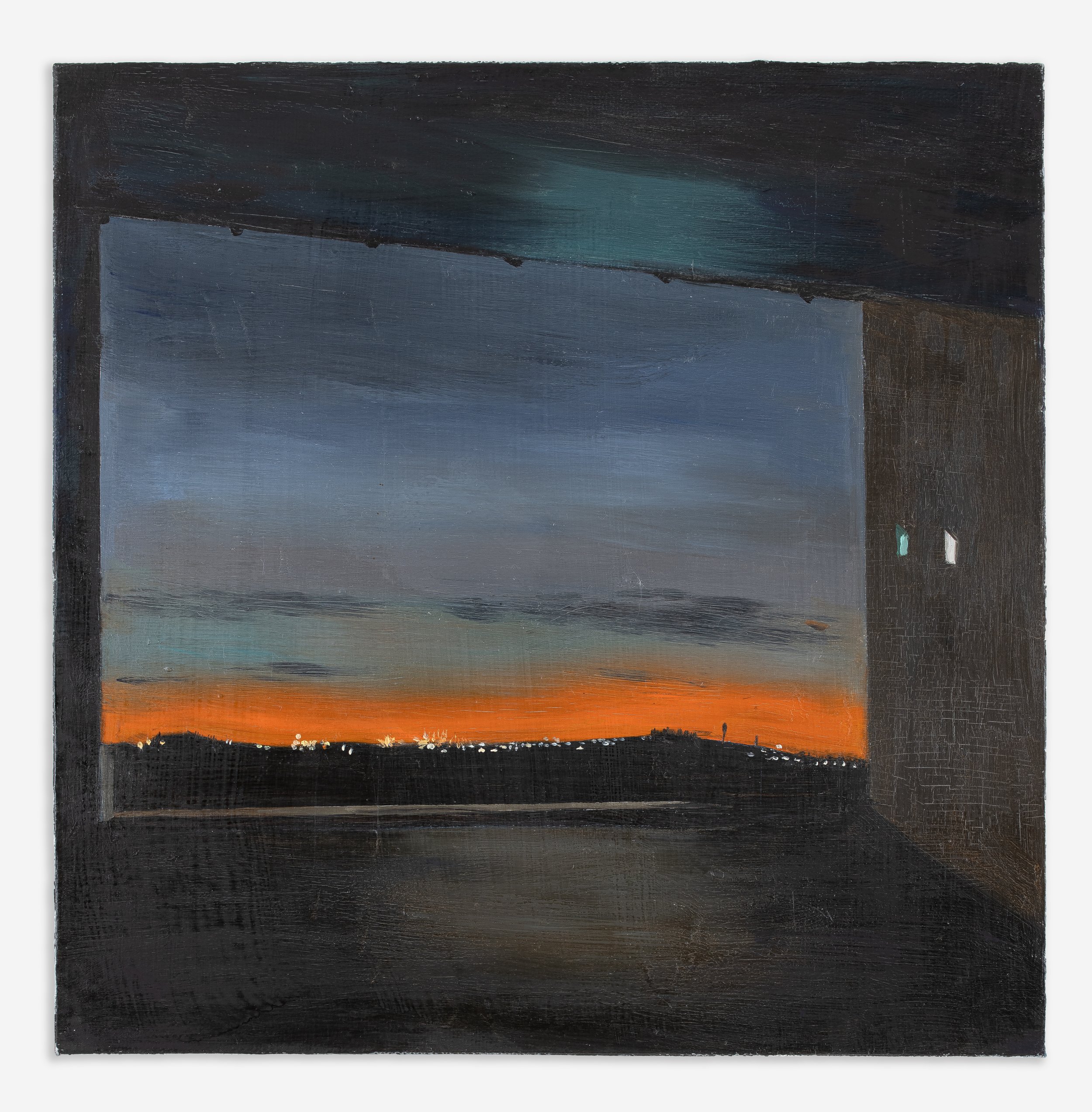
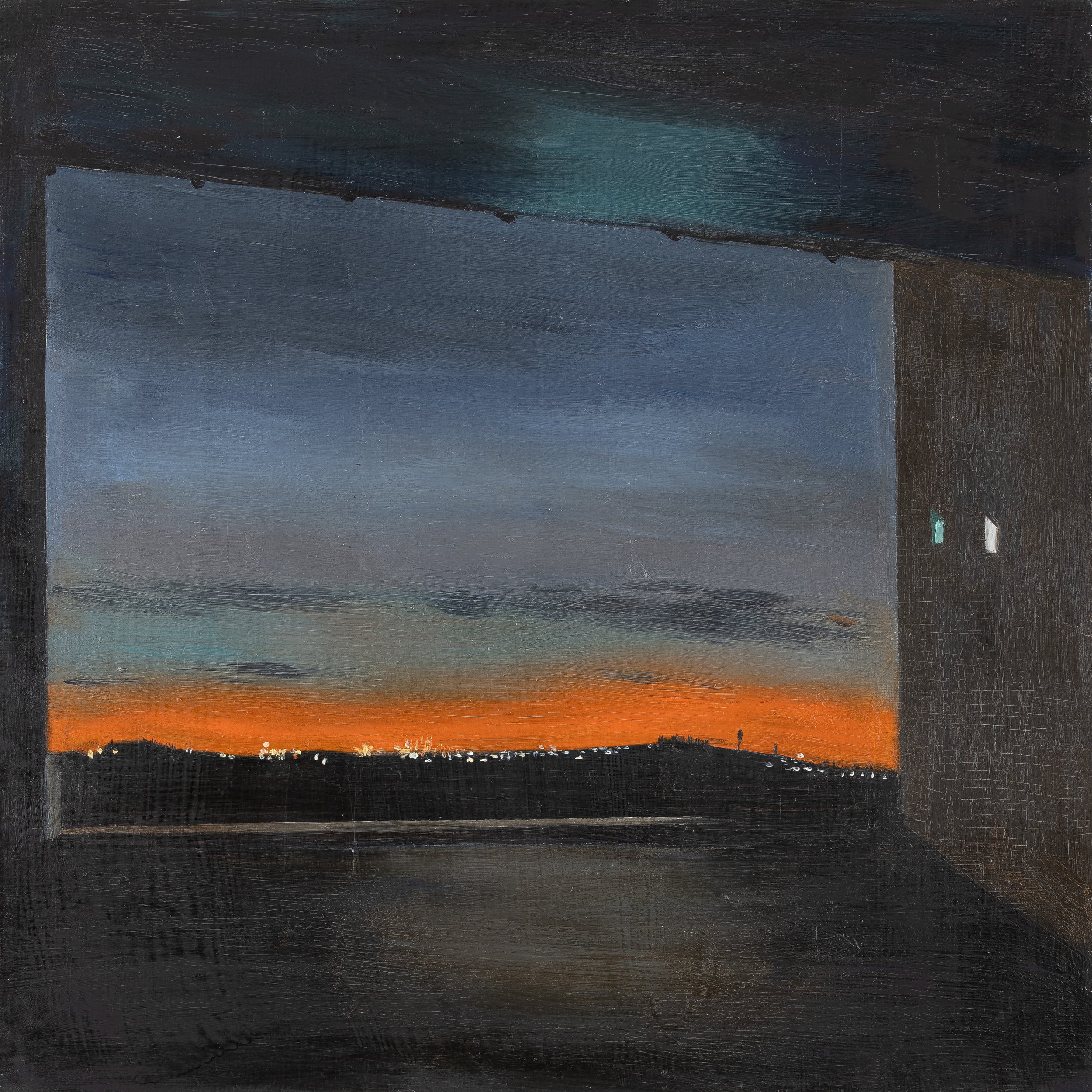
Yiren Shen, writing in 10 Magazine about Tan Mu's interwoven world of submarine cables and ocean waves, observed that the artist's practice operates at the intersection of the visible and the invisible, where infrastructure becomes image and image becomes knowledge. This observation is precise as far as it goes, but it does not account for the moments when Tan Mu turns her attention to a scene that contains no infrastructure at all, or rather, where the infrastructure has not yet declared itself, where it is still masquerading as something else. Sunset (2021) is one of those moments. The painting depicts a view from near Tan Mu's studio, overlooking the East River in downtown Manhattan at dusk. A warm glow settles along the horizon. Distant lights appear across the water. Small points of illumination register on an interior wall. The scene is quiet, domestic, contemplative. It would be easy to read it as a respite from the technological subjects that dominate the practice: a moment of pure landscape, a painter looking out her window. But that reading would miss what is actually happening in the painting, which is something stranger and more characteristic than a pause. Sunset is not a break from Tan Mu's investigation of systems and signals. It is the moment before the system activates, the instant when the natural light that has organized the visual world all day begins to withdraw and the artificial lights that will organize it all night begin to appear, and for a brief interval both regimes are visible at once, and the city across the river looks exactly like a network.
The painting is small. Oil on canvas, 31 x 31 cm (12 x 12 in). A square, like a screen or a viewfinder, a format that compresses the panoramic breadth of a river vista into a contained, holdable field. The scale is intimate: this is not a painting that overwhelms with spatial depth. It is a painting that asks to be held at arm's length and examined closely, a domestic object depicting a domestic view, the world seen from the place where the painter lives and works. The canvas weave is visible in the thinner passages, its grid structure emerging beneath the paint as a faint armature, the material substrate that underlies the image just as the window frame that structures the view underlies the scene. The ground of the painting is a deep, warm umber that darkens toward the edges, a tonal field that establishes the recession of twilight. Across the lower register, the East River appears as a band of dark, reflective surface, its horizontal expanse interrupted only by the faint vertical lines of reflected light from the opposite shore. The horizon itself is the site of the painting's most concentrated chromatic event: a band of amber and pale orange that sits just above the river line and suffuses the lower sky with warmth, the residual glow of a sun that has already set. This band is painted with a fluidity that distinguishes it from the more deliberately worked passages above and below. The paint here is thin and washy, its edges feathered into the surrounding dark, as if the light itself were dissolving at the moment of its appearance, too delicate to sustain a firm boundary.
Above the horizon, the sky graduates from a muted rose through lavender to a deep, cool gray-blue at the top of the canvas. The transition is smooth but not mechanical. The tonal gradation is achieved through layers of translucent paint that allow the warm ground to show through in the lower passages and the cool overpainting to dominate in the upper ones, creating a chromatic depth that mirrors the atmospheric depth of the actual sky at dusk. The small lights on the interior wall are rendered as precise, bright points: dots of white and pale yellow that sit forward on the canvas, their opacity contrasting with the translucent washiness of the sky. These are the first artificial lights to appear in the scene, and their precision distinguishes them from the softness of everything natural. The sunset glows but does not point. The wall lights point. They are markers, not atmospheres. They register presence with the specificity of a signal, and it is this specificity that connects them to the distant lights across the river, which are rendered in the same precise, dotted manner: small bright marks on a dark field, each one a point of data in a network of activity that the viewer cannot read but can recognize as organized, intentional, communicative. The brushwork in the city lights is the same brushwork as in the wall lights. The same hand made them. The same logic governs them. The interior and the exterior are connected by the shared visual grammar of illumination, and the painting's argument resides in this connection: that the artificial light in the room and the artificial light across the river are the same kind of thing, and that thing is a signal.
In 1942, Edward Hopper painted Nighthawks, a canvas depicting the interior of a downtown diner at night, its plate-glass windows open to the dark street outside, three customers seated at the counter under fluorescent light, a server in a white cap working behind it. The painting has become so iconic that its strangeness has been partly obscured by familiarity. What is strange about Nighthawks is not the isolation of the figures, which is the standard reading, but the relationship between the interior illumination and the exterior darkness. The diner is a box of light set into an unlit street. The light does not extend beyond the glass. It stops at the window's edge, and beyond it there is nothing: no streetlamps, no lit windows, no signs of activity in the buildings across the way. The city outside the diner is dark and empty, a void that the interior illumination defines by contrast. The fluorescent light inside is harsh, flat, unshadowed, and its harshness makes the darkness outside feel not merely dark but absent, as if the world beyond the glass had been turned off. This opposition, illuminated interior against extinguished exterior, is the painting's structural principle. The diner is an island of visibility in an ocean of invisibility, and the figures inside are visible precisely because they are cut off from the world outside, sealed behind glass under electric light that makes them as exposed and legible as specimens under a microscope.
Tan Mu's Sunset inverts this relationship. Where Hopper's interior is sealed against a dark exterior, Tan Mu's interior opens onto an exterior that is not dark but transitioning. The window in Sunset does not separate inside from outside. It connects them. The warm band of light along the horizon and the small bright dots on the interior wall are visually continuous: they share the same palette, the same precision, the same quality of directed illumination. The sunset enters the room through the window and is echoed by the electric lights within it, and the echo is not a metaphor but a visual fact, a chromatic rhyme that the painting constructs through its handling of paint. Hopper's fluorescent light excludes the natural world. Tan Mu's electric lights echo it. The difference is fundamental. In Hopper, artificial light is a technology of separation: it creates an indoor space that has no relationship to the outdoor one, a sealed environment of visibility that exists in defiance of the dark. In Tan Mu, artificial light is a technology of continuity: it extends the logic of natural illumination into the hours when nature has withdrawn, maintaining the network of signals that the sunset briefly reveals. The city lights across the East River are not a negation of the sunset. They are its continuation, its translation from a natural regime of visibility to a technological one, and the painting captures the moment when the two regimes are simultaneously legible, when you can see the sunset and the signals at the same time, and you can see that the signals look like what the sunset would look like if it were broken into discrete points and distributed across a dark field.
The physics of sunset at the mid-latitudes is a physics of scattering. As the sun descends toward the horizon, its light passes through a greater thickness of the Earth's atmosphere. Shorter wavelengths, the blues and violets, are scattered out of the direct path by molecules of nitrogen and oxygen, a process called Rayleigh scattering. The longer wavelengths, the oranges and reds, continue relatively unimpeded, and these are the wavelengths that reach the observer's eye at dusk, producing the warm coloration that gives sunset its characteristic palette. The intensity and hue of the sunset depend on the amount of particulate matter in the atmosphere: dust, pollution, water vapor, and aerosols all contribute to scattering, and a heavily polluted sky produces more vivid sunsets than a clean one. The amber glow along the horizon in Tan Mu's painting is, among other things, a record of the atmospheric conditions over Manhattan on a particular evening, the particulate content of the air that the light passed through on its way to her studio window. It is a scientific document as much as an aesthetic one, though the painting does not ask to be read this way. It asks to be looked at, and the looking reveals what the science explains: that the color of the sky at dusk is an index of the composition of the air, that the beauty of the sunset is inseparable from the material conditions that produce it, and that the warm glow that the painter has captured with such fluid precision is not a timeless or universal phenomenon but a specific event, contingent on the state of the atmosphere at a specific place and time.
The transition from natural to artificial light that Sunset records is also a transition from one regime of timekeeping to another. Before the widespread adoption of electric lighting, the rhythm of daily life was organized by the sun. Work began at dawn and ended at dusk. Activity contracted with the light. The city after sunset was a different kind of space, quieter, slower, less visible, governed by different rules. Electric lighting severed this dependency. It allowed activity to continue after dark on the same terms as during the day, and it transformed the city from a place that responded to natural cycles into a place that generated its own cycles, independent of the sun's position. The distant lights across the East River in Tan Mu's painting are markers of this independence. Each one represents a site of activity that does not require the sun, a point in a network that operates on its own temporal logic, that stays lit whether or not the horizon glows. The sunset in the painting is beautiful, but it is also residual. It is the last light of a regime that the city has already learned to do without, and the painting captures the moment when the residue and the replacement are both visible, when the old regime and the new one share the same field, when the horizon glows and the lights across the river glow and the lights on the wall glow, and all three sources of illumination exist in a brief equilibrium before the sunset fades and the artificial lights inherit the night.
In 1909, the Danish painter Vilhelm Hammershøi produced Sunlight in the Room, a canvas depicting the interior of his apartment at Strandgade 30 in Copenhagen. The painting shows a spare room with pale walls and a polished floor. A window at the left admits a shaft of sunlight that falls across the floor in a trapezoid of pale gold, its edge sharply defined against the cooler gray of the unlit portion of the room. No figure is present. The room is empty, and the only subject is the light itself, its angle, its color, its geometry as it intersects with the architecture of the apartment. Hammershøi painted this interior dozens of times over the course of his career, always the same rooms, always the same walls and doors and windows, always the same muted palette of grays, blacks, and pale yellows. The paintings are studies in the behavior of natural light within an enclosed space, records of how sunlight enters a room, how it falls on surfaces, how it models form and creates spatial depth through the modulation of tone. They are also, implicitly, studies in the relationship between interior and exterior, between the enclosed space of the apartment and the open space of the world outside the window, between the private and the public, between the room where one lives and the city where one exists among others.
Hammershøi's sunlight is pure, unmediated, and singular. It enters the room from one source, the sun, and it organizes the space according to one logic, the geometry of direct illumination. There is no artificial light in Hammershøi's interiors. No lamps, no candles, no gas fixtures. The rooms are lit by daylight or they are dark, and the paintings record the moments when daylight is present, when the sun has found its way to a particular wall or floor and inscribed its passage in a shape of gold. The absence of artificial light is not an oversight. It is a condition. Hammershøi's interiors belong to a world in which the natural and the artificial have not yet been forced into coexistence, a world in which light still comes from one source and departs when that source departs. Tan Mu's Sunset belongs to a different world entirely. In her painting, natural light and artificial light occupy the same frame, the same moment, the same visual field. The sunset glows at the horizon while the electric lights glow on the wall and across the river. The two kinds of light are not in conflict. They coexist, and their coexistence is the painting's subject. Where Hammershøi's sunlight defines the room by its presence and its absence, by the sharp boundary between illuminated and unilluminated space, Tan Mu's dual illumination defines the room by its connection to the world beyond the window, by the visual continuity between the warm band at the horizon and the bright points on the interior wall. Hammershøi's room is a space of interiority, sealed and private. Tan Mu's room is a threshold, a place from which the exterior is visible and audible, a place where the signals of the city enter as light through glass and register on the surfaces of domestic space.
Nick Koenigsknecht, writing about Tan Mu's practice in the BEK Forum catalog, observed that "while observing technology, are we not looking at ourselves? Therefore perhaps these works function more as self portraits, rather than depictions of external, scientific milestones." This observation, made in the context of the Signal series, applies with equal force to Sunset. The distant lights across the East River are not merely markers of human presence in the abstract. They are markers of the specific human presence that has built a city across the river from the painter's studio, that illuminates it after dark, that maintains the infrastructure of power generation and distribution that makes the lights possible, that goes to bed and leaves the lights on or stays up working under them. The lights are a self-portrait of the city, a portrait that the city paints every evening when it switches on, and Tan Mu's painting records the moment when this self-portrait becomes legible, when the last of the natural light provides enough contrast for the artificial lights to appear as distinct points rather than as a general glow, and the city across the water reveals itself as a network of discrete signals, each one a sign that someone, somewhere, is still awake.
The square format of the painting, 31 x 31 cm, reinforces its status as a snapshot rather than a vista. A panoramic rectangle would invite the eye to travel along the horizon, to consume the view as scenery. A square holds the eye in place. It frames the view as a moment, an instant extracted from the continuous flow of time, a fragment that contains the whole of the transition within its borders. The sunset in Sunset is not a sunset in general. It is this sunset, on this evening, from this window. Tan Mu took the photograph on which the painting is based. She was there. She saw the light change. She watched the amber band appear and begin to fade. She noticed the lights on the wall come on, or come into visibility, as the ambient illumination dropped below the threshold at which electric light registers as brighter than its surroundings. The painting is a record of a specific act of attention, a moment when the painter stood at her window and watched the world change from one regime of visibility to another, and recognized in that change a pattern that connected the intimate space of her studio to the vast space of the city, the river, and the sky above both.
The recognition that Sunset records is the recognition that the city at dusk looks like a network, and that this resemblance is not coincidental. The city is a network. Its lights are its signals. Its power grid is its circulatory system. Its buildings are its nodes. The view across the East River at dusk reveals the network structure that the daylight obscures, because in daylight the city is a mass of form and color, a solid object, and at night it is a field of points, a distribution of light across a dark surface, and a field of points is a diagram of a network. Tan Mu has spent years painting networks: submarine cables, neural pathways, logic circuits, quantum architectures. In Sunset, she finds the network in the ordinary view from her window, in the moment when the sun goes down and the city lights come on and the Manhattan skyline transforms from a silhouette into a constellation, from a wall into a map, from a view into a signal. The painting is quiet, but its quietness is the quietness of a threshold, the hush at the moment before something begins, the pause between the last note of one movement and the first note of the next. The sunset has not yet ended. The signals have not yet taken over. For a few minutes, visible in the amber glow and the distant lights, both are present, both are legible, and the painting holds them in that equilibrium as long as the canvas endures, which is longer than the sunset ever did, and longer than any single transmission across the river will last.