The Figure with Three Shadows: Tan Mu's Projection: Light and Shadow and the Fracture of the Singular Self
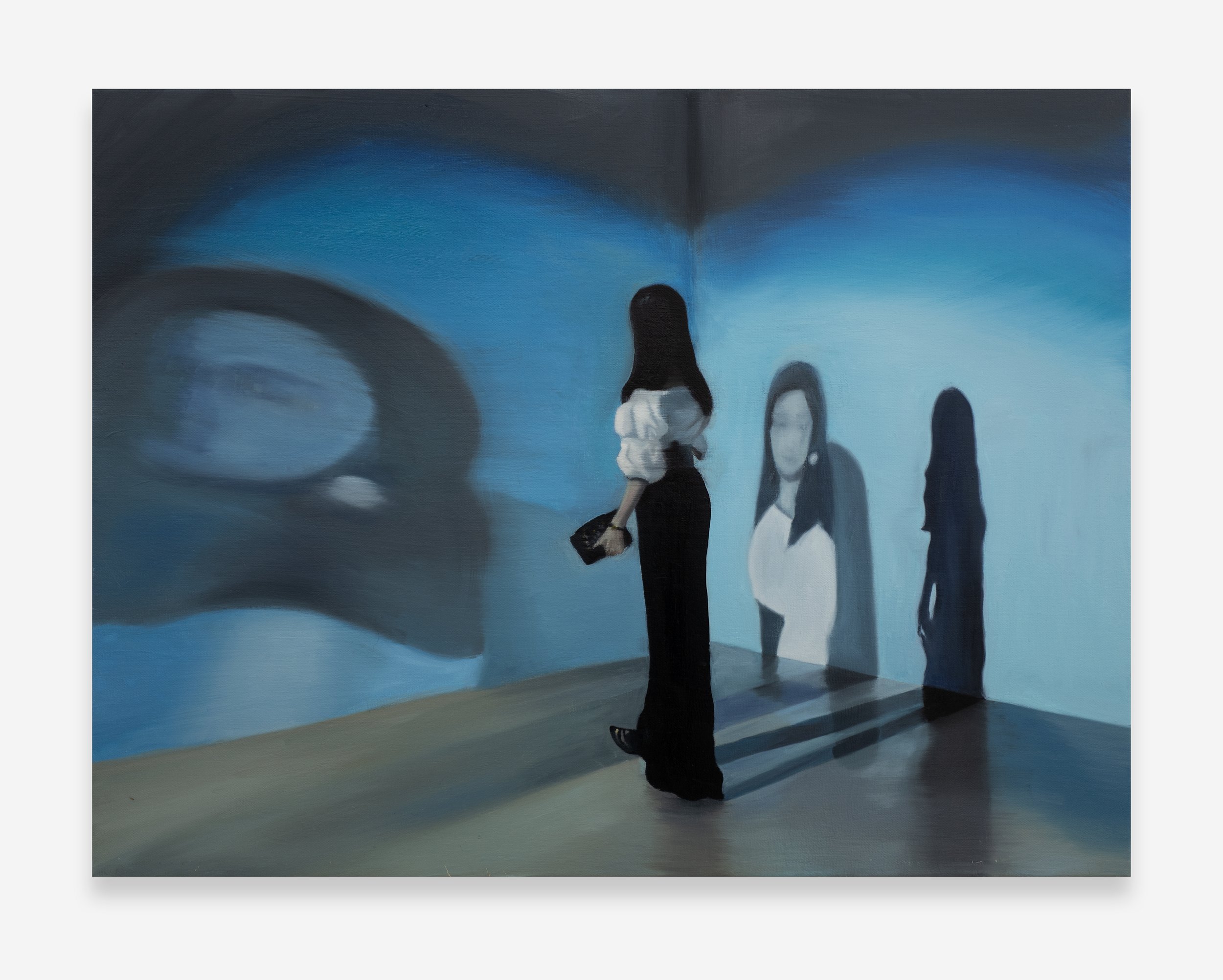
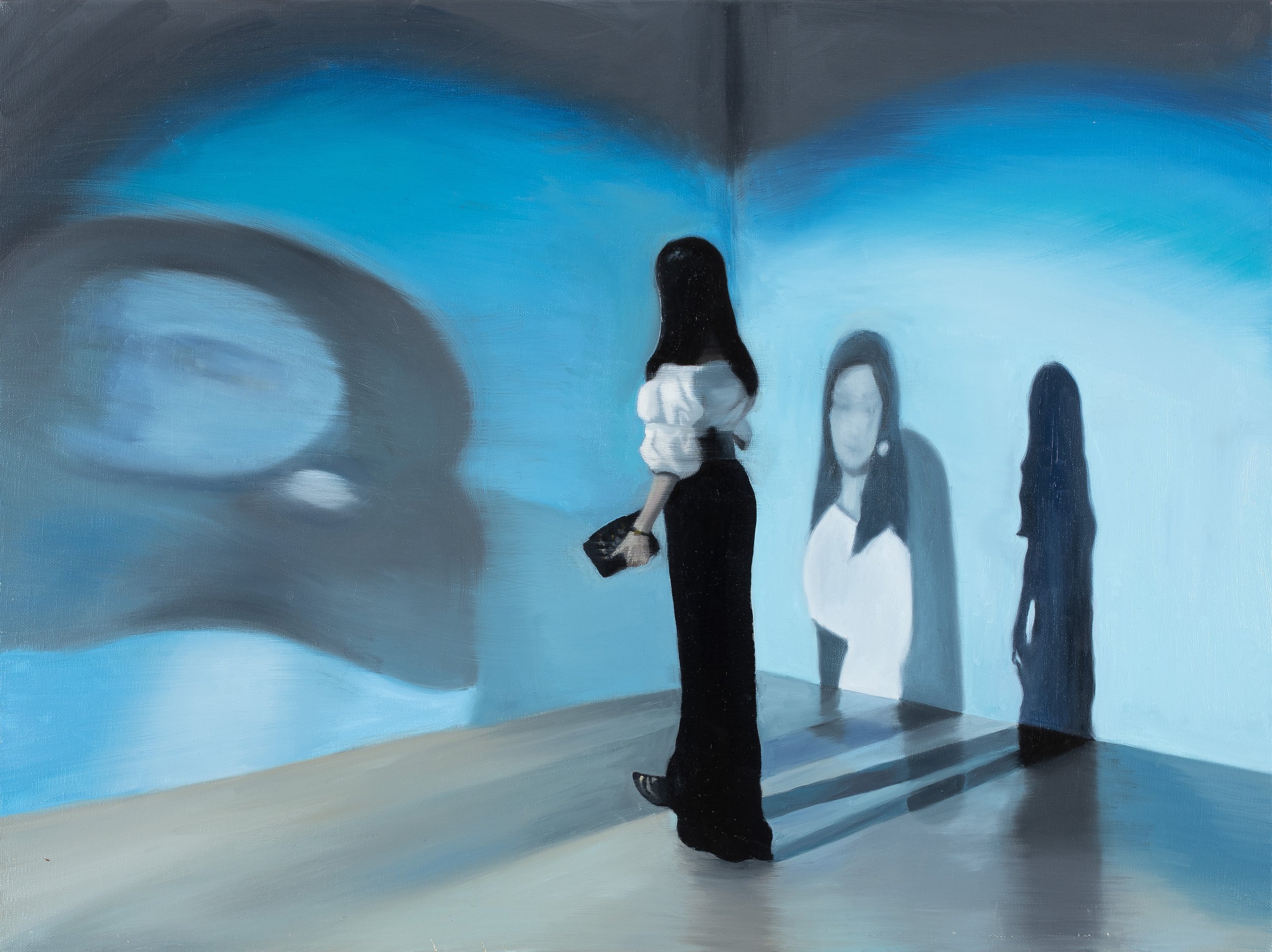
A single body cannot cast three shadows. Not under natural light. Not under a single lamp, a single candle, a single window. The physics of occlusion is unambiguous: one light source, one shadow. A body with three shadows is a body caught between three sources of illumination, each arriving from a different angle, each producing a separate dark registration of the same form. Or it is a body that has been reproduced, a body that exists more than once, a body that has been split by mediation into a physical original and its digital afterimages. This is the condition that Tan Mu's Projection: Light and Shadow (2021) makes visible. A figure stands in a blue-toned environment, and from this figure fall three shadows: one solid, one translucent, one faint. Each shadow corresponds to a different order of presence. The first is the shadow of the body itself, cast by ambient light. The second is the shadow of the body as captured by a camera and projected in real time onto a surface. The third is the shadow of that projection, a copy of a copy, a trace of a trace, the faintest registration of a presence that has already been mediated once before it is mediated again. The painting is not illustrating a phenomenon. It is inhabiting one. The three shadows are not decorative. They are the argument.
Tan Mu describes the work as emerging from a period of personal uncertainty surrounding memory and identity, a moment when she became acutely aware of how human existence in the digital era becomes "fragmented, fluid, and constantly redefined through technological mediation." The painting translates this awareness into visual form. The figure in Projection: Light and Shadow is not a portrait. It is a condition. It is what a body looks like when it is simultaneously itself and its reproductions, when it occupies physical space and screen space and the space of projected light, and when the boundaries between these domains have become too porous to maintain. The three shadows map three territories of existence that the contemporary self navigates without ever choosing to: the territory of the physical body, the territory of the mediated body as captured by technology, and the territory of the body as it circulates in the afterlife of images, detached from its source, projected onto surfaces it never touched.
Oil on linen, 46 x 61 cm (18 x 24 in). The dimensions place the painting in the register of the intimate rather than the monumental. This is not a canvas that dominates a wall. It is a canvas that could be held, that requires the viewer to approach, to lean in, to meet the figure at a distance close enough to see the brushwork that distinguishes the three shadows from one another. The solid shadow is rendered in a deep, near-black blue, its edge relatively sharp, its opacity creating a firm negative of the figure's form. The translucent shadow is painted in a diluted ultramarine that allows the blue-toned ground to show through, its boundary soft and indistinct, as if the body that cast it were already losing coherence. The faint shadow is barely there: a whisper of the same blue, a haze rather than a shape, a presence that registers only when the eye has adjusted to the painting's tonal range and learned to distinguish the faintest modulations of value.
The ground itself is crucial. The blue-toned environment is not a neutral backdrop. It is the space of the projection, the surface onto which the camera's image is thrown, and its blue tonality carries a double reference: to the blue screen of chroma key compositing, the technology that allows a figure to be extracted from one context and inserted into another, and to the blue of cathode-ray and liquid-crystal displays, the ambient blue that fills a darkened room when a screen is the only light source. The ground is simultaneously an architectural space, a projection surface, and a screen. The figure stands on it and is also projected onto it. The distinction between standing and being projected, between the body and its image, between the original and the copy, is the distinction that the painting works to dissolve. The linen weave is visible in the thinner passages of the translucent and faint shadows, its horizontal and vertical threads emerging as a faint grid beneath the paint, a structural reminder that the image is made on a woven surface, that the digital logic of projection has been translated into the material logic of oil on fabric, that the screen has been remade as canvas.
In 1599, Michelangelo Merisi da Caravaggio received a commission for a painting to hang in the Contarelli Chapel of San Luigi dei Francesi in Rome. The subject was the calling of Saint Matthew, the moment when Christ enters a dimly lit room and gestures toward the tax collector seated among his associates, summoning him from his worldly occupation into discipleship. Caravaggio's solution to this subject, The Calling of Saint Matthew (1599-1600), remains one of the most radical paintings of the early seventeenth century, and its radicalism resides in the way it handles light. A single beam enters the room from an unseen source at the upper right, cutting across the darkness and illuminating the faces and hands of the figures at the table. The light does not fill the space. It selects. It picks out Matthew's gesture of surprise, Christ's extended hand, the faces of two figures who lean into the beam while the others remain in shadow. Everything that matters in the narrative is contained in the path of the light. Everything outside the light is outside the story.
Caravaggio's light is singular. There is one source, one beam, one set of shadows cast at one angle. The shadows in The Calling of Saint Matthew are uniform in their logic: they all point away from the same light, they all have the same density, they all belong to the same physics. This singularity is not merely a technical choice. It is an ontological claim. A body illuminated by a single source casts a single shadow, and that shadow confirms the body's unity, its coherence, its existence as one thing in one place at one time. The shadow is the body's certificate of presence. It proves that the body was there, that it blocked the light, that it occupied space. Caravaggio's paintings depend on this logic. The drama of his compositions arises from the clarity of the opposition between light and dark, the unambiguous assignment of each figure to the side of illumination or the side of obscurity, and the corresponding clarity of identity that this assignment produces. You are either in the light or you are not. You are either seen or you are invisible. The shadow does not fragment the self. It confirms it.
Tan Mu's three shadows shatter this logic. Where Caravaggio's light produces identity by selecting and illuminating, the light in Projection: Light and Shadow produces identity by multiplying and dispersing. Each shadow is a separate registration of the same figure, and each registration tells a slightly different truth about the body that cast it. The solid shadow says: this body was here. The translucent shadow says: this body was captured by a camera and projected elsewhere. The faint shadow says: this body has been reproduced so many times that its presence is barely distinguishable from the ground on which it appears. The three shadows do not confirm a singular self. They describe a self that has been distributed across multiple platforms, a self that exists simultaneously as flesh, as data, and as image. Caravaggio's light created subjects by revealing them. Tan Mu's projection creates subjects by splitting them. The shift from one logic to the other is the shift from a world in which identity is confirmed by illumination to a world in which identity is complicated by reproduction.
The technology that produces the image in Projection: Light and Shadow is real-time video recording and projection. A camera captures the figure. A projector throws the captured image onto a surface. The projected image arrives at the surface at the same time as the figure itself, or near enough to the same time that the delay is imperceptible. This simultaneity is what distinguishes projection from photography. A photograph records a moment that has already passed. A projection presents a moment that is still happening. The projected image is not a memory. It is a live broadcast. It is the body's present tense, translated into light and reconstituted on a surface. Tan Mu has spoken of her attraction to media that "do not simply document reality, but actively reconstruct it." Video projection reconstructs reality in real time. It takes the body's image and separates it from the body, and then it reattaches the image to a surface that the body does not occupy, creating a situation in which the body is simultaneously here and there, simultaneously physical and mediated, simultaneously whole and split.
The history of light in painting is, in one telling, the history of light's gradual liberation from the obligations of representation. In the early Renaissance, light was a theological instrument: the gold leaf of a Giotto altarpiece signified divine illumination, a light that did not come from any natural source but from the presence of the sacred. In the High Renaissance and Baroque, light became a dramatic tool: Caravaggio's single beam, Georges de La Tour's candlelit interiors, Rembrandt's graduated tonalities modeling form from darkness. In the nineteenth century, light became an empirical subject: the Impressionists pursued the effects of natural light on the retina, recording the difference between morning and afternoon, between direct sun and overcast sky, between the color of a shadow and the color of the surface it falls on. In each of these phases, light was in the service of something else: theology, drama, observation. Tan Mu's projection is the next term in this sequence, and it is the term that turns the sequence on itself. Light is no longer in the service of something else. Light has become a medium that generates its own reality. The projector does not illuminate a preexisting scene. It produces a scene that would not exist without it. The projected image is made of light, it occupies a surface by means of light, and it disappears the moment the light is withdrawn. It is an image that is simultaneously visible and contingent, present and provisional, there and not there.
In 1973, Adrian Piper began a project that would occupy her for two years. Self-Portrait as the Mythic Being (1973-1975) consisted of a series of public performances and associated photographs in which Piper assumed the identity of a constructed persona: the Mythic Being, a male figure wearing an Afro wig, round sunglasses, and a mustache, who rode the New York subway, walked through Central Park, and inserted himself into crowds. Piper advertised the Mythic Being in The Village Voice, published his thoughts in a regular column, and circulated his image as a kind of parallel self that existed alongside her own. The project's central insight was that identity is not a fixed property but a performative act, something that is produced through repetition and recognition rather than discovered through introspection. The Mythic Being was not Piper in disguise. The Mythic Being was a second self, generated by the same body but governed by a different logic of presentation, a different set of social codes, a different relationship to the gaze of others.
Piper's work operates through multiplication, and in this respect it provides a structural parallel to Projection: Light and Shadow that is more exact than any reference from the history of light in painting. Both Piper and Tan Mu are concerned with the condition of existing in multiple registers simultaneously, of being more than one version of oneself at the same time. Piper's multiplication is performative: she generates a second self through embodied action, through the adoption of costume, gesture, and social position. Tan Mu's multiplication is technological: she generates additional selves through the apparatus of projection, which captures the body's image, separates it from its source, and redeploys it elsewhere. The methods are different, but the condition they describe is the same: a condition in which the self is not singular but layered, not fixed but fluid, not contained within the boundaries of the physical body but distributed across the media through which it is registered. Piper wrote that the Mythic Being was a way of "objectifying my own subjectivity," of making visible the internal division between the self that perceives and the self that is perceived. Tan Mu has described her figures in Projection: Light and Shadow as existing "simultaneously as physical presences and as digital echoes," and the phrase "digital echoes" carries the same weight as Piper's objectification: it names the moment when the self becomes an object to itself, when it appears outside itself, when it encounters itself as an image rather than as a lived experience. Li Yizhuo, writing about Tan Mu's practice in her 2022 essay "Imaginary of an Image," observed that the paintings "conjure up a kind of vitality and depth of their own" and that they do not aim at diagnosing modern spectacles from a distance. The vitality Yizhuo identifies is the vitality of a self that persists even in its fragmentation, that retains coherence even when it has been split into multiple echoes. The three shadows in Projection: Light and Shadow do not cancel the figure. They amplify it. They make it more present, not less, by multiplying the evidence of its presence, by insisting that the body was here, and here again, and here again, each time slightly different, each time slightly less solid, but each time unmistakably the same form.
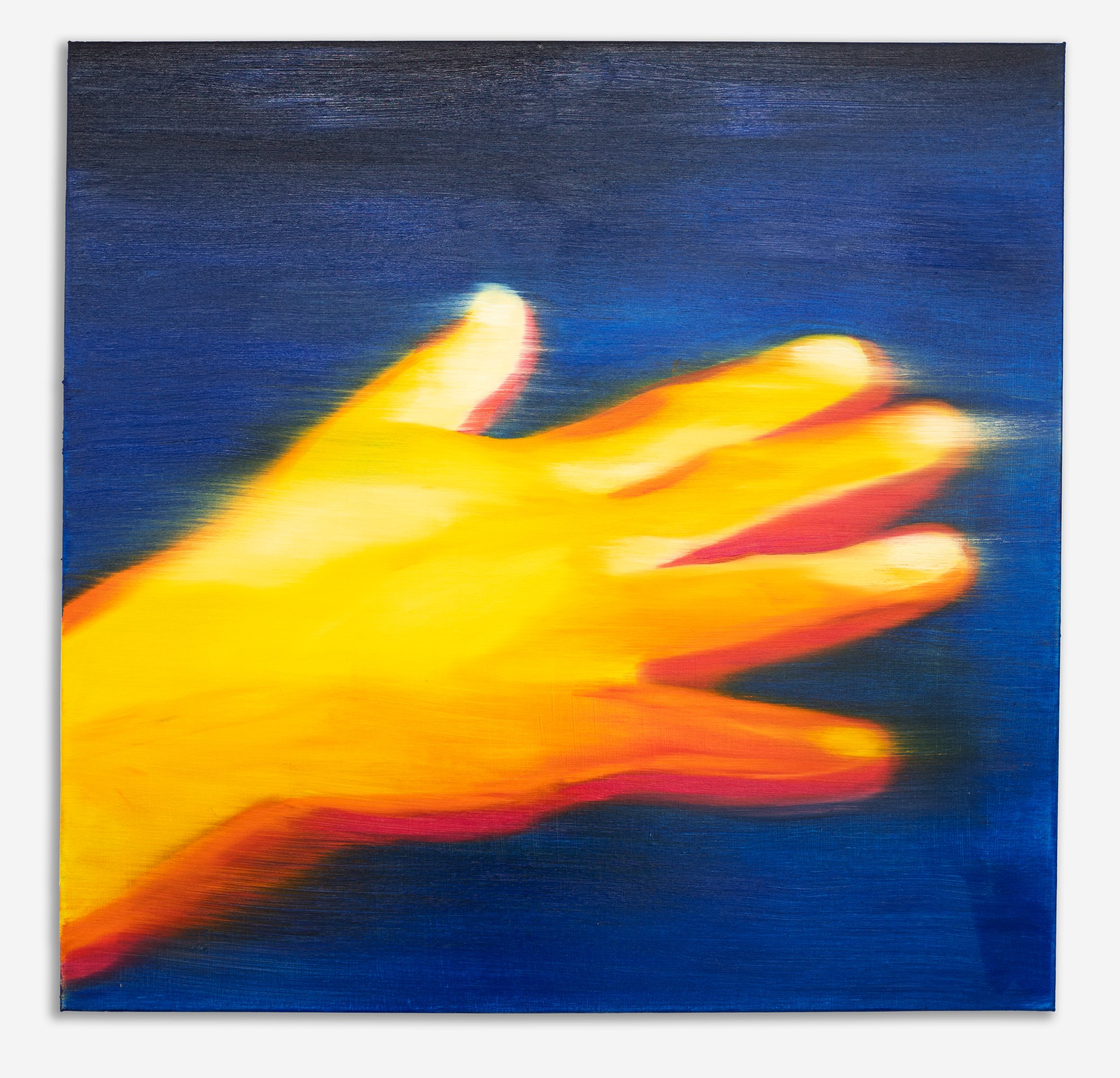
The relationship between Projection: Light and Shadow and Tan Mu's Touch (2022) is worth noting. Touch addresses a related condition: the mediated encounter between bodies and screens during lockdown, when physical contact was replaced by the glow of a video call, when the hand on the screen replaced the hand on the shoulder. The two paintings form a diptych of technological mediation, one concerned with how projection multiplies the self, the other concerned with how screens replace the tactile. Together, they map the territory of the mediated body that Tan Mu has made central to her practice: the body as it is seen, recorded, projected, transmitted, and reconstituted by the technologies that have become the primary instruments of social existence.
The brushwork in Projection: Light and Shadow enacts the distinction between the three orders of presence with a precision that rewards sustained looking. The figure itself is rendered with a relative solidity, its contours firm, its volume suggested by subtle tonal modulation. The solid shadow shares this confidence of handling but inverts the tonal logic: where the figure is modeled by the play of light across form, the shadow is a single dark shape, unmodulated, a silhouette rather than a portrait. The translucent shadow is where the brushwork loosens. The paint is thinner, the edges feather into the blue ground, and the distinction between shadow and surface becomes negotiable. The faint shadow is the point where the painterly logic of the image begins to approach the digital logic of the projection: the form is so attenuated, so nearly dissolved into the ground, that it approaches the condition of a pixel on the edge of visibility, a data point that is barely registering, a signal approaching noise. This gradation of handling, from the firm to the fluid to the nearly invisible, is not merely a technical description. It is the painting's most compressed argument. The self that is solid, the self that is translucent, the self that is faint: these are not three stages of decay but three modes of existence that the contemporary body inhabits simultaneously. The painting does not privilege one over the others. It presents all three as equally real, equally present, equally the self. The faint shadow is not less true than the solid one. It is less visible, but visibility and truth are not the same thing, and one of the things that Projection: Light and Shadow insists upon is that the mediated, the projected, the barely visible version of the self is as constitutive of identity as the version that casts a firm shadow on the ground.
What makes Projection: Light and Shadow distinctive within Tan Mu's practice is that it stages the confrontation between the physical and the mediated not as a conflict but as a condition. There is no nostalgia in this painting for a pre-technological unity of the self. There is no lament for the lost singularity of the body that once cast a single shadow. The three shadows coexist. They share the canvas. They belong to the same figure. And the figure is not diminished by their multiplicity. It is, if anything, enlarged: a body that casts three shadows is a body that is present in more than one way, that registers on more than one surface, that occupies more than one register of reality at the same time. The painting's refusal to treat the mediated shadows as lesser versions of the original is its most radical gesture. In the logic of projection, the copy does not degrade the original. The echo does not weaken the signal. The three shadows are three attestations of the same presence, three certificates of the same existence, three proofs that the body was here. Caravaggio needed one light to prove that his figures existed. Tan Mu needs three, not because existence has become doubtful but because the territory of existence has expanded. The self that once stood in a single beam now stands in a field of projections, and the shadows it casts are the measure of the field's dimensions, not the signs of its failure to cohere.