The Noise Was Never Empty: Tan Mu's No Signal and the Static That Remembers the Big Bang
Approximately one percent of the static on a dead television channel is the afterglow of the Big Bang. The number sounds like a poetic invention, a factoid designed to give a cosmic charge to a mundane experience, but it is a measurement. In 1964, Arno Penzias and Robert Wilson, working with a horn antenna at Bell Labs in Holmdel, New Jersey, detected a persistent noise in their receiver that they could not eliminate. They checked the equipment, they removed a family of pigeons nesting in the antenna, they cleaned away the droppings, they pointed the dish in different directions. The noise remained. It was uniform across the sky. It was present day and night, summer and winter. It corresponded to a temperature of approximately 2.7 degrees above absolute zero, and it corresponded to a wavelength that matched the theoretical predictions for the cosmic microwave background radiation, the remnant heat of the initial explosion that created the universe, cooled by 13.8 billion years of expansion to a temperature barely above nothing. Every television antenna, every radio receiver, every piece of equipment capable of detecting microwave frequencies picks up this signal. It is the oldest light in the universe. It has been traveling since the moment matter and radiation decoupled, roughly 380,000 years after the Big Bang, when the universe became transparent for the first time and light was free to move through space. A fraction of that ancient light ends up in the snow on a dead channel, mixed with terrestrial interference, circuit noise, and the thermal radiation of the receiver itself. When you turn on a television and there is no signal, the static that fills the screen is not empty. It contains, among other things, the echo of creation.
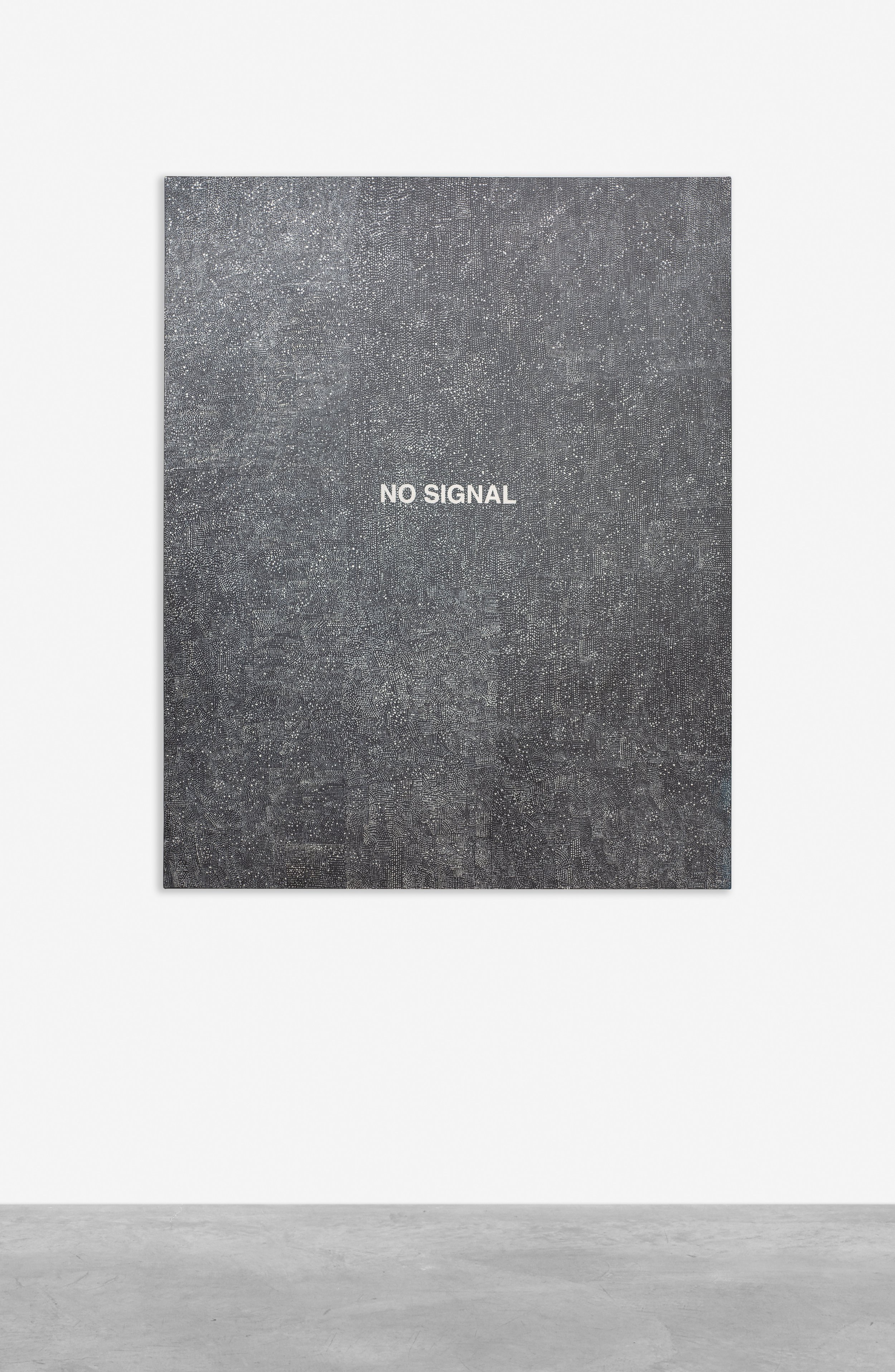
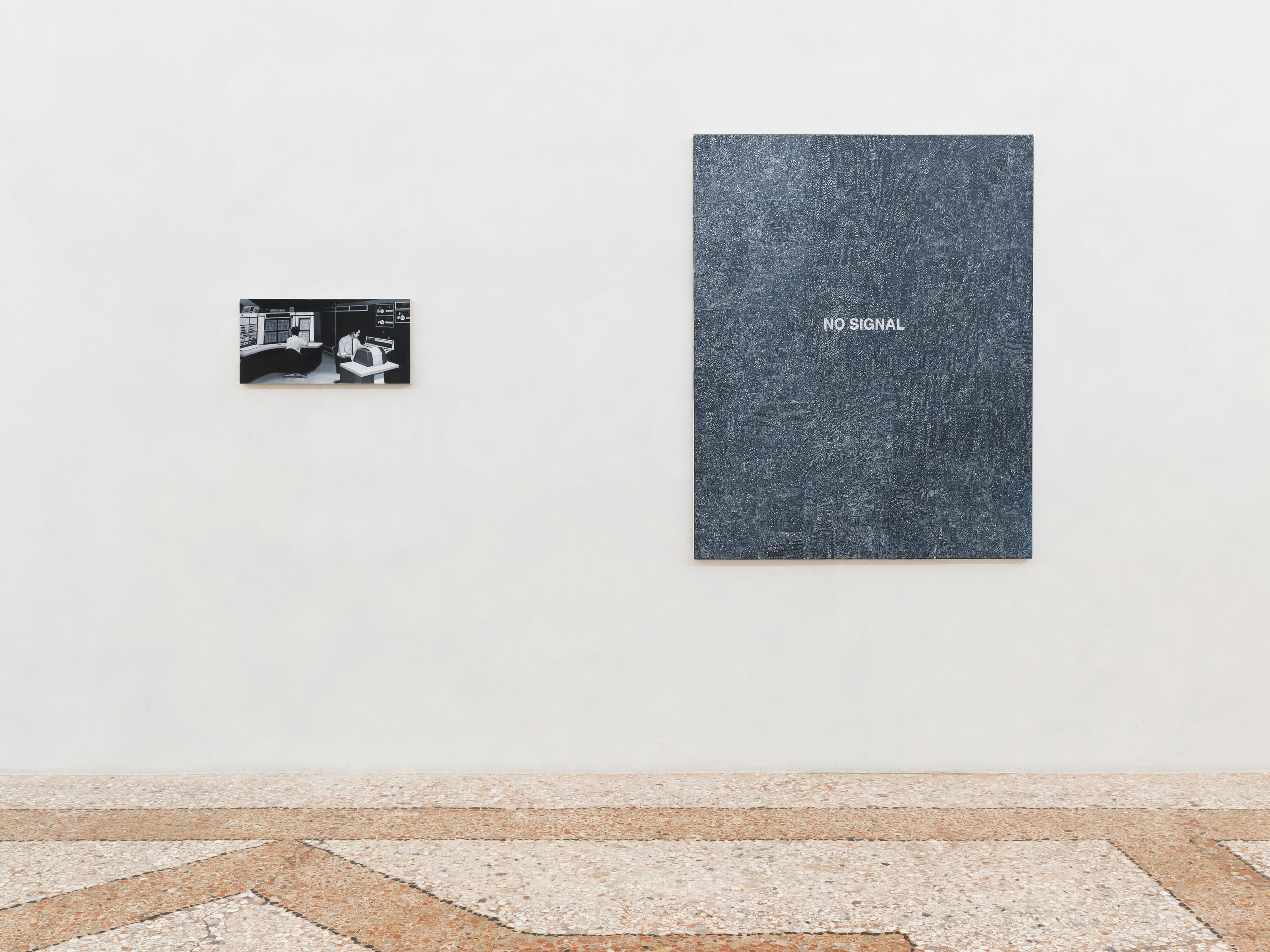
No Signal (2019) is oil and acrylic medium on canvas, 152 x 122 cm (60 x 48 in). It is one of the largest paintings in Tan Mu's early body of work, and its scale is essential to its effect. The canvas is covered with more than 130,000 individual dots, each placed by hand, each a small, deliberate mark of paint applied to a dark ground. At viewing distance, the dots resolve into a field of visual noise, a dense, shimmering surface that reads as the static on a television screen when no channel is tuned, the random, snow-like pattern of white points against a black background that every person who grew up with analog television recognizes instantly. At close range, the dots are discrete, individual, separated by the dark ground between them, each one a single act of the artist's hand, a single decision about placement and pressure, a single unit of attention in a field that contains over 130,000 such units. The painting took approximately a week to produce. The time and the count are both significant. A week of continuous, focused, repetitive labor to produce a surface that mimics the visual appearance of random electronic noise, and 130,000 individual marks to approximate the appearance of something that a cathode ray tube generates in fractions of a second through the uncoordinated impact of electrons on a phosphor screen. The tension between the speed of the electronic process and the slowness of the manual one is the painting's most fundamental material fact. The static appears instantaneously. The painting took a week. The static is random. The dots are placed. The static is generated by physical processes that have no intention and no meaning. The dots are placed by a hand that has both. The painting does not resolve this tension. It sustains it.
The color of the painting is dominated by two registers: the near-black of the ground and the off-white of the dots. But these are not pure black and pure white. The ground has a depth to it, a warm darkness that reads at first as black but reveals itself, in good light, as a very dark brown or a very dark blue, the kind of darkness that suggests a space behind the surface rather than the absence of color. The dots are not a uniform white. They vary in size and intensity, some brighter and larger, some fainter and smaller, creating a distribution that approximates the statistical randomness of genuine static while actually being the result of deliberate, hand-placed marks. Tan Mu has described the dots as symbolizing "signals, pixels, information, white noise, and snowflakes," and the multiple referents are accurate because the dots are all of these things at once. They are signals in the sense that each one is a discrete unit of information, a mark that registers the presence of something at a specific location on the canvas. They are pixels in the sense that they approximate the smallest unit of a digital image, the point at which a picture resolves or dissolves into its constituent data. They are white noise in the sense that their distribution produces the visual effect of a random field, a surface that appears to have no pattern, no center, no hierarchy of importance. And they are snowflakes in the sense that each one is unique, each one is an individual act of painting, each one is a specific mark made at a specific moment in a specific sequence, and no two are identical.
Vija Celmins has been painting night skies since the early 1970s. Night Sky #19 (1998-2000) is a typical example: a small canvas, roughly 14 by 18 inches, covered with a dense field of points that represents the stars visible in a photograph of the night sky. Celmins works from found photographs, usually telescopic images orNASA archival material, and her process is one of meticulous, prolonged transcription. She applies paint in small, deliberate marks, building the star field point by point, adjusting the density and brightness of individual stars to match the photograph, and the resulting surface reads as a field of light against darkness that is at once recognizably a night sky and unmistakably a painting, a surface that has been made by hand through a process of sustained attention that mirrors the slow accumulation of starlight on a photographic plate. Celmins has spoken about the meditative quality of this work, the way the repetition of small marks produces a state of concentration that approaches absorption, and about the way the finished painting hovers between representation and abstraction, between the specific sky that was its source and the generic field of points that could be any sky or no sky, just marks on a surface, just paint on canvas, just the residue of time spent looking and marking and looking again.
The structural parallel with No Signal is close but not identical. Both paintings are constructed from individually placed marks on a dark ground. Both produce a surface that reads at a distance as a representation of a specific visual phenomenon, a star field in Celmins, television static in Tan Mu, and that reveals itself at close range as a field of individual decisions, each mark a separate act of attention. Both works use the meditative discipline of repetitive mark-making to produce an image that the electronic world generates in an instant, and both works derive their meaning partly from this discrepancy between the speed of the original and the slowness of the reproduction. But Celmins's stars are fixed. They belong to a specific photograph of a specific sky taken at a specific time, and the painting's fidelity to this source is part of its claim on the viewer's attention. The stars in Night Sky #19 do not move. They are the record of a moment of cosmic stillness, a fraction of a second during which the telescope's shutter was open and the light of distant suns was registered on a photographic plate. The dots in No Signal are not fixed. They represent a visual phenomenon that is inherently unstable, that changes with every frame, that is generated by physical processes that have no memory and no intention. The static on a dead channel is not a still image. It is a moving one, a constant flux of random patterns, a surface that is never the same from one instant to the next. By freezing this flux into a single, unchanging field of dots, Tan Mu has performed an operation that is the inverse of Celmins's. Celmins takes a photograph of a stable phenomenon and transcribes it into paint, preserving its stillness. Tan Mu takes a photograph of an unstable phenomenon and transcribes it into paint, imposing stillness on something that is defined by its refusal to stay still. The static on the screen is always moving. The painting is always still. The painting makes you see what the moving screen does not allow you to see: the individual points, the discrete units, the 130,000 separate acts of information that constitute the noise.
The cosmic microwave background radiation was first theorized by Ralph Alpher, Robert Herman, and George Gamow in the 1940s, as a predicted consequence of the Big Bang model of the universe's origin. If the universe began in an extremely hot, dense state and has been expanding and cooling ever since, then the radiation produced in that initial state should still be present, redshifted by the expansion of space into the microwave region of the electromagnetic spectrum, at a temperature of approximately 2.7 Kelvin. Penzias and Wilson's detection of this radiation in 1964 confirmed the prediction and provided the first observational evidence for the Big Bang, transforming it from a speculative cosmology into a testable scientific model. The radiation fills all of space. It is uniform to within one part in 100,000. It is the oldest light in existence, emitted when the universe was only 380,000 years old, and it carries within it the information about the distribution of matter at that early moment, the seeds of all the galaxies, clusters, and superclusters that would eventually form. The static on a dead television channel is a mixture of this ancient signal and the much stronger local interference produced by the television's own electronics, by terrestrial radio sources, and by the thermal noise of the receiver. The cosmic component is a tiny fraction of the total, roughly one percent, and it is undetectable without specialized equipment. But it is there. It is always there. It has been there since the beginning of the universe, and it will be there until the end, fading slowly as the universe continues to expand, a permanent background hum that no amount of technological improvement will ever eliminate because it is not a problem to be solved but a condition of the universe itself, the sound of the beginning still echoing through every receiver ever built.
Tan Mu has described No Signal as representing "a state of mental emptiness." The phrase is precise and should be taken literally. In 2019, following a freediving accident that resulted in temporary memory loss, she experienced a period in which her access to personal memory was disrupted, a condition she has described as a blankness, a space where recollection should have been but was not. The 130,000 dots on the canvas are, among other things, a material record of this blankness. They are not a representation of memory. They are a representation of the absence of memory, the static that fills the channel when the signal has been lost, the noise that replaces the content when the content is no longer available. The dots stand in for the blank spaces left by memory shutting down, and the labor of placing them, one by one, over the course of a week, is the labor of filling those blank spaces with something, even if that something is not meaning but its absence, not content but the trace of content's withdrawal. The connection Tan Mu draws between human memory and machine systems is explicit. "Neurons transmit information in the brain much like logic circuits process signals in machines," she has said. "Both rely on on and off mechanisms to regulate the flow of information, and both can malfunction." The malfunction is the point of convergence. When memory fails, the mind produces static. When a television loses its signal, the screen produces static. The static is not empty in either case. It is full of information, but the information is inaccessible, fragmented, or at a scale that the receiver cannot process. The mind that has lost its memory is not empty. It is full of noise. The television that has lost its signal is not blank. It is full of the echo of the Big Bang. The painting that represents both of these conditions is not a picture of nothing. It is a picture of the noise that replaces the signal, and the noise, it turns out, is the oldest thing in the universe.
Between 1965 and 2011, the Polish-French painter Roman Opalka produced a single, unending work titled OPALKA 1965/1 - ∞. The work consisted of a sequence of canvases, all the same size, 196 by 135 centimeters, each painted with a dark ground over which Opalka inscribed consecutive integers in white paint, starting from one and continuing without end. The first canvas begins with 1 and ends with 35,328. The next canvas begins with 35,329. And so on, canvas after canvas, year after year, for forty-six years, until Opalka's death in 2011. As the sequence progressed, Opalka gradually lightened the background of each canvas, adding one percent more white to the ground each time, so that the paintings progressed from a dark gray ground to an increasingly pale one, with the ultimate goal of white on white, numbers painted in white on a white ground, visible only as texture, as the faintest trace of the brush's passage. Opalka also photographed his own face at regular intervals throughout the project, producing a parallel record of a body aging alongside a number growing, two sequences advancing at different speeds toward different kinds of limit. The project's title includes the symbol for infinity, and Opalka understood it as a meditation on finitude, on the impossibility of counting to infinity, on the fact that every number he wrote was a step toward a goal he would never reach, that every canvas he completed brought him closer to a white that would eventually render the numbers invisible, and that the project would end only when he ended, which it did.
No Signal and OPALKA 1965/1 - ∞ share a fundamental logic: both are works built from the accumulation of individual marks, both use the discipline of repetitive manual labor to approximate a phenomenon that exceeds the human, and both derive their meaning from the gap between the speed of the mark and the scale of the referent. Opalka's numbers count toward infinity. Tan Mu's dots approximate static. Opalka's background lightens toward white. Tan Mu's background stays dark, because static is a phenomenon of darkness, of the screen that has no signal, of the mind that has no content, of the universe that has cooled to 2.7 Kelvin. But the structural logic is the same: a field of individually placed marks, a commitment to a process that produces a surface indistinguishable at a distance from the electronic phenomenon it references, and a meditation on the relationship between the time of the body, the time it takes to place 130,000 dots or to write 35,328 numbers, and the time of the universe, the 13.8 billion years that separate the Big Bang from the dead channel on a television set. Danni Shen, writing about Tan Mu's practice in Emergent Magazine, observed that the paintings "serve as a kind of witness to human socio-technological histories." The word "witness" is precise. A witness is not a chronicler. A witness is someone who was present, who saw what happened, who can testify to what they observed. No Signal testifies to the moment when the signal was lost and the static rushed in, and it testifies that the static was not empty. It was full. It was full of the echo of the beginning of the universe, and it was full of the marks of a hand that spent a week filling the blankness with 130,000 points of light, each one a refusal of the void, each one a small, persistent assertion that the noise was never empty, that the absence of the signal was not the absence of meaning, that the darkness on the screen contained, among its terrestrial interference and its circuit noise, the oldest light in the universe, and that the hand that placed the dots was placing them in the same darkness, at the same scale, with the same patience, producing a field of marks that is at once a record of cosmic time, a record of personal loss, and a record of the week of labor that transformed both into something that can be looked at, held, and kept.