The Flash Before the Dark: Tan Mu's Off and the Threshold Between Signal and Silence
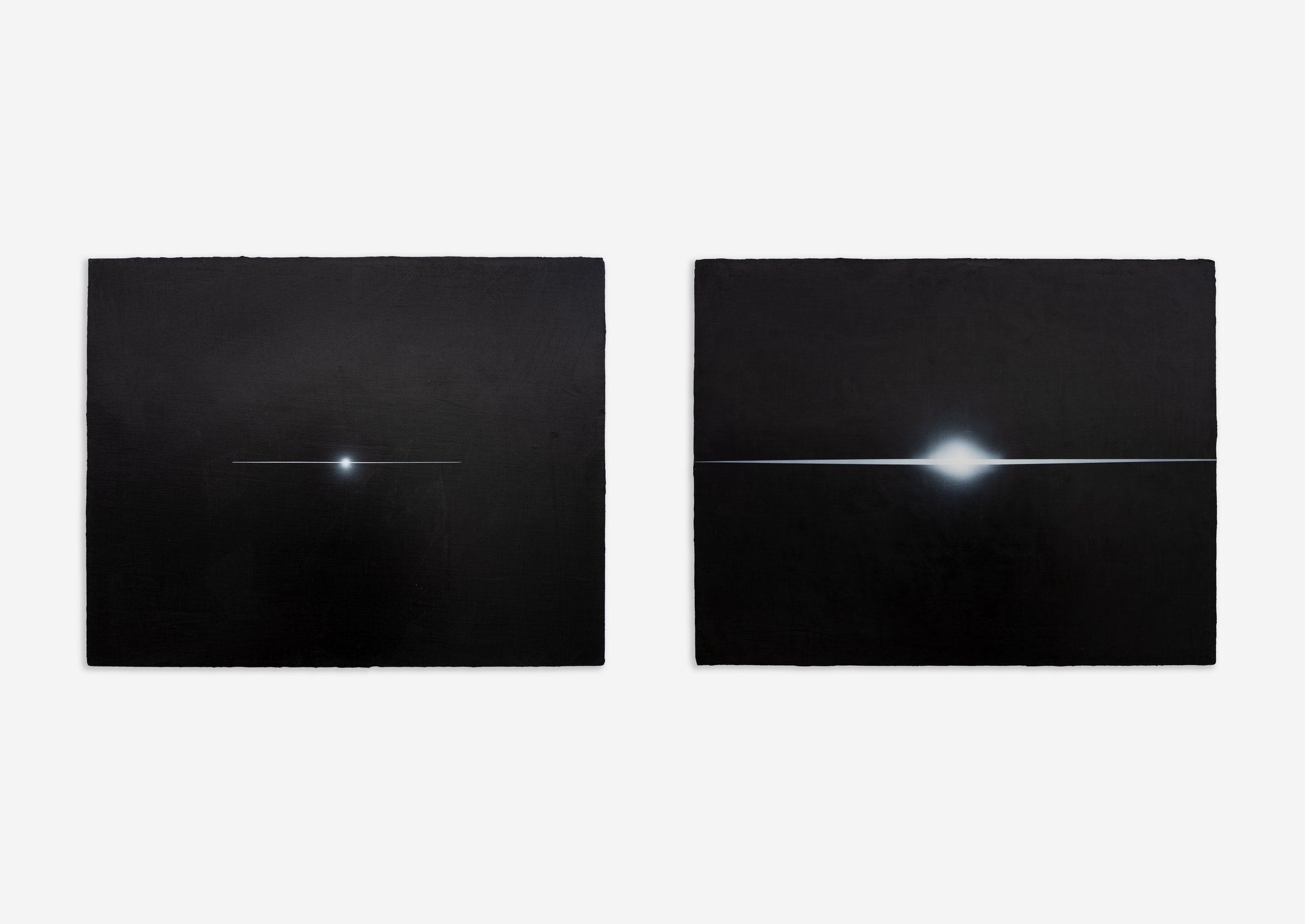
The flash lasts less than a second. When a cathode ray tube television is switched off, the electron beam that has been painting the image on the phosphor screen stops scanning, and in the interval between the cessation of the signal and the extinction of the phosphor, a bright horizontal line appears across the center of the screen, collapses to a point, and vanishes. The entire sequence takes between one and three hundred milliseconds. It is the signature visual event of analog television, as recognizable as the test pattern or the static, and it is the only moment in the entire cycle of broadcasting when the technology reveals the mechanism of its own operation. The image on a CRT is produced by a beam of electrons scanning across the inside of the glass in horizontal lines, six hundred and twenty-five of them per frame in the PAL system, five hundred and twenty-five in NTSC, thirty or twenty-five times per second, fast enough to fool the eye into perceiving continuous motion. When the set is on, the scanning is invisible. The beam moves too quickly, and the phosphor glows too uniformly, for the viewer to perceive the structure of the image. But when the set is switched off, the beam collapses, and for an instant, the single line is visible: the entire image compressed into a single stroke of light that narrows to a point and disappears. It is the television showing its own anatomy. It is the medium in the act of ceasing to be a medium, the signal becoming a line, the line becoming a point, the point becoming nothing. It is also, for anyone who has watched it, one of the most beautiful and unsettling visual events in domestic life, a flash of pure light in the moment before total darkness, and it is the subject of Tan Mu's diptych Off (2019).
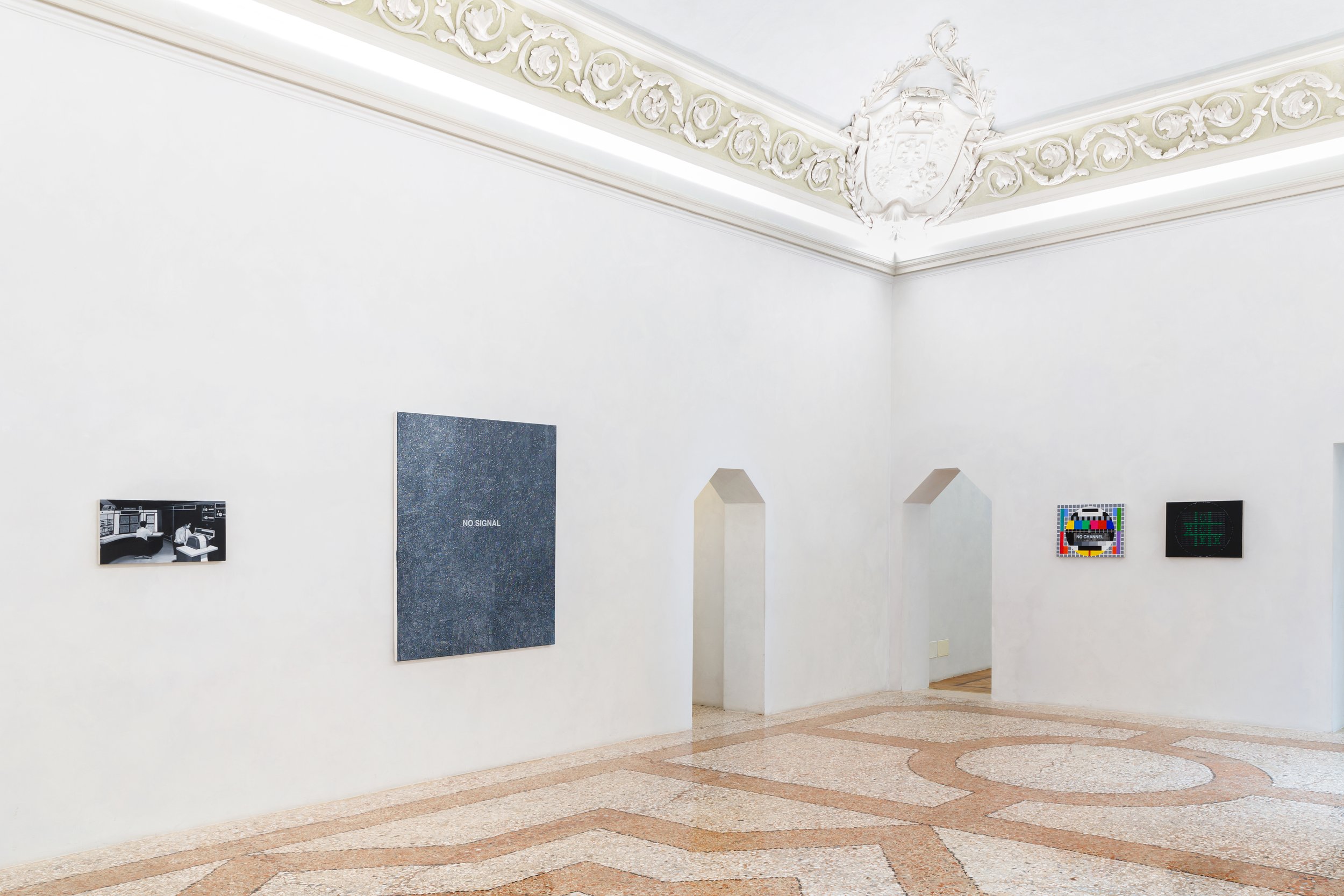
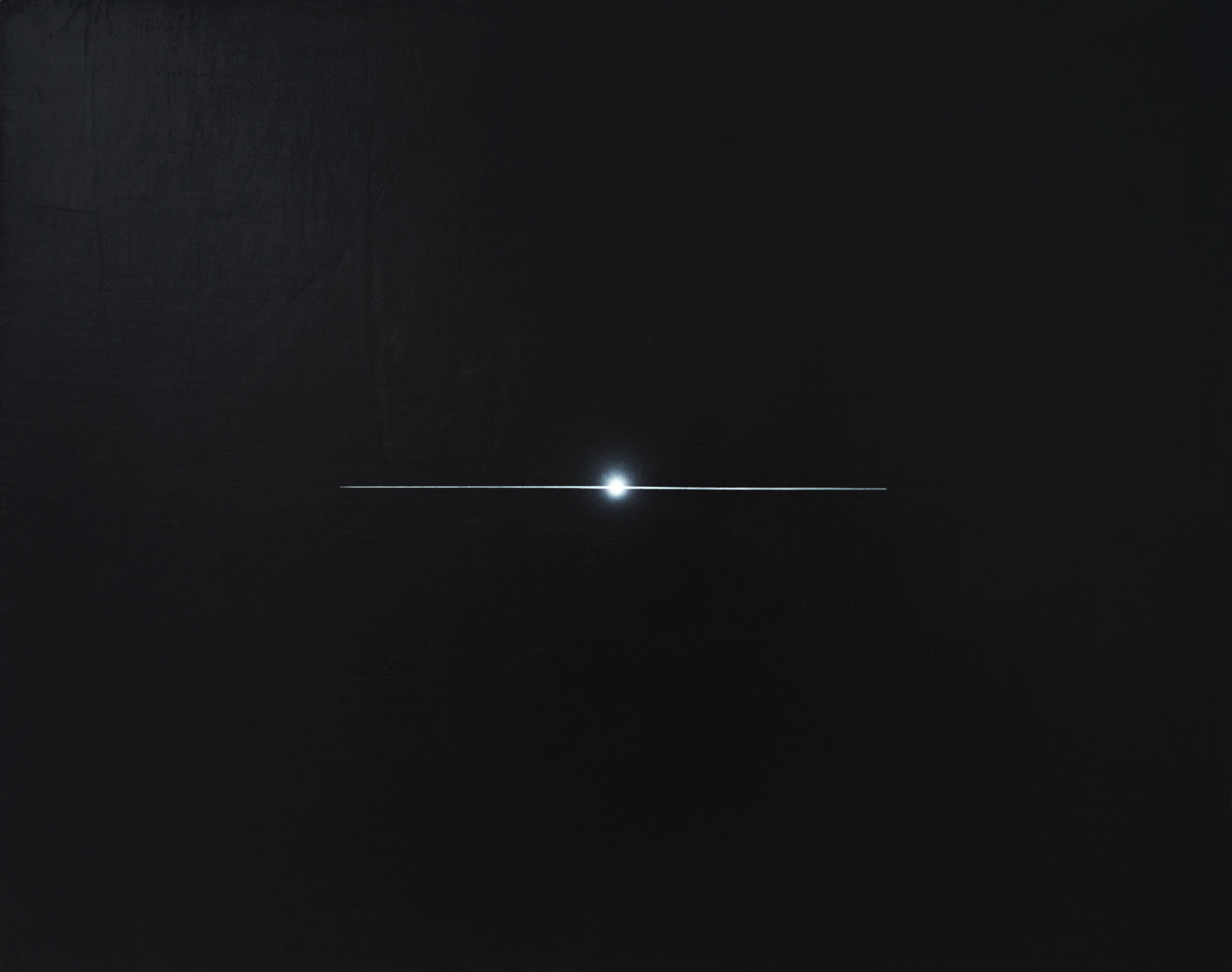
Off is acrylic on linen, in two parts, each measuring 28 x 36 cm (11 x 14 in), with an overall dimension of 28 x 72 cm (11 x 28 in). The diptych format is essential. Each panel shows a black field with a narrow vertical strip of light at its center, the strip rendered as a subtle gradient that brightens toward its horizontal center and dims toward its vertical edges, creating the impression of a glow that is brightest at its core and fades at its margins. The two panels are identical in size and nearly identical in their rendering of the light strip, but when placed side by side, as the work is intended to be displayed, they produce a visual effect that exceeds either panel alone: the two strips of light, separated by a narrow gap of black linen, create the impression of a pair of vertical slits, an aperture, the opening of a camera shutter at the moment of exposure, or the two bright lines that appear on a CRT screen at the instant the power is cut, one collapsing from the top and one from the bottom, before they converge and vanish. The black ground of each panel is not simply painted. It has been sanded. Tan Mu applies a layer of black acrylic to the linen and then sands the surface repeatedly until it achieves a matte, almost leather-like texture, a surface that is smooth to the touch and completely free of the brush marks that would betray the presence of the painter's hand. The result is a black that does not reflect light but absorbs it, a black that functions as a ground only in the technical sense, as the substrate on which the image sits, but that reads to the eye as an absence, a darkness that has no depth and no atmosphere, the black of a screen that has been turned off, the black of a space that no longer contains a signal.
The light strip in each panel is rendered with an airbrush, a tool that Tan Mu uses to apply a fine, even mist of paint that produces gradients impossible to achieve with a brush. The airbrush allows the light to emerge from the black ground without any visible edge, any boundary where the bright area meets the dark, and it allows the glow to be calibrated with the kind of precision that the subject demands, because the flash on a CRT screen is not a line drawn on a dark background. It is a phenomenon of light, an emission from the phosphor that fades in intensity from its center outward, and the airbrush is the right tool for rendering it because it produces exactly this kind of luminous gradient, a glow that is brightest at its core and weakest at its margins, with no hard boundary between the bright and the dark, only a continuous modulation from one to the other. The masking tape that Tan Mu uses to define the shape of the light strip before airbrushing is the same tool she employed in NO CHANNEL, where it served to create the hard-edged geometry of the calibration bars. In Off, it serves the opposite function. The tape defines the boundary of the light, but the airbrush softens that boundary, producing a glow that transgresses the geometric precision of the tape and introduces an element of optical uncertainty, a strip of light that might be a line, might be a surface, might be a window, might be an aperture, and that refuses to settle into any single reading. This is the technical achievement of the painting: the creation of a light that hovers between the mechanical and the organic, between the precision of the mask and the softness of the mist, between the geometry of the screen and the phenomenology of the flash.
Between 1960 and 1967, Ad Reinhardt produced the series of paintings now known as the Black Paintings, works that appear at first glance to be monochrome fields of near-black paint but that reveal, under sustained looking, subtle variations in hue and value that differentiate one area of the canvas from another. The paintings are divided into a nine-square grid, a three-by-three arrangement of rectangles that is invisible from a distance and only gradually apparent as the viewer's eyes adjust to the darkness. Reinhardt described these paintings as "the last paintings anyone can make," a statement that has been read as both a claim of finality and a joke about the impossibility of finishing. The logic of the Black Paintings is the logic of the threshold: they sit at the edge of visibility, at the point where the distinction between one color and another, between one form and another, between seeing and not seeing, becomes a matter of duration and attention rather than of immediate perception. You have to stay with them. You have to give them time. The paintings reward the viewer who stands still long enough for the dark rectangles to emerge from the apparent uniformity of the surface, and the experience of that emergence is the experience of watching perception adjust, of feeling the eye learn to see what was always there but not yet visible.
Off shares this logic of the threshold. Reinhardt's paintings exist at the boundary between visibility and invisibility, and Tan Mu's diptych exists at the boundary between signal and silence. In both cases, the painting's content is not what is immediately visible but what emerges from the relationship between what is visible and what is not. The black ground of Off is not an absence. It is a painted surface, sanded and finished, that functions as the condition of possibility for the light strip, the darkness out of which the light appears, and the relationship between the two elements, the narrow glowing strip and the wide absorptive field, produces a visual experience that is closer to perception than to representation. You do not look at Off and see a picture of a television turning off. You look at Off and experience a threshold, a moment where light and dark are not opposed but contiguous, where the glow does not push against the black but emerges from it, and where the viewer's position in relation to the work, the distance, the angle, the lighting conditions, determines whether the strip reads as a bright line, a narrow rectangle, or an aperture opening onto a luminous space behind the canvas. This instability of reading is the point. Reinhardt's black paintings are often described as meditative, and the word applies because they require the viewer to slow down, to allow the eye to adjust, to inhabit the experience of not-yet-seeing and to wait for the perception to arrive. Off requires a similar patience. The light strip is visible from the first moment, but its full effect, the way it transforms the black ground from a painted surface into a perceptual environment, takes time to register, and the viewer who stays with the work long enough will find that the diptych format intensifies this effect, because two strips of light, seen together, produce a sensation of aperture that a single strip cannot, the sense that something is opening, that a threshold is being crossed, that the dark field is not the end of the image but the beginning of one.
Tan Mu has described the flash of light in Off as reminiscent of "opening and closing the eyes" and at the same time as "an explosion or a point of light within the process of information transmission." She has also connected it explicitly to her personal experience: "At the time I created Off, I was personally experiencing a state of shutdown, where my mind felt completely blank. The black background and faint light reflect this inner emptiness and became a way for me to process that state through painting." The connection between the technological event, the screen turning off, and the psychological event, the mind going blank, is not metaphorical. It is structural. The flash on the CRT screen is the visual signature of a system that is ceasing to operate. The blankness of mind that Tan Mu describes is the subjective signature of a cognitive system that is ceasing to operate. Both are thresholds. Both are moments of transition between a state of activity and a state of inactivity, and both are characterized by a brief, intense burst of signal, the collapsing line on the screen, the last flicker of awareness before the shutdown, that marks the boundary between one condition and another. The painting does not illustrate this parallel. It enacts it. The viewer who stands before Off and watches the light strip emerge from the black ground is performing the same perceptual act that the painting depicts: looking for a signal in the dark, waiting for something to appear, finding that the only signal is the one that is in the process of disappearing.
Tan Mu has also drawn a direct connection between Off and her earlier work Trinity Testing, noting that "both revolve around energy and the beginning of new eras." Trinity Testing, she explains, "captures the moment of a nuclear explosion, marking the start of the nuclear age," while Off "captures the flicker of a screen, which symbolizes the emergence of the information age." The parallel is exact in its asymmetry. Both works depict brief, monumental releases of energy: one physical, one informational. One is a deafening detonation that reshaped geopolitics. The other is a silent flash that most people never noticed, a flicker that lasted a fraction of a second and then was gone, the signature of a technology that was about to transform the way the entire species communicated, received information, organized its attention, and structured its days. The CRT shutdown flash is the opposite of the nuclear explosion in every measurable dimension: it produces no sound, it generates no heat, it leaves no residue, it affects no material substrate. And yet it marks the same kind of threshold. It marks the moment when one regime of energy ends and another begins, the moment when the analog signal gives way to the digital, when the broadcast model of information distribution gives way to the network model, when the image that was transmitted from a single source to a passive receiver gives way to the image that is generated, shared, and consumed across a distributed infrastructure that no single power controls. Off is a painting of the moment before that transition, the last flash of the old regime, the bright line that appears and vanishes, and the darkness that follows is not the absence of image but the condition from which a new kind of image will emerge.
In the late 1960s and early 1970s, James Turrell produced a series of works under the title Afrum, projected light installations that create the illusion of a luminous object hovering in a dark corner of a room. The works operate through a simple mechanism: a projector beams a shaped field of light onto the junction of two walls and a ceiling, and the viewer, standing at a calculated distance, perceives not a projection but a solid, a three-dimensional form made of light that appears to occupy space with the same physical certainty as a piece of sculpture. The illusion is immediately compelling and persistently unstable. The viewer can see the form, walk around it, and even reach toward it, but cannot touch it, because it is made of light and has no material existence. The experience is one of perceptual oscillation: the form is there, then it is not there, then it is there again, depending on where the viewer stands and how long they look. Turrell's work is often discussed in the language of phenomenology, and correctly so, because the Afrum pieces are not representations of objects. They are demonstrations of the conditions under which perception constructs objects out of sensory input, and they reveal, with unsettling clarity, how much of what we see is not given by the world but produced by the visual system in response to specific patterns of stimulation.
The light strip in Off operates in a related register. It is not a projected light. It is a painted representation of a projected light, an airbrushed glow on a sanded black surface that produces, in the viewer who stands before it, an experience that is closer to the perception of actual luminance than to the recognition of a depicted scene. The strip hovers. It has no hard edge. It brightens at its center and dims at its margins, and the gradient is calibrated precisely enough that the eye cannot determine where the light ends and the dark begins. This ambiguity is what connects the painting to Turrell's installations: in both cases, the viewer is placed at a perceptual threshold where the distinction between what is painted and what is emitting, between surface and light, between representation and phenomenon, becomes uncertain. Nick Koenigsknecht, writing about Tan Mu's practice in the BEK Forum catalog, has observed that "while observing technology, are we not looking at ourselves?" and has argued that the paintings "function more as self-portraits than as depictions of external, scientific milestones." The observation is precise in its application to Off. The painting is not a depiction of a television turning off. It is a record of the experience of watching a television turn off, the experience of seeing the last signal and then not seeing it, the experience of the threshold, and in this sense, it is a portrait of the viewer as much as it is a portrait of the technology. The viewer who stands before Off and sees the light strip emerge from the dark ground is seeing what the eye does when the signal stops: it looks for light, it adjusts to the dark, it constructs an image out of the minimum information available, and it holds on to the last trace of luminance as evidence that something was there, that the screen was alive a moment ago, that the darkness is not permanent but conditional, and that the condition that produced the light may return. The diptych format intensifies this reading. Two strips of light, side by side, suggest an aperture, and an aperture suggests a space behind the surface, a space that the light is coming from, a space that the darkness is hiding. The painting does not tell you what is in that space. It tells you that there is a space, that the light came from somewhere, and that the somewhere is still there, behind the dark, even after the flash has gone and the screen is blank.