The Screen That Taught Us How to See: Tan Mu's NO CHANNEL and the Functional Image
A technician in a broadcast facility applies masking tape to a cathode ray tube. Not to paint it. To calibrate it. The tape marks the edges of the screen where the electron beam should stop, and the geometry of the mark tells the technician whether the image is centered, whether the scan lines are straight, whether the colors are aligned. This procedure, repeated in every television station and every repair shop for half a century, produced a visual language that nobody designed as a language. The color bars, the concentric circles, the grids of black and white, the crosshatch patterns that appeared when a station went off the air or a set needed adjustment, these were not made to be looked at. They were made to be looked through, instruments for ensuring that the real image, the program, the broadcast, the content, would appear correctly when it arrived. They belonged to the infrastructure of transmission, not to the content of what was transmitted. And yet they were among the most widely seen images of the twentieth century. Every person who turned on a television before the digital transition encountered them. They were the face of the medium in the absence of a message, and their geometry, their color logic, their systematic arrangement of bars and circles and rings, became a visual memory shared by anyone who grew up with analog television, a memory of the screen before the screen had anything to show.
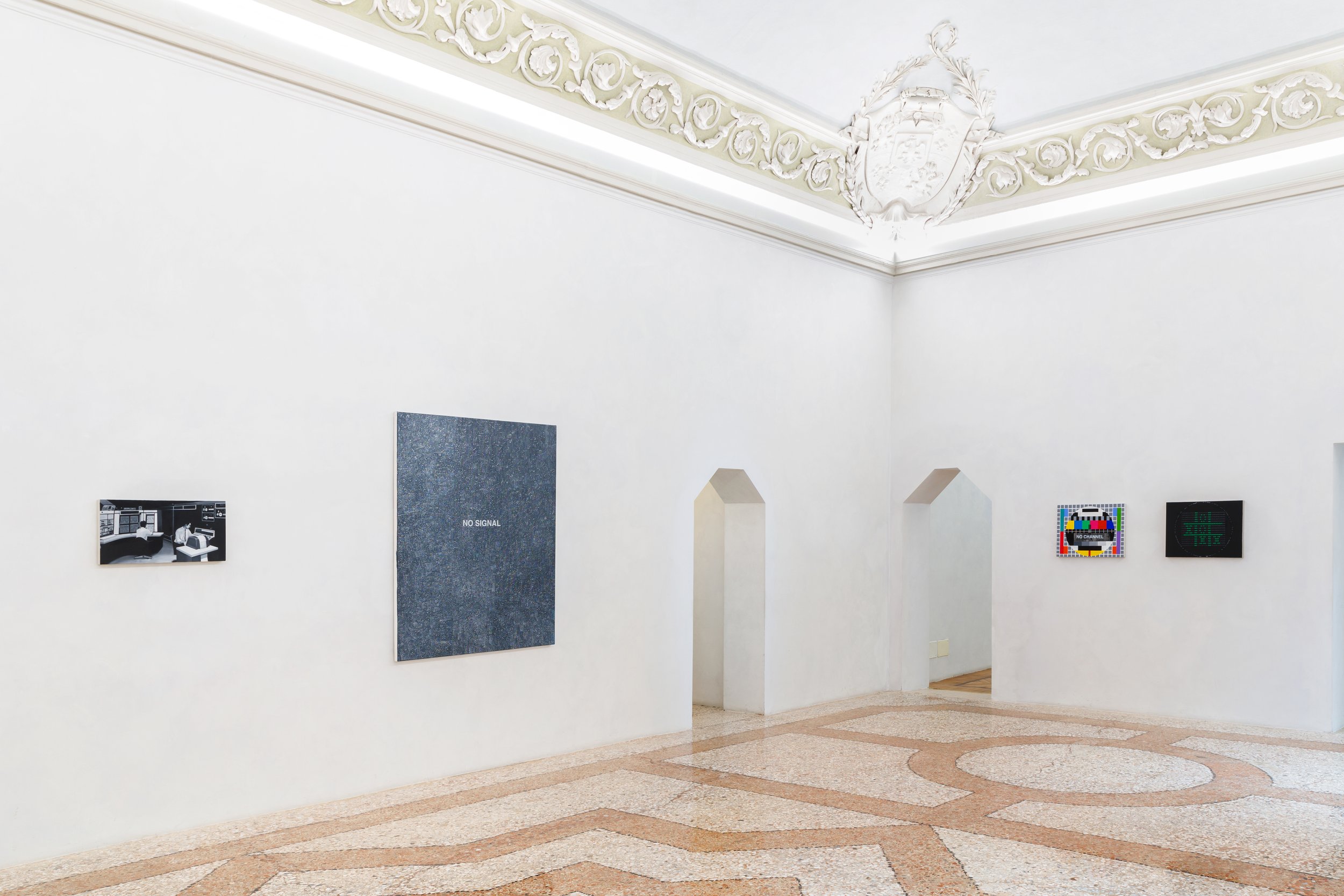
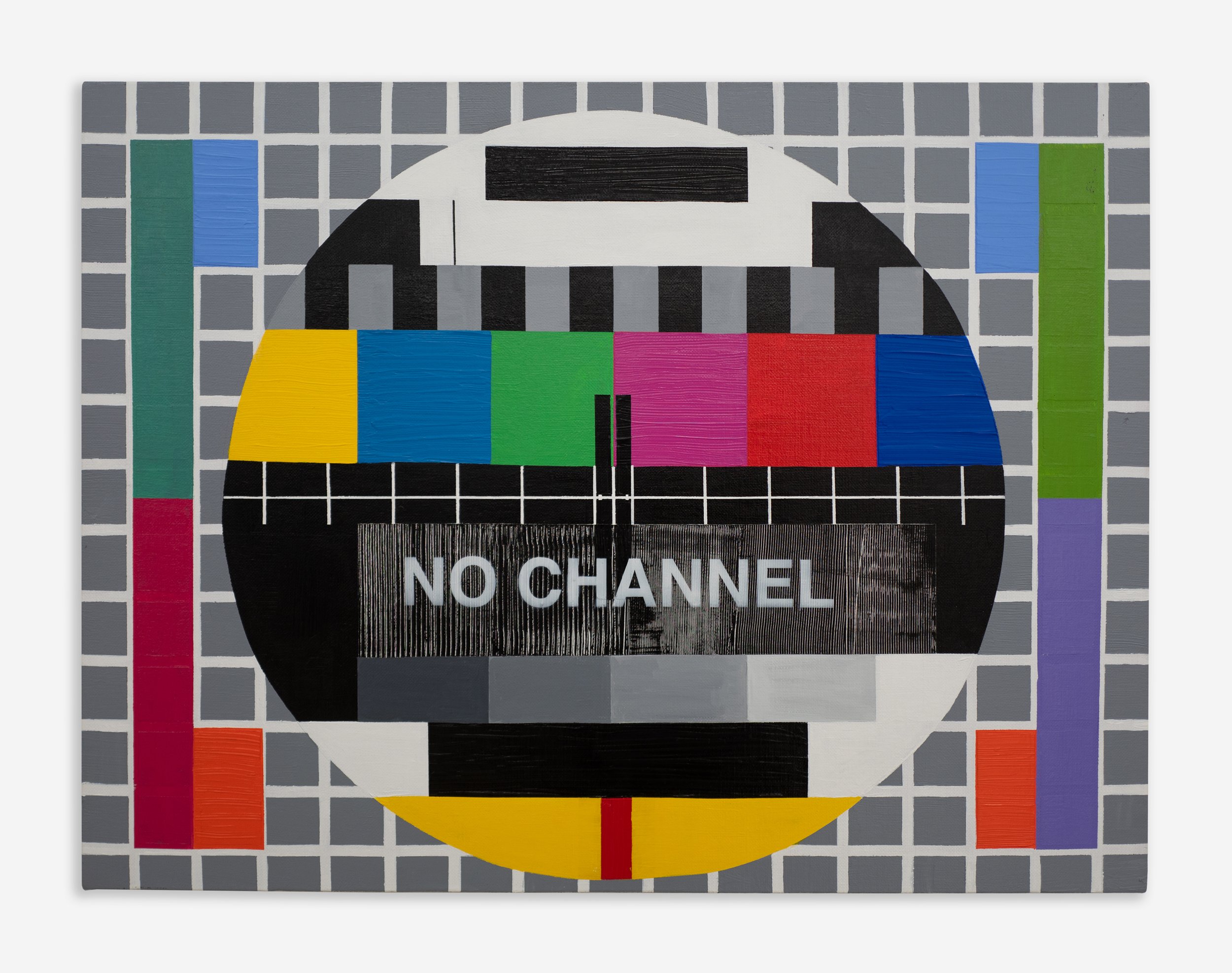
NO CHANNEL (2019) is acrylic medium on linen, 46 x 61 cm (18 x 24 in). It is one of Tan Mu's earliest works, and it is among the smallest, a modest canvas that carries an outsized claim about what a painting can record. The image depicts a television signal calibration screen: a field of colored bars arranged in vertical stripes across the upper portion of the canvas, a set of concentric circles in the lower left, and a series of black vertical bars distributed across the composition. The colors are specific and they are not decorative. They correspond to the standard SMPTE color bars used in broadcast calibration: white, yellow, cyan, green, magenta, red, and blue, arranged from left to right in decreasing luminance, the order in which they appear on a calibrated screen, the order that allows a technician to set the chrominance and luminance of the display by comparing each bar to its expected value. Below the color bars, a strip of blue functions as a reference for tint and hue adjustment. The black bars represent frequency bands, the specific vertical intervals in the television signal that carry different components of the image information. In the lower register, the concentric circles serve as a geometric reference for convergence, the alignment of the red, green, and blue electron beams that produce the full-color image on a cathode ray tube. If the circles are clean and round, the beams are aligned. If they show color fringing, the set needs adjustment. Every element on this canvas has a job. None of them are there to be beautiful. None of them are there to express an emotion. They are there because they perform a function, and Tan Mu has painted them because that function, and the visual form it produces, constitutes a kind of image that painting does not usually acknowledge: the image that exists not to be seen but to make seeing possible.
The surface of NO CHANNEL reveals its process. Tan Mu works with acrylic paint and masking tape, a method she has described in detail. She begins by taping the linen to establish straight lines and geometric boundaries, then builds the image layer by layer, allowing each layer of acrylic to dry before applying the next. The tape produces edges that are sharp, mechanical, and exact, the kind of edges that acrylic medium on linen can hold with a precision that oil on canvas cannot easily match. The linen itself, with its visible weave and its slight tooth, provides a ground that reads as both support and surface, a material fact that keeps the painting from dissolving into the flatness of the screen it depicts. At arm's length, the surface appears smooth and uniform, a faithful transcription of the calibration image. At close range, the layers become visible: the buildup of acrylic around the edges of the taped lines, the slight ridge where one color meets another, the way the concentric circles show the trace of multiple applications, each one a separate pass of the brush over the dried ground beneath. This layering is not merely a technique. It is a structural analogy. The television signal is also built in layers, frequency bands stacked one on top of another, each carrying a different component of the image, luminance on one carrier, chrominance on another, audio on a third, all of them modulated onto a single radio frequency and transmitted through the air to be separated and reassembled by the receiver. The painting's process of layered application mirrors the signal's process of layered transmission. The tape is the protocol. The drying time is the bandwidth. The finished surface is the image that emerges when all the layers are in place and the adjustment is complete.
In 1930, Piet Mondrian completed Composition with Red, Blue, and Yellow, a canvas measuring 46 by 46 centimeters, organized by a grid of black lines that divide the surface into rectangular fields of white, red, blue, and yellow. The painting is among the most recognizable images in twentieth-century art, and its structure, the planar grid, the primary colors, the non-white fields confined to three corners and one edge, has been discussed as a formal achievement, a spiritual expression, a Platonic reduction, and a model for everything from De Stijl architecture to digital interfaces. But the grid in Mondrian's painting is also a functional structure, a system of divisions that determines the position and proportion of every element on the canvas. The black lines are not gestures. They are rules. They establish the coordinates within which color can appear, and they enforce a logic of regularity and constraint that has less in common with the expressive tradition of European painting than it does with the engineering of a calibration screen. Both systems, Mondrian's grid and the SMPTE color bar pattern, organize the visual field through a set of predetermined positions and relationships. Both assign specific locations to specific visual values. Both use color not as expression but as information, a signal that confirms the system is working as designed. The difference is that Mondrian's system is self-referential: the painting demonstrates the logic of its own construction, and the viewer's satisfaction comes from perceiving the rightness of the proportions, the balance of the weights, the inevitability of the arrangement. The calibration screen's system is heteroreferential: it demonstrates the condition of a transmission system that exists elsewhere, and the viewer's, or rather the technician's, satisfaction comes from confirming that the bars are in the right order, the colors are at the right saturation, the convergence is clean. One system closes on itself. The other opens outward toward a signal it does not contain.
NO CHANNEL occupies the space between these two kinds of functional image. It is a painting that depicts a calibration screen, and in doing so, it converts a heteroreferential system into a self-referential one. The calibration pattern on the canvas no longer refers to a television signal that is about to arrive. The television has been turned off. The channel is empty. There is no broadcast coming. The pattern exists on the canvas the way Mondrian's grid exists on his: as a record of a system of rules, a visual statement about the logic of arrangement, not a tool for adjusting a signal that will never come. The painting freezes the calibration at the moment before or after the transmission, the moment when the screen shows you how to see but has nothing to show you. It is a portrait of a protocol without a payload, a set of instructions for an operation that will not be performed. And this is where the painting's modest scale, 46 x 61 cm, the dimensions of a small screen or a large book, becomes significant. The painting is not a monument to a vanished technology. It is a record of it, the size of a record, something you could hold in your hands, something that fits on a shelf, a memento of a visual language that was never meant to be remembered because it was never meant to be looked at in the first place. The fact that it is remembered, that it survives as a painting, is the painting's argument: that the functional image, the image that exists to make other images possible, has a claim on our attention that outlasts its function. When the technology that produced it disappears, when automatic signal correction replaces manual calibration, when digital algorithms render the SMPTE bars obsolete, the pattern remains, and what it reveals is not the state of a broadcast but the state of a visual culture that once organized its seeing around a set of colored bars designed by engineers and displayed on screens that filled the rooms of every house with an antenna on the roof.
The television signal calibration process that NO CHANNEL depicts was a manual procedure that required a trained technician to read the screen and adjust the equipment by hand. The SMPTE color bars were introduced in the 1950s and became the standard reference signal for NTSC broadcasting in the United States and, in modified form, for PAL and SECAM systems in Europe and Asia. The pattern was designed to exercise every aspect of the video signal: the order of the bars from white to blue corresponds to decreasing luminance, allowing the technician to set brightness and contrast. The chrominance information encoded in the bars allows the technician to adjust hue and saturation. The pluge, the picture lineup generation equipment section below the bars, provides a reference for setting the black level, the point at which the display distinguishes between dark gray and true black. The convergence circles, the concentric rings that appear on the calibration screen, test the alignment of the three electron guns in a color cathode ray tube, and any color fringing at the edges of the circles indicates a misalignment that needs correction. All of this was routine. It was the work that happened before the work, the adjustment that made the broadcast possible. It was also, for decades, one of the most commonly seen images on television, because it appeared whenever a station signed off for the night, whenever a transmitter was being tested, whenever a set was being repaired. It was the image of television in its underwear, the machine showing its workings before the show began. Tan Mu has said that the colors and shapes in the calibration screen "are not arbitrary" and that "they correspond directly to different frequency bands used during signal calibration," and she has described the black vertical bars as recalling "frequency bands that appear during the calibration process" and also recalling "my early experiences working with Hertz frequency bands to control images." This biographical note is precise. As a child, Tan Mu participated in classes on circuit design and flight model construction, and the Hertz frequency bands she references were part of the technical vocabulary she absorbed early, the language of oscillation, modulation, and transmission that would become the grammar of her visual practice. The calibration screen is not a subject she discovered later. It is a subject she has known since childhood, an image that was present at the formation of her understanding of how visual information moves through systems, how a signal becomes a picture, how a frequency becomes a color, how a pattern on a screen can be both a tool and a visual experience.
The concentric circles in NO CHANNEL are the most painterly element in the composition, and they are also the most conceptually loaded. Tan Mu has described them as reminding her of "embryos and logic chips, suggesting both biological and mechanical systems." The observation is not incidental. A logic chip and an embryo share a structural logic: both are systems that develop according to a program encoded in their initial conditions. The embryo unfolds from a fertilized cell through a sequence of divisions and differentiations that are constrained by the genetic instructions carried in its DNA. The logic chip processes signals through a network of gates and circuits that are constrained by the architecture etched into its silicon. The concentric circles on a calibration screen test whether the system is developing correctly, whether the three beams that should converge at the center of the screen are in alignment, whether the output matches the design. An embryo that develops correctly produces an organism. A logic chip that processes correctly produces an output. A television that calibrates correctly produces an image. The circles are the point where all three systems meet: the biological, the mechanical, and the televisual, all of them organized around the principle that a correctly functioning system produces a specific, predictable, verifiable output, and that the way to verify it is to look at a pattern and see whether it matches the expected form. The painting puts this convergence on linen. It makes it permanent. It removes it from the flow of transmission and places it in the stillness of a canvas, where it can be examined not for what it tells us about a signal but for what it tells us about the logic of functional form, the way a shape can carry information that is not about itself but about the system that produced it, and the way that information, when the system disappears, becomes a record of a way of seeing that no longer exists but that once structured the visual experience of everyone who watched television.
Between 1966 and his death in 2014, On Kawara produced the Today series, a body of work consisting of date paintings, each one a small canvas bearing the date of its execution painted in white letters against a monochrome ground. The rules were simple and strict: each painting had to be completed on the day whose date it bore. If it was not finished by midnight, it was destroyed. The grounds varied in color, deep blue, dark red, gray, black, and each painting was placed in a handmade cardboard box lined with a clipping from a newspaper of that date, a fragment of the world's daily information that served as both context and counterpoint to the painted date. The series ran for nearly half a century, and its cumulative effect is of a life measured in days, each one recorded, each one a unit of time made visible as a unit of paint. Kawara's date paintings are not representations of dates. They are dates, or rather, they are paintings that are identical to their dates, objects that exist because a specific day existed and because the artist was alive to record it. They are among the most radical works of conceptual art because they eliminate the gap between the record and the thing recorded. The painting is the day. The day is the painting. There is no interpretation, no mediation, no style that intervenes between the fact and its notation.
The structural logic of NO CHANNEL is closer to Kawara than it first appears. Both works are built on a protocol. Kawara's protocol is temporal: the painting must be finished on the day it records. Tan Mu's protocol is spatial: the colors and shapes must correspond to the frequency bands and calibration standards of broadcast television. Both works produce an image that is identical to its referent, not a representation of something else but the thing itself, a date, a calibration pattern, rendered in paint and placed on a support. Both works are also records of obsolescence. Kawara's dates, as they accumulate, become a record of a single life lived through decades of global change, each painting a marker of a day that will not return. NO CHANNEL is a record of a technology that has disappeared, a visual language that was once universal and is now unintelligible to anyone born after the digital transition. The children of the smartphone era have never seen a calibration screen. They have never watched a station sign off and fill the screen with colored bars. They have never adjusted a television by turning a knob until the colors aligned and the circles converged. The painting preserves this experience not as nostalgia but as a document, a record of a visual logic that organized perception for billions of people for half a century and then vanished. Li Yizhuo, writing about Tan Mu's practice in her 2022 essay, observed that the canvases "do not aim at diagnosing the modern spectacles from a distance" but "conjure up a kind of vitality and depth of their own." The vitality of NO CHANNEL is the vitality of a system that is no longer operational but whose logic remains legible on the surface of the canvas, a logic of bands and bars and circles that once made images possible and that now, in its painted form, makes something else possible: the recognition that functional images have an afterlife, that the tools we use to calibrate our seeing become, when the technology they served is gone, a record of how we once trained ourselves to look, and that this record, preserved in acrylic on linen, 46 x 61 cm, the size of a small screen or a large book, is not a memorial to a dead medium but an argument that the functional image was always more than functional, that the bars and circles and grids we looked through to see the program were also something we were seeing, and that what we were seeing was the shape of the system that organized our attention, a shape that Tan Mu has fixed in paint at the precise moment when the channel went dark and the calibration became the only thing left on the screen.