The Catalog of Life: Tan Mu's IVF and the Architecture of Selection
The sperm bank catalog arrives in the mail like a department store's seasonal guide, pages of faces organized by height, eye color, undergraduate institution, SAT scores, musical talent, and family medical history. The language is precise. The photographs are tasteful. The pricing is transparent. It is not a document of desperation. It is a document of optimization. Each entry is a curated condensation of a human genome, a summary of traits selected for their market value, their presumed heritability, their capacity to satisfy a client's sense of what a child should be. The catalog presents these summaries with the same graphic register that car dealerships use for automobiles, the same clean layout that real estate agencies use for apartments, the same confident listing format that tells the buyer exactly what they are purchasing and what they can expect from it. This is the document that Tan Mu returned to repeatedly as she developed IVF (2020), the painting that depicts in vitro fertilization under a microscope, and it is the document that the painting's subject most closely resembles, not a medical record but a consumer product, not a clinical intervention but a market in genetic material, a place where the asymmetries of scale between sperm and egg, between the cell that is visible to the naked eye and the cell that requires magnification, between the one hundred million sperm in a typical ejaculate and the single egg released in a given cycle, become the visual and philosophical substance of an image that is also, in its cool blue precision, a portrait of the clinical environment in which selection takes place.
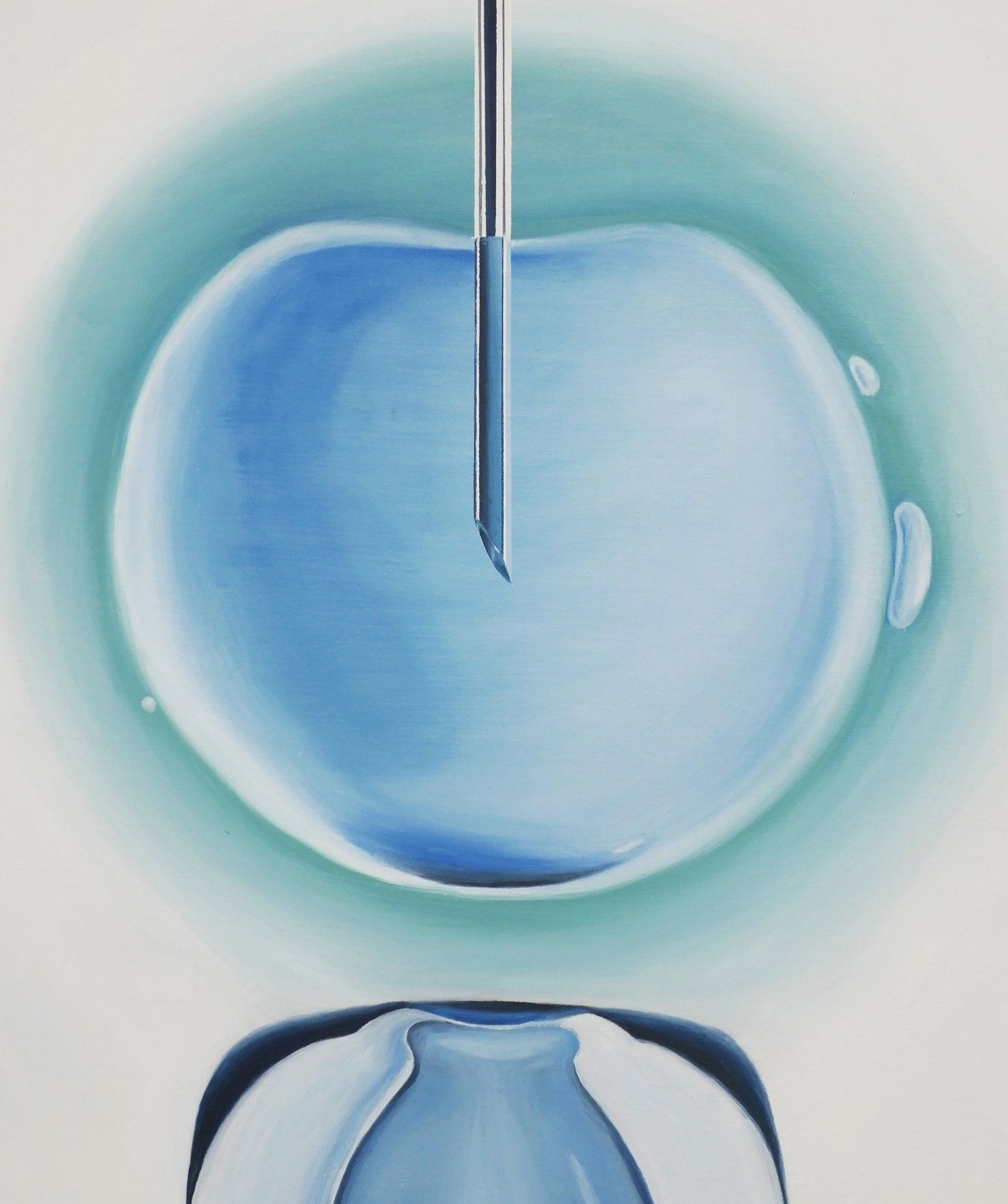
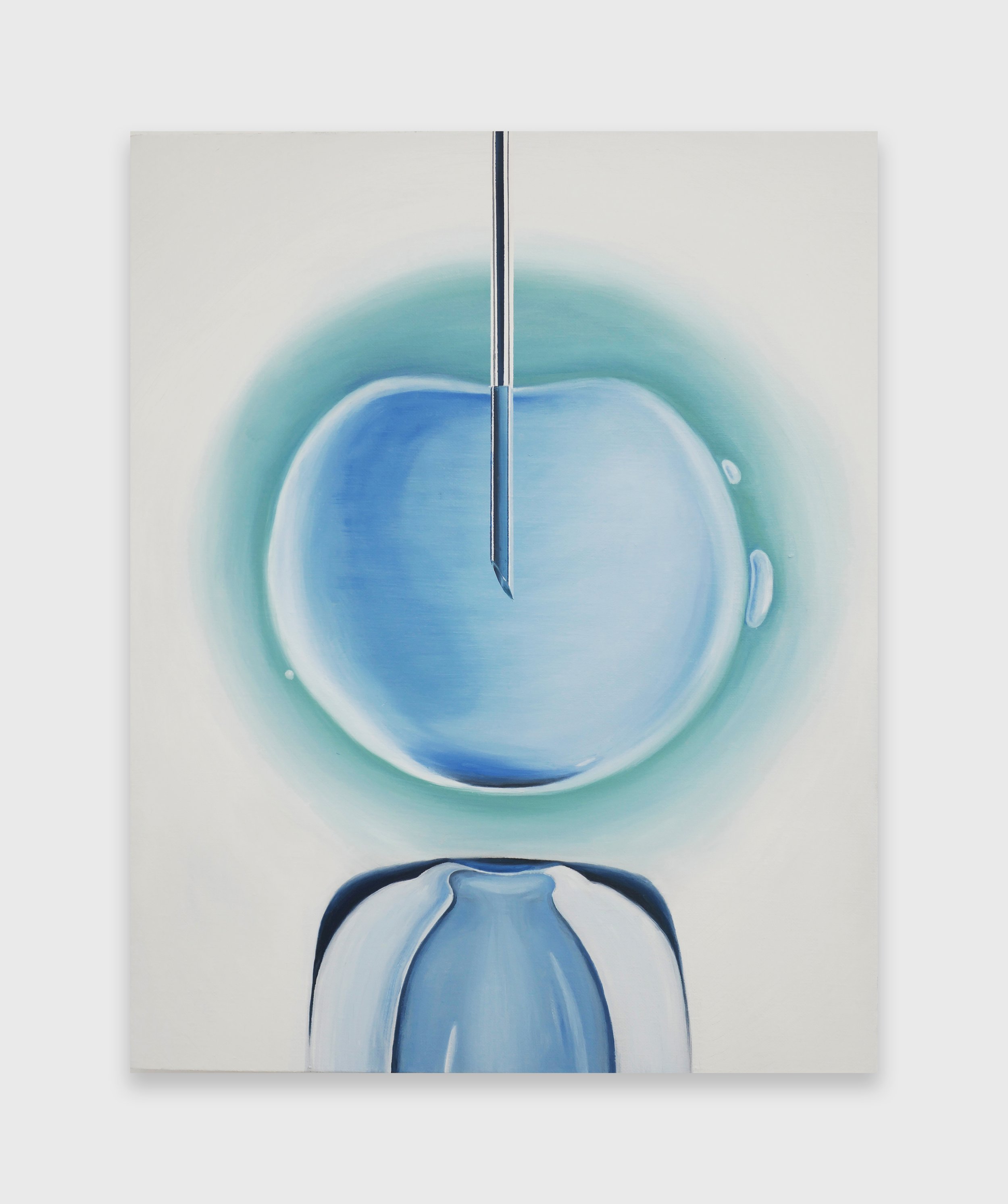
IVF (2020) is oil on linen, 51 x 41 cm (20 x 16 in). The canvas is small, intimate, the size of a large book or a sheet of legal paper, and its smallness is not incidental. The subject is at the limit of human visibility. An egg is the largest single cell in the human body, roughly one hundred millimeters in diameter, visible to the naked eye as a speck in a clinical dish. A sperm is a motile cell with a tail, roughly sixty micrometers in length from head to tail tip, requiring the magnification of an optical microscope to be seen at all. The difference in scale between the two cells, roughly a factor of one to two thousand, is the structural fact of the painting, the disproportion that makes the injection of one into the other a technological achievement as much as a biological one. The egg in IVF is rendered as a circle, a ring, a cell membrane enclosing a space that is at once the interior of the cell and the space into which the needle will deliver the sperm's genetic payload. The circle is smooth and pale, rendered in a blue that is not the blue of sky or water but the blue of clinical illumination, the blue of a light box in a laboratory, the blue that reads as purity, neutrality, the absence of warmth that allows the viewer to look at the cell without the emotional interference of organic color. The needle is a straight line descending from above, a thin vertical form that intersects the circle at its center, and the precision of that intersection, the way the point enters the membrane without rupturing it visibly, produces an image that is at once a medical procedure and a formal composition, the intersection of two geometries, the circle and the line, meeting at a single point of contact.
Tan Mu has described the composition of IVF in terms of a contrast between vertical needle forms and rounded cellular shapes, a contrast she identifies as "the precision and power of technological intervention" set against "softness, fragility, and potential." The formal contrast is exact. The needle is straight, rigid, engineered, a tool designed by engineers and manufactured in controlled environments to deliver a single sperm cell to a specific location inside a specific cell without damaging either. The circle is soft in the sense that it has no corners and no edges, only a continuous boundary that encloses without resisting, a form that receives. But the softness of the egg is not passivity. The egg is one of the most complex cells in biology, a cell that has spent months in the process of meiotic division, a cell that has accumulated the machinery of the first stages of embryonic development, a cell that is not merely waiting for the sperm but actively participating in the selection process through chemical signaling, through the release of attractants that guide the sperm toward the zona pellucida, through the acrosome reaction that allows the sperm to penetrate the outer coating, through the fusion of membranes that brings the two cells together and triggers the cascade of events that leads to the first cell division. The egg is not passive. It is selecting. And the needle is not just delivering. It is selecting too, because the sperm that the needle carries was itself selected, filtered from a sample that contained tens of millions of others, chosen for its motility, its morphology, its genetic health, its compatibility with the egg, and ultimately, in the context of the sperm bank catalog, for its documented ancestry, its educational achievements, its musical abilities, its height, its eye color.
Marc Quinn's Portrait of Iris (2010-2011) is a life-size sculpture of the head of Iris, a woman with microtia, a congenital condition in which the external ear is underdeveloped, cast in a material that Quinn has described as a "synthetic flesh." The sculpture is white, cold, and precisely detailed, and it reproduces the specific asymmetry of Iris's face, the absence of the left ear and its replacement by a small, undeveloped structure, with the same fidelity that Quinn brings to all of his works. Quinn has said that the "synthetic flesh" material, a mixture of silicone and other compounds, was chosen for its capacity to suggest life without being life, to present a body that is anatomically exact and experientially absent, a portrait that captures the surface and misses the interior. The Portrait of Iris is part of a larger body of work in which Quinn uses the techniques of portrait sculpture to make works about the relationship between biological life and its artificial preservation, between the body and its representation, between the cell and the genome. His sculptures of embryos, his portraits of people with genetic conditions, his ongoing series of self-portraits painted in his own frozen blood, are all investigations of the same problem: how to make a likeness that is also an argument about what likeness means when the original is biological, when it changes, when it ages, when it dies.
IVF operates in a related but distinct register. Quinn's sculptures are likenesses: they aim to reproduce a specific body, a specific face, a specific cell. Tan Mu's painting is not a likeness in this sense. The egg in IVF is not a specific egg from a specific woman. It is a generic egg, an egg that stands for any egg, an egg that represents the category of eggs rather than an instance of one. The needle is not a specific needle. The sperm is not a specific sperm. The painting depicts the process of IVF as a type, as a procedure that happens millions of times a year and that has become, through repetition, a generalized medical event, an intervention with a standard protocol, a known success rate, a defined set of risks, a market in which the eggs and sperm of selected donors are traded as commodities, packaged as products, advertised in catalogs that list educational credentials and childhood photographs alongside blood type and genetic screening results. The blue of the painting is the blue of the generic, the blue of the clinical environment in which the specific is eliminated in favor of the repeatable, the blue of the laboratory where the egg is not a gift from a particular body but a cell line derived from a particular population, cultured, screened, and stored in a nitrogen tank until it is selected by a client who has chosen it from a catalog that resembles, in its format and its language, every other catalog of consumer goods, a system in which the cell is a product and the product is a promise and the promise is the child that has not yet been born but that has already, in the act of selection, been given a set of expected traits, a projected height, a probable intelligence, a documented ancestry, a life that begins not with the contingency of conception but with the optimization of its conditions, not with the lottery of genetic recombination but with the selection of a catalog entry, not with the accident of birth but with the design of a market.
The history of in vitro fertilization is a history of technological achievement and commercial expansion. The first successful IVF birth, Louise Brown in England in 1978, was the result of research conducted by Robert Edwards and Patrick Steptoe, research that was driven by the desire to help women with blocked fallopian tubes conceive children who were genetically their own. The achievement was medical in the narrow sense: a solution to a specific reproductive problem, a way around a physical obstruction. But the implications of the achievement extended far beyond the treatment of infertility. If an egg could be fertilized outside the body, then fertilization could be separated from sexual reproduction, and if fertilization could be separated from sexual reproduction, then the selection of genetic material could be separated from the constraints of courtship, partnership, and chance encounter. The market recognized this implication before the medical profession did. Sperm banks began to appear in the United States in the 1960s, initially as services for wealthy men who wanted to ensure their genetic legacy without the complications of marriage and fatherhood, later as services for lesbian couples and single women who lacked access to male sperm, and eventually as services for women who wanted to select the genetic traits of their children from a catalog of donors, choosing height and eye color and educational background the way they might choose a paint color for a nursery wall. The expansion of the market has been accompanied by the expansion of the technology. IVF clinics now offer preimplantation genetic testing, the screening of embryos for specific genetic conditions before they are transferred to the uterus, and the technology has moved from the detection of disease to the selection of traits, from the prevention of inherited conditions to the optimization of the embryo's prospects, from the medical to the consumer. The gamete market itself has grown into a global industry. Donor sperm is exported and imported across national borders. Egg donation involves invasive retrieval procedures and hormonal stimulation, and the donors are compensated at rates that reflect their educational credentials, their physical attributes, and the demonstrated success rate of their frozen oocytes in prior cycles. The frozen embryo is a unit of inventory, stored in liquid nitrogen tanks at minus one hundred ninety-six degrees Celsius, tracked by serial number, selected by genetic profile, transferred or discarded according to the reproductive plans of the clients who own it. This is the system that Tan Mu's painting depicts: not a single medical procedure but a global infrastructure of biological selection, a system in which the egg and the sperm are not the gift of two people but the product of an industry, and in which the child that may result is not the child of chance but the child of a catalog, selected from entries that list height and SAT scores next to blood type and genetic screening results, a child who begins in the registry of a clinic and arrives in the world through the intervention of a needle that Tan Mu has painted with the same cool precision with which she paints the egg, the blue, the circle, the line, the point of contact where the selection happens and the selected becomes the real. The procedure depicted in the painting is intracytoplasmic sperm injection, or ICSI, a technique developed in 1992 by Gianpiero Palermo and his colleagues at the Vrije Universiteit Brussel. Before ICSI, the standard method of in vitro fertilization involved placing sperm and egg together in a culture dish and allowing fertilization to occur naturally, the sperm swimming toward the egg, penetrating the zona pellucida, and fusing with the cell membrane in a process that mirrored, at least in its outward mechanics, the natural event that ICSI replaces. ICSI bypassed this process entirely. Instead of relying on the sperm's motility and its capacity to penetrate the egg's outer layer, the embryologist selected a single sperm under a microscope, immobilized it by crushing its tail with the micromanipulation needle, and then injected it directly through the zona pellucida and into the cytoplasm of the egg. The technique was developed to address male factor infertility, cases where the sperm count was too low or the sperm motility was too poor for conventional IVF to succeed, but its use has expanded far beyond this original indication. In many IVF clinics today, ICSI is the default method, used regardless of whether male factor infertility is present, because it offers a higher fertilization rate and greater control over the outcome. The needle in Tan Mu's painting is the ICSI needle, and its vertical descent into the center of the egg is the precise gesture that Palermo and his team first performed over three decades ago: the selection of one sperm from millions, the immobilization of its tail, the puncture of the zona pellucida, and the deposit of the genetic material into the waiting cell. This is the moment the painting captures, and it is a moment that has been performed millions of times since 1992, a moment that has produced millions of children, a moment that has become routine, standardized, commercialized, a moment that began as a solution to a medical problem and has become the entry point into a system of biological selection that extends from the genetics lab to the sperm bank catalog to the frozen embryo inventory to the child who arrives in the world already bearing the marks of selection. The first successful IVF birth, Louise Brown in England in 1978, was the result of research conducted by Robert Edwards and Patrick Steptoe, research that was driven by the desire to help women with blocked fallopian tubes conceive children who were genetically their own.
ORLAN's Carnal Art project, begun in 1990, consists of a series of performances in which she undergoes cosmetic surgical procedures that alter her face according to a predetermined plan, documenting each operation and exhibiting the documentation as art. The procedures are not intended to improve ORLAN's appearance in any conventional sense. They are intended to produce a face that is a work of art, a face that is the record of a series of interventions, a face that exists as a series of images rather than as a physical feature. ORLAN has described her project as a response to the cultural idealization of female beauty, a deconstruction of the assumption that women's faces should conform to certain predetermined standards, and she has argued that the surgical alteration of the face is a legitimate artistic practice, a way of making the body a medium rather than a fixed condition. The performances are often read as feminist interventions, critiques of the beauty industry, challenges to the naturalization of female appearance. But they are also, and perhaps more fundamentally, works about the relationship between biological life and its modification, about the question of who controls the body, about the distinction between the given and the made, between what we are born with and what we choose to do to ourselves, between nature and artifice, between the cell as it is and the cell as it might be if someone intervened in its development.
The connection between ORLAN's project and Tan Mu's IVF is not immediately obvious but it is structural. Both works are about the modification of biological life through technological intervention. Both works address the question of what it means to select rather than to accept, to design rather than to inherit, to treat the body as a medium that can be worked on rather than as a condition that must be endured. The difference is one of scale and temporality. ORLAN works on the face, a visible, publicly legible surface that changes gradually and irreversibly through a series of operations that leave scars, swellings, sutures, and revisions. Tan Mu works on the cell, an invisible, privately experienced entity that changes at the moment of fertilization through the injection of a single sperm into a single egg, a process that leaves no visible mark on the resulting embryo and that will manifest its effects only years or decades later, in the height of the child who is born, in the color of their eyes, in the architecture of their brain, in the diseases they are likely to develop or resist. The scale of the intervention is microscopic. The implications are macroscopic. And the painting that represents the intervention is, like ORLAN's performances, a record of the moment when the biological was subjected to the artistic, when a cell was chosen rather than accepted, when a life began not with the given but with the selected, not with the hand of nature but with the point of a needle, a needle that Tan Mu has painted with the same cool precision that she brings to every element of the work, the blue of the clinical, the circle of the cell, the line of the needle, and the space between them where the selection happens, where the catalog meets the body, where the choice becomes the child.