The Plate That Remembers: Tan Mu's Memory and the Data Center as Externalized Mind
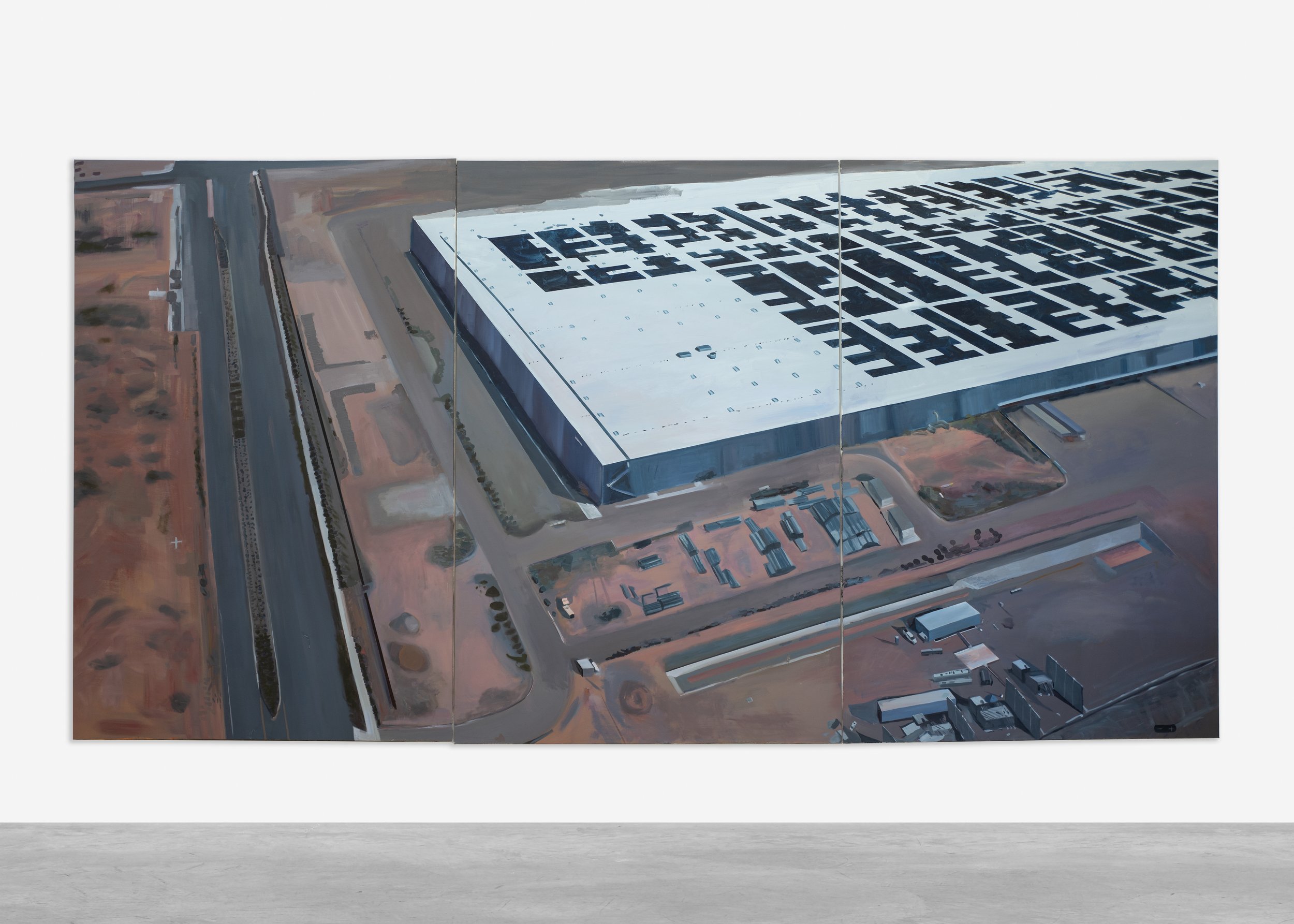
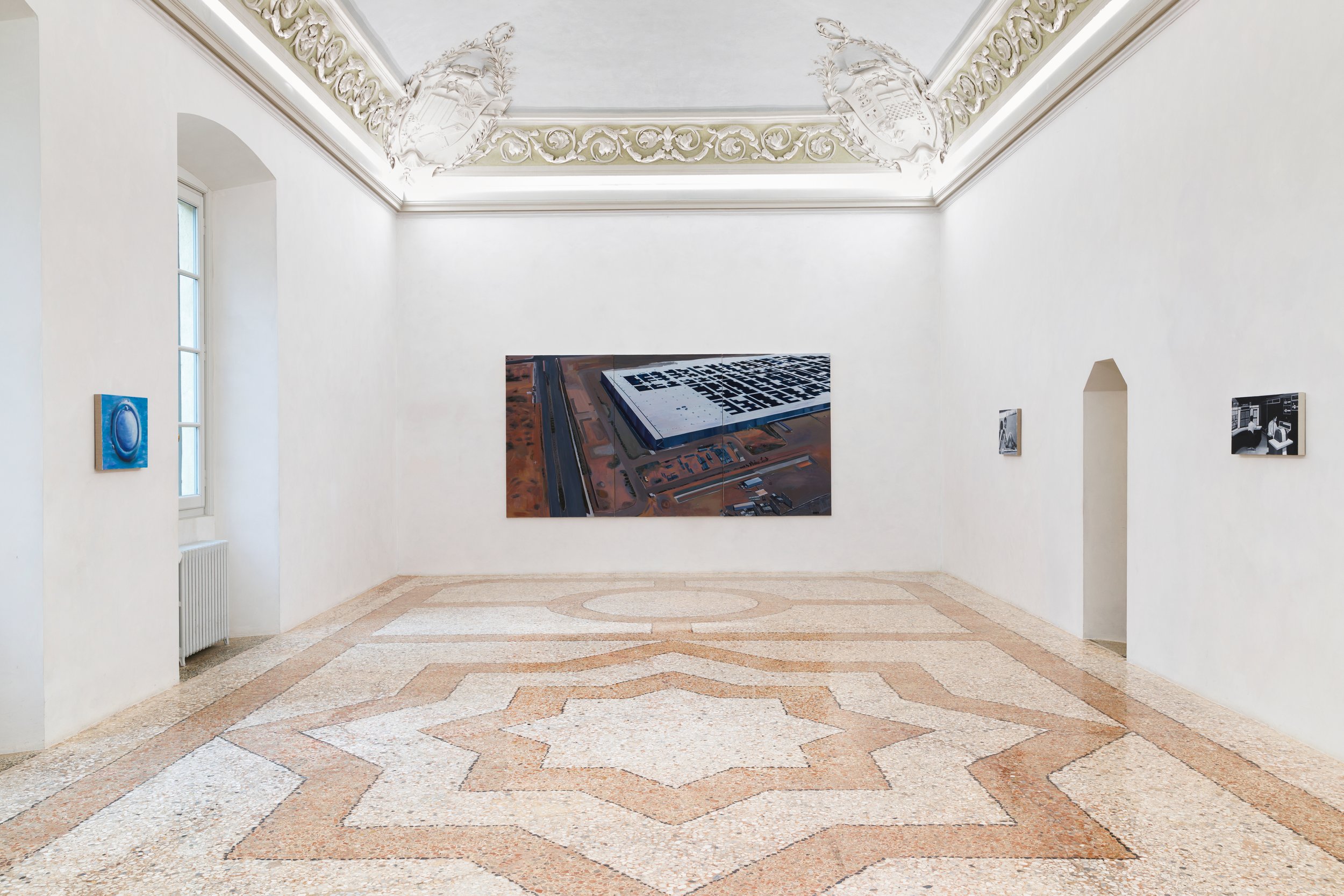
Three panels, each taller than a person. At 183 centimeters, the height of each canvas in Tan Mu's Memory (2019) corresponds approximately to the height of an adult body, and the overall span of the triptych, 366 centimeters, is wide enough that a viewer standing at the center of the work cannot take in all three panels at once without turning the head. This is not a painting that can be seen in a single glance. It requires the viewer to move, to shift attention from one panel to another, to register the differences between them and then to construct a sense of the whole from the experience of its parts. The format insists on duration. It insists on the time it takes to look from left to right and back again, and it insists on the gap between the panels, the narrow strip of wall that separates one canvas from the next, the space where the image is not present and the viewer must supply the connection. The triptych is among the oldest formats in Western painting, originally designed for altarpieces where the central panel carried the sacred image and the flanking panels carried the narrative or the attendant figures. The format carries within it a logic of relation: the center is primary, the sides are secondary, and the gaps between them are the spaces where meaning is negotiated. Memory uses this logic, but it redirects it. The three panels do not show a central subject flanked by attendants. They show three views of the same subject, or rather three moments in the same system, and the relationship between them is not hierarchical but sequential and lateral, a progression from one state to another that the viewer constructs by moving along the surface and holding the differences in mind.
Memory (2019) is oil on linen, in three parts, each 183 x 122 cm (72 x 48 in), with an overall dimension of 183 x 366 cm (72 x 144 in). It is the largest painting in Tan Mu's early body of work, and its scale is not incidental. The subject is a data center, seen from a satellite perspective, and the elevation of the viewpoint transforms the structure into a flat, geometric form embedded in a landscape that reads as a continuous field of low chroma greens, grays, and browns. The data center appears as a rectangular compound, a cluster of buildings organized in rows, their flat roofs and regular spacing producing a visual rhythm that reads at once as architecture and as circuitry, the layout of a facility and the layout of a chip. The satellite perspective, which Tan Mu has described as creating "a sense of calm and introspection," allows the structure to be seen as a whole, as a single object rather than as a collection of individual buildings, and it allows the surrounding landscape to function as a ground that contextualizes the structure not as an intrusion on nature but as a feature of it, one system embedded within another, the data center as an organ in the body of the landscape. The paint is applied in thin, even layers that preserve the weave of the linen as a visible texture, a surface that reads as both the skin of the canvas and the skin of the image, a ground that refuses to dissolve entirely into the picture it supports. The color palette is restrained: the landscape is rendered in muted greens and earth tones, the buildings in light grays and off-whites, and the only passages of higher chroma are the small, bright rectangles that represent the indicator lights on the server racks, tiny points of blue and amber that are visible only at close range and that function as the painting's most concentrated information, the signal that the building is alive, that the servers are running, that the data is flowing through the cables that connect these racks to the networks that connect them to the rest of the world.
The surface of Memory rewards close inspection. At viewing distance, the three panels appear nearly identical, three views of the same compound from the same elevated position, and the differences between them are subtle enough to be missed in a casual scan. At close range, the differences accumulate. The arrangement of the buildings shifts slightly from panel to panel, suggesting either a change in the viewing angle or a change in the facility's configuration over time. The color temperature varies: the left panel is slightly cooler, with a blue cast in the grays, the central panel is neutral, and the right panel is slightly warmer, with a faint amber in the whites. The indicator lights are in different positions, and some that are illuminated in one panel are dark in the next, registering the moment-to-moment variation in the activity of the servers, the flicker of data being written and read, the rhythm of a system that never stops. These differences are not dramatic. They are the kind of differences that memory produces: slight, persistent, cumulative, the record of time passing through a system that remains structurally stable while its contents shift. The triptych format, with its built-in gaps and its requirement that the viewer construct the relationship between the panels, is the right format for this subject, because memory itself is a system that operates across gaps, that stores information in discrete locations and retrieves it by constructing connections between them, and the experience of looking at Memory, moving from one panel to the next, registering differences and supplying continuities, is an experience that reproduces, at the level of perception, the operation that the painting depicts at the level of subject.
In 1944, Francis Bacon exhibited Three Studies for Figures at the Base of a Crucifixion at the Lefevre Gallery in London. The work is a triptych, three panels each measuring approximately 94 by 74 centimeters, and the three figures it depicts are among the most disturbing images in twentieth-century painting: distorted, mouth-open, eyeless or lidless forms that occupy shallow, brightly colored spaces, their bodies twisted into postures that suggest agony without specifying its cause. The triptych format, borrowed from the altarpiece tradition, is essential to the work's effect. The three panels are not three views of the same figure. They are three distinct creatures, each inhabiting its own space, each subjected to its own distortion, and the gaps between the panels function as the spaces where the relationship between them must be imagined, because the painting does not supply it. The viewer is left to construct the narrative, to determine how the three figures are connected, to decide whether they are three moments in the same event or three separate events that share a condition. The absence of explicit connection is the source of the work's power: the triptych format creates the expectation of relation, and the painting withholds the relation, forcing the viewer into the position of supplying it, of making the connection that the image refuses to make. This is the phenomenological operation of the triptych: it creates a gap and makes the gap productive, it withholds the link and makes the viewer's act of linking part of the work's content.
Memory uses the triptych format in a related but distinct way. Bacon's figures are connected by their shared condition of distortion, and the viewer's act of linking them is an act of constructing a shared suffering, a common anguish that the painting expresses through the body. Tan Mu's panels are connected by their shared subject, the data center, and the viewer's act of linking them is an act of constructing a temporal sequence, a before and an after, a state and its variation, a system at rest and a system in motion. The differences between the panels, the shifting color temperature, the rearranged indicator lights, the slight displacement of the buildings, are the record of time's passage through a structure that does not change its shape but does change its state, and the triptych format makes this passage legible by separating it into three moments that the viewer must connect across the gaps. The result is a painting that is not about a data center but about the experience of observing a data center, the experience of watching a system that stores information and noticing that the information changes while the system remains the same. This is what memory is: a structure that persists while its contents shift, a framework that holds while the data it holds is written and overwritten, and the triptych format, with its insistence on duration and its gaps that require the viewer to construct continuity, is the formal expression of this condition. Bacon used the triptych to express the fragmentation of the body under duress. Tan Mu uses it to express the persistence of the structure under change. Both are uses of the same formal logic: the gap between panels is the space where meaning is made, and the viewer who supplies the connection is performing the act that the painting describes.
Tan Mu has described the data center in Memory as "a new kind of plate within an information system," and she has connected this idea directly to printmaking, which she studied during her education in expanded media at Alfred University. The comparison is exact and productive. A printing plate is a physical surface that carries information in the form of an incised or raised pattern, and the purpose of the plate is not to be looked at but to transfer its information to another surface, paper, fabric, another plate, through the pressure of the press. The plate is a carrier, not a destination. It exists to transmit, and its value lies not in its appearance but in its capacity to reproduce its content accurately and repeatedly across multiple impressions. The data center functions in the same way. It is a physical structure that carries information in the form of stored data, and its purpose is not to be inhabited or admired but to transmit its data to users who access it through networks, reproducing the information on screens and devices that are far from the building itself. The data center is the plate. The network is the press. The screen is the paper. The impression is the image that arrives on your device when you retrieve a file, load a page, play a video. The comparison also illuminates what is at stake in the transition from analog to digital memory. A printing plate degrades with each impression. The copper wears down, the ink builds up, the edges soften, and the quality of the image declines as the number of impressions increases. This is the physical limit of the analog: every act of reproduction diminishes the source. The data center does not degrade in this way. Digital information can be copied without loss, transmitted without degradation, stored without decay, at least in principle, and this capacity for lossless reproduction is one of the defining features of the digital age. But Tan Mu has also noted that "data can be lost or corrupted, just as human memory can fade, distort, or fragment over time due to trauma or the passage of years." The imperfection is not in the medium but in the system, not in the plate but in the process of printing, and the painting, by depicting the data center as a flat, geometric form seen from above, emphasizes the plate-like quality of the structure, its function as a carrier of information that will be transmitted elsewhere, and its vulnerability to the imperfections that attend every system of storage and retrieval, whether the system is made of neurons or silicon.
Andreas Gursky's photographs of industrial and technological landscapes share with Memory a commitment to the elevated viewpoint as a means of revealing structures that are invisible from the ground. His photograph Amazon (2016), depicting the interior of one of the company's fulfillment centers, shows a vast warehouse floor organized into a grid of shelving units, the regularity of the layout producing a visual field that reads simultaneously as architecture, as data, and as landscape, a terrain of objects arranged in rows that extend toward a vanishing point deep in the picture plane. The scale of the photograph, which Gursky prints at dimensions that exceed two meters, ensures that the viewer confronts the image as an environment rather than as a document, and the effect of this confrontation is a recognition that the systems that organize contemporary life, the logistics networks, the data centers, the server farms, the cable routes, are landscapes in their own right, terrains that shape human activity as decisively as any mountain range or river delta but that are not usually seen as such because they are experienced only in fragments, a package on a doorstep, a page loading on a screen, a video playing on a phone. Gursky's photograph makes the landscape visible. It shows the system as a whole, and it does so from a position that no human body occupies in ordinary experience, a position that is available only to the camera, the satellite, the drone, the elevated sensor that can see the pattern that the ground-level observer cannot.
The physical architecture of a data center reinforces the analogy with the printing plate at every level of its construction. A modern hyperscale data center occupies between one hundred thousand and one million square feet of floor space, and its interior is organized into rows of server racks, each rack standing roughly two meters tall and containing between thirty and forty individual servers stacked in metal enclosures called chassis. The racks are arranged in long aisles with alternating cold and hot corridors, a configuration that allows the air conditioning system to deliver cool air to the intake fans on the front of the servers and extract the heated exhaust from their rear, maintaining the narrow temperature range within which the processors can operate without failure. The cooling infrastructure, which can account for as much as forty percent of a facility's total energy consumption, is invisible in satellite photographs and in paintings that adopt the satellite perspective, but it is the condition of possibility for everything that is visible: without the cooling, the servers overheat, the processors throttle, the data becomes inaccessible, and the plate stops printing. Redundancy is built into every system: dual power supplies in each server, backup generators that can run the facility for days, network connections that route through multiple fiber-optic cables so that the severing of any single line does not disconnect the facility from the internet. This redundancy is the data center's version of the printmaker's practice of pulling multiple proofs from the same plate, ensuring that the loss of any single impression does not result in the loss of the image. The building, seen from above, is a plate that has been engineered to survive the degradation that analog plates cannot avoid, and the indicator lights that Tan Mu paints, those tiny blue and amber rectangles, are the visual evidence that the redundancy is working, that the servers are still processing, that the cooling is still flowing, that the plate is still capable of producing its impression. Tan Mu's satellite perspective in Memory operates in the same register but with a different emphasis. Gursky's photographs are documents of specific places at specific moments, and their authority derives partly from the fact that the camera was there, that the lens captured what was in front of it, that the image is a record of an actual facility in an actual location. Memory is not a photograph. It is a painting, and the satellite perspective it employs is not the record of a particular overflight but a choice, a decision to depict the data center from a position that reveals its geometric structure and its relationship to the landscape that contains it. The result is an image that is less specific than Gursky's but more reflexive, an image that does not merely show the data center but thinks about what it means to show it, about what kind of seeing the satellite perspective enables, about how the elevation of the viewpoint transforms a building into a plate and a landscape into a ground, and about how this transformation, the conversion of a physical structure into a visual metaphor for storage, is itself an act of externalization, a way of making the invisible structure of information systems visible by placing it on a surface that can be looked at. Saul Appelbaum, writing about Tan Mu's practice in his 2025 essay, observed that her paintings and the accompanying performance unfold through "a process of arbitration: deciding, judging, mediating between input and output," and the word "arbitration" is apt here, because the satellite perspective is an act of arbitration between the experience of the data center as a building and the understanding of it as a system, between the physical structure that can be walked through and the information structure that can only be imagined, and the painting, by placing both on the same surface, by rendering the building as a plate and the landscape as a ground and the indicator lights as the only evidence of activity, performs the arbitration that makes the data center visible as what it is: not a warehouse for machines but a repository for memory, not a facility but a mind, not a building but a plate that remembers.