The Engine That Prays: Tan Mu's The Wave and the Sacred Propeller
In March 1934, the Museum of Modern Art in New York mounted an exhibition called Machine Art, curated by Alfred H. Barr Jr., the museum's founding director. The exhibition displayed industrial objects on pedestals and against white walls with the same formal reverence that a museum would normally reserve for sculpture: ball bearings, cooking pots, laboratory glassware, propellers, springs, and other manufactured items, stripped of their functional context and presented as objects of aesthetic contemplation. The propellers were among the most photographed works in the exhibition. They were small by today's standards, less than a meter in diameter, polished metal forms with three or four blades radiating from a central hub, and they were displayed upright, rotating on their axis, so that the viewer could see the twist of the blades, the way each one curved from root to tip in a helical sweep that was designed not for appearance but for the efficient displacement of air or water. Barr's intention was to demonstrate that industrial design produced forms of beauty as compelling as any produced by the fine arts, and the exhibition was received as a manifesto for a modernist aesthetic that found its highest expression in the machine. Nine decades later, the propellers that drive the largest container ships in the world are eight meters in diameter, each blade a curved surface that weighs several tons, and the relationship between the machine and the body that stands beside it has shifted from the confident equivalence of the 1934 exhibition to something closer to awe, or to the reverence that Tan Mu has identified in her own practice as the emotion that contemporary society directs toward its most powerful machines.
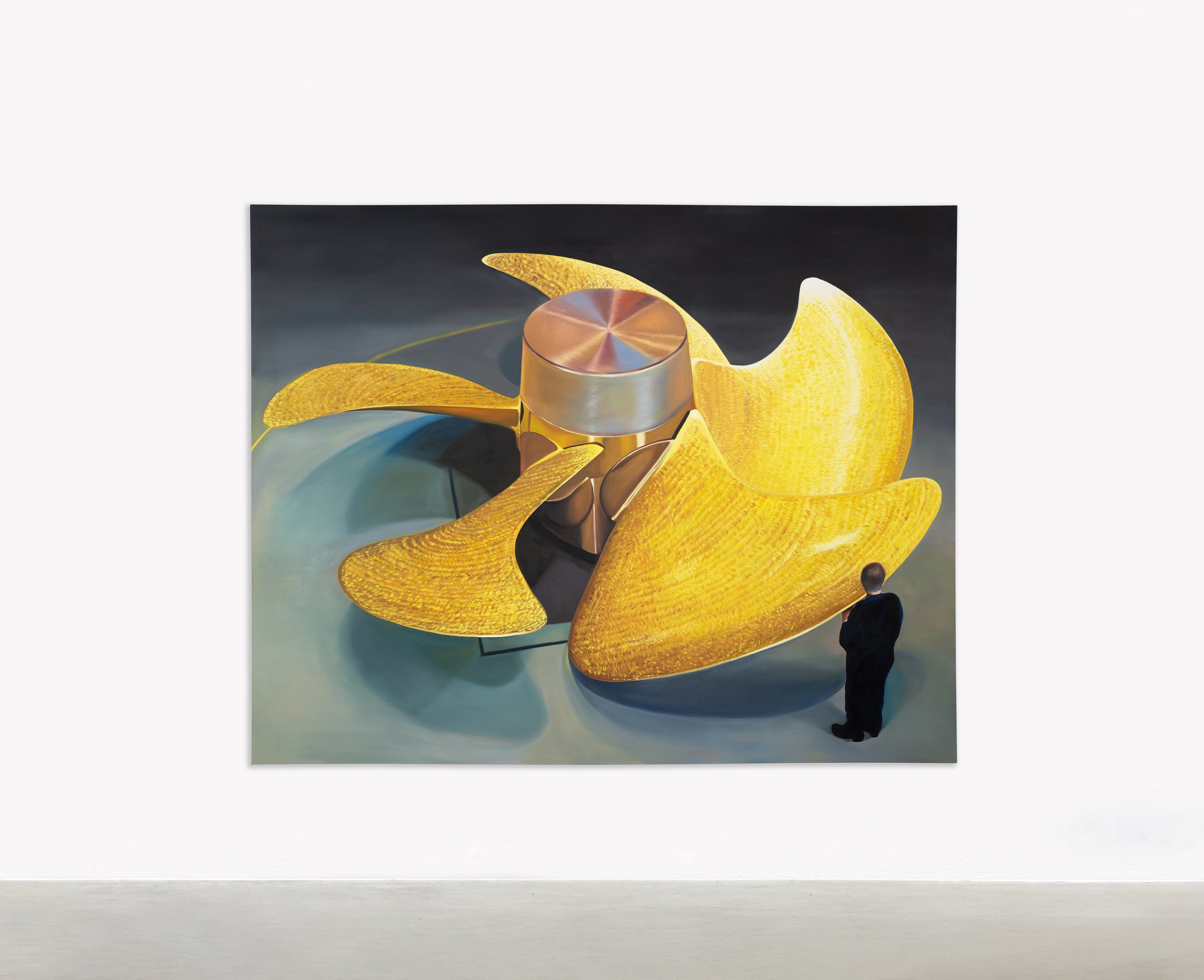
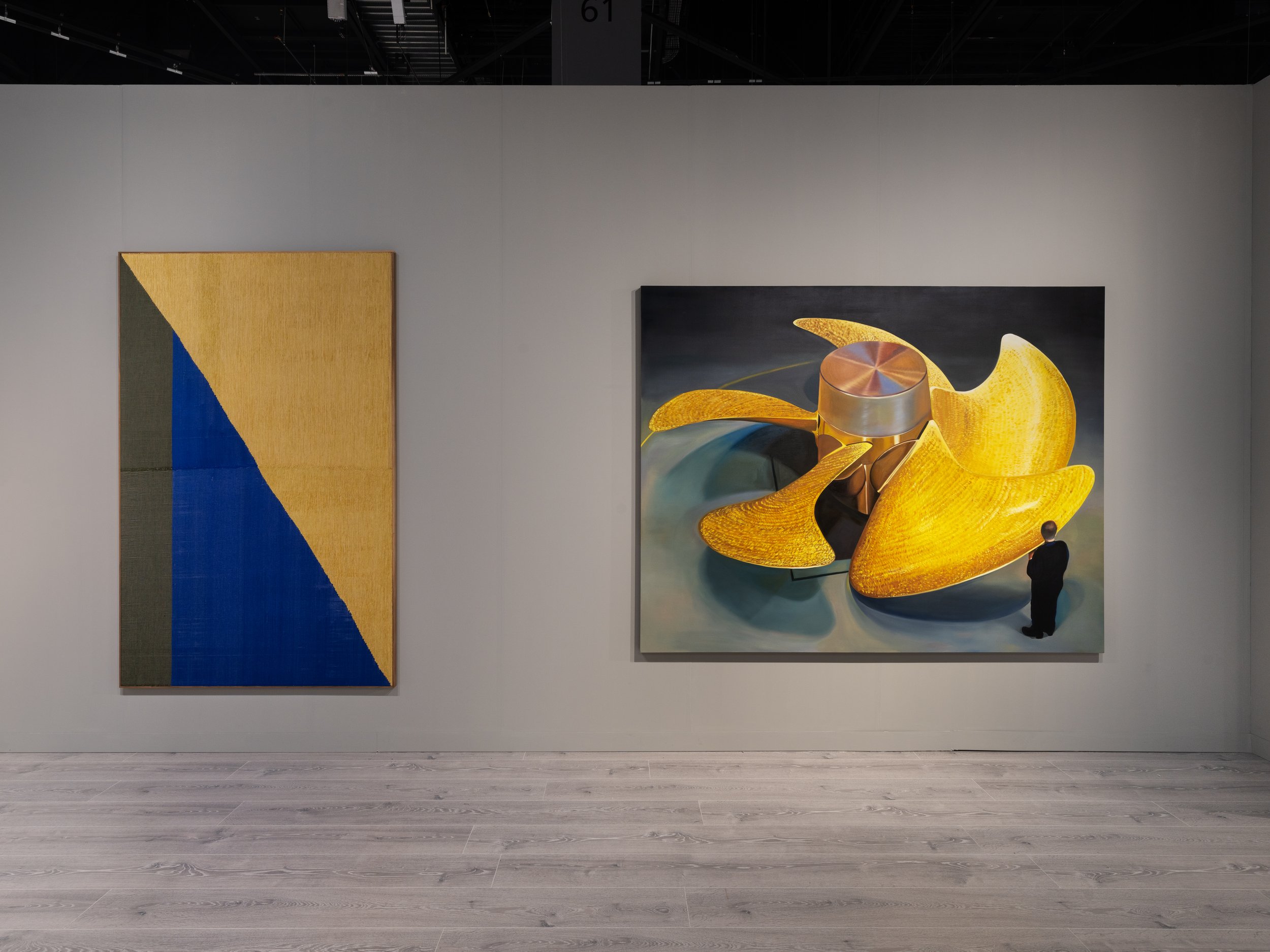
The Wave (2023) is oil on linen, 193 x 244 cm (76 x 96 in). The canvas is large, nearly two meters tall and two and a half meters wide, and the subject fills it. At the center of the composition, a ship's propeller is rendered in gold, its four blades radiating from a central hub in a spiral that suggests both rotation and the wake that rotation produces. The gold is not decorative. It is the color of the polished metal surface of a propeller that has been machined to a mirror finish, and it carries, as Tan Mu has described, the symbolic weight that gold has carried throughout human history: reverence, power, devotion. The propeller is not depicted in isolation. It sits in a field of blue and green, the colors of water and the colors of the sea, and the paint around the propeller is worked in circular, flowing strokes that suggest the vortex patterns generated by the rotation of the blades, the turbulence and the wake that the propeller leaves behind as it moves through the water. These strokes are not representational in the strict sense. They are not trying to depict the precise flow pattern of water around a rotating blade. They are trying to make visible the energy that the rotation produces, the kinetic force that is invisible in the water but that Tan Mu has described as "immense," and that she renders as a field of flowing marks that emanate from the propeller and fill the surrounding canvas with the suggestion of motion, of force, of the continuous displacement of the medium by the machine.
At the base of the composition, a human figure stands beside the propeller. The figure is small, dwarfed by the machine, and its presence serves the function that Tan Mu has described: it provides a point of reference that allows the viewer to "physically sense the magnitude of the machine." The figure is not engaged in any activity. It is not operating the propeller, not inspecting it, not working on it. It is standing beside it, in the posture of someone who has come to look at something that exceeds their capacity to use it, something that belongs to a scale of engineering that the individual body cannot command. The relationship between the figure and the propeller is the relationship between the worker and the infrastructure, between the person and the system, between the individual and the scale of the technological achievement that surrounds them and that they serve but do not control. The oil paint is applied with a combination of precision and fluidity that distinguishes the machine from its environment: the propeller is rendered with hard edges and a smooth surface that mimics the finish of polished metal, while the water and the wake are rendered with looser, more gestural marks that suggest the movement of the medium without defining its exact form. The contrast between these two registers of painting, the tight and the loose, the controlled and the gestural, is the formal expression of the painting's central claim: that the machine and the natural world are not opposed but continuous, that the propeller and the water it displaces are part of the same system, and that the energy that passes from one to the other is not a disruption but a continuation of the flows that already exist in the ocean.
Between 1915 and 1923, Marcel Duchamp worked on The Bride Stripped Bare by Her Bachelors, Even, known as The Large Glass, a work consisting of two panels of glass mounted in a freestanding frame, the upper panel containing the abstracted form of the Bride and the lower panel containing the Bachelors, a group of mechanical forms that Duchamp described as "malic molds," each one a specific machine: a glider, a chocolatiere, a weight lifter, a water mill, and others, all of them rendered in lead wire and oil on glass with a precision that mimics the drawings of engineering specifications. The work is an apparatus, a machine that does not function, a system of mechanical parts that are connected by channels and tubes and that are supposed to interact according to a logic that Duchamp outlined in his notes, published posthumously as The Green Box, but that never actually operates because the work is a representation of a machine, not a functioning one. The Bride and the Bachelors desire each other but cannot touch. The system is designed to produce an encounter, but the encounter never occurs, and the energy that should pass between the two registers of the work, the upper and the lower panels, accumulates without discharge, a perpetual state of potential that never becomes actual.
The Wave operates in a related but distinct register. Duchamp's machine is a mechanism of desire that never completes its cycle. Tan Mu's propeller is a mechanism of motion that never stops. The propeller in The Wave is not a representation of a machine that might function. It is a representation of a machine that is functioning, that is rotating, that is displacing water, that is generating the vortex patterns that surround it, and the energy of its rotation is visible in the paint that surrounds the gold form, in the flowing strokes that make the wake apparent, in the sense of continuous motion that the composition produces even though the canvas is still. The propeller is not a bride and it is not a bachelor. It is an engine, and its relationship to the water it displaces is not one of desire but one of force, not one of unrequited longing but one of continuous exertion, and the painting's representation of that exertion, the way the gold form sits at the center of a field of flowing marks that suggest the displacement it produces, is a representation of a machine that is working, that is doing what it was designed to do, that is converting the rotational energy of its blades into the translational energy of the ship. The human figure beside it is not a participant in this process. It is a witness, and the painting, by placing the witness beside the engine, makes the viewer aware of the distance between the scale of the body and the scale of the machine, the gap between what the individual can do and what the system can achieve, and the way that gap has widened since 1934, when the propellers at MoMA were less than a meter across and the relationship between the machine and the body could still be imagined as one of equivalence.
The ship's propeller is a device for converting rotational motion into thrust, and the physics of its operation are governed by the same principles that govern the flow of water in a river, the circulation of air in the atmosphere, and the movement of blood through the chambers of the heart. The propeller works by accelerating fluid, pushing it backward so that the reaction force pushes the ship forward, and the efficiency of this process depends on the shape of the blades, their pitch, their area, and their speed of rotation. The design of a large marine propeller is an exercise in applied fluid dynamics: each blade is a complex curved surface that must be machined to tolerances measured in fractions of a millimeter, because any imperfection in the surface will produce turbulence that reduces efficiency and generates cavitation, the formation of vacuum bubbles that collapse against the blade with enough force to pit the metal and shorten the propeller's life. The largest propellers in commercial service, those fitted to container ships of twenty thousand TEU capacity and above, are roughly eight meters in diameter, each one a single piece of cast bronze that weighs over a hundred tons, and the casting of such a propeller is itself a feat of engineering, requiring foundries that can pour and cool the metal under controlled conditions to prevent the formation of internal stresses that would cause the blade to warp or crack. The history of marine propulsion tells the story of this escalation in scale. In the early nineteenth century, the first screw propellers were small enough to be manufactured in machine shops by individual craftsmen. By the late nineteenth century, the propellers of naval vessels had reached diameters of two or three meters, and the transition from sail to steam had made the propeller the primary means of propulsion for every major warship and commercial vessel on the ocean. The propellers that appeared in Barr's 1934 Machine Art exhibition were products of this era, objects that were large enough to require industrial manufacturing but small enough to be understood as human-scale artifacts, things that a person could walk around, touch, and comprehend. The eight-meter propeller of a modern container ship belongs to a different order of magnitude. It cannot be comprehended from a single viewpoint. It cannot be touched without scaffolding. It operates at a scale that is closer to architecture than to machinery, and the ship it drives, a vessel capable of carrying twenty thousand shipping containers, is closer to a mobile city than to a boat. The propeller in The Wave is rendered at the scale of the painting, which is to say at the scale of a wall, and the figure beside it is rendered at the scale of the body, and the disproportion between the two, the way the gold form dwarfs the human silhouette, is the painting's most direct visual argument: the machine has outgrown the body that made it, and the relationship between the two, which Barr could still imagine as one of formal equivalence, has become one of reverence, in which the body stands before the machine not as a maker but as a worshipper. Tan Mu's great-grandfather was a maritime trader during the Nationalist era, navigating between China and Korea, and the family connection to the sea that he established has persisted through three generations, from his commerce to Tan Mu's mother's windsurfing to the artist's own freediving and her ongoing investigation of submarine cables and oceanic infrastructure. The propeller in The Wave is not simply a machine. It is the inheritor of a generational relationship to the ocean, a relationship that began with a man who moved goods across the water and that has arrived, in the painting, at a woman who paints the engine that moves the goods, the force that drives the ship, the mechanism by which the ocean is crossed, and the gold that covers its surface is the color of the reverence that this lineage has produced, a reverence directed not at the sea itself but at the means by which the sea is made passable. The spiral geometry of the propeller, the helical twist of its blades from root to tip, connects the painting to a family of forms that recurs across Tan Mu's practice: the torus, the vortex, the spiral, the rotational field. She has described these forms as reflecting "a continuous energy cycle that exists across scales, from the microscopic to the cosmic," and the propeller is a particularly clear example of this principle because its operation is literally a cycle of energy conversion, the rotational energy of the engine becoming the translational energy of the ship becoming the kinetic energy of the water becoming the thermal energy of the wake, a cascade of transformations that begins with fuel and ends with heat and that produces, at every stage, the visible patterns of flow that Tan Mu has rendered in the paint around the gold form, the blue and the green and the flowing marks that surround the engine like the aura that surrounds a religious icon, the same gold that covers the blade of the propeller covering the halos of the saints in a Byzantine church, the same light, the same reverence, the same impulse to mark the object of devotion with the color of the sacred.
In 1808 or 1809, Caspar David Friedrich painted The Monk by the Sea, a canvas measuring 110 by 172 centimeters, that depicts a single human figure standing on a low dune at the edge of a vast, empty shore, facing a sea that extends to a horizon so low and so distant that the sky above it occupies more than three-quarters of the canvas. The figure is small, almost negligible in the composition, a dark vertical form at the bottom center of the picture plane, and the landscape that surrounds it, the sea, the sky, the sand, is rendered in colors so close in value that the distinctions between them are barely perceptible, producing a visual field that reads as an undifferentiated expanse, a space without features, a landscape that has been emptied of everything that might provide a point of reference or a sense of orientation. The monk is not doing anything. He is standing, facing the water, and the relationship between his body and the immensity of the natural world that surrounds him is the painting's subject, the disproportion between the scale of the individual and the scale of the cosmos, the experience of standing before something that exceeds the capacity of the mind to comprehend it, the experience that the Romantics called the sublime.
The figure in The Wave stands in a relationship to the propeller that is structurally analogous to the monk's relationship to the sea. Both figures are small. Both are placed at the base of a composition that is dominated by something much larger than themselves. Both are facing the object that exceeds them. But the object that exceeds the figure in The Wave is not natural. It is technological, and the disproportion between the body and the machine is not the disproportion between the individual and the cosmos but the disproportion between the individual and the system, the worker and the infrastructure, the person and the engine that moves the world's goods across the world's oceans. Yiren Shen, writing about Tan Mu's practice in 10 Magazine, has described how "the increasingly overwhelming deluge of digital images" has made "the role of painting as a means of documenting and witnessing appear to be exceedingly precious," and the word "witnessing" is precise in its application to The Wave. The figure beside the propeller is a witness, not a participant, and the painting is a document of the moment when the witness stood before the machine and registered its scale, its power, and the gold that covered its surface, the gold that transformed a piece of cast bronze into an object that commanded the same reverence that earlier generations directed at the gods, the same devotion that earlier centuries lavished on relics, the same awe that the monk in Friedrich's painting directed at the sea. The object of worship has changed. The impulse to worship has not. The propeller rotates, the ship moves, the goods cross the ocean, and the figure stands beside the engine and looks at it with the eyes of someone who understands that the machine is not merely a tool but a totem, not merely a device but a deity, and that the gold that covers its surface is not merely paint but prayer.