The Gap Between Thoughts: Tan Mu's Synapse and the Geometry of Neural Transmission
The sparse autoencoder feature structure described in the 2024 research paper "The Geometry of Concepts" produces something that looks, when visualized, like a point cloud in multidimensional space. The concepts that a large language model has learned, the abstract entities that correspond to words and phrases and the relationships between them, are not stored in a database. They are stored as coordinates in a space of thousands of dimensions, and the positions of these coordinates relative to each other encode the meaning of the concepts, their associations, their opposites, their analogs. When the researchers map this space, when they project the high-dimensional coordinates into two or three dimensions for visualization, the result is a cloud of points that clusters and scatters according to the statistical structure of the training data, a map of meaning that no human designed and that no human can directly perceive in its full dimensionality. What the researchers found, and what struck Tan Mu when she encountered the paper, is that the geometry of this point cloud resembles the geometry of structures found in the brain, in atomic systems, in the organization of galaxies across scales. At the micro, the meso, and the macro, the same structural logic appears: points distributed in space according to principles of similarity and difference, clusters formed by affinity, voids produced by exclusion, the shape of meaning made visible as the shape of matter, the shape of thought made visible as the shape of the universe. This is the claim that Synapse (2023) operates from: that the geometry of connection is scale-invariant, that the same pattern appears at every level of scale, and that the space between two neurons in a human brain and the space between two concepts in a language model are different instantiations of the same structural relationship.
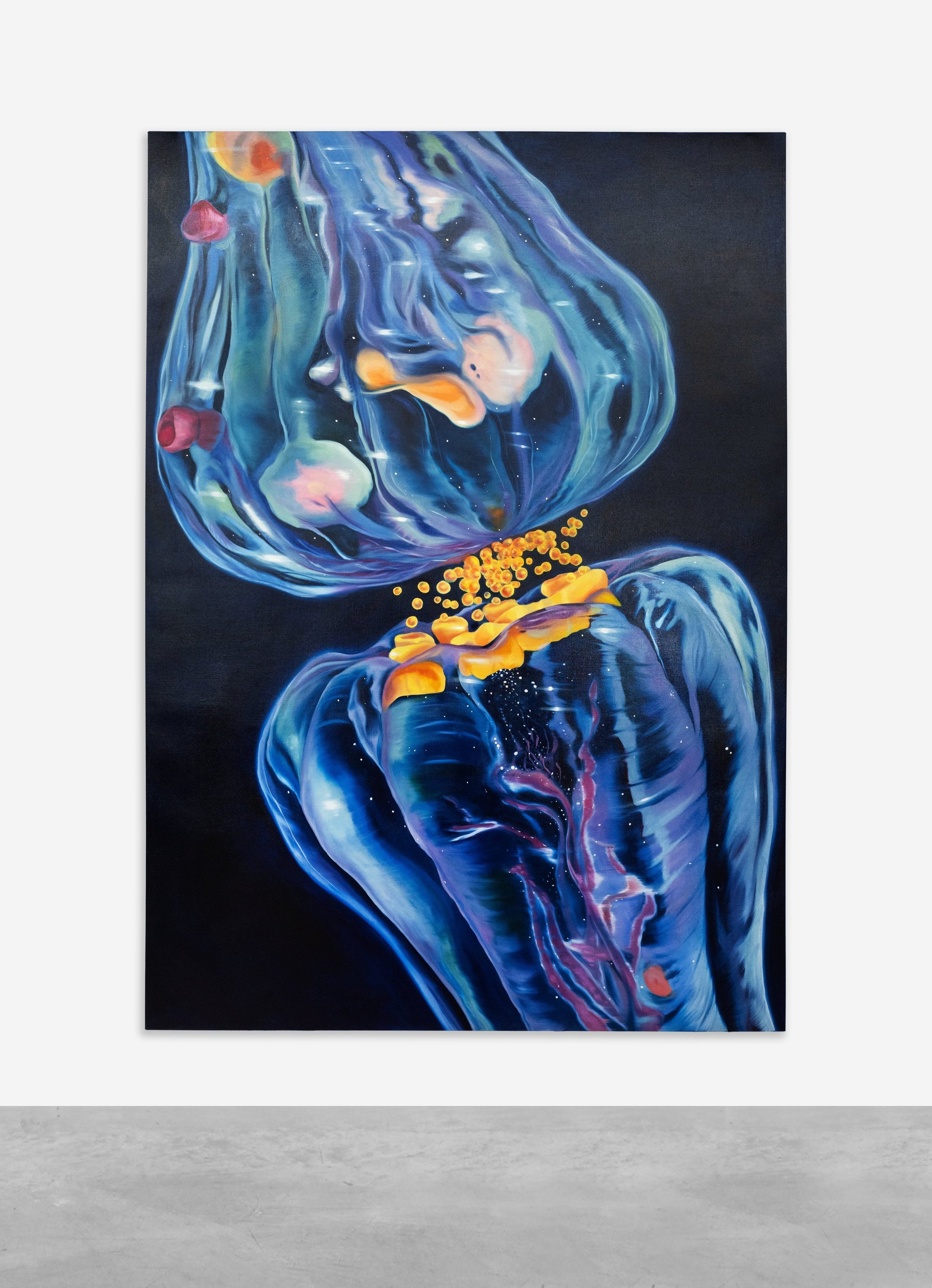
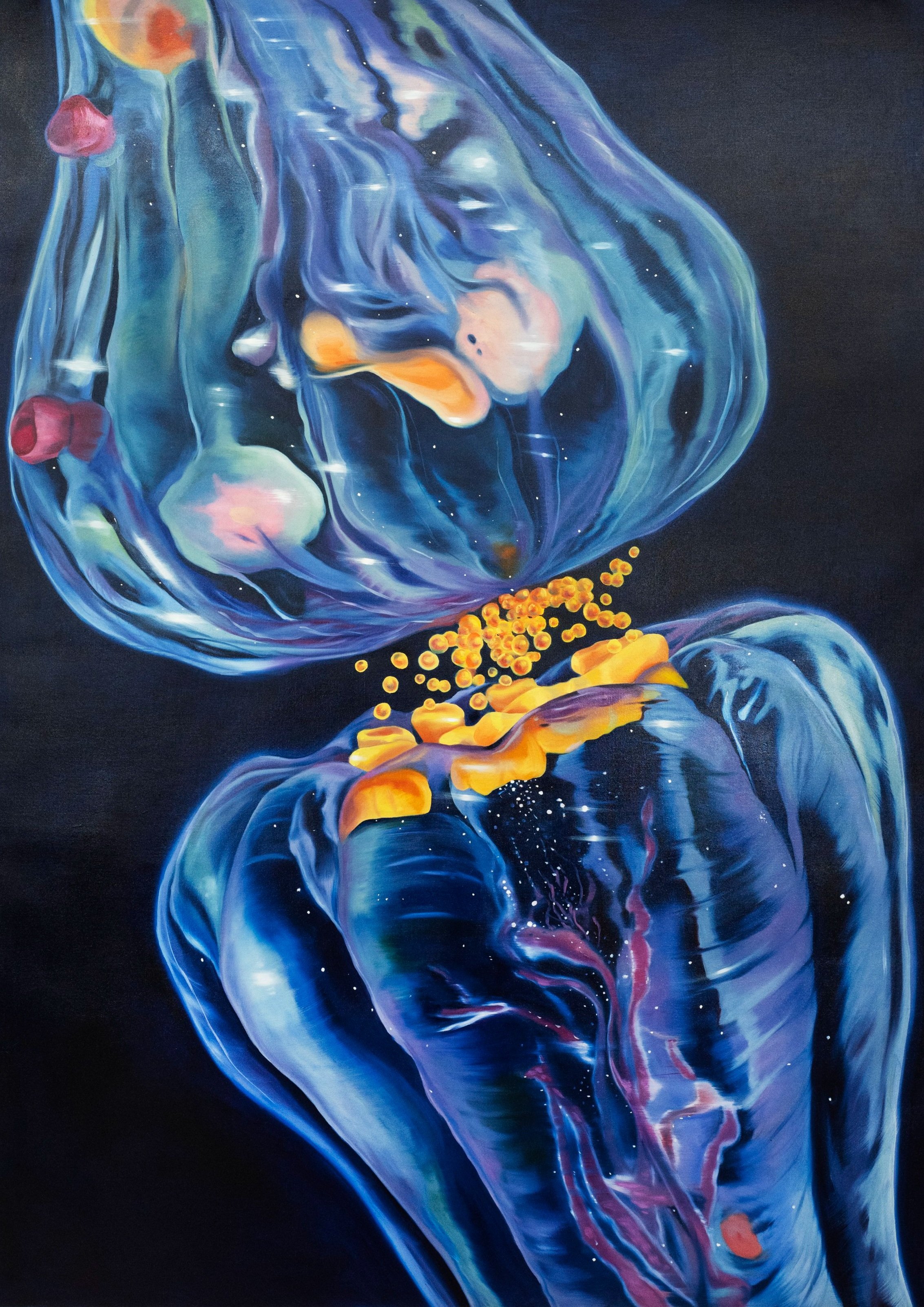
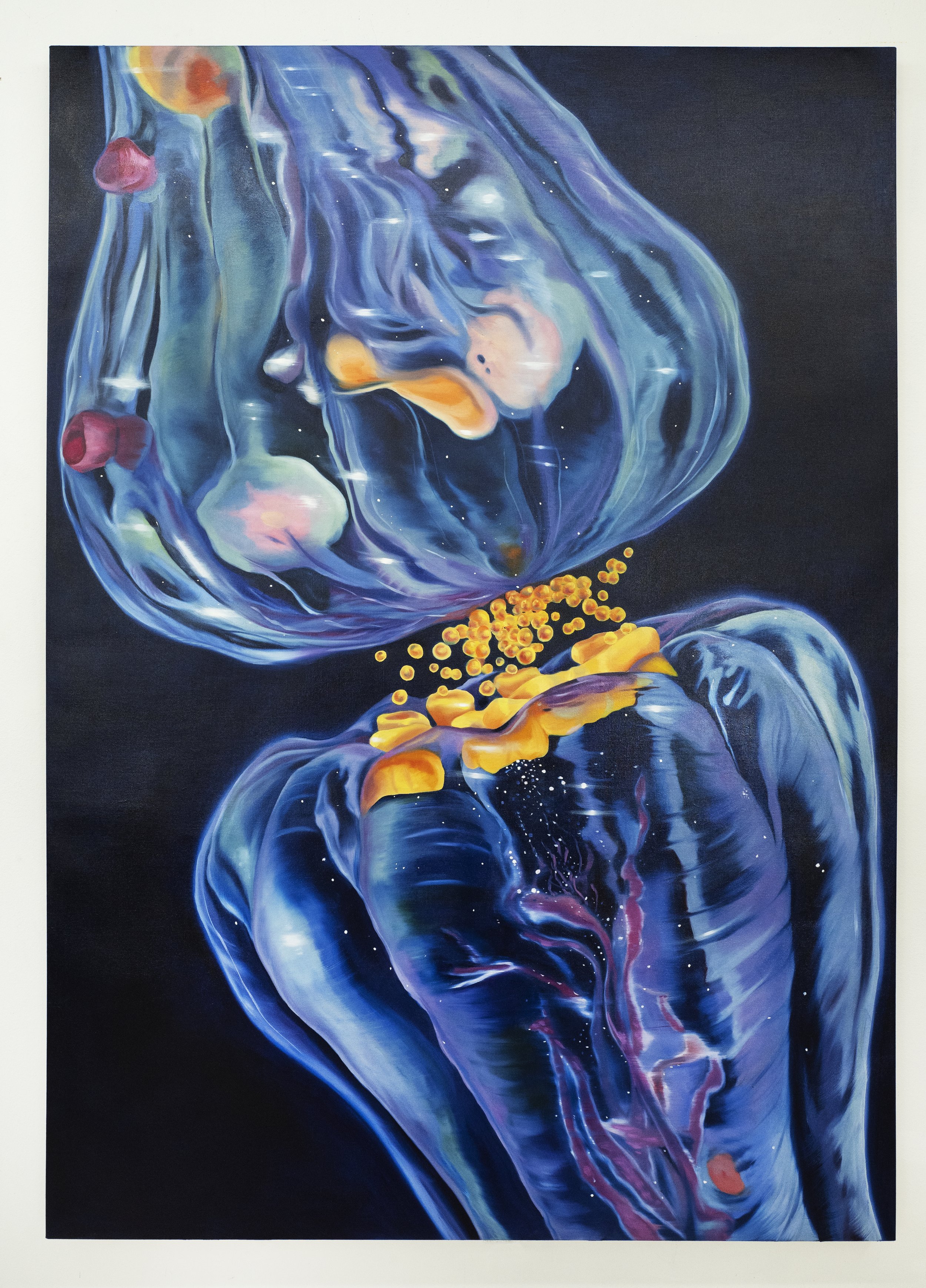
Synapse (2023) is oil on linen, 184 x 132 cm (72.5 x 52 in). The canvas is large, nearly two meters in its longer dimension, and the scale is significant because it allows the painting to operate at the threshold between the microscopic and the humanly legible. At viewing distance, the surface resolves into a field of blue and yellow marks, a dense visual texture that does not immediately read as anything recognizable. The blue dominates, forming the structural ground of the composition, and the yellow appears as interruptions within that ground, as points of light that are scattered, clustered, and distributed according to principles that are not visible as such from a distance but that become legible at close range. The yellow marks are not uniform. They vary in size, intensity, and distribution, and the pattern they form is not random but structured, a field of points that clusters in some regions and scatters in others, that has density and voids, centers and peripheries, a geometry that is produced by the relationships between the marks rather than by any single mark alone. This is the point cloud, rendered in paint. The individual yellow points are the concepts, and their positions relative to each other, their clustering and scattering, are the geometry of meaning. The blue ground is the space in which the points exist, the medium through which they are distributed, and the relationship between the two is the painting's representation of the relationship between structure and signal, between the architecture of the synapse and the neurotransmitter that crosses it.
The surface texture of Synapse is a product of the oil paint working against the linen ground. Tan Mu applies the paint in layers, building up the blue ground and then introducing the yellow marks through a process that is partly controlled and partly responsive, the kind of painting in which the artist makes a mark, responds to it, adjusts the adjacent area, and lets the composition evolve through a series of localized decisions rather than through a predetermined plan. The result is a surface that reads as both organic and systematic, a field of marks that appears to have grown according to its own logic rather than having been placed according to a rule. At close range, the individual yellow points are distinct, each one a small concentration of brighter paint on the darker blue ground, each one a separate event of attention in the field of the canvas. Some are clustered in groups of two or three, suggesting the formation of temporary coalitions, the kind of associative connection that is constantly being made and unmade in a neural network as new inputs arrive and new patterns are recognized. Others are isolated, single points in the blue field, suggesting the formation of longer-distance connections that traverse the space between the clusters. The overall effect is of a system in dynamic equilibrium, a network that is constantly reconfiguring itself in response to new inputs, a structure that is always in the process of becoming and never in a state of completion.
Dini Seid's paintings operate at the intersection of abstraction and epistemology, using the visual language of geometric abstraction to represent structures of knowledge that are not themselves visual. Her work Epistemology IV (2019) is a large-scale canvas, approximately two meters on each side, organized around a grid of cells that the artist has described as representing the categories of a specific domain of knowledge, each cell a unit of meaning, each row and column a system of classification, and the grid as a whole the structure of a way of knowing. The cells in Epistemology IV are not uniform. Some are filled with color, some are empty, some contain marks that are dense or sparse, and the pattern of filled and empty cells is not random but structured, a map of which categories are active and which are dormant in a particular moment of the history of the field the painting represents. Seid's grid is a knowledge structure made visible: a classification system that organizes the world into discrete units, assigns each unit a position, and defines the relationships between them through their positions in the grid. The painting does not depict any specific body of knowledge. It depicts the form of knowledge organization itself, the way that any domain of understanding imposes structure on the flux of experience by dividing it into categories, assigning them locations, and defining their relations through adjacency, hierarchy, and exclusion.
Synapse operates in a related but distinct register. Seid's grid is a structure of classification, a way of organizing knowledge into discrete units that can be located and compared. Tan Mu's point cloud is a structure of relationship, a way of organizing meaning into a space where position encodes similarity and distance encodes difference. The distinction is between a categorical and a continuous representation of knowledge, and it maps onto the distinction between two models of how the brain stores information. The classical model of memory storage, the one that dominates common-sense understanding, treats memory as a categorical store: specific experiences are filed in specific locations, and retrieval is a matter of finding the right file and opening it. The connectionist model, which has come to dominate neuroscience and artificial intelligence research, treats memory as a pattern of relationships: information is stored not in locations but in the strengths of connections between nodes, and retrieval is a matter of activating a pattern that reconstructs the stored information from the pattern of activation itself rather than from a specific address. The point cloud is a connectionist representation. The yellow points are nodes, and their positions relative to each other encode the relationships between them. The blue ground is not empty space but the medium through which the relationships propagate, the space in which the signal travels from one node to another. Tan Mu has described the brain and the large language model as operating according to the same structural logic, and the point cloud is her visual expression of that claim: a representation of meaning distributed across a space, encoded not in what the points are but in where they are, not in their identity but in their geometry.
The binary logic of the synapse is also the binary logic of the computer, and this is the structural parallel that Tan Mu has pursued across multiple bodies of work. In Logic Circuit (2022), she depicted the circuit board as a visual field in which information flows through channels that are either open or closed, conducting or insulating, the same binary that governs the neural impulse. In Memory (2019), she depicted the data center as a plate that stores information in binary form, the same on/off that governs the strength of the synaptic connection. In Signal (ongoing), she depicts the submarine cable as a line that transmits binary signals across the ocean floor, the same impulse that travels from one neuron to the next. The binary is the common element across all of these works, the simplest possible representation of information, and the point cloud in Synapse is the representation of meaning distributed across a space organized by the same binary logic, the same on/off, the same switch that determines whether information flows or stops. The difference between the biological and the technological is only a difference of substrate. The structure is the same. The geometry is the same. The space between two neurons and the space between two concepts in a language model are different instantiations of the same structural relationship, and Synapse is the painting in which Tan Mu makes this claim most explicitly, using the point cloud to render visible the invisible geometry of connection, the shape of thought as it exists in the space between neurons before it becomes the shape of language, of memory, of self. The synaptic cleft is twenty nanometers wide. This is the space that Tan Mu's painting is about, the gap between the presynaptic neuron and the postsynaptic neuron where the chemical signal becomes the electrical signal, where the neurotransmitter is released from the synaptic vesicle, crosses the cleft by diffusion, and binds to the receptor protein on the postsynaptic membrane. Twenty nanometers is not very far in absolute terms. It is two hundred times smaller than the wavelength of visible light, so small that the space cannot be resolved by any optical microscope. The signals that cross it are molecules, tiny protein structures that carry electrical charge, and the crossing happens through the random motion of thermal diffusion, the molecules drifting from the place where they were released to the place where they can be caught by the receptor. The human brain contains approximately eighty-six billion neurons, and each neuron forms, on average, seven thousand synaptic connections with other neurons, producing a total of roughly six hundred trillion synapses. The number is difficult to comprehend because it exceeds the number of stars in the Milky Way by a factor of several thousand. Each synapse is a point of decision, a location where a signal either passes or does not pass, where a connection either strengthens or weakens, where the network either consolidates a pattern or discards it, and the cumulative effect of six hundred trillion such decisions, made continuously across the entire brain, is what we experience as thought, memory, perception, and consciousness. The scale of the system is the reason that the brain can produce the richness of subjective experience from such simple components: each individual synapse is a binary switch, on or off, but the number of switches and the density of their interconnections produce emergent behaviors that no single switch could produce alone, just as the individual pixels on a screen produce an image that no single pixel could convey. The signals that cross it are molecules, tiny protein structures that carry electrical charge, and the crossing happens through the random motion of thermal diffusion, the molecules drifting from the place where they were released to the place where they can be caught by the receptor. This is not a directed process. The neurotransmitter does not choose its target. It drifts and is caught, or drifts and is reabsorbed, or drifts and is broken down by enzymes in the cleft. The transmission is probabilistic rather than deterministic, a matter of chance and timing, of how many molecules were released, how many receptors are available, how long the neurotransmitter stays in the cleft before it is cleared. The signal is not a message in the sense of a designed communication. It is a chemical event, a change in the local concentration of a specific protein, and the postsynaptic neuron responds to that change by adjusting the electrical potential across its membrane, opening or closing ion channels, depolarizing or hyperpolarizing in response to the accumulated effect of all the molecules that have been caught by all the available receptors.
Tan Mu has described the moment of transmission as "between connection and separation," as a state that "operates like an on and off switch," and these descriptions point to the fundamental logic of the synaptic event: the signal is binary, the neurotransmitter is either present or absent, the receptor is either activated or not, the postsynaptic neuron either fires or it does not. This binary is the foundation of the neural code, the basic unit of information processing in the brain, and it is the same binary that governs the logic circuit in a computer, the same on/off that governs the flow of information through the data center, the same switch that appears at every scale of Tan Mu's practice, from the synapse to the server rack to the submarine cable to the signal that crosses the ocean floor. The point cloud in Synapse is made of many such binaries: each yellow point is a signal event, a moment when the switch is on and the neurotransmitter has crossed the cleft, and the positions of the points relative to each other encode the relationships between the signals, the geometry of the neural network as it has developed through a lifetime of experience, a record of which connections have been strengthened by use and which have been pruned by disuse, a map of the self that is not fixed but constantly being revised, every new experience either reinforcing an existing connection or forming a new one, the brain as a structure that is always in the process of becoming and never in a state of completion.
Nick Koenigsknecht, writing about Tan Mu's practice in the BEK Forum catalog, has argued that "while observing technology, are we not looking at ourselves?" and that the paintings "function more as self-portraits than as depictions of external, scientific milestones." The argument applies with particular force to Synapse, because the painting is about the structure that produces the self, the neural architecture that is the condition of possibility of consciousness, memory, and identity. The point cloud is not a representation of synapses. It is a representation of the geometry of meaning in a particular mind at a particular moment, and because meaning is distributed rather than localized, because the position of each concept in the space encodes its relationship to every other concept, the point cloud is a portrait of a way of seeing, a way of organizing experience, a way of being in the world that is specific to one particular biological system and that is also, Tan Mu argues, structurally identical to the way a large language model organizes meaning, the same geometry of concepts appearing in the space of the neural network and in the space of the artificial network, the same pattern at the micro and the meso and the macro, the shape of thought and the shape of the universe converging in the point cloud that Tan Mu has rendered in oil on linen, 184 by 132 centimeters, a surface that holds the record of a structure that cannot be seen with the naked eye and that is, nonetheless, the place where the self is made.