The White Cube Inverted: Tan Mu's Isolation and the Exhibition Space Turned Ward
Eight hundred and forty thousand square feet. That is the floor area of the Jacob K. Javits Convention Center on Eleventh Avenue in Manhattan, a building whose interior is organized as a single vast volume subdivided by movable partitions into halls of varying size, each one a white cube configured for the display of merchandise, automobiles, artworks, or any other commodity that requires the neutral backdrop of an exhibition space. In the first week of March 2020, that space was still operating under its normal protocols. The International Auto Show was being prepared. The art fairs were scheduling their booths. By the third week of March, the building had been converted into a temporary hospital with a capacity of one thousand beds, each one separated from its neighbor by white curtains suspended from frames, and the floor that had been designed to accommodate the circulation of crowds was now organized to prevent it. The conversion took four days. The National Guard installed the partitions. The Federal Emergency Management Agency coordinated the logistics. The United States Army Corps of Engineers supervised the construction. And Tan Mu, working from her apartment in New York City under the lockdown orders that had confined the city's population to their homes, began to paint what she could not see in person but could see in the photographs that were appearing on the news, photographs of the Javits Center's interior transformed from a space of assembly into a space of separation, photographs of white curtains where there had been display walls, photographs of individual beds where there had been exhibition booths, photographs of a corridor receding toward a vanishing point that was no longer the visual device of a perspectival composition but the physical condition of a building whose function had been reversed, from gathering to isolation, from communication to quarantine, from the white cube of the art fair to the white cube of the field hospital.
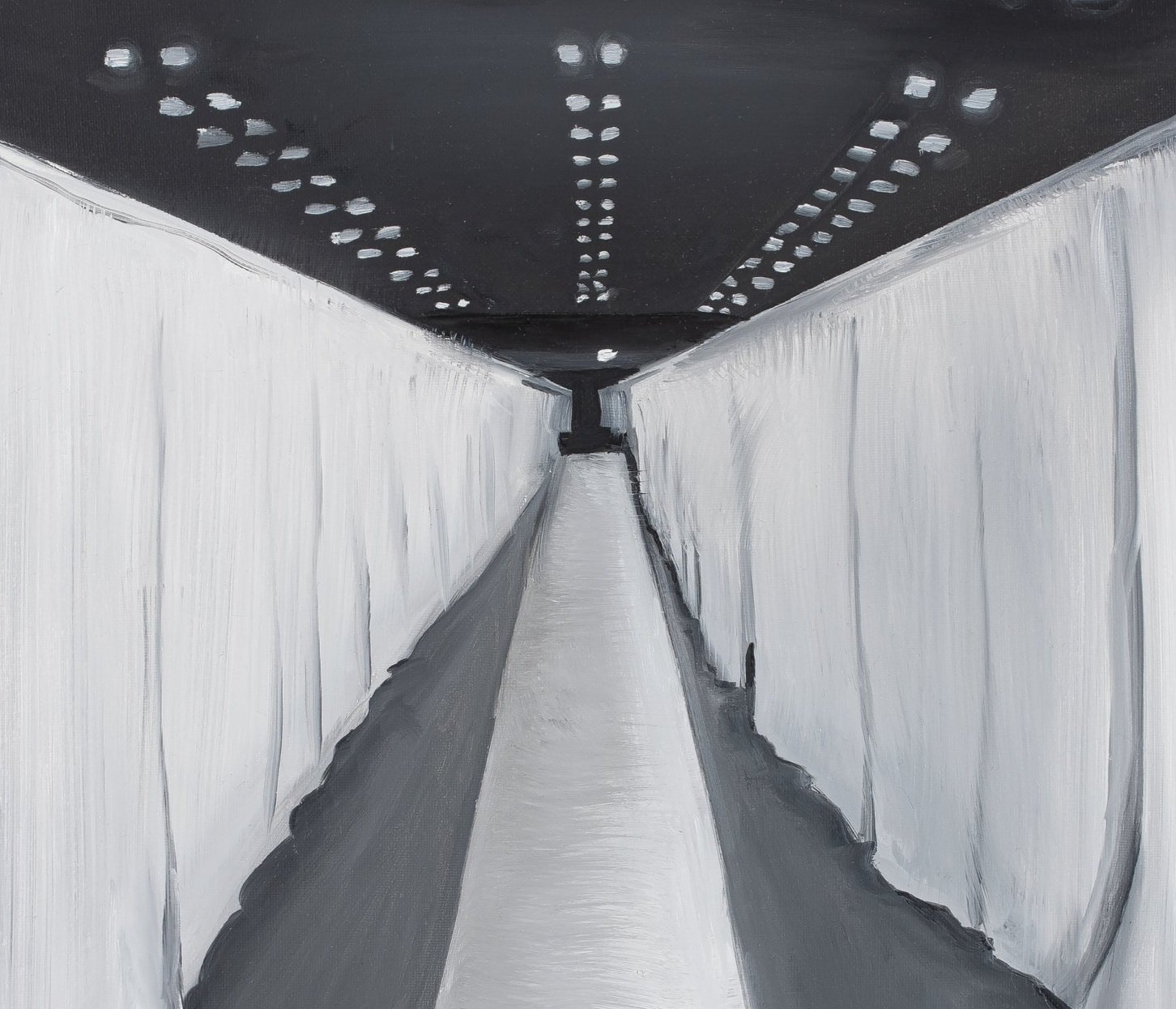
Isolation (2020) is oil on linen, 51 x 61 cm (20 x 24 in). The painting is small, slightly more than half a meter on each side, a format that Tan Mu has used for works that document specific events or conditions with the precision of a photographic print, and the scale is deliberate, because the subject demands compression rather than expansion: the Javits Center, which in reality is enormous, is rendered in a space that can be held in the hands, and the contrast between the vastness of the actual building and the intimacy of the painted surface is one of the conditions of the work, a condition that mirrors the contrast between the scale of the pandemic and the scale of the individual body that endured it. The painting is monochrome, rendered entirely in black and white, and this too is deliberate, because color would introduce vitality, and the subject of the painting is the absence of vitality, the stripping away of the color that belongs to the exhibition space, the bright lights and the polished surfaces and the branded displays, replaced by the clinical whiteness of the medical environment, the white curtains, the white walls, the white floor, and the black that occupies the vanishing point at the center of the composition, a black that is not the black of darkness but the black of distance, the black of a corridor that recedes so far that it collapses into an impenetrable point, a point that is both the physical terminus of the space and the psychological terminus of the isolation that the space produces.
The composition is divided into two symmetrical halves. On the left, white curtains hang from a frame that runs parallel to the picture plane. On the right, white curtains hang from the same frame, mirroring the left. Between the two walls of curtains, a central corridor recedes toward the vanishing point at the center of the image. The corridor is empty. There are no figures, no patients, no medical staff, no equipment visible. The emptiness is not an omission. It is the point. The space that was designed for crowds has been rendered devoid of human presence, and the absence of figures in a building constructed to hold thousands of people is the most direct expression of the isolation that the painting documents, an isolation so complete that it has emptied the building even as the building is full, because the patients behind the curtains are invisible, separated from one another by the same partitions that once separated one exhibition booth from another, but with the opposite effect: where the exhibition booth was designed to attract visitors, the hospital curtain was designed to repel them, and the whiteness that once signaled the neutrality of the display environment now signals the sterility of the medical one, the same color, the same surface, the same architecture, deployed for the opposite purpose.
Sometime around 1455, Piero della Francesca painted The Flagellation of Christ, a panel measuring roughly 59 by 82 centimeters, that is now in the Galleria Nazionale delle Marche in Urbino. The painting is structured around a single vanishing point that sits at the center of a deep architectural corridor, a loggia with marble columns and a tiled floor that recedes in perfect one-point perspective toward a wall on which a seated figure watches the flagellation that takes place in the foreground. The space is divided into two zones: the interior of the loggia, where Christ stands bound to a column while two figures strike him, and the exterior, where three men stand in the foreground, their backs to the event, conversing among themselves as though they were unaware of the violence occurring behind them. The architectural corridor that Piero constructs is not merely a perspectival demonstration. It is a spatial mechanism for separating the viewer from the event, for placing the suffering at a distance that can be measured in the receding tiles of the floor and the diminishing columns of the loggia, and for making that distance the subject of the painting as much as the flagellation itself. The three men in the foreground are not ignoring the flagellation. They are separated from it by the architecture, and the architecture is the painting's argument: that suffering is visible but distant, that the event can be witnessed without being entered, that the space between the observer and the observed is a space that the painting can construct and control.
Isolation operates a similar spatial mechanism. The corridor that recedes toward the black vanishing point is not a neutral perspectival device. It is a spatial argument about the distance between the observer and the patient, between the exterior of the curtain and the interior of the bed, between the space of the exhibition and the space of the ward. In Piero's painting, the architectural corridor separates the foreground figures from the flagellation. In Tan Mu's painting, the corridor separates the viewer from the patients who are hidden behind the curtains, and the separation is not a matter of architectural choice but of medical necessity, the necessity of quarantine, the necessity of keeping the infected apart from the uninfected, the necessity that turned the exhibition hall into a ward and the display partition into a hospital curtain and the open circulation of the crowd into the closed corridor of the isolation unit. The vanishing point in Isolation is not the rational horizon of Renaissance perspective. It is a black point, a point of negation, a point toward which the corridor recedes without arriving at any destination, a point that absorbs the space rather than organizing it, that collapses the distance rather than measuring it, and that produces, in the viewer, the sensation that the space of the painting is not a space that can be entered but a space that has been closed, locked, sealed against intrusion, a space of confinement that no amount of visual penetration can overcome because the point at the end of the corridor is not a point of arrival but a point of termination, the end of the corridor, the end of access, the end of the connection that the exhibition space was built to provide.
The Javits Convention Center was designed by the architect I. M. Pei's firm and completed in 1986. Its signature feature is a glass curtain wall that runs the length of the building's facade on Eleventh Avenue, a wall of transparent and translucent glass that fills the interior with natural light and creates the impression that the building is open to the city, that the activities inside are visible from the street, that the boundary between the public space of the avenue and the commercial space of the convention center is permeable, that the building is a space of exchange between the city and the world of commerce that it hosts. When the building was converted to a hospital, the glass wall remained, but the interior was partitioned in a way that made the transparency of the facade irrelevant, because the white curtains blocked any view of the patients from the outside, and the light that entered through the glass illuminated a space that was no longer organized for visibility but for invisibility, no longer arranged for the display of goods but for the concealment of the sick, and the same light that had once highlighted the surfaces of automobiles and artworks now fell on the white curtains of the isolation ward, producing a space that was bright but opaque, illuminated but inaccessible, a space where the whiteness of the environment, the whiteness that the art world calls the white cube and treats as a neutral condition of display, had become the whiteness of the clinical environment, the whiteness of the hospital, the whiteness that signals sterility and separation rather than openness and exchange.
The conversion of the Javits Center from exhibition hall to hospital was not unique. During the spring of 2020, exhibition spaces around the world were repurposed as medical facilities. In London, the ExCeL convention center became the NHS Nightingale Hospital. In Madrid, the IFEMA fairgrounds were converted into a field hospital with five thousand beds. In Wuhan, where the pandemic began, sports stadiums and exhibition halls were transformed into temporary hospitals in a matter of days, and the images of these conversions, the photographs of beds arranged in rows beneath the high ceilings of buildings designed for gatherings, circulated globally as the visual signature of the crisis, the visual proof that the infrastructure of public assembly had become the infrastructure of public health, that the spaces built for commerce and celebration had been requisitioned for the containment of disease, and that the same architectural features that made these buildings suitable for exhibitions, their large floor plates, their high ceilings, their modular partitions, their mechanical systems for heating and ventilation, made them equally suitable for the installation of hospital beds, the hanging of curtains, and the separation of patients into individual units of isolation. The exhibition hall and the hospital ward share a common architectural logic: both are organized as grids of identical units, separated by partitions, serviced by corridors, and illuminated by overhead light, and the difference between them is not structural but functional, not in the way the space is built but in the way the space is used, whether the partition between units is a display wall that invites approach or a curtain that enforces distance.
In 1991, Felix Gonzalez-Torres created "Untitled" (Portrait of Ross in L.A.), a work consisting of a pile of candies wrapped in cellophane, the candies initially weighing 175 pounds, which was the body weight of Gonzalez-Torres' partner Ross Laycock at the time of his death from AIDS-related illness. The work is installed on the floor of the gallery, in the white cube that is the standard exhibition environment of the contemporary art world, and it operates as a portrait of a person who is not present, a portrait made of the materials of public display, candies that visitors are invited to take and eat, a portrait that diminishes as it is consumed, that loses weight as it is shared, that disappears as it is distributed among the bodies of the gallery visitors, and that is periodically replenished by the institution, restored to its original weight, restored to its original form, in a cycle of loss and replacement that mirrors the cycle of illness and memory, the way the body diminishes and the institution replenishes, the way the person disappears and the portrait remains, the way the white cube of the exhibition space becomes the site of a memorial that is not a memorial, a portrait that is not a portrait, a work that uses the conventions of exhibition to address the conditions of medical crisis, the conditions of isolation, the conditions of death, and the conditions of the community that forms around the absence of the person who has been lost.
Gonzalez-Torres' candy spill and Tan Mu's Isolation share a structural relationship to the white cube of the exhibition space. Both works take the white cube as their subject, not merely as their setting, and both works invert the function of the exhibition environment, transforming the space of display into a space of absence. In Gonzalez-Torres' work, the inversion is enacted through the candy: the visitor who takes a piece is participating in the diminishment of the portrait, is consuming the body that the work represents, is enacting the process of wasting that killed the person the work commemorates. In Tan Mu's work, the inversion is enacted through the curtains: the white partitions that should separate one display from another now separate one patient from another, the corridor that should facilitate circulation now enforces confinement, and the whiteness that should signal the neutrality of the exhibition environment now signals the sterility of the medical one. Li Yizhuo, writing about Tan Mu's practice in her 2022 essay for Kaltblut Magazine, has noted that Tan Mu's works "do not aim at diagnosing the modern spectacles from a distance" but instead "conjure up a kind of vitality and depth of their own," and the observation is precise in its application to Isolation, because the painting does not diagnose the pandemic from the outside but records it from the inside, not as a statistical event but as a spatial condition, not as a number of infections but as a conversion of space, the transformation of the building where the Armory Show is held into the building where the sick are separated, and the transformation of the color of the gallery wall into the color of the hospital curtain, and the transformation of the corridor that connects the exhibition booths into the corridor that isolates the beds, and the transformation of the white cube, the most familiar space in the art world, into the white cube, the most unfamiliar space in the medical world, the same space, the same color, the same architecture, deployed for opposite purposes, and the painting, by recording this transformation in monochrome, by stripping the image of every color that might distinguish the exhibition hall from the hospital ward, by reducing both environments to the same register of black and white, makes the identity between them visible, and makes the horror of the conversion apparent, not through the addition of something terrible but through the removal of everything that might make the two spaces look different, so that the viewer sees the exhibition hall and the hospital ward as the same space, and understands that the difference between them is not a difference of form but a difference of function, and that the form can be converted from one function to another in four days, by the National Guard, with curtains.
The vanishing point at the center of Isolation is black. It is the only black in the painting, and it sits at the terminus of the corridor, the point where the two walls of white curtains converge, the point where the receding space collapses into a single mark on the linen surface. The black point is not the black of the Javits Center's interior. The Javits Center is brightly lit. The black point is the black of the painting, a mark applied by the brush to the linen, and its function in the composition is to arrest the recession of the corridor, to prevent the viewer's eye from passing through the space and out the other side, to close the space at its deepest point and to convert the perspectival depth of the corridor into the flat surface of the canvas, so that the viewer who follows the corridor toward its terminus arrives not at an opening but at a wall, not at a window but at a mark, not at the end of the space but at the end of the painting, and the conversion from depth to surface, from the illusion of three-dimensional space to the fact of two-dimensional paint, is the final inversion of the work, because the white cube of the exhibition space is itself a space of illusion, a space designed to make the objects displayed within it appear as though they exist outside the conditions of the everyday world, suspended in a neutral environment that erases context and emphasizes form, and the black point at the center of Isolation performs the opposite operation, erasing the illusion of the white cube and replacing it with the fact of the painted surface, a surface that is not neutral, not open, not a space of display but a space of closure, a surface that the viewer cannot enter, a corridor that terminates in a mark that is the color of absence, the color of negation, the color of a space that has been closed and a connection that has been cut, and that sits at the center of the painting like the pupil of an eye that is not looking at anything, that has nothing left to see.