The World Without Us: Tan Mu's Horizons 03 and the Peace of the Orbital View
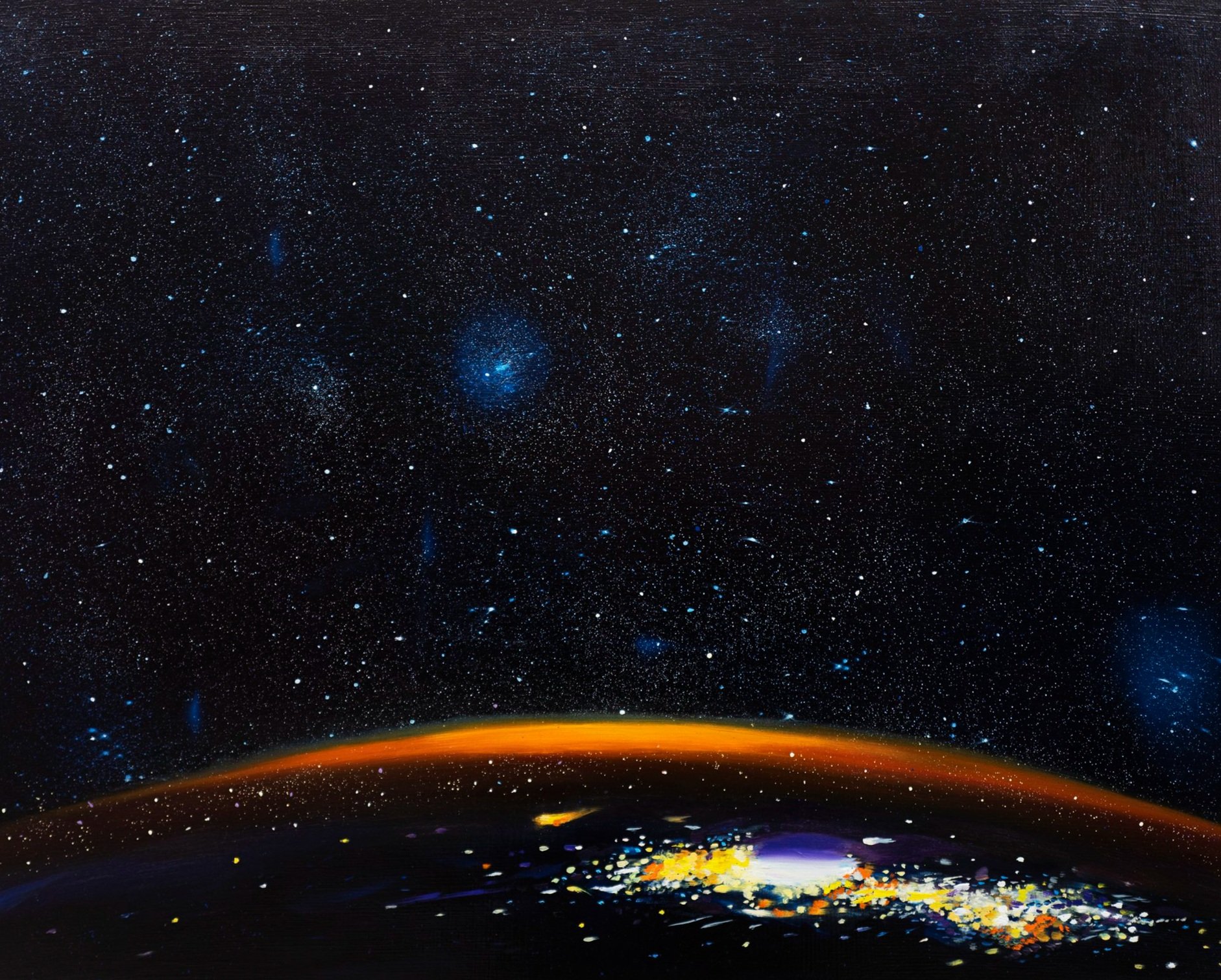
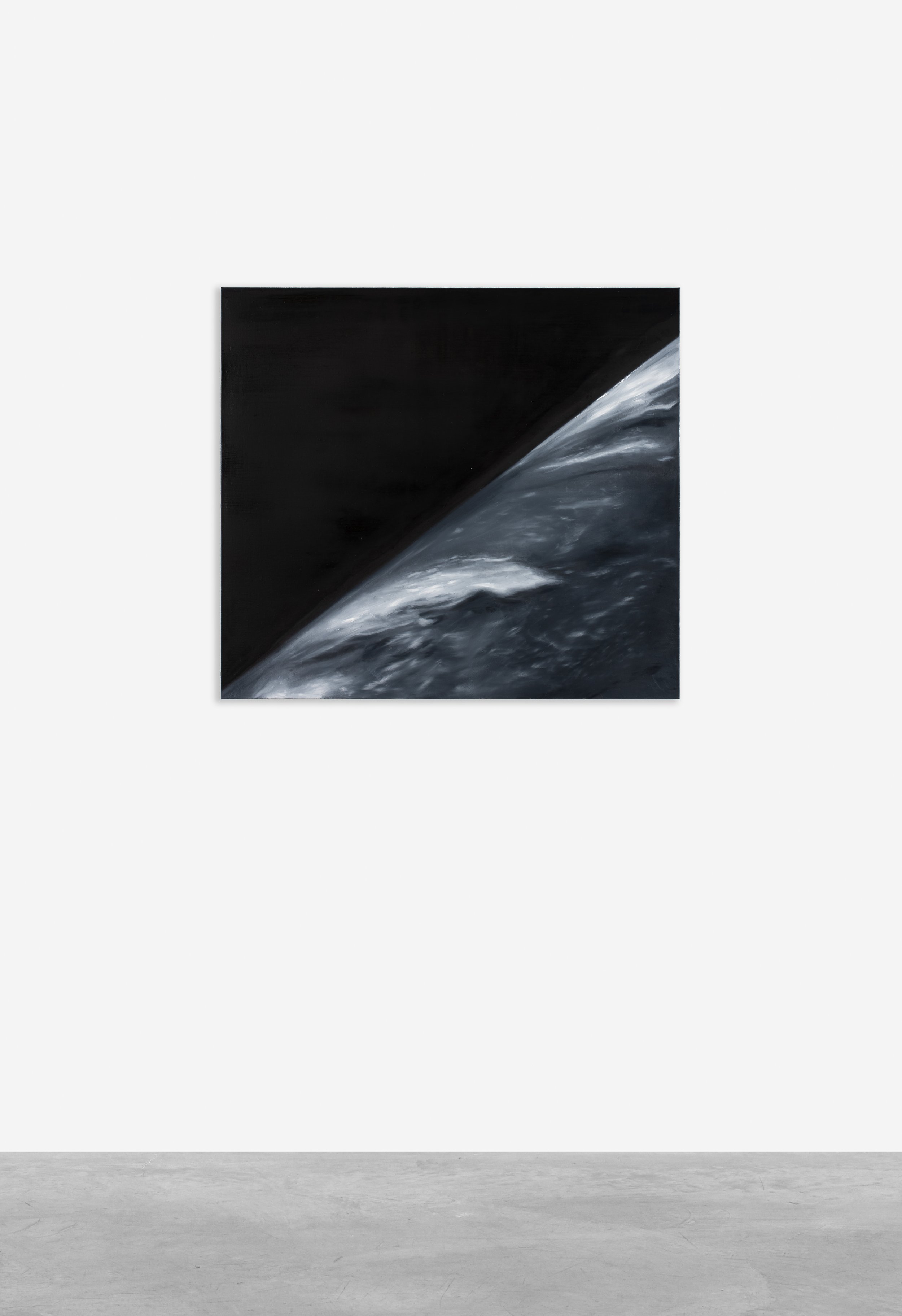
The first time a camera looked back at Earth from beyond the atmosphere, the planet was a small blue sphere suspended against a black sky in a grainy monochrome image captured by a V-2 rocket in 1946, and the image was not beautiful by conventional standards. It was noisy, low-resolution, and largely meaningless to anyone who did not already know what it was supposed to represent. But for those who understood what they were seeing, the image was a revelation: for the first time in the history of life on Earth, a conscious eye was looking at the planet from outside the planet, and the effect of that repositioning of the viewer was not merely visual but philosophical, because the image showed the planet as a thing that could be seen from a distance, as a whole, as an object, and once that had happened it could not be unknown. Tan Mu has described Peek (2021), her reinterpretation of this first photograph, as the conceptual origin of the entire Horizons series, the moment when the satellite perspective entered her practice as a way of seeing that surpasses the horizon, that offers what she calls a shared, planetary view of Earth, a view that is collective rather than individual, technological rather than biological, and that produces in the viewer a sense of the fragility and the connectedness of human existence within an infinite universe. Horizons 03 (2024) is the third work in this series, oil on linen, 46 x 61 cm (18 x 24 in), and it depicts the planet from the same orbital vantage point that Tan Mu has described as fundamentally altering her understanding of humanity's position within the universe.
The painting is small enough to hold in the hands, and this is not incidental. The intimacy of the format contrasts with the vastness of the subject, and the contrast is the point, because the satellite perspective is not naturally available to the human body. A person standing on the surface of the Earth cannot see the planet as a whole. They can see the sky, the horizon, the ground beneath their feet, and they can infer the curvature of the Earth from the way the horizon recedes as they ascend, but they cannot see what Horizons 03 shows: the planet as a continuous surface, a sphere with visible weather systems and illuminated coastlines and the dark patches of the oceans and the bright clusters of the cities, rendered in layers of oil on linen with the same kind of atmospheric haze that the artist has described as a key element of the series, the haze that surrounds the planet like a skin, the atmosphere that makes the planet visible as a living thing rather than as a geological object, that gives it the glow that makes it appear not just seen but inhabited, not just photographed but known.
The composition is organized around the horizon line that gives the series its name, but the horizon in Horizons 03 is not the horizon of the terrestrial landscape. It is the horizon of the orbital view, the line where the illuminated surface of the planet meets the darkness of space, and it is rendered with a precision that makes it clear that the perspective is not aerial but orbital, not a view from an airplane but a view from beyond the atmosphere, because the curvature of the horizon is visible, the slight bulge of the planet's surface as it curves away from the viewer, the edge of the world as seen from the International Space Station at an altitude of roughly four hundred kilometers, high enough to see the curvature, low enough to distinguish the individual lights of the megacities below, the way they cluster along coastlines and river valleys, the way they form the patterns of habitation that the satellite image reveals when seen from above, the way human civilization has inscribed itself on the surface of the planet in luminous lines and nodes that are visible from space and that constitute, in the satellite view, the most striking evidence of the presence of the species on the planet, the proof that the planet is not merely inhabited but organized, not merely alive but cultural, not merely a geological body but a social one, a body with cities.
Andrea Mantegna painted the Camera degli Sposi in the Ducal Palace of Mantua between 1465 and 1474, and the room is famous above all for its ceiling, which depicts a oculus open to the sky, and through that oculus the painter has rendered a sky that is blue and cloudless and populated by putti and by a ring of spectators leaning over the parapet of a balustrade that surrounds the aperture, so that the viewer standing in the room and looking upward sees the world from a new vantage point, a point below the ceiling and inside the room, but looking up and out, through the oculus, to a sky that is rendered with such conviction that the illusion is complete and the viewer feels, for a moment, that they are looking at a real aperture, a real hole in the ceiling, a real view of the sky above the palace. The technical term for this illusion is di sotto in su, seen from below, and Mantegna's achievement in the Camera degli Sposi is not merely technical. It is philosophical, because the oculus in the ceiling is a device for repositioning the viewer, for making the viewer look at the world from a different angle, for reminding them that their ordinary perspective is not the only perspective, that the ceiling is not a flat surface but a threshold, that looking up is a way of looking beyond, that there is always a sky above the ceiling, a sky that can be seen if only the ceiling can be opened, if only the aperture can be made, if only the perspective can be shifted from the horizontal to the vertical, from the everyday to the extraordinary, from the body to the mind.
Horizons 03 operates the same displacement of the viewer, but in the opposite direction. Mantegna opens the ceiling to show what is above. Tan Mu positions the viewer above the planet to show what is below. In both cases, the displacement is achieved through the manipulation of perspective, the shift from the ordinary vantage point to the extraordinary one, and the effect of that shift on the viewer is a sense of the relativity of their position within the world, the sense that their habitual perspective is not the only one, that there are other ways of seeing that may be as real as their own, that the Earth is not only the ground they walk on but also the sphere they are standing on, not only the world they live in but also the world they can see from outside. The difference is one of scale and of technology. Mantegna's oculus is a painted aperture, a fiction, a trick of perspective. Tan Mu's satellite view is a real image transmitted from a real position in space, a view that is available to anyone with access to the right equipment, a view that has been shared billions of times through satellite imagery and live feeds from the International Space Station, a view that is no longer extraordinary but ordinary, no longer rare but ubiquitous, no longer the province of painters but the province of cameras, of sensors, of the technological apparatus that has made the orbital perspective available to anyone who wants it and that has thereby changed not only what we see but how we see, not only the content of our images but the structure of our perception, the way we understand our position within the world and our relationship to the planet that carries us.
The city lights in Horizons 03 are rendered as luminous clusters against the dark surface of the planet, warm tones of gold and amber set against the cool blues and grays of the atmosphere and the ocean, and Tan Mu has described how she thinks of these lights as resembling neural networks, as suggesting that human activity on the surface of the planet mirrors the structures of biological systems, that the city is to the planet what the neuron is to the brain, a node in a network, a point of concentration in a field of dispersed activity, a locus of connection in a system that is otherwise too large and too diffuse to be perceived from the surface but that becomes visible, and legible, from the satellite perspective. The metaphor is one that the orbital view makes available and that earlier perspectives could not, because the orbital view is the only perspective from which the pattern of the city lights on the surface of the planet becomes a visible pattern, a shape that can be perceived as a whole rather than as a collection of individual buildings and streets, and the pattern is the information, the signal, the meaning, the thing that the satellite perspective reveals and that no other perspective can. When the view is from the surface, the city is a collection of buildings. When the view is from orbit, the city is a network, and the network is the truth of the city, the organizational logic that is invisible from within but visible from without, and Tan Mu's painting renders that organizational logic visible in the same way that the painting renders the atmosphere visible, as a field of distributed activity that is organized according to principles that can be seen but not named, understood but not explained, felt but not stated. The orbital perspective that makes these networks visible has a history that parallels the history of the image itself. The V-2 photographs of 1946 were followed by the photographs taken by Explorer 6 in 1959, which produced the first crude television images of Earth from orbit, and by the photographs taken by the TIROS weather satellites beginning in 1960, which provided the first systematic observations of cloud cover and weather patterns from above. But it was the photographs taken by the crew of Apollo 8 in December 1968, particularly William Anders's famous Earthrise image, that transformed the orbital perspective from a technical achievement into a cultural event, an image that was reproduced on postage stamps and book covers and protest banners and that is widely credited with catalyzing the environmental movement by making the planet visible as a single object in a single frame, a blue marble floating in the void, fragile and alone and infinitely precious. The International Space Station, which has been continuously occupied since November 2000, orbits at approximately four hundred kilometers above sea level and completes one circuit of the planet every ninety minutes, and the crews that have lived aboard it have transmitted countless images and hours of video from the orbital perspective, images that have been broadcast live and replayed millions of times, images that have changed not only what we know about the planet but how we imagine it, because the orbital image is now a familiar image, an image that everyone recognizes, an image that appears in textbooks and documentaries and presentations and corporate logos, an image that has become so common that its strangeness has been worn away by repetition, so familiar that its profundity has been flattened by ubiquity, and Tan Mu's painting is an attempt to restore the strangeness and the profundity to the image, to make the familiar strange again, to make the common image uncommon, to make the viewer feel the weight of what they are seeing when they see the planet from outside, the weight of the knowledge that the planet is small and the space is vast and the distance between any two points on the surface is nothing compared to the distance to the edge of the observable universe.
James Turrell has spent his career making works that are fundamentally about the act of seeing, about the conditions of visual perception, about the way that light is not merely a medium for seeing but is itself the substance of what is seen, and hisganzfeld works, which he began in the late 1960s and has continued to develop throughout his career, are among the most radical exercises in the manipulation of visual perception in the history of art. Theganzfeld is a German word that refers to a visual field that is undifferentiated, a field of uniform color or light that eliminates all visual reference points and thereby produces in the viewer a disorientation that is not merely psychological but physiological, a loss of the sense of where the body ends and the environment begins, a dissolution of the boundary between the self and the surround, an experience that Turrell has described as a return to the condition of the fetus in the womb, surrounded by uniform warmth and uniform light and without any of the visual markers that allow the adult body to orient itself in space. The experience is not pleasant in any conventional sense. It is vertiginous, uncomfortable, and in some viewers produces a panic response, the sense that they are falling even though they are standing still, the sense that they have lost the ground, the sense that the world has disappeared because they can no longer see it as a world because they can no longer see it as anything because the visual field has been reduced to an undifferentiated expanse of light.
In Horizons 03, the atmosphere that surrounds the planet functions as a kind ofganzfeld, an undifferentiated field of light that surrounds the illuminated surface of the Earth and that eliminates the visual markers of scale and distance that would allow the viewer to orient themselves in relation to the planet, so that the planet appears not as a large object seen from a small distance but as a small object seen from a vast distance, not as a world you could walk on but as a world you could hold in your hands, not as a ground but as a sphere, not as an environment but as an object, and the disorientation that this produces is the painting's central affect, the sense that the familiar has become strange, that the ground has become a surface, that the world has become a thing, that the thing you live on has become a thing you can see, and that seeing it as a thing is both the condition of the satellite perspective and the condition of the painting, the condition of technology and the condition of art, and that these two conditions are not separate but identical, not different ways of seeing but the same way of seeing, the way that sees the world from outside, the way that sees it as a whole, the way that produces in the viewer the sense of awe and expanded perception that Tan Mu has described as the central experience of the series, the sense of looking at something so large and so complex and so fragile that the only adequate response is silence, is stillness, is the quiet acknowledgment that you are looking at the only world you have, at the only planet that carries you, at the only ground that stands beneath your feet, and that it is small and fragile and finite and that the view from outside, the orbital view, the satellite perspective, is the view that makes that finitude visible, that makes that fragility legible, that makes the peace that Tan Mu has described as emerging when the perspective rises above the horizon, the peace that is not the absence of conflict but the presence of perspective, the peace of seeing the world from outside the world, the peace of the orbital view, the peace that comes from looking at the planet and knowing that it is the only one you have.