The Machine That Measures Itself: Tan Mu's Quantum Gaze and the Processor as Portrait
In January 2019, IBM unveiled the Q System One at the Consumer Electronics Show in Las Vegas, and the event was covered not in the technology press alone but in the general press, because the machine that IBM had built was not merely a computer but a spectacle, a object that had been designed to be looked at as much as to be used, a nine-foot cube of borosilicate glass that housed a quantum processor at a temperature of fifteen millikelvins, colder than the vacuum of outer space, and the glass enclosure was not a functional necessity but an aesthetic choice, because the processor inside the cube required isolation from vibration and electromagnetic interference, and the cube provided that isolation, but the cube also made the processor visible, and the visibility of the processor was the point, because IBM had understood that quantum computing was not yet ready to solve practical problems at scale, that the technology was still in what the industry calls the noisy intermediate-scale quantum era, in which qubits are unstable and error rates are high and the number of reliable calculations that the machine can perform is limited, but that the visibility of the machine, the fact that it could be seen and photographed and displayed in a glass case like a museum object, like an artwork, like a sculpture, was itself a form of communication, a way of making the concept of quantum computing tangible to an audience that could not be expected to understand the physics of superposition and entanglement but that could be expected to respond to the visual presence of a machine that looked like nothing they had ever seen, a machine that was housed in a glass cube that was designed by a team that included an industrial designer and an architect and that was intended to suggest both the transparency of the scientific process and the preciousness of the object that the process was designed to protect, and that did suggest those things, and that made the quantum computer visible for the first time as an object that could be looked at, not as a technical diagram in a journal article, not as a photograph of a laboratory setup with wires and tubes and a dilution refrigerator that looked like a chandelier, but as a designed object, an object that had been shaped by human intention to appear a certain way, to communicate a certain idea, to embody a certain promise, and that was, in this respect, not so different from the paintings that Tan Mu has been making of the quantum computer since 2020, paintings that treat the machine not as a tool but as a portrait, not as an instrument of calculation but as a reflection of the mind that made it.
Quantum Gaze (2023) is oil on linen, 244 x 193 cm (96 x 76 in). The canvas is large, nearly two and a half meters on the longer side, and the scale is not incidental, because the subject demands it, the quantum processor is not a small object and the painting is not a small painting, and the relationship between the scale of the machine and the scale of the canvas is one of equivalence, the painting is as large as it needs to be to contain the machine, and the machine is as large as it is because the physics of superconducting qubits requires a dilution refrigerator and a series of cooling stages and a tangle of cables and connectors that occupies a volume roughly equivalent to the volume of the painting, and the painting makes this volume visible, makes the scale of the machine apparent, makes the viewer aware that they are looking at something that is not miniature, not compressed, not reduced to a diagram but rendered at a size that corresponds to the physical presence of the object itself. The composition is centered on the quantum processor chip, which appears as a lattice of golden lines against a dark ground, the lines forming a grid of squares and rectangles that suggests both a circuit board and a city seen from above, and the colors shift from warm gold and amber at the center of the composition, where the processor chip is rendered with a luminosity that suggests the glow of superconducting circuits at near-absolute-zero temperatures, to cool blues and greens at the periphery, where the cables and the cooling structure extend outward from the chip toward the edges of the canvas, and the transition from warm to cool, from the golden center to the blue-green periphery, is the transition from the active zone of the processor, where the qubits exist in their superposed states, to the passive zone of the infrastructure, where the cables carry the signals and the cooling structure maintains the temperature and the entire apparatus that supports the quantum processor extends outward like the roots and branches of a tree, or like the dendrites of a neuron, or like the cables on the ocean floor, or like any of the other networks that Tan Mu has painted throughout her career, because the quantum processor is one more network in a practice that has been dedicated to the painting of networks since its beginning, and the painting of the quantum processor is the painting of a network that is smaller than any other network she has painted, a network that fits on a chip the size of a fingernail, and that is also, in its computational power, the most complex network she has ever depicted, a network in which the nodes are qubits that can exist in multiple states simultaneously, and the connections between them are entanglements that are not physical wires but quantum correlations, and the logic that governs their behavior is not the binary logic of classical computing but the probabilistic logic of quantum mechanics, in which a qubit can be zero and one at the same time, in which the measurement of one qubit can determine the state of another qubit that is physically distant, in which the act of observation changes the state of the system being observed, and all of this is rendered on a canvas of oil and linen with the same brush that painted the submarine cables and the synaptic clefts and the propeller and the hospital curtains, because Tan Mu has described her practice as one of "receiving and transmitting signals, aided by sensors and systems," and the quantum processor is one more signal in a world of signals, one more network in a world of networks, one more system in a world of systems, and the painting of it is one more act of reception and transmission in a practice that has always been about receiving and transmitting, about standing at the point where the signal enters and the signal leaves and making visible what passes between.
Leonardo da Vinci's Vitruvian Man (c. 1490) is a drawing on paper measuring roughly 34 by 25 centimeters that shows a male figure standing with his arms and legs extended in two superimposed positions, one with the arms raised to form a square and the legs together, the other with the arms spread to form a circle and the legs apart, and the figure is inscribed within both geometries simultaneously, the square and the circle, the two fundamental shapes of classical geometry, and the drawing is accompanied by notes in Leonardo's mirror writing that transcribe the passage from Vitruvius's De Architectura that describes the proportions of the human body, the span of the arms equals the height of the body, the head is one eighth of the body's height, the foot is one sixth, and so on, a list of measurements that establishes the human body as the standard of proportion from which the proportions of architecture should be derived, because the temple should be proportioned like the body, because the body is the measure of all things, because the human figure is the microcosm that contains the proportions of the macrocosm, because the human is the unit of measurement that makes the universe legible. The drawing is not merely a demonstration of proportion. It is a claim about the relationship between the body and the world, a claim that the body is the model from which the world can be understood, that the proportions of the body are the same as the proportions of the temple and the city and the cosmos, and that the act of measuring the body is the act of measuring the universe, and that the act of drawing the body within the square and the circle is the act of inscribing the human within the geometry of the world.
Quantum Gaze inverts this relationship. Where the Vitruvian Man proposes that the body is the measure of the world, Quantum Gaze proposes that the machine is the measure of the mind. The quantum processor is not a representation of the human body. It is a representation of human cognition, a machine that has been designed to think in a way that no classical computer can think, to solve problems that no classical computer can solve, to exist in states that no classical computer can occupy, and the painting of this machine is not a painting of an external object but a painting of a mirror, a mirror that reflects the mind that made it, the mind that designed it, the mind that looks at it and recognizes in its operations a version of its own operations, a version that is faster and stranger and more powerful than any biological mind but that is, at its base, an externalization of the same impulse that drives the painter to paint and the viewer to look, the impulse to understand, to measure, to inscribe the human within the geometry of the world. The lattice of golden lines at the center of Quantum Gaze is the equivalent of the square and the circle in Leonardo's drawing, the geometry that contains the figure, and the figure it contains is not a human body but a human cognition, not the span of the arms but the span of the calculation, not the height of the body but the depth of the qubit, and the painting's claim is the same as Leonardo's claim, that the figure inscribed within the geometry is the measure of all things, except that the figure has changed, and the geometry has changed, and the measure has changed, and what remains is the act of measurement itself, the act of inscribing the human within the geometry of the world, the act that the painting performs and that the quantum processor performs and that the viewer performs when they stand before the painting and recognize in its golden lattice a version of their own cognitive architecture, their own neural network, their own synaptic connections, their own capacity for superposition, for existing in multiple states of understanding simultaneously, for seeing one thing as both the quantum processor and the portrait of the mind that made it.
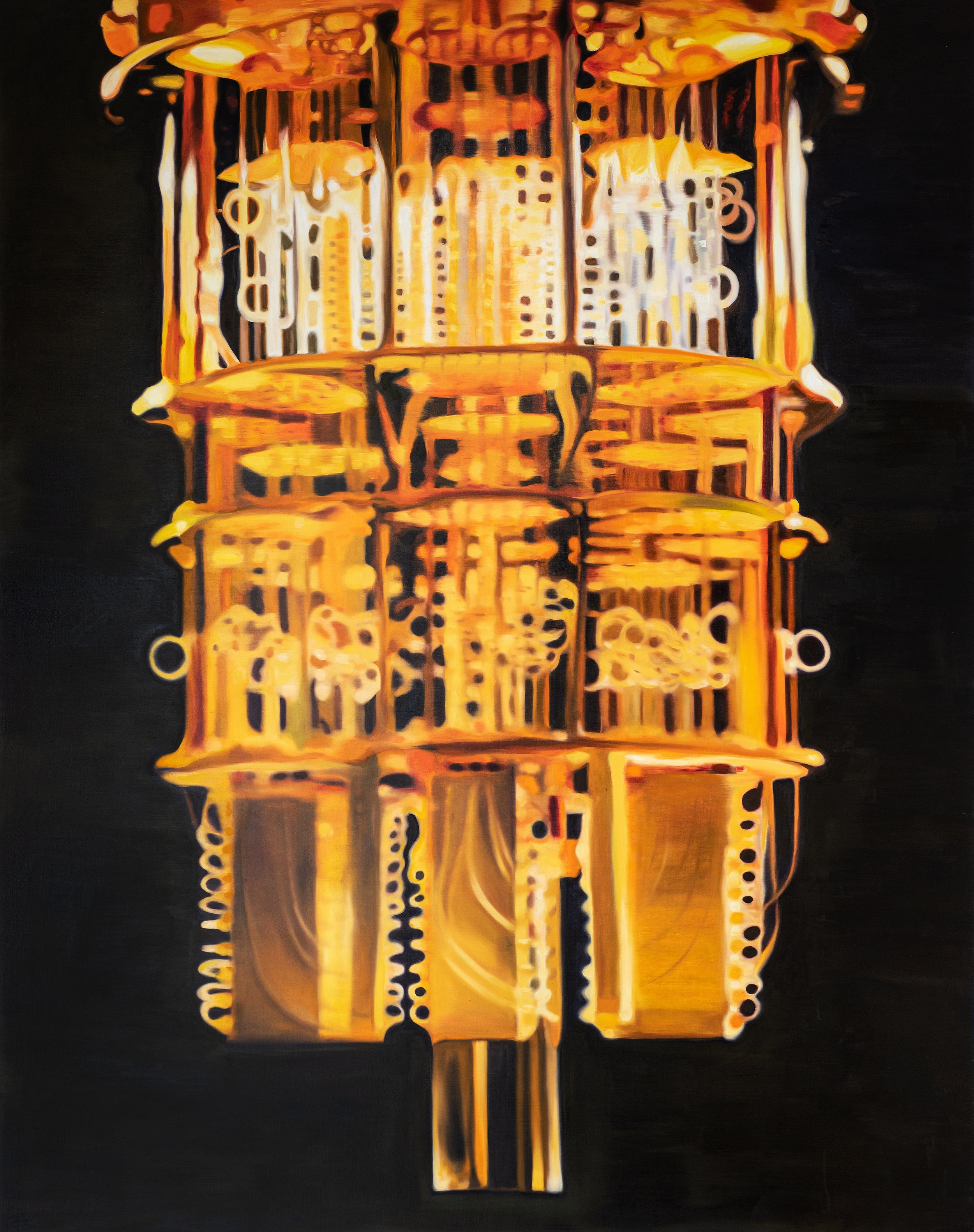
The quantum processor that Tan Mu has painted is a superconducting device, and the superconducting state is a state of matter in which electrical resistance drops to zero and the material can carry current without any loss of energy, a state that occurs at temperatures near absolute zero, at temperatures that are colder than the coldest place in the known universe, at temperatures that can only be achieved inside a dilution refrigerator, which is the tall, cylindrical structure that sits above the processor chip in the physical machine and that contains the cooling stages and the heat exchangers and the mixture of helium isotopes that produces the temperature gradient from room temperature at the top of the refrigerator to approximately fifteen millikelvins at the bottom, where the processor chip resides. The chip itself is made of niobium or aluminum or some other superconducting metal, and the qubits are etched onto its surface using lithographic techniques that are similar to the techniques used to manufacture classical computer chips, except that the features are larger, because the qubits require a physical separation that the transistors on a classical chip do not, and the qubits are connected by microwave resonators that carry signals between them, and the entire assembly is surrounded by magnetic shielding and thermal shielding and radiation shielding, because the qubits are so sensitive that any external disturbance, a stray photon, a fluctuation in the magnetic field, a vibration in the building, can cause them to decohere, to lose their quantum state, to collapse from superposition into a single definite state, and the challenge of building a quantum computer is not only the challenge of fabricating the qubits and connecting them but the challenge of protecting them from the environment long enough to perform a calculation, long enough to run an algorithm, long enough to do something useful with the quantum advantage that the qubits provide, and the difficulty of this protection is the reason that quantum computing has been called the noisy intermediate-scale quantum era, the NISQ era, the era in which we have enough qubits to be interesting but not enough to be useful, in which the qubits are noisy and the algorithms are short and the error rates are high and the practical applications are still on the horizon, and the painting of this machine is the painting of a promise, a promise that the quantum computer will one day solve problems that no classical computer can solve, that it will simulate molecules and optimize logistics and break encryption and model the weather and do all the things that the press releases say it will do, and the painting does not judge whether the promise will be kept, it simply records the promise as a fact about the present, as a fact about the way the machine looks and the way the machine makes the viewer feel and the way the machine reflects the mind that made it, and the feeling is awe, the same awe that IBM designed the glass cube to produce, the same awe that the press releases are designed to produce, the same awe that Tan Mu has described in her own words, when she says that she approaches quantum computing as a subject that expands the boundaries of what humans can think through and solve, and the painting is the record of that awe, the trace of that awe, the mark that the awe has left on the linen, in the oil, in the golden lines that radiate from the center of the canvas like the glow of a processor chip that is performing calculations that no human mind can follow but that every human mind can recognize as a version of its own activity.
Agnes Martin painted grids throughout her career, from the early 1960s until her death in 2004, and the grid in a Martin painting is not a representation of anything. It is a structure, a pattern of horizontal and vertical lines drawn in graphite on a canvas that has been painted in a thin wash of color, and the lines are drawn with a ruler and they are spaced at regular intervals and they extend from edge to edge of the canvas, and they produce an effect that is difficult to describe in words because it is not an effect of representation but an effect of presence, an effect of the painting being present in the room with the viewer, an effect of the surface being active, an effect of the light falling on the canvas and the graphite lines catching the light and the pale color of the ground reflecting the light and the combination of the two producing an experience that is not visual in the ordinary sense but perceptual, an experience of the surface as a field of subtle variation, of the lines as a pulse or a rhythm or a breath, of the painting as an object that is not representing the world but existing in it, existing in the room, existing in the light, existing in the attention of the viewer who is standing in front of it and who is aware, as they look, that they are not looking at a picture of something but at something that is itself, a painted surface with lines on it, and that the experience of looking at this surface is the experience that Martin intended, not the experience of seeing a grid but the experience of seeing a surface that has been marked with a grid, not the experience of recognizing a pattern but the experience of attending to a surface that has been organized according to a pattern, and the pattern is the vehicle, not the destination, the structure is the means by which the surface becomes present, and the presence of the surface is the content of the painting, and the content of the painting is not the grid but the experience of the grid, not the structure but the awareness of the structure, not the information but the consciousness of the information.
The golden lattice at the center of Quantum Gaze operates in a related register. It is a grid, like Martin's grids, and it is a structure, like Martin's structures, and it is a vehicle for the experience of looking, like Martin's painted surfaces, but where Martin's grids are abstract, the grid in Quantum Gaze is representational, it is a representation of the architecture of a quantum processor chip, it is a depiction of a real object that exists in the world and that can be photographed and measured and reverse-engineered, and the tension between the abstract and the representational, between the grid as pattern and the grid as depiction, is the tension that gives the painting its charge, because the viewer can see the grid as both things simultaneously, can see it as a pattern of golden lines on a dark ground, which is how it functions as a painting, and can see it as the architecture of a quantum processor chip, which is how it functions as a representation, and the two ways of seeing are not separate but simultaneous, they are superposed, like the qubits on the chip, like the states of the quantum processor that can be zero and one at the same time, and the painting, by making both ways of seeing available at once, by allowing the viewer to see the pattern and the representation at the same time, enacts in the act of viewing the same condition that the quantum processor enacts in the act of computing, the condition of superposition, the condition of being in two states at once, the condition of being both a grid and a chip, both a painting and a machine, both an aesthetic experience and a scientific document, both the record of a signal and the signal itself. Danni Shen, writing about Tan Mu's practice in Emergent Magazine in February 2024, described the paintings as serving "as a kind of witness to human socio-technological histories," and the word "witness" is precise in its application to Quantum Gaze, because the painting does not advocate for quantum computing or against it, does not celebrate its promise or mourn its limitations, but witnesses it, records it, makes it present on the canvas in the same way that Agnes Martin's grids make the surface present, by organizing the surface according to a structure that allows the viewer to see what is there, to see the grid and the chip and the pattern and the machine and the pattern-as-machine and the machine-as-pattern, and to recognize that what they are seeing is not only a painting of a quantum processor but a painting of the act of seeing a quantum processor, a painting of the consciousness that is looking at the machine that is looking back at the consciousness, a painting of the gaze that the quantum processor has provoked, the gaze that the painting returns, the gaze that the viewer completes, the gaze that is both human and machine, both seeing and being seen, both the measure and the measured, both the quantum state and its collapse into the single state of understanding that occurs when the viewer stands before the painting and recognizes, in the golden lines that radiate from the center of the canvas, the architecture of their own thought.
