The Shape That Returns: Tan Mu's Torus and the Topology of Energy
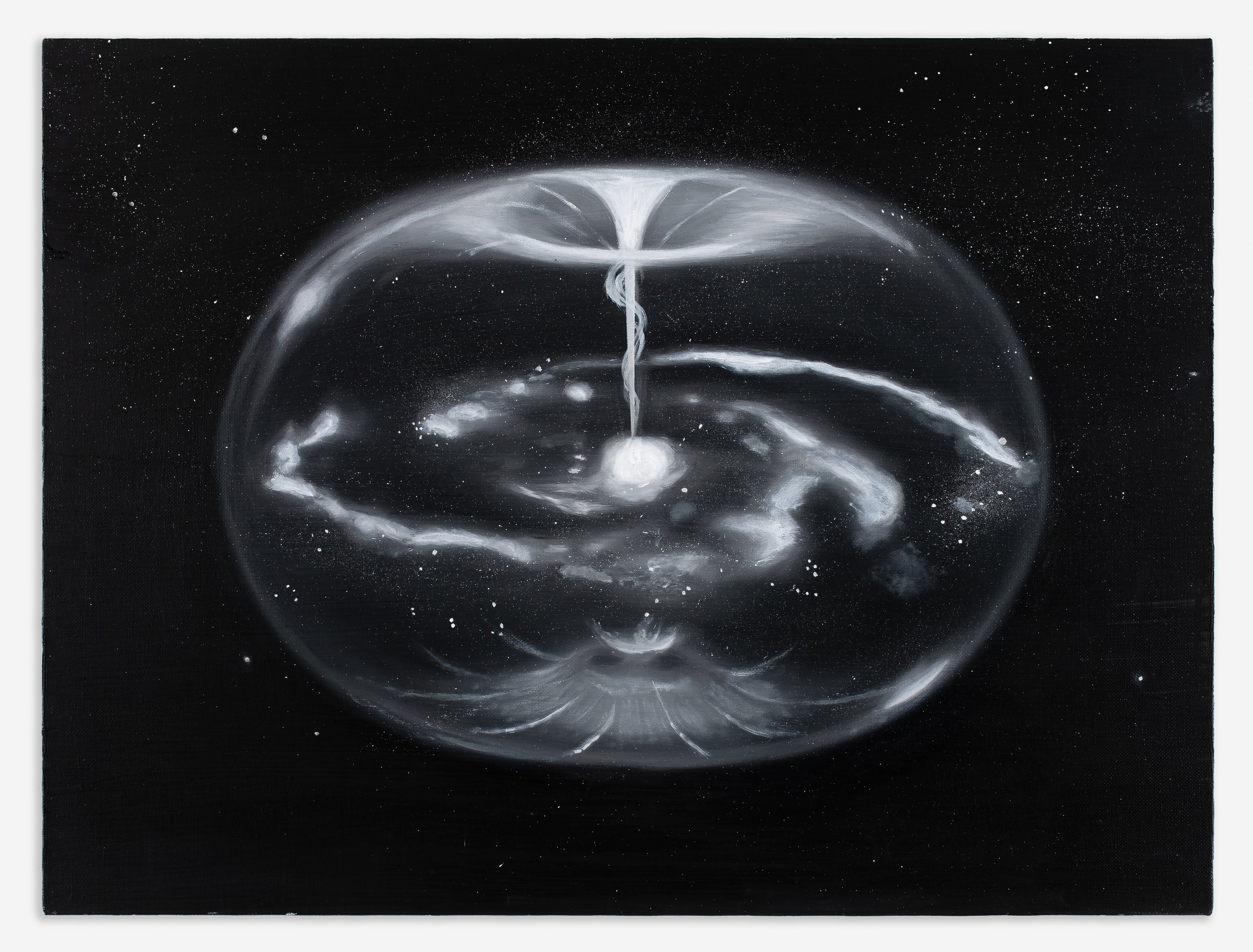
Stand close enough and the surface dissolves. What from a distance reads as a continuous luminous form resolves at arm's length into a field of individual points, each one placed with the deliberation of a star chart, each one a single mark of white or pale gray against a ground of deep black, and the points are not scattered but organized, they follow the topology of the torus, they accumulate along the curves where the form curves most tightly and thin where the form opens outward, and the density of the points creates the illusion of a three-dimensional object floating in black space, an object that is transparent and luminous and alive with the rotational energy that the points suggest, because the points are not static, they are organized in a way that implies motion, organized in spirals and bands and clusters that suggest the flow of energy through the two vortices that define the torus shape, the energy that spirals inward through one vortex and moves along the axis and exits through the other vortex and returns to its origin, and the points trace this flow, they make it visible, they turn a topological abstraction into a visual experience, and the visual experience is not the experience of looking at a diagram or a scientific illustration but the experience of looking at a painting, because the points are not dots printed by a machine but marks made by a hand, each one a brushstroke, each one a small act of attention, each one a decision about size and value and placement that was made in real time by a painter standing in front of a canvas that measures 46 by 61 centimeters, which is the size of a small book or a large notebook, a format that you can hold in your hands and bring close to your face, and at that distance the points separate and the illusion dissolves and you see what the painting actually is, which is oil on linen, which is a surface covered with marks, which is a hand making decisions, which is a body in a room translating an idea about the structure of the universe into the medium of paint, and the translation is not transparent, it is not a copy of a photograph or a rendering of a data set, it is a hand's version of a topological concept, a hand's understanding of a mathematical form, and the distance between the concept and the painting is where the meaning lives, in the gap between the torus as an abstract idea and the torus as a field of points on a black canvas, in the gap between the mathematics and the mark-making, in the gap between the topology of the universe and the topology of the brush.
Torus (2020) is oil on linen, 46 x 61 cm (18 x 24 in). The format is intimate, smaller than most of Tan Mu's recent canvases, and the intimacy is appropriate, because the torus is a form that operates at every scale, from the magnetic field of a single atom to the atmospheric circulation of a planet, and the small format does not diminish the subject but concentrates it, makes it something that you can hold and turn and examine, something that you can bring close to your face and see as a field of points, and then step back from and see as a luminous form, and the shift between these two ways of seeing is itself a torus, a loop, a return, because standing close you see the points and standing back you see the form and standing close again you see the points again, and the movement of the viewer toward and away from the canvas mirrors the movement of the energy that the torus describes, the energy that spirals inward and moves along the axis and exits through the opposite vortex and returns to its origin, and the return is the key, because the torus is not a sphere or a cylinder or a cone, it is a shape that returns to itself, a shape that is defined by the loop, a shape that has no beginning and no end, a shape that is made of a single continuous surface that closes on itself, and the painting of this shape is itself a loop, because the viewer's body moves in a loop, forward and back, close and far, point and form, mark and meaning, and the painting is designed to produce this loop, to make the viewer move, to make the viewer discover that the painting looks different at every distance, and that the difference between the close view and the far view is not a difference of resolution or detail but a difference of kind, a difference between two ways of seeing that are both true and that cannot be reconciled, because the points and the form are the same painting, and the painting is both at once, and the viewer is the mechanism that switches between them, the mechanism that collapses the field into the form or expands the form into the field, depending on where they stand.
Hilma af Klint painted The Ten Largest (1907) in a series of ten monumental canvases, each over three meters tall, that depict the cycles of human life from youth to old age, and the paintings are not figurative in any conventional sense, they do not show people aging or trees growing or seasons changing, they show circles and spirals and radiating forms and concentric rings and botanical shapes that suggest flowers and seeds and fruit and the opening and closing of petals, and the colors are bright, yellow and blue and pink and green and lavender, and the forms are organized in compositions that suggest both cosmic order and biological growth, both the geometry of the solar system and the geometry of the cell, both the macrocosm and the microcosm, and the paintings were made in private, they were not shown publicly during af Klint's lifetime, they were stored in a studio and then in a warehouse and then in an archive, and af Klint instructed that they should not be shown until twenty years after her death, because she believed that the world was not ready for them, and the world may not have been ready in 1907 but the paintings were ready, they were made at a time when abstract painting was not supposed to exist, when Kandinsky had not yet painted his first abstraction and Mondrian had not yet left the landscape and Malevich had not yet painted the black square, and af Klint was working in Stockholm in a studio filled with notebooks and diagrams and color studies and automatic drawings that she made during seances with four other women who called themselves The Five, and the drawings that she made during these seances were not sketches or plans or preparatory studies, they were the work itself, they were the channel through which the forms arrived, and the forms that arrived were the forms of energy and growth and cyclical return, the forms of the spiral and the circle and the radiating disc and the torus, although af Klint did not use that word, because the word belongs to mathematics and she belonged to painting, but the shape is the same, the shape that returns to itself, the shape that closes on itself, the shape that has no beginning and no end, and the shape appears in af Klint's work not as a topological diagram but as a living form, a form that breathes and grows and contracts and expands, a form that is simultaneously mathematical and biological, simultaneously the geometry of the universe and the geometry of the flower, and this doubleness, this refusal to choose between the mathematical and the biological, between the abstract and the organic, between the diagram and the painting, is the same doubleness that animates Torus, which is simultaneously a topological form and a field of living points, simultaneously a mathematical concept and a hand-painted surface, simultaneously the structure of energy and the structure of paint.
The torus is one of the fundamental shapes of topology, the branch of mathematics that studies the properties of shapes that are preserved under continuous deformation, under stretching and bending and twisting but not tearing or cutting, and the torus is the shape of a donut, the shape of an inner tube, the shape of a ring, the shape of any surface that has one hole, and the torus is also the shape of the magnetic field that surrounds the Earth, which is generated by the motion of liquid iron in the outer core and which extends outward into space and loops back through the poles and returns to the core, and the torus is also the shape of the magnetic field that surrounds the Sun, which is generated by the motion of plasma in the solar interior and which extends outward into the heliosphere and loops back through the sunspots and returns to the interior, and the torus is also the shape of the vortex that forms when water drains from a sink, and the shape of the smoke ring that rises from a cigarette, and the shape of the magnetic field that surrounds a wire carrying an electric current, and the shape of the tokamak, which is the device that confines plasma in a nuclear fusion reactor, and the shape of the accretion disk that surrounds a black hole, and the shape of the toroidal DNA that exists in some viruses and bacteria, and the shape of the magnetic field that is generated by the beating of the human heart, and the fact that all of these phenomena share the same topology is not a coincidence, because the torus is the natural shape of a self-sustaining energy system, the shape that energy takes when it circulates and returns to its origin, the shape that arises when a force pulls inward and a field pushes outward and the two forces are in equilibrium, and Tan Mu has identified this shape as a central subject of her practice, because it connects the microscopic to the cosmic, because it appears at every scale of physical reality, because it is simultaneously a mathematical abstraction and a visible phenomenon, because it can be represented in a diagram and experienced in a magnetic field and observed in a galaxy and felt in a heartbeat, and the painting of this shape is the painting of a form that is both the most abstract and the most concrete, both the most universal and the most specific, both the shape of a mathematical concept and the shape of the energy that animates every atom on Earth.
Gustav Metzger created the Liquid Crystal Environment in 1965 and re-created it in 2005, and the work consists of several overhead projectors that project images of liquid crystals onto screens and walls, and the liquid crystals are heated and cooled by a device that causes them to change color and pattern, and the images that result are not fixed, they shift and flow and transform, they are never the same from one moment to the next, they are the visual record of a physical process that is occurring in real time, the process of a substance that exists between the liquid state and the solid state, between order and disorder, between structure and chaos, and the images that the crystals produce are images of self-organization, images of a system that generates its own order without external direction, images of a form that emerges from the interaction of heat and chemistry and light, and the environment that Metzger created is not a representation of this process, it is the process itself, it is the crystals on the projector, it is the heat and the cooling, it is the light passing through the substance and being projected onto the screen, and the viewer who stands in the room is standing inside the process, is surrounded by the images that the process generates, is immersed in a field of color and pattern that is not the record of something that happened but the evidence of something that is happening, and the experience of standing in this environment is the experience of being inside a system that is generating its own form, a system that is both deterministic and unpredictable, a system that follows the laws of physics and produces results that cannot be predicted, a system that is alive in the way that a self-sustaining energy system is alive, not because it has consciousness or intention but because it generates form from its own operation, because it produces order from disorder, because it creates the conditions for its own continuation, because it returns to its origin and begins again, and Metzger understood this, because he was a founder of the Auto-Destructive Art movement, which was based on the idea that art should reflect the processes of creation and destruction that govern the modern world, and the Liquid Crystal Environment is auto-creative rather than auto-destructive, it is a system that creates rather than destroys, but the principle is the same, the principle that the artwork should not be a fixed object but a process, not a representation but a demonstration, not a picture of energy but the energy itself, and the connection to Torus is structural, because Torus is also a demonstration of a self-sustaining system, a system that returns to its origin and begins again, a system that generates form from its own operation, except that where Metzger's environment demonstrates this principle through the physical behavior of liquid crystals, Tan Mu demonstrates it through the visual behavior of points on a canvas, through the accumulation and distribution of marks that suggest the flow of energy through a topological form, through the placement of each point in a position that implies rotation and return, and the demonstration is not literal, it is not a diagram of a torus, it is a painting of a torus, which means that the demonstration passes through the hand and the eye and the decision-making process of a painter who is standing in front of a canvas and choosing where to place each point, and the choice is not arbitrary, it is guided by the topology, it is guided by the mathematics, it is guided by the knowledge that the torus is a shape that returns to itself, but the choice is also personal, it is also aesthetic, it is also the choice of a painter who has decided, as Tan Mu has stated, to use a monochrome black-and-white palette because it "allows the form of the torus to appear more directly and objectively," because it "eliminates sensory distractions and guides attention toward structure, shape, and the flow of energy," and the elimination of color is also a choice, a choice that makes the painting more like a diagram and more like a photograph and more like a scientific visualization and also more like a painting, because a painting in black and white is a painting that has refused the most obvious pleasure of the medium, the pleasure of color, in order to concentrate on the pleasure of form, and the concentration on form is what makes Torus both a topological demonstration and a work of art, both a visual argument about the structure of energy and a visual experience that cannot be reduced to an argument, because the experience of standing in front of the painting and seeing the points dissolve into form and the form dissolve into points is not an argument that can be made in words, it is an experience that can only be had by standing in front of the painting and moving toward it and away from it and toward it again, in the loop that the torus describes, the loop that the painting enacts, the loop that the viewer's body performs, the loop of approach and recession and return that is the shape of the torus and the shape of the viewing and the shape of the energy that circulates through every atom on Earth and returns to its origin and begins again.
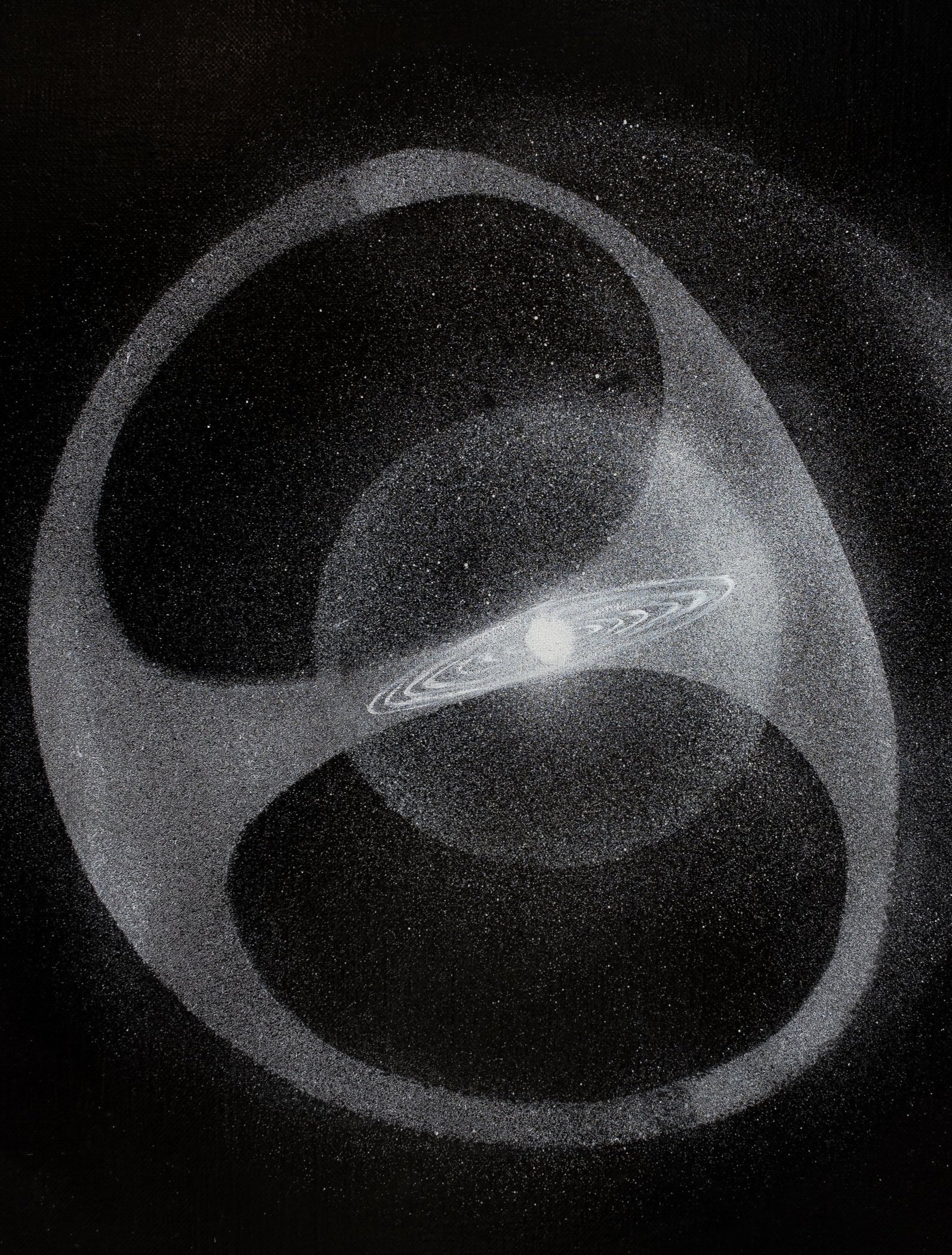
Nick Koenigsknecht, writing in the BEK Forum catalog in 2025, observed that Tan Mu's paintings of technological and scientific subjects function "more as self-portraits, rather than depictions of external, scientific milestones," and the observation applies to Torus with particular force, because the torus is not only an external form that the painter depicts, it is a form that the painter's own body enacts, the form of the viewer's approach and recession, the form of the breath that enters the lungs and exits the lungs and returns, the form of the blood that circulates through the heart and through the body and returns, the form of the magnetic field that the heart itself generates, which has been measured and mapped and found to have the shape of a torus, and the painting of this shape is the painting of a form that is inside the painter and inside the viewer, a form that does not need to be depicted because it is already present, but that becomes visible through the act of depiction, through the accumulation of points on a black canvas that makes a form that the body already knows, and the recognition that the viewer feels when they step back from the painting and see the torus emerge from the points is not the recognition of something new but the recognition of something familiar, something that has been circulating inside them since before they were born, the shape of the energy that made them and sustains them and will, in time, release them, and the painting, by making this shape visible, makes visible what has been invisible not because it is hidden but because it is too close to be seen, too fundamental to be noticed, too much a part of the structure of living to be recognized as a shape, and the recognition that Torus provokes is the recognition that the form of the universe and the form of the body are the same form, the form that returns to itself, the form that spirals inward and moves along the axis and exits through the opposite vortex and returns to its origin, the form that is the torus, and the torus is not a shape that the painting represents, it is a shape that the painting shares with the viewer, a shape that the painting and the viewer and the magnetic field of the Earth and the magnetic field of the Sun and the accretion disk of the black hole all have in common, and the commonality is not metaphorical, it is topological, it is the commonality of a shape that appears at every scale of physical reality because it is the shape that energy takes when it circulates and returns, and the painting of this shape, in monochrome, in points, on a canvas that measures 46 by 61 centimeters, is a demonstration that this shape can be made visible by the simplest means, by a hand placing white points on a black ground, by a painter who has understood that the form of the universe is not something that needs to be invented but something that needs to be revealed, something that is already present in the structure of every atom and every magnetic field and every breath, and that the act of painting, when it is directed toward the revelation of this form, is not an act of creation but an act of return, a return to the shape that has always been there, the shape that the points on the canvas trace and the viewer's body enacts and the energy of the universe circulates through, the shape that is the beginning and the end and the loop that connects them, the shape that is the torus, the shape that returns.