Six Panels of Falling Water: Tan Mu and the Documentary Power of Painting
The frontispiece of Arthur Mason Worthington's 1895 book shows three photographs of a milk drop striking a plate, and the rest of the book shows hand-drawn illustrations. This is not because Worthington preferred drawing to photography. It is because his camera could not capture what his eye could see. The flash technology of the 1890s, which consisted of an open shutter, a dark room, and a single spark from an induction coil, could record the splash at three points during its trajectory: the initial impact, the formation of the crater, and the rise of the corona. But the finer stages of the event, the moment when the rim of the crater thins and begins to segment into ligaments, the moment when the ligaments break into droplets, the moment when the central jet rises from the crater floor and separates into a satellite droplet that climbs above the main splash and hangs in the air for a fraction of a second before falling back, these moments were too brief and too finely differentiated for the photographic apparatus of the time, and Worthington, who had spent years observing these splashes with his own eyes in a darkened room, watching the same drop fall from the same height onto the same surface thousands of times, training his attention on the microseconds that the camera missed, made drawings of what he had seen, and the drawings were considered more accurate than the photographs, because the drawings incorporated the knowledge that comes from repeated observation, the kind of knowledge that a single exposure cannot provide, the kind of knowledge that accumulates across hundreds of repetitions and allows the observer to fill in the gaps between the frames, and this is the paradox that sits at the center of Tan Mu's The Splash of a Drop 1 (2022): that in 1895, the most precise record of a physical event was not a photograph but a drawing, and that the hand, trained by repetition and attention, could see more than the lens, and that painting, which is the most manual and the most time-consuming of the image-making arts, might be the medium best suited to record an event that lasts less than a second, because painting, unlike photography, does not freeze a single instant but accumulates the memory of many instants into a single surface, and the surface that results from this accumulation carries a kind of information that no single photograph can carry, the kind of information that Worthington was reaching for when he put down his camera and picked up his pen.
The Splash of a Drop 1 is oil on linen, in 6 parts, each: 28 x 36 cm (11 x 14 in), overall: 28 x 216 cm (11 x 84 in). The format is sequential, six small canvases arranged in a horizontal row, each depicting a different stage of the splash, and the sequence reads from left to right like a strip of film or a row of stills pulled from a reel, except that the images are not stills, they are paintings, each one made by hand over the course of hours or days, each one the product of a separate session at the easel, and the consistency across the six panels, the way the light falls at the same angle and the background remains the same deep charcoal gray and the water retains the same pale silvery blue, is not the consistency of a camera that has been fixed in position but the consistency of a hand that has learned to reproduce the same conditions across multiple sessions, the consistency of a painter who has internalized the sequence so thoroughly that each panel feels as though it were painted in a single breath, and the scale of each panel, 28 by 36 centimeters, is intimate, the size of a notebook page or a photograph in an album, and the overall span of the six panels, 216 centimeters, is the width of a long shelf or a mantlepiece or a section of wall that a viewer walks along, reading the sequence as they move, and the physical act of walking past the panels mirrors the temporal act of watching the splash unfold, because the splash is an event in time and the installation is an event in space, and the viewer's body, moving from left to right along the row of canvases, becomes the clock that measures the duration of the splash, becomes the mechanism that transforms spatial sequence into temporal experience, becomes the instrument that translates the static images into a dynamic event, and the translation is not perfect, it cannot be perfect, because the time between one panel and the next is not the time of the splash but the time of the viewer's step, and the gap between the panels is not the gap between frames on a filmstrip but the gap between one glance and the next, and this gap, this space between the images where the viewer's imagination must fill in what the paintings do not show, is where the documentary power of painting asserts itself, because it is precisely in the gaps, in the moments between the panels, that the hand and the eye and the memory of the viewer complete what the camera cannot, and what Worthington completed with his pen.
Eadweard Muybridge's The Horse in Motion (1878) is a sequence of twelve photographs arranged in a grid, four rows of three images, each image showing a horse at a different point in its gallop, and the sequence was made using twelve cameras placed along a track, each camera triggered by a thread that the horse broke as it ran past, and the result was a set of images that, for the first time in history, showed the positions of a horse's legs during the different phases of the gallop, and the result settled a bet that had been running for years, the question of whether all four of a horse's hooves leave the ground simultaneously during the gallop, and the answer, which no human eye had been able to see and no painter had been able to determine, was that they do, but only when the legs are gathered beneath the body, not when they are extended, and the discovery was not only a fact about horses but a fact about the limits of human perception, a demonstration that the eye cannot see what happens at the speed of a gallop and that the camera, which is not limited by the persistence of vision, can see what the eye cannot, and Muybridge understood this, and he spent the next two decades producing sequential photographs of animals and humans in motion, running and jumping and walking and throwing and sitting down and standing up, and the images were published in eleven volumes under the title Animal Locomotion (1887), and they were used by scientists and artists and physiologists and engineers, and they changed the way that motion was understood and represented, because they showed that the body in motion passes through positions that no observer had ever seen, positions that are invisible to the unaided eye, positions that exist only in the fraction of a second between one heartbeat of perception and the next.
The relationship between Muybridge's sequential photographs and Tan Mu's six panels is not one of influence but one of structure. Muybridge arranged his images in grids and strips, and the arrangement was not merely a convenient format for display but an argument about the nature of time, an argument that time can be divided into discrete instants and that each instant can be captured and fixed and compared with the instants that precede and follow it, and that the sequence of instants, when viewed together, reveals the logic of the motion that produced them. Tan Mu's six panels make the same argument, but they make it in a different medium, and the difference in medium changes the argument, because a photograph captures an instant through the action of light on a photosensitive surface, and a painting constructs an instant through the action of a hand on a canvas, and the photograph is an index of the event, a trace left by the light that reflected off the splash, while the painting is an interpretation of the event, a record made by a hand that has looked at the splash and thought about the splash and decided how to represent the splash, and the difference between the index and the interpretation is the difference between what the camera sees and what the painter knows, the difference between a single exposure and an accumulated understanding, the difference between a moment and a memory, and Worthington understood this difference in 1895 when he chose to supplement his three photographs with dozens of hand-drawn illustrations, because the photographs showed what the splash looked like at three moments, but the drawings showed what the splash was, and the distinction between looking like and being, between appearance and knowledge, is the distinction that The Splash of a Drop 1 occupies and extends and makes visible across its six small panels, each one a painting that knows more than a photograph can show.
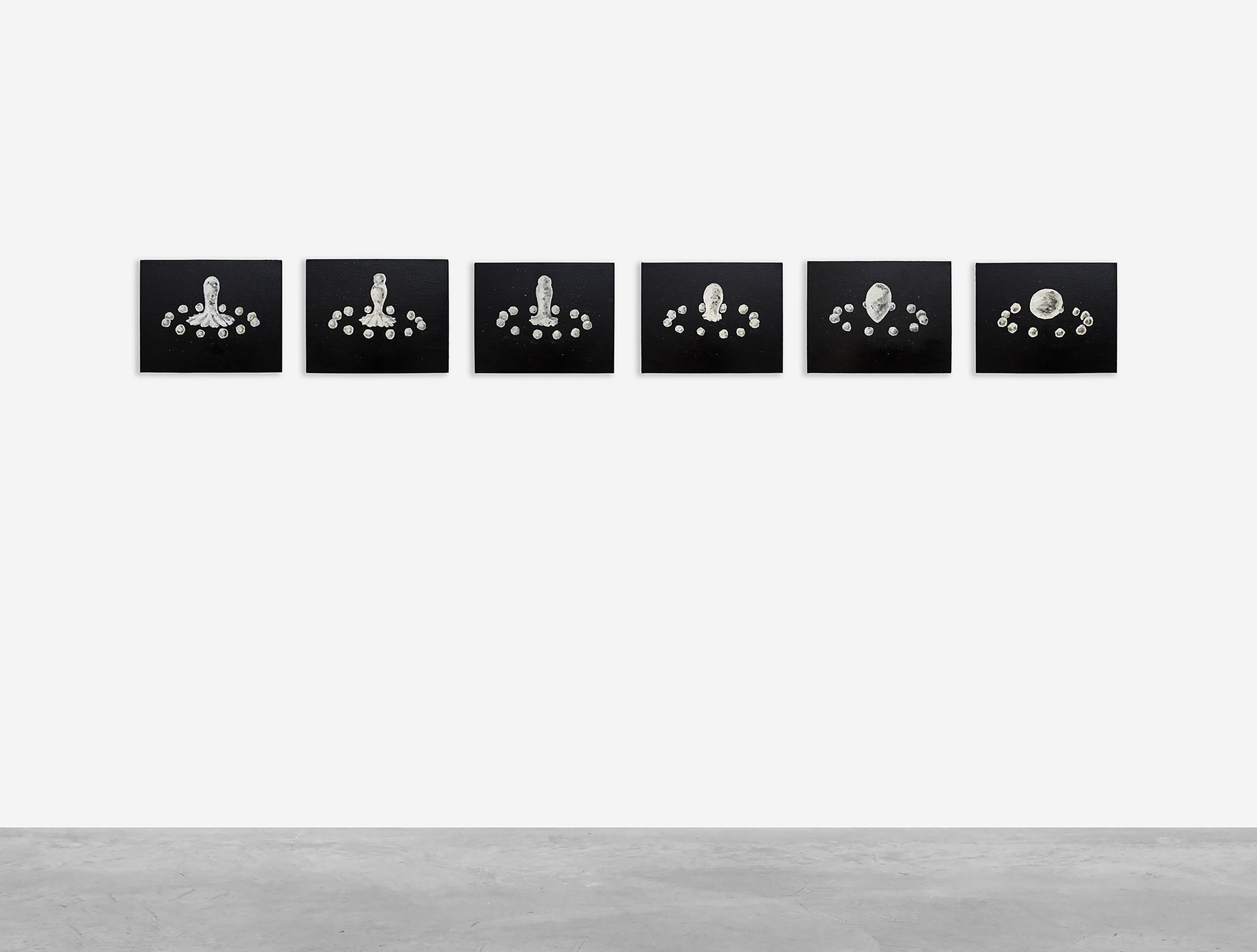
The physics of a splashing drop has been studied with increasing precision since Worthington's first experiments in the 1870s, and the basic phenomenon is now well understood, though the details remain a subject of active research. A liquid drop falling onto a solid surface creates a crater, and the crater expands radially as the kinetic energy of the falling drop is converted into the motion of the liquid film that spreads outward from the point of impact, and the rim of the crater rises as the film decelerates, and the rim thickens as surface tension pulls liquid toward the edge, and the rim becomes unstable and segments into ligaments, and the ligaments break into droplets that are ejected upward and outward, and a central jet rises from the floor of the crater as the liquid collapses inward, and the jet may produce a satellite droplet that rises above the main splash, and the entire event, from the first contact of the drop with the surface to the last droplet settling back onto the liquid film, takes between ten and fifty milliseconds, depending on the size of the drop, the height from which it falls, the viscosity and surface tension of the liquid, and the properties of the surface it strikes, and Worthington studied all of these variables, varying the height of the drop, the composition of the liquid, the temperature of the surface, and he published his findings in a series of papers that culminated in the 1895 book The Splash of a Drop, and the book is a work of both science and aesthetics, because Worthington was attentive not only to the physical mechanisms of the splash but to the visual beauty of the forms that the splash produces, the symmetry of the crater, the elegance of the ligaments, the grace of the satellite droplet as it separates from the central jet, and he wrote about these forms with the language of an art critic as much as a physicist, calling the crater "a beautiful crater" and the corona "a coronet" and the satellite droplet "a gem," and his drawings are precise but they are also beautiful, they have the quality of scientific illustration at its best, where the precision of the observation and the beauty of the representation are inseparable, and it is this double quality, the scientific and the aesthetic, that Tan Mu has recognized and responded to in her painting, because the painting of the splash is not only a painting of a physical event but a painting of the way that the physical event looks when it is seen by someone who has learned to see it, someone who has looked at it again and again until the forms of the splash have become as familiar as the features of a face, and the painting is a record of that familiarity, a record of the attention that Worthington brought to the splash and that Tan Mu brings to Worthington's record, a record of the way that repeated observation transforms the visible into the known and the known into the painted.
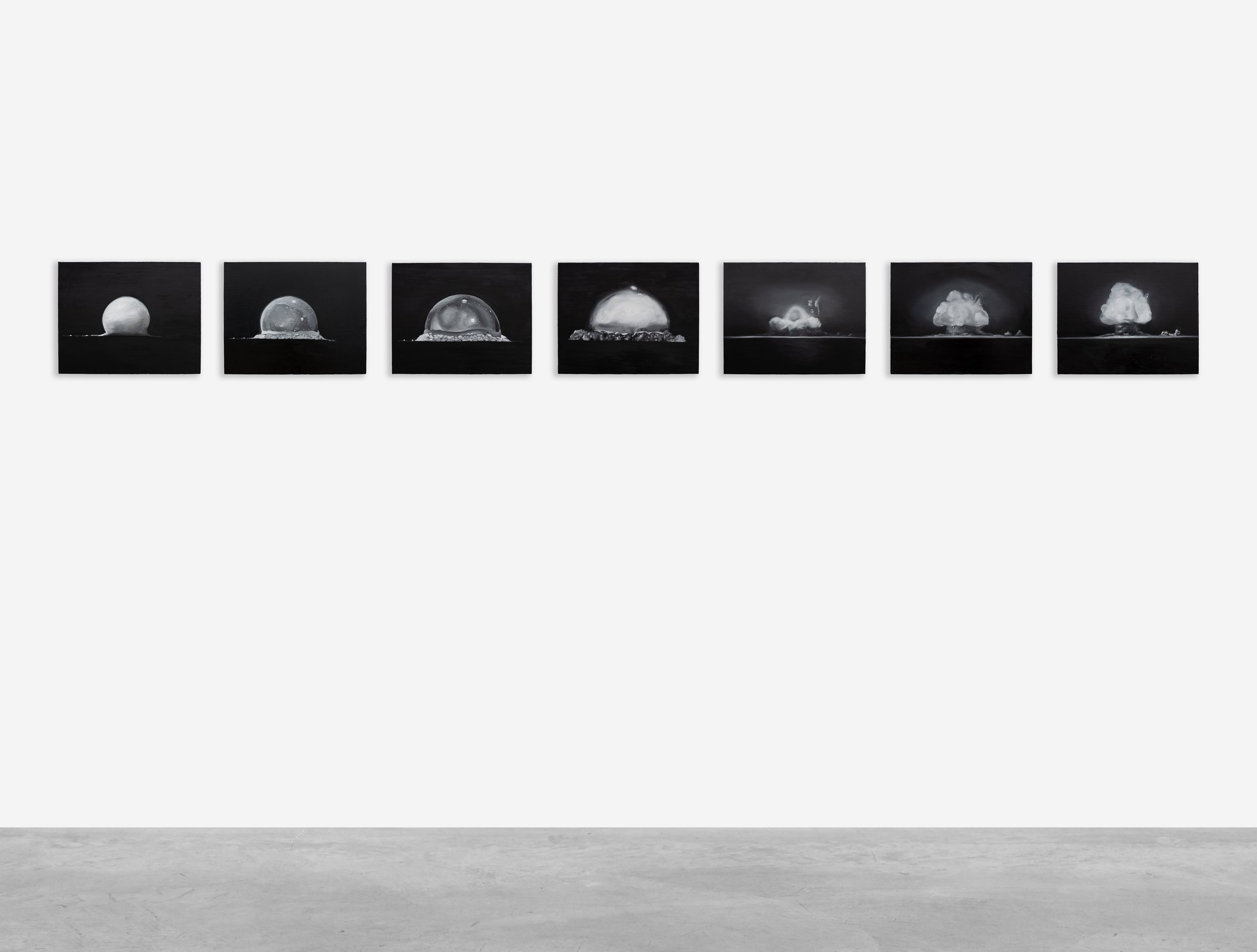
Tan Mu has described The Splash of a Drop 1 as a companion to Trinity Testing (2020), which was exhibited alongside it at the DAWN exhibition at Peres Projects in Berlin, and the two works share the same dimensions, the same format, and the same palette, and the pairing is not incidental, because both works are about the documentation of transient events, events that occur in fractions of a second and that would be invisible to the unaided eye without the technology that makes them visible, and the technology in the case of Trinity Testing is the high-speed camera that photographed the first nuclear detonation at the Trinity site in New Mexico on July 16, 1945, and the technology in the case of The Splash of a Drop 1 is the spark photography that Worthington used in the 1890s to capture the splash of a milk drop, and the difference in scale between the two events, the nuclear explosion that released the energy of nineteen thousand tons of TNT and the milk drop that released the energy of a fall from a few centimeters, is bridged by the similarity of the technology that recorded them and the similarity of the paintings that represent them, and the bridge is the argument that the scale of the event is less important than the act of recording it, that what matters is not the magnitude of the transformation but the fact that the transformation has been observed and documented and represented, and that painting, as a medium of documentation, does not distinguish between the enormous and the minute, between the detonation that destroys a desert and the splash that disturbs a puddle, because the painting does not record the energy of the event but the appearance of the event, and the appearance of the nuclear fireball and the appearance of the milk drop are, at the level of form, not so different, both are spherical expansions followed by radial disintegration, both produce coronas and ligaments and satellite forms, both pass through phases that are invisible to the unaided eye, and both have been made visible by technology and then re-made visible by painting, and the painting, in both cases, is the final stage of the documentation, the stage at which the mechanical record is transformed into a manual record, the stage at which the photograph becomes a painting, the stage at which the instant of the event is replaced by the duration of the hand.
Cy Twombly's The Four Seasons (1993-94) is a four-panel painting, each panel depicting one season of the year, and the sequence is not a narrative but a meditation on time and transformation, on the way that the same motifs, flowers and leaves and light and color, change across the cycle of the year, and the panels are large, each one roughly three meters tall and two meters wide, and they are installed in a room at the Museum of Modern Art in New York where the viewer stands among them as if standing among the seasons themselves, and the scale of the panels is not the scale of the natural world but the scale of the room, the scale of the body, the scale of the experience of standing in front of a painting and being addressed by it, and the sequence of the panels is the sequence of time, spring to summer to autumn to winter, and the sequence is irreversible, the seasons do not run backward, and the viewer who walks from the first panel to the last panel walks through the year, and the walk takes as long as it takes to cross the room, a few seconds, and the year that the walk traverses is not the year of the calendar but the year of the painting, the year that Twombly has compressed into four panels, and the compression is not a reduction but a concentration, the year is not diminished by being condensed into four panels but intensified, because each panel carries the weight of its season, and the weight of the season is the weight of all the seasons that have ever been, the weight of the cycle itself, the weight of time passing and returning and passing again.
Tan Mu's six panels operate in a related register of temporal concentration, but where Twombly's panels compress a year into a room, Tan Mu's panels compress a fraction of a second into a wall, and the compression is not from the year to the step but from the millisecond to the glance, and the intensity of the concentration is proportional to the brevity of the event, because the shorter the event, the more concentrated the representation, and the more concentrated the representation, the more the viewer becomes aware of the gap between the time of the event and the time of the viewing, the gap between the ten milliseconds of the splash and the ten seconds it takes to walk past the six panels, and the gap is not a deficiency but a condition, because it is in the gap that the documentary power of painting becomes legible, the power that comes from slowing down what the camera freezes, from extending what the photograph truncates, from giving the viewer time to see what the event does not have time to show, and Li Yizhuo, writing about the DAWN exhibition in Kaltblut Magazine in October 2022, observed that The Splash of a Drop and Trinity Testing, "of radically different topics, bear striking resemblance in their form, palette, and sequence," and the resemblance is the argument, because the resemblance between a milk drop and a nuclear explosion is not a coincidence but a demonstration that the formal logic of expansion and disintegration is the same at every scale, and that painting, by representing the formal logic rather than the physical magnitude, can make the universal visible in the particular, can make the structure of a nuclear detonation visible in the structure of a falling drop, can make the passage of a year visible in the passage of a season, can make the duration of a millisecond visible in the span of six small panels on a wall, and can make the act of seeing visible in the act of painting, the act that Worthington performed with his pen and that Tan Mu performs with her brush, the act of looking at something so closely and so repeatedly that the looking becomes a kind of knowledge, and the knowledge becomes a kind of image, and the image becomes a kind of witness to an event that no one can see but that everyone can recognize, because the splash of a drop is one of those events, like the change of a season or the flash of a detonation, that we know happens even though we can never watch it happen, and the painting stands in for the watching, stands in for the time that we do not have and the speed that we cannot match and the attention that we cannot sustain, and it gives us what Worthington's camera could not give us and what his drawings could, which is the knowledge that comes from looking at something for a long time, the knowledge that is not in any single frame but in the accumulation of frames, the knowledge that is not in the photograph but in the painting, the knowledge that lives in the hand and not in the lens, the knowledge that accumulates across the six panels of a falling drop and arrives, in the final panel, at the stillness that follows the splash, the flat surface of the water settling back into equilibrium, the event over, the record complete, the painting finished, the drop returned to the surface from which it came, and the surface, in the last panel, is as smooth as the linen on which it has been painted, as if the painting and the event were the same thing, as if the record and the recorded were indistinguishable, as if the hand that made the mark and the drop that made the splash were performing the same gesture, the gesture of falling and arriving and becoming still.