The Box That Moves the World: Tan Mu's Containers and the Memory of Logistics
In April 2021, a single container ship called the Ever Given ran aground in the Suez Canal and sat there for six days, blocking twelve percent of global trade. The ship is 400 meters long and carries 20,000 containers, and when it turned sideways in the canal, it blocked every vessel that needed to pass between the Mediterranean and the Red Sea, and the ships that were waiting formed a queue that stretched back fifty kilometers in both directions, and the insurance industry calculated the value of the goods that were delayed each day at ten billion dollars, and the meme economy, which is the economy that runs on social media platforms and that treats attention as currency, produced in those six days more jokes and memes and observations about global trade than the previous decade had produced, because the Ever Given had made visible what had been invisible, it had made the infrastructure of globalization visible by blocking it, it had taken the pipe through which the world's goods flow and had turned it into a spectacle, and the spectacle was not the ship, it was the dependency, because what the Ever Given demonstrated was not the fragility of the canal but the fragility of the system that the canal serves, a system in which a single vessel blocking a single channel can delay the delivery of coffee and furniture and car parts and medical supplies and consumer electronics and everything else that moves by sea, which is most of the things that move, because the shipping container is the technology that made globalization possible, the metal box that can be loaded onto a ship and then onto a train and then onto a truck and then onto a dock and then into a warehouse and then onto a shelf without ever being opened, the box that carries your clothes and your electronics and your food and your furniture and your medicine from the factory where it was made to the room where you live, and the box is invisible, it is invisible in the way that all infrastructure is invisible, until it fails, until the ship runs aground or the port backs up or the truck driver cannot cross a border or the chip factory cannot get the materials it needs to make the chips that go into the devices that carry the news of the next disruption, and Tan Mu painted Containers in 2021, in the second year of the pandemic, when the chip shortage was biting and the ports were clogged and the shelves were empty and the container ships were anchored offshore waiting their turn to dock, and she painted not the failure of the system but the system itself, not the crisis but the thing that the crisis had revealed, the thing that had been running so smoothly for so long that it had become invisible, the thing that she knew from childhood, from the harbor at Yantai, where she watched the ships being loaded and the containers moving in and out, where the images of maritime logistics became part of her visual memory before she knew that these images would become the subject of her painting.
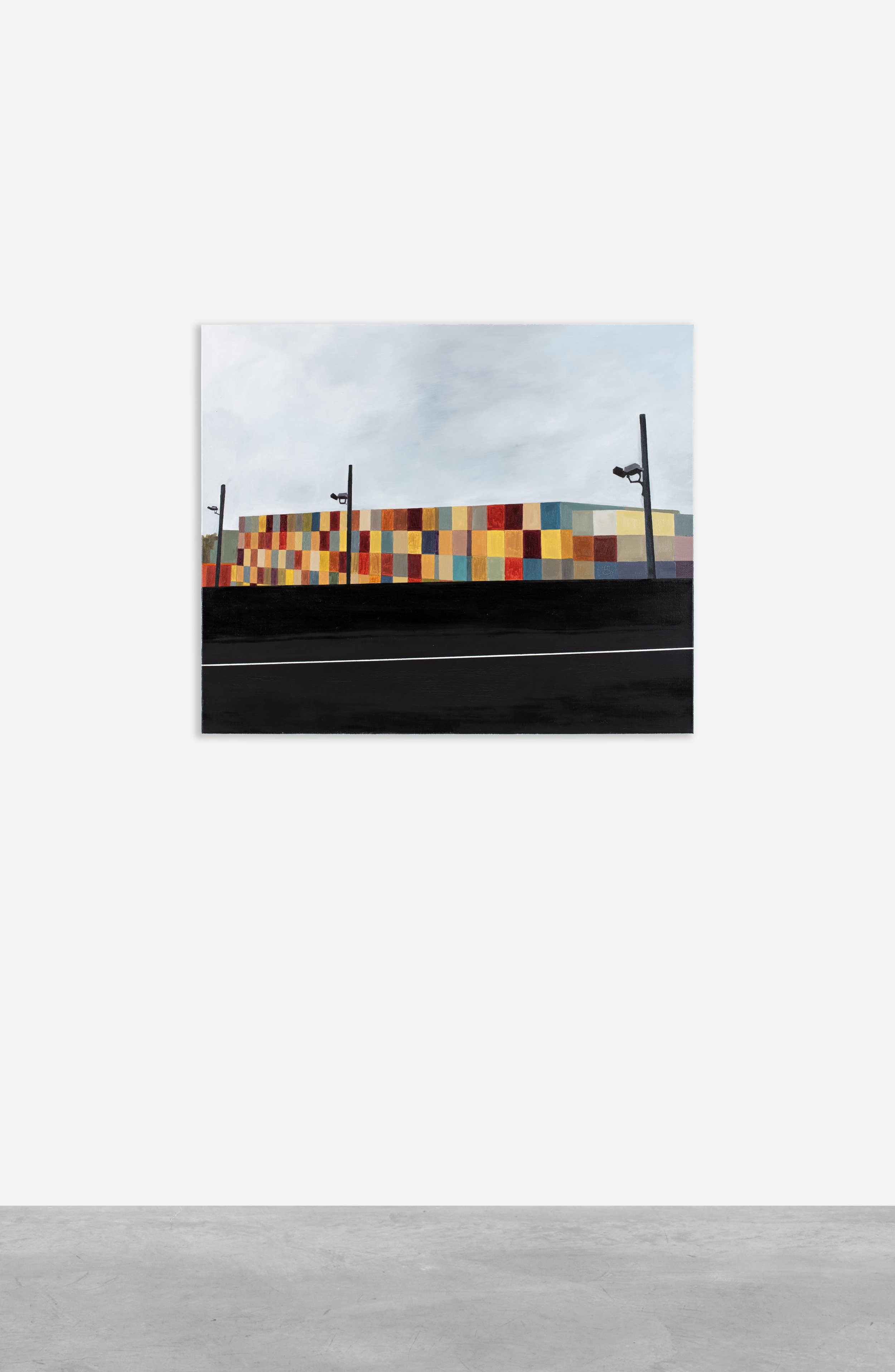
Containers (2021) is oil on linen, 76 x 91 cm (30 x 36 in). The composition is divided into two registers, a dark road in the foreground that runs from the bottom edge of the canvas toward the center of the composition, and beyond the road, a field of shipping containers stacked in rows and tiers, multicolored rectangles of red and blue and green and gray and rust and white, each container a single flat color, each container rendered with the same crisp edge and the same level of descriptive economy, and the containers do not look like photographs of shipping containers, they look like paintings of shipping containers, which means that they have been processed through the hand and the eye and the judgment of a painter who has decided what to keep and what to leave out, who has decided to preserve the color and the rectangle and to eliminate the texture and the rust and the dents and the corporate logos and the identification numbers that would tell you which shipping line owned the container and which port it came from and which port it was going to, and the elimination of this information is not a loss but a gain, because what remains after the information has been removed is the form, the form of the container as such, the form of the metal box that moves the world's goods, and the form is geometric and simple and severe, it is a rectangle with rounded corners and a corrugated surface that Tan Mu has simplified into a flat wash of color, and the rectangles are organized in a grid that is not perfectly regular, because the containers are stacked at different angles and at different heights and the rows overlap and the stacking creates a rhythm of positive and negative space that is more like a city seen from above than like a warehouse or a port, because the stacking of containers in a port yard is a form of urban planning, it is an organization of space that is optimized for density and access and movement, and Tan Mu has rendered this organization with the same attention that a painter of cityscapes would bring to the organization of a city, and the result is a painting that is both a painting of a specific place, the New Jersey highway in the foreground and the stacked containers in the background, and a painting of a general condition, the condition of globalization, the condition in which the goods that surround us have come from somewhere and gone somewhere and passed through many hands and many borders and many ships before they arrived at the shelf or the room where we receive them.
Edward Burtynsky has spent forty years photographing the sites where the world's goods are made and moved, and his photographs of container ships loading and unloading at the ports of Hong Kong and Singapore and Rotterdam and Los Angeles are among the most precise and most beautiful images of industrial infrastructure that exist, because Burtynsky does not photograph industry as destruction, he photographs it as order, he photographs the organization of containers on a ship's deck as if it were a composition by Josef Albers, rectangles of color arranged in a grid that extends from the edge of the frame to the horizon, and the comparison to Albers is not incidental, because Burtynsky's photographs, like Albers's color studies, reward formal analysis, they are paintings made with a camera, paintings that demonstrate that the visual pleasure of organized color and geometry is not limited to the painted surface but extends to the photographed surface, to the world when the world has been organized according to geometric and chromatic principles, and Burtynsky's photographs of container ships and port yards and shipping terminals are also social documents, they show the human labor that underlies the logistics, the workers in helmets and high-visibility vests who move among the containers and the cranes and the trucks, and the workers are present in Burtynsky's photographs as evidence of the human scale within the industrial vastness, as proof that the containers do not move themselves and the ships do not load themselves and the cranes do not operate themselves, that behind every container that arrives at a port there is a worker who loaded it and a worker who unloaded it and a worker who drove the truck that carried it and a worker who packed the goods that are inside it, and the goods themselves were made by workers in factories that Burtynsky has also photographed, in series that show the fabrication of textiles and the extraction of oil and the processing of minerals and the harvesting of food, and all of these photographs, taken together, constitute a portrait of the industrial civilization that produces the world as we know it, a portrait that is neither celebratory nor condemnatory but simply accurate, simply a record of what the world looks like when you follow the chain of production and distribution to its source, and Tan Mu's Containers is a painting that participates in this project, that follows the same impulse that drives Burtynsky's photography, the impulse to make visible the infrastructure that has been made invisible by its own efficiency, the impulse to document not the dramatic moment but the ongoing condition, the impulse to say, here is a shipping container, and here is what it looks like when you pay attention to it, when you do not take it for granted, when you see it as a form and a color and a shape and a system and a history and a future, when you see it as both a box that carries your goods and a symbol of the world that carries you.
The container is a standardized object, and its standardization is its most important property, more important than its strength or its size or its weather resistance or its security features, because the standardization of the container means that any container can be loaded onto any ship and unloaded by any crane and loaded onto any truck and driven to any destination and stacked on top of any other container, and this interchangeability is what made globalization possible, because before the container, loading and unloading a ship was labor-intensive and time-consuming and expensive, it required gangs of dockworkers who would spend hours or days hand-loading each item individually, and the cost of this labor was a significant fraction of the total cost of shipping, and the container changed all of that by standardizing the unit of cargo, by creating a module that could be handled by machines, by making it possible for a single crane operator to load or unload a ship's entire cargo in a matter of hours instead of days, and the effect of this change on the global economy was not incremental but revolutionary, because the cost of shipping a container from Shanghai to Los Angeles is now less than the cost of loading it onto the truck that will carry it from the factory to the port, and this cost structure has made it possible for goods to be made wherever labor is cheapest and sold wherever prices are highest, which has reshaped the manufacturing landscape of the entire planet, which has created supply chains that span multiple countries and multiple continents and multiple oceans, which has made the container ship the workhorse of the global economy, and the container ship is also the symbol of this economy, the visible evidence of the system that delivers your goods, and when a ship like the Ever Given runs aground in the Suez Canal, the system becomes visible, and when Tan Mu paints the containers in her studio, she is making the system visible in a different way, not through disruption but through attention, not through crisis but through painting, and the attention that she brings to the multicolored rectangles and the stacking and the New Jersey highway and the whole composition of the painting is an attention that is both aesthetic and political, both a response to the beauty of the organized forms and a recognition of the labor and the logistics and the history that the forms contain, and the recognition is not separate from the beauty, it is part of the beauty, because the beauty of the painting is the beauty of a form that is also a system, a beauty that includes the human labor and the global movement and the pandemic disruption and the childhood memory of the harbor at Yantai, a beauty that is not separate from the world but embedded in it.
Donald Judd made his first stack in 1961, a column of seven identical boxes, each one the same size and the same color, placed one on top of another at regular intervals, and the stack was not a sculpture in the traditional sense, it was not carved or modeled or welded or assembled from found objects, it was fabricated, it was made to specifications by a metal shop, and the boxes were identical because identity was the point, because the repetition of the same form at regular intervals was an argument about the nature of the object, an argument that the object in art is not a unique handmade thing but a produced thing, a thing that can be specified and reproduced and placed in the world, and the stack does not rest on a pedestal, it rests on the floor, it occupies the same space as the viewer, it is at eye level and knee level and ankle level, it can be walked around and touched and measured with the body, and the body becomes the measure of the object, the body's relationship to the stack is the relationship of one repeated form to another repeated form, the body's height is the measure of the gap between the boxes, the body's reach is the measure of the height of the column, and the body is not separate from the artwork but implicated in it, because the artwork is designed to produce a bodily response, a response of scale and proportion and repetition and rhythm, and the response is not intellectual but perceptual, it occurs in the body before it occurs in the mind, it is the response of the nervous system to a field of identical forms at regular intervals, a response that is musical as much as visual, a response that is about time as much as space, because the stack implies a sequence, one box then another box then another box, a before and an after and a before and an after, and the sequence is open, it could continue upward indefinitely, the stack is not a complete object but an ongoing proposition, a suggestion that the form could be extended, could be added to, could become a column of ten boxes or a hundred boxes or an infinite column of boxes that rises through the floor and the building and the atmosphere and into space.
Tan Mu's containers are stacked, like Judd's boxes, in a vertical organization that implies extension and repetition, and the containers are also identical in their basic form, they are all the same shape, the same corrugated metal rectangle with the same rounded corners and the same door end and the same structural geometry, and Tan Mu has emphasized this identity by rendering each container as a flat rectangle of a single color, she has removed the individualizing marks, the identification numbers and the corporate logos and the country codes and the safety certifications, she has reduced each container to its essential form, the form that all containers share, the form that is the container as such, and the result is a field of rectangles that is closer to Judd's stacks than it might at first appear, because both works are organized around the repetition of a standard unit, both works demonstrate that the repetition of an identical form produces an aesthetic experience that is different from the experience of a unique form, and the difference is the difference between a system and an object, between an object that exists in relation to other objects and an object that exists as part of a series, and the containers in Tan Mu's painting exist as part of a series that extends beyond the frame of the painting, there are more containers in the port yard that are not shown, there are more ships at sea that are not shown, there are more containers in transit that are not shown, the series is open, it continues beyond the painting, it is the series of all containers everywhere, and Li Yizhuo, writing about Tan Mu's practice in the BEK Forum catalog in 2025, observed that "the constellation in Tan Mu's paintings points away from subject or telos toward a telecommunication system," and this observation applies to Containers as well, because the stacked rectangles in the painting do not point toward the specific containers that they represent but toward the system that those containers constitute, the system of global logistics that moves goods from factory to consumer, and the system is what Tan Mu is painting, not the individual container but the system, not the object but the network, not the box but the flow, and the flow is what Li Yizhuo means when she speaks of the constellation pointing away from the individual star and toward the pattern that the stars make, and the pattern that the containers make in Containers is the pattern of the global supply chain, which is the largest and most complex system of coordination that human beings have ever created, a system that touches every person on the planet, that delivers the goods that constitute the material life of civilization, that operates invisibly until something disrupts it and makes it visible, and Tan Mu, by painting the containers, has made the system visible not through disruption but through art, has shown the pattern that the individual boxes make when they are stacked and organized and counted and shipped and received and unloaded and loaded again and stacked again in another port yard in another country, the pattern that is the infrastructure of globalization, the pattern that Li Yizhuo recognizes as the true subject of the painting, the subject that is not the individual object but the system that the object enters, the subject that is not the container but the flow, not the box but the journey, not the stillness of the stacked forms but the movement that the stillness implies, the movement of goods from one side of the world to the other, the movement of the economy from one season to the next, the movement of the painting from the harbor at Yantai to the highway in New Jersey to the studio where the painter has transformed the photographs and the memories and the observations into a composition that holds all of these movements at once, in a single image, on a single canvas, at a human scale, at a scale that you can hold in your mind and carry with you, like a container, like a box that contains what it has received and delivers it intact to wherever it is going, which is the room where the viewer stands, looking at the painting, receiving the goods that the painting carries, which are not clothes or electronics or furniture but something more strange and more durable, which are the images and the memories and the histories and the systems that Tan Mu has placed inside the composition, the childhood memory of the harbor and the pandemic disruption of the ports and the great-grandfather's maritime trading between China and Korea in the Republican era and the emotional and cultural weight that the containers carry beyond their physical cargo, the goods that cannot be weighed or measured, the memory and the history and the connection that pass from one generation to the next in the holds of ships and the bodies of travelers and the paintings of artists who grew up by the sea and who carry the harbor with them into the studio and onto the canvas, where the containers stand in their rows, waiting to be loaded, waiting to be shipped, waiting to arrive, the boxes that move the world and the world that moves inside the boxes, the system and the memory and the painting, all together, in the end, arriving.