The Star in the Mineral: Tan Mu's Antimony and the Element That Bridges Alchemy and Silicon
Isaac Newton wrote more than a million words on alchemy. This is not a footnote in the biography of the man who formulated the laws of motion and universal gravitation; it is the central fact, because the alchemical writings constitute the largest single body of manuscript material that Newton produced, larger than the mathematical writings, larger than the optical writings, larger than the theological writings, and the fact that Newton spent decades pursuing the transmutation of base metals into gold and the discovery of the philosopher's stone has been treated by historians of science as an embarrassment, a lapse of rigor in an otherwise rigorous mind, a vestige of medieval superstition that the founder of modern physics should have outgrown, and this treatment is wrong, because Newton's alchemical research was not a departure from his scientific method but an extension of it, because the question that alchemy posed, the question of how one substance could be transformed into another substance, how a base metal could become a noble metal, how a mineral could become a medicine, how a stone could become a principle, was the same question that Newton posed to nature in his physics, the question of how things interact across distances, how gravity acts at a distance, how light refracts through a prism, how one body exerts a force on another body without touching it, and the element that connected Newton's alchemical research to his physical research was antimony, the semimetal that Newton called "Regulus," the purified metallic component that he produced by roasting stibnite, the ore of antimony, with iron and saltpeter, and that he named after the star Regulus in the constellation Leo, because the crystalline surface of the purified antimony, when it cooled in the crucible, displayed a starlike pattern of radiating lines that reminded Newton of the fixed star that the Romans had named Regulus, the little king, and Newton recorded these experiments in his laboratory notebook, which is now held at the National Library of Israel, and the notebook is full of precise measurements and careful observations and detailed descriptions of the colors and textures and crystalline forms that antimony produces under various conditions of heat and pressure and combination, and the notebook is not the work of a mystic or a dreamer, it is the work of a natural philosopher who is observing and recording and measuring with the same discipline that he brought to his observations of the spectrum and the orbit of the moon, and Tan Mu's Antimony (2020) is a painting of the product of these observations, the crystalline form that Newton saw in his crucible, the star in the mineral, the pattern that reminded the founder of modern physics of a fixed star in a constellation that the Romans named after a king, and the painting renders this form against a black ground that is as absolute as the night sky that Newton observed from his rooms at Trinity College, and the blackness of the ground is not the blackness of a blank canvas or the blackness of a background but the blackness of a field that is as deep and as active and as full of potential as the night sky that contains the stars, and the crystalline form that rises from this ground is not a representation of antimony but a representation of what antimony has meant, to Newton and to the alchemists who preceded him and to the semiconductor engineers who succeeded him, which is a substance that connects the visible to the invisible, the material to the cosmic, the ancient to the modern, the mineral to the star.
Antimony (2020) is oil on linen, 16 x 20 inches / 40.6 x 50.8 cm. The format is small, smaller than most of the works in Tan Mu's practice, and the smallness is appropriate because antimony is an element that does not demand scale, it demands attention, it demands the kind of close looking that a small format enforces, and the painting rewards this looking, because the crystalline form that occupies the center of the composition is rendered with a precision and a luminosity that make the small canvas feel larger than its dimensions, and the form is not a single crystal but a cluster of crystals, a radiating aggregate of sharp-edged, faceted shapes that emerge from the black ground like a growth or a explosion or a flower, and the edges of the crystals catch the light and hold it, because the paint that Tan Mu has used to render the crystalline surfaces is not white but a range of pale grays and silvers and icy blues that suggest the metallic luster of antimony in its natural state, the luster that reminded Newton of the star Regulus, and the luster is not the luster of a polished metal but the luster of a raw mineral, a luster that is sharp and cold and almost electric, a luster that seems to generate its own light rather than reflect it, and the black ground that surrounds the crystalline form is not a uniform black but a deep, slightly warm black that has been built up in layers and that varies in density from edge to edge, and the variation gives the black a sense of depth and atmosphere, a sense that the black is not the absence of color but the presence of a darkness that has substance and texture and weight, and the contrast between the luminous crystalline form and the dense black ground is the contrast between the mineral and the void, between the element and the space that contains it, between the star and the night, and the painting holds these contrasts in equilibrium, the crystal does not float on the black but rises from it, the black does not surround the crystal but supports it, and the relationship between the form and the ground is the relationship between antimony and the void from which it emerges, between the element and the cosmos that produced it, between the mineral and the star that it was named after, and the painting makes this relationship visible, makes it tangible, makes it something that the viewer can see and feel and understand, not as a scientific fact but as a visual experience, not as information but as illumination.
Joseph Beuys made Fond between 1979 and 1984, and the work consists of twenty-one fat corners made of mutton fat and iron corners made of sheet metal, and the fat and the iron are arranged in a room in the Hessisches Landesmuseum in Darmstadt, and the arrangement is not a sculpture in the conventional sense but an environment, a space that the viewer enters and experiences, and the fat corners are placed at the points where the walls and the floor and the ceiling meet, and the iron corners are placed at the points where the fat corners are not, and the result is a room in which every angle and every intersection is occupied by one of two materials, fat or iron, and the two materials are opposites, fat is organic and warm and soft and mutable, it melts and reforms and changes shape with temperature, and iron is mineral and cold and hard and fixed, it holds its shape and resists change and conducts heat away from the body that touches it, and Beuys chose these materials because they represent two principles that he believed were fundamental to all natural and social processes, the principle of warmth and organic transformation and the principle of cold and crystalline structure, and the fat and the iron are not symbols of these principles, they are the principles themselves, they are the materials that embody the forces that Beuys believed shaped the world, and the room in which they are arranged is not a gallery space but a thermal system, a space in which warmth and cold, organic and mineral, soft and hard, mutable and fixed, are in contact and in tension, and the viewer who enters the room is not looking at a representation of these forces but standing inside them, surrounded by them, immersed in a space that is organized according to the same principles that organize the natural world, and the experience of standing in Fond is the experience of being inside a system that is both material and symbolic, both physical and metaphorical, both a room full of fat and iron and a model of the forces that shape the world, and Beuys called this model "social sculpture," by which he meant that the same principles that organize fat and iron in a room also organize human society, and that the artist's task is not to represent the world but to shape it, not to depict the forces but to work with them, not to make images of warmth and structure but to make warmth and structure visible and tangible and available to the viewer as materials that can be understood and transformed.
The connection between Beuys's fat and iron and Tan Mu's antimony crystal and black ground is not a connection of style or period or influence, it is a connection of material logic, it is the logic of the element as both substance and principle, the logic of the mineral as both a physical thing that can be held and weighed and tested and a carrier of meaning that extends beyond its physical properties into the realm of history and culture and cosmology, and antimony, as an element, carries more of this extended meaning than almost any other substance in the periodic table, because antimony is the element that connects alchemy to chemistry, connects the medieval pursuit of transmutation to the modern pursuit of semiconductor fabrication, connects the star in the crucible to the star in the constellation to the star in the supernova where antimony is formed, because antimony is not produced in the ordinary nuclear fusion that powers stars like the sun, antimony is produced in the catastrophic collapse and explosion of a supernova, in the extreme conditions of temperature and pressure that exist for a fraction of a second during the death of a massive star, in the r-process nucleosynthesis that produces the heaviest elements, and the antimony that exists on Earth, the antimony that Newton roasted in his crucible and that semiconductor engineers deposit in thin films on silicon wafers today, the antimony that is the active ingredient in flame retardants and the dopant in diodes and the alloy in lead-acid batteries, all of this antimony was forged in the death of a star that exploded billions of years before the Earth formed, and the atoms of antimony that are in the painting were once in the core of a star, and the painting that renders these atoms as a crystalline form against a black ground is rendering the history of the element in visual terms, the history that begins in a supernova and passes through a crucible and arrives in a semiconductor, and Beuys would have recognized this logic, because it is the logic of his own practice, the logic of taking a material that carries meaning and placing it in a context that makes the meaning visible, the logic of fat as warmth and iron as structure and antimony as the connection between the star and the mineral, and the context that Tan Mu has chosen for antimony is the context of the black ground, the void from which the crystal emerges, the night sky that contains the star, and the emergence is not a visual metaphor but a material fact, because the antimony crystal did emerge from the void, it did emerge from the explosion of a star, it did arrive on Earth through the process of stellar nucleosynthesis and planetary accretion, and the painting places this history on the surface of a canvas, where it can be seen and felt and understood as what it is, which is not a symbol of cosmic origin but a record of cosmic origin, not a representation of a process but a trace of a process, not a picture of a star but the mineral that the star produced, rendered in oil on linen, on a canvas that measures 16 by 20 inches, in a format that you can hold in your hands and bring close to your face, and at that distance you can see the brushstrokes, you can see the way the paint has been applied in thin layers and thick accents, you can see the way the crystalline edges have been defined with precise marks that follow the faceted geometry of the mineral, and you can see that the painting is not a photograph and not a diagram and not a scientific illustration but a painting, a painting made by a hand that has looked at antimony and thought about antimony and decided to render antimony in a way that makes the element visible as both a physical substance and a historical actor, a mineral that carries the memory of a star.
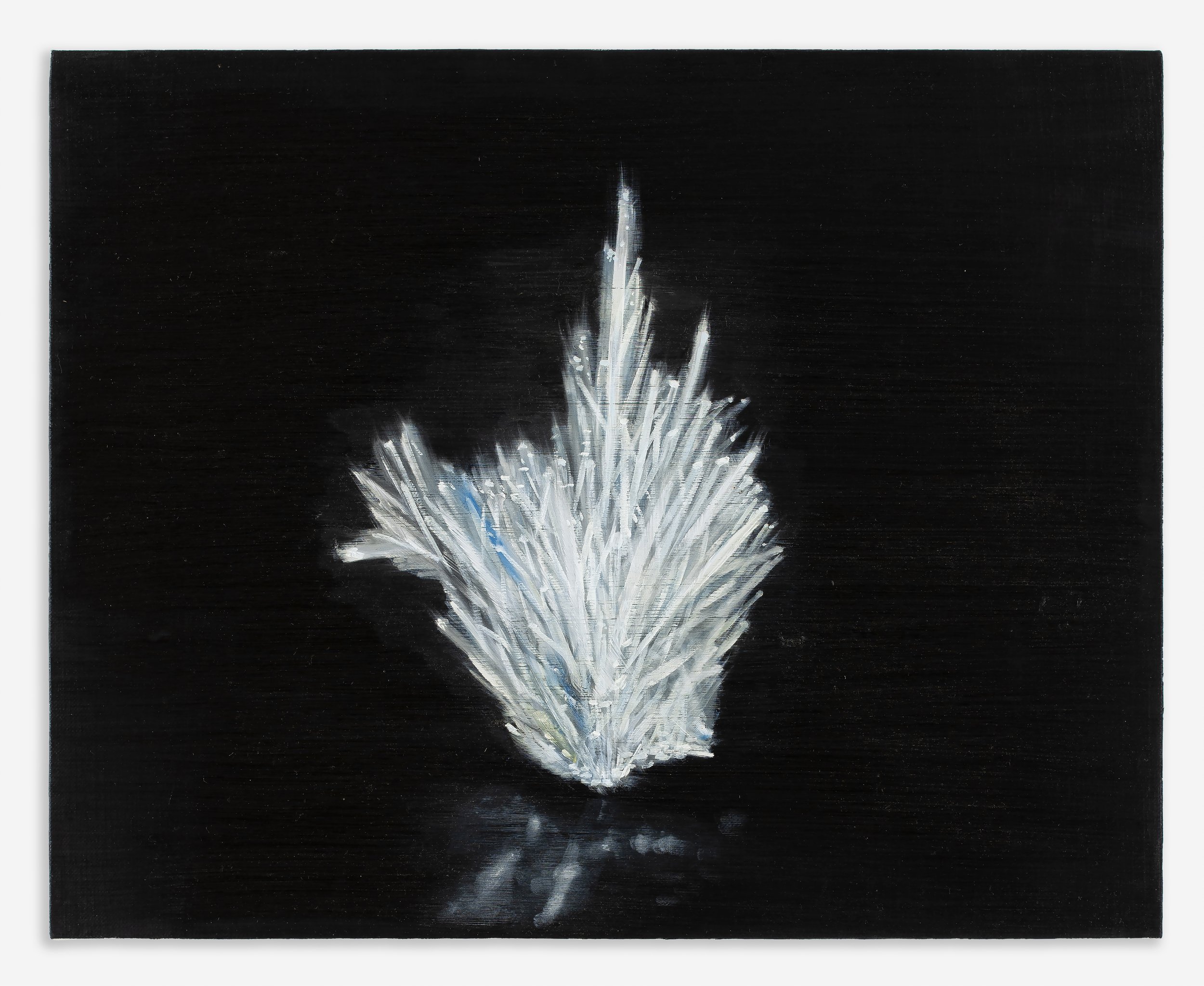
Antimony, element 51 on the periodic table, symbol Sb from the Latin stibium, atomic weight 121.76, is a metalloid, which means it has properties of both metals and nonmetals, it conducts electricity but not as well as a metal, it is brittle at room temperature, it has a crystalline structure that forms starlike patterns when the metal solidifies from a melt, which is why Newton named his purified antimony Regulus, after the star, and the starlike pattern is not a coincidence, it is a consequence of the way that antimony atoms arrange themselves when they cool from a liquid to a solid, they form a crystalline structure that grows outward from nucleation points in radiating branches that resemble the rays of a star, and this pattern is visible to the naked eye, it does not require a microscope or an X-ray diffraction apparatus, it can be seen in the crucible by anyone who cares to look, and Newton cared to look, and he recorded what he saw, and he named what he saw after a star, and the name connects the mineral to the sky in a way that is not metaphorical but observational, because the pattern in the crucible does look like a star, and the naming of the pattern after a star is an act of attention, an act of looking at something and recognizing in it something else, something that connects the small to the large, the mineral to the sky, the crucible to the cosmos, and this act of recognition is what Tan Mu's painting performs, it recognizes in the crystalline form of antimony a connection to the star that gave it birth, a connection that is not metaphorical but physical, because antimony is formed in supernovae, and the painting makes this connection visible by placing the crystal against a black ground that functions as both the black of the void and the black of the night sky, and the crystal rises from this ground like a star rises from the darkness, and the viewer who stands in front of the painting and sees the crystal against the black ground is standing in the position that Newton stood in when he looked into his crucible and saw the starlike pattern and named it Regulus, the little king, and the naming was an act of attention that connected the mineral to the sky, and the painting is an act of attention that connects the sky to the mineral, and the connection goes both ways, because the antimony that Newton held in his hand was made in a star, and the star that gave antimony its name was made of the same processes that produced the antimony, and the painting makes this circuit visible, the circuit from the star to the supernova to the nucleosynthesis to the accretion to the mining to the refining to the roasting to the crystallizing to the naming to the painting, a circuit that connects the cosmos to the crucible to the canvas, and Tan Mu has described antimony as a substance that "has played an important role in the history of alchemy and has strong connections to figures such as Newton, as well as to astronomy and early scientific inquiry," and has noted that "in contemporary technology, antimony has become an essential material used in semiconductors, alloys, and flame-retardant applications," and the continuity between these two statements, the continuity between the alchemical past and the technological present, the continuity between the star in the crucible and the dopant in the semiconductor, is the continuity that the painting embodies, the continuity that the black ground and the crystalline form and the starlike pattern and the name Regulus all contribute to, the continuity that connects Newton's alchemical experiments to the semiconductor industry to the painting on the wall to the viewer standing in front of it, and the continuity is not a metaphor, it is a material fact, it is the fact that antimony is the same element in all of these contexts, it is the fact that the atoms that Newton roasted in his crucible are the same atoms that semiconductor engineers deposit in thin films on silicon wafers, the same atoms that are in the painting, the same atoms that were in the star.
Yves Klein's IKB 3 (1960) is a monochrome painting, a single rectangle of ultramarine blue pigment suspended in polyvinyl acetate and applied to a stretched canvas, and the blue is not a color that represents something, it is not the blue of a sky or a sea or a robe or a mood, it is the blue that Klein patented as International Klein Blue, the blue that he formulated by suspending ultramarine pigment in a synthetic binder that preserves the luminosity and intensity of the pigment without the flattening effect of traditional oil medium, and the result is a blue that is not merely deep or vivid or intense but that appears to generate its own light, that appears to glow from within, that appears to be not a surface coated with pigment but a window opening onto a dimension of pure color, a dimension that has no objects in it and no figures and no perspective and no narrative, only the color itself, only the blue, only the experience of blue as blue, and Klein understood this dimension as the dimension of the void, the dimension that he had experienced in 1947 when he lay on the beach at Nice with two friends and they divided the world among themselves, one friend took the sky, the other friend took language, and Klein took the void, and he spent the rest of his life making the void visible, making the void tangible, making the void into something that could be experienced as a presence rather than an absence, and the monochrome paintings were his primary instrument, because a monochrome painting is a painting that has removed everything except the color, and the removal of everything except the color is not a reduction but an intensification, because the color that remains is not a color that is part of a composition, it is a color that fills the entire field of the painting, and the field is the void, and the void is not empty, the void is full of color, the void is full of blue, and the experience of standing in front of a Klein monochrome is the experience of standing in front of a void that is not empty but full, a void that is not the absence of something but the presence of blue, and the presence of blue is the presence of a dimension that is not the dimension of objects or figures or narratives but the dimension of pure experience, and this dimension is the same dimension that Tan Mu's black ground occupies, because the black in Antimony is not the absence of color but the presence of darkness, the presence of a field that is as active and as full and as generative as Klein's blue, a field that does not receive the crystal passively but produces it, a field that is not the background of the painting but the ground of the painting, the ground from which the crystal emerges, the ground that is the night sky and the void and the supernova and the crucible and the space in which the element forms, and the crystal that rises from this ground is not an object that has been placed on a dark surface but a form that has emerged from the darkness, a form that the darkness has produced, a form that the void has yielded, and the relationship between the crystal and the ground is the same as the relationship between Klein's blue and the canvas, which is the relationship between a presence and the field that makes it visible, between a form and the ground that gives it shape, between an element and the cosmos that produced it, and the painting of this relationship is not a depiction of antimony, it is a demonstration of antimony, a demonstration that antimony is an element that emerges from the void and that carries the memory of the void within it, an element that is both a mineral and a star, both a crystal and an explosion, both a substance in a crucible and a trace of a supernova, and Saul Appelbaum, writing about Tan Mu's practice in Dreaming in Public in November 2025, observed that "what matters is not a direct alignment between system and representation, but the act of arbitration," and the arbitration in Antimony is the arbitration between the mineral and the cosmic, between the crystal and the void, between the element that can be held in the hand and the star that produced it billions of years ago, and the painting is the instrument of this arbitration, the surface on which the mineral and the star are brought into contact, the canvas on which the crystal and the ground are made visible as two aspects of the same process, the process by which the void produces form and the form carries the memory of the void, the process by which a supernova produces antimony and antimony produces a crystal and a crystal produces a painting and a painting produces the experience of standing in front of a small canvas and seeing a mineral that is also a star.