What the Break Reveals: Tan Mu's The Glitch and the Instability It Makes Visible
A glitch is not an error. An error is a mistake, a deviation from the intended outcome, a failure of the system to produce the result that it was designed to produce, and the failure can be corrected, the mistake can be fixed, the deviation can be brought back into alignment with the design, and the system resumes its operation as if the error had never occurred, because the error was an anomaly, an exception, a temporary departure from the norm that the system reasserts as soon as the correction is applied. A glitch is something else. A glitch is a moment in which the system reveals itself, a moment in which the architecture that sustains the seamless operation of digital experience becomes visible, not because someone has opened the casing and exposed the circuitry but because the circuitry has produced a result that it was not designed to produce, a result that does not belong to the repertoire of intended outputs, a result that emerges from the interaction of processes that were not expected to interact in the way that they have interacted, and the result is not a mistake, it is a revelation, because the glitch shows what the system is made of, it shows the layers of encoding and transmission and decoding that normally operate invisibly beneath the surface of the image, it shows the data that has been compressed and the signal that has been transmitted and the protocol that has been violated, it shows the infrastructure that the user never sees because the user sees only the output, the smooth and continuous and unbroken output that the system produces when it is functioning correctly, and the glitch is what happens when the system does not function correctly, and the malfunction is not a failure of the system but a disclosure of the system, a moment in which the apparatus that produces the image becomes apparent in the image, and this is the distinction that Tan Mu has drawn in her account of The Glitch (2022), the distinction between the error that can be corrected and the malfunction that reveals, and she has said that she approaches glitches not "as errors to be corrected" but "as moments where underlying systems briefly reveal themselves," and the distinction is the distinction that animates the entire series of paintings that bear the title, paintings that do not depict glitches as problems to be solved but as events to be witnessed, events in which the digital infrastructure that organizes contemporary life becomes momentarily visible, and the visibility is not comfortable, it is not reassuring, because what the glitch reveals is the fragility of the systems that sustain the smooth operation of the digital world, the fragility of the networks that carry the data and the protocols that encode the data and the screens that display the data, and the fragility is not hypothetical, it is documented in the reports of network outages that ground flights and halt logistics and delay medical responses, it is documented in the European outage that stranded travelers in airports and disrupted medical services while Tan Mu was developing this series, it is documented in the cascading failures that propagate through interconnected systems when a single node goes offline and the traffic that the node carried is rerouted and the rerouting overloads the adjacent nodes and the overload propagates through the network like a crack through a pane of glass, and the painting is a record of this crack, a record of the moment when the smooth surface of digital experience shatters and the infrastructure beneath it becomes visible, and the record is not a warning, it is a witness, a witness to the fragility that the smoothness conceals.
The Glitch is oil and acrylic on linen, 193 x 244 cm (76 x 96 in). The scale is commanding, nearly two meters tall and more than two and a half meters wide, the dimensions of a screen that dominates the wall of a room, and the painting occupies the space of a monitor or a display, the space of the surface on which digital information appears, and the painting is a painting of that surface in the moment of its failure, the moment when the coherent image that the screen was displaying dissolves into the fragments and displacements and color shifts that constitute a glitch, and the surface of the canvas is divided into horizontal bands of color that recall the scan lines of a cathode ray tube or the pixel rows of a digital display, and the bands are not uniform, they are broken and shifted and displaced, some of them running straight across the canvas while others are offset or interrupted or overlaid with bands of a different color, and the colors are the colors of digital display at the moment of malfunction, saturated cyan and magenta and yellow and black, the colors of the CMYK color model that governs print production and the RGB color model that governs screen production, the colors of the subtractive and additive systems that produce all of the images that appear on all of the screens and all of the pages that constitute the visual environment of the twenty-first century, and the colors in the painting are not the colors of the natural world, they are the colors of the machine, the colors that the machine produces when the machine is working and the colors that the machine produces when the machine is failing, and the failure is not a departure from the palette of the machine but an intensification of it, a concentration of the pure chromatic values that the machine deploys in its normal operation, a concentration that produces the visual violence of the glitch, the sudden and disorienting shift from the smooth gradient of the intended image to the sharp and saturated bands of the malfunction, and the surface of the painting is not smooth, it is built up in layers of acrylic and oil, with areas of thick impasto that create a physical texture beneath the chromatic bands, and the impasto is the register of the hand, the register of the painter who has applied the paint in layers and allowed the layers to accumulate and drag and smear and overlap, and the physicality of the surface is the counterweight to the digitality of the image, the evidence that the glitch that appears on the canvas is not a digital glitch but a painted glitch, a glitch that has been transcribed from the screen to the canvas by the hand of a painter who has reconstructed the visual effect of the malfunction in the material of paint, and the transcription is not a reproduction, it is a translation, a translation from the instantaneous and ephemeral medium of the digital display to the slow and permanent medium of oil on linen, and the translation changes the meaning of the glitch, because the digital glitch is transient, it lasts as long as the malfunction lasts and then it is gone, replaced by the restored image as if the glitch had never occurred, but the painted glitch is permanent, it is fixed on the canvas, it does not resolve, it does not correct itself, it remains in the state of malfunction forever, and the permanence is the painting's argument, the argument that the fragility that the glitch reveals is not a temporary condition that can be corrected but a permanent condition that can only be witnessed, and the painting is the site of the witness, the surface on which the fragility is recorded and preserved and made available to the viewer who stands before the canvas and sees the glitch that does not resolve.
Nam June Paik's video work of the 1960s and 1970s is the precedent for treating the malfunction of electronic media as an aesthetic and conceptual resource, and Paik understood the signal as a material that could be shaped and distorted and interrupted, not simply a carrier of information but a substance with its own properties and its own behaviors, and his work with the video signal began in the early 1960s when he acquired a used television set and began to modify its circuitry, replacing the components that controlled the horizontal and vertical synchronization of the image with oscillators that produced patterns of lines and shapes that bore no relation to any broadcast signal, and the result was not a broken television but a new kind of image, an image that emerged from the television not because the television was receiving a signal but because the television was generating a signal of its own, a signal that was not a transmission from a studio but an output of the apparatus itself, and Paik called these works "participation TV" because the viewer could influence the pattern by speaking into a microphone or moving a magnet across the surface of the screen, and the participation was not the participation of the audience in the content of the broadcast but the participation of the viewer in the generation of the signal, the participation of the human body in the operation of the machine, and the machine was no longer a passive receiver of information but an active producer of images, and the images that the machine produced were images of its own processes, images of the electron beam as it swept across the phosphor coating of the screen, images of the synchronization circuits as they oscillated and drifted and interfered with one another, images of the machine in the act of producing images, and Paik's later works extended this investigation into the manipulation of the video signal as a medium, works such as TV Buddha (1974), in which a statue of a seated Buddha faces a television camera that feeds the image of the Buddha to a monitor that the Buddha faces, creating a closed circuit in which the Buddha watches himself on television for eternity, and the work is not a comment on Buddhism or on television but on the circuit itself, on the loop that connects the object to its image and the image to the object, and the loop is the structure of all electronic media, the structure of the signal that is captured and transmitted and displayed, and Paik's manipulation of this structure is the precedent for Tan Mu's manipulation of the glitch, because both artists treat the malfunction of the signal not as a failure of the medium but as a revelation of the medium, a moment in which the processes that normally operate invisibly become visible, and the visibility is not an accident, it is the product of an intervention, Paik's intervention in the circuitry of the television and Tan Mu's intervention in the visual language of the digital display, and both interventions produce images that are not representations of something outside the medium but are manifestations of the medium itself, images that arise from the material of the signal and the circuit and the screen rather than from the content that the signal carries and the circuit processes and the screen displays, and the distinction between the representation and the manifestation is the distinction that Paik established and that Tan Mu has extended, the distinction between the image that depicts the world and the image that reveals the apparatus that produces the image of the world, and the glitch is the moment when the apparatus reveals itself, the moment when the signal departs from its intended path and produces an image that belongs to the apparatus rather than to the content, and the painting of this moment is not a painting of the content but a painting of the apparatus, not a painting of what the screen was showing but a painting of what the screen was doing, and the doing is what Paik made visible and what Tan Mu has made permanent.
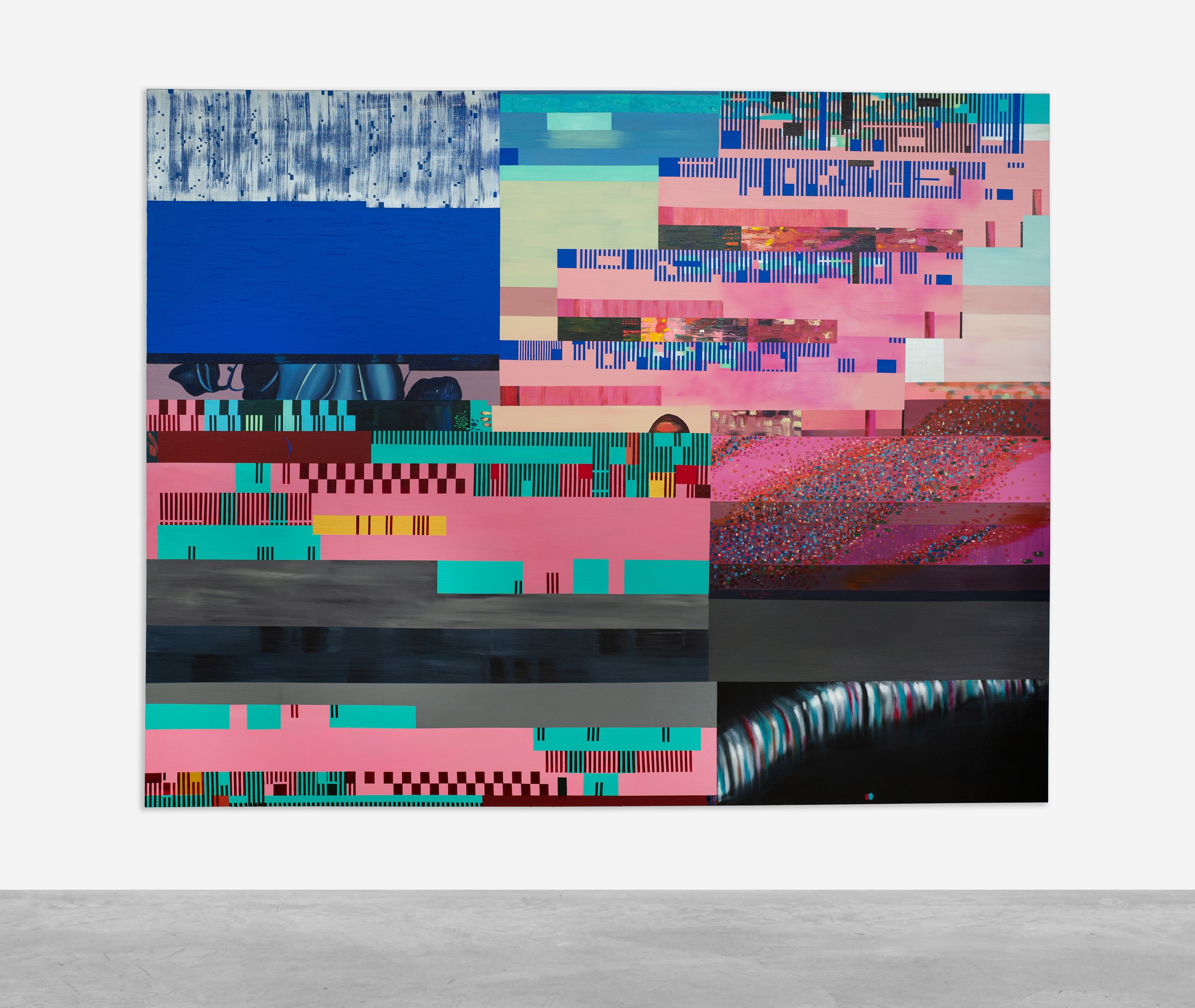
The barcode is a visual form that most people encounter dozens of times a day without ever looking at it, because the barcode is not designed to be read by human eyes but by optical scanners, and the pattern of bars and spaces encodes a number that identifies a product and its manufacturer and its price, and the number is read by the scanner and transmitted to a database and the database returns the price and the price is added to the total and the transaction proceeds, and the entire process takes less than a second, and the barcode is not seen, it is scanned, and the scanning is not a visual act but a data transaction, an exchange of information between the optical sensor and the database, and the barcode is the interface between the physical object and the digital system, the point at which the object enters the network, the point at which the product becomes data, and Tan Mu has incorporated barcode imagery into the linear structures of The Glitch, and the incorporation is not decorative, it is conceptual, because the barcode is the most ubiquitous and the most invisible form of information in contemporary life, the form that encodes identity and value and movement while remaining largely unseen, and the barcode in the painting is not functioning as a barcode, it is not encoding a product number, it is not waiting to be scanned, it is present as a visual element, as a pattern of bars and spaces that has been detached from its function and rendered as a mark on the canvas, and the detachment is the point, because the barcode that has been detached from its function becomes visible as a form, and the form is the form of information, the form of the code that governs the movement of goods and money and people through the networks of the global economy, and the visibility of the form in the painting is the visibility of the infrastructure that the form represents, the infrastructure of tracking and identification and transaction that operates invisibly beneath the surface of everyday life, and the glitch in the painting is the moment when this infrastructure becomes visible, the moment when the barcode that was designed to be scanned by a machine is seen by a human eye, the moment when the code that was intended to be read by a device is read by a person, and the reading is not the reading of the data but the reading of the form, the reading of the pattern of bars and spaces as a visual structure rather than an information structure, and the reading is the experience that the painting offers, the experience of seeing the infrastructure of digital life not as a system that operates invisibly but as a visual field that occupies the canvas, and Tan Mu has said that by embedding these visual cues into the paintings she aims to "prompt viewers to consider the fragile architecture of the networks that organize modern existence," and the architecture is fragile because it is invisible, because it operates in a register that human perception does not normally access, and the glitch is the moment when this register becomes accessible, the moment when the invisible architecture becomes a visible form, and the painting preserves this moment, it fixes the glitch on the canvas and makes the revelation permanent, and the permanence is the painting's contribution to the understanding of digital infrastructure, the contribution of a medium that does not refresh and does not scroll and does not resolve, a medium that holds the image in place and allows the viewer to stand before it and see what the break reveals, the fragility of the systems that the smoothness conceals and the architecture that the glitch discloses.
Albert Oehlen's computer paintings, produced between 1994 and 2008, are paintings that also arise from the encounter between the hand and the digital process, and the encounter is not a collaboration but a confrontation, because Oehlen used early computer drawing programs to generate compositions that he then transcribed onto canvas, and the transcriptions were not faithful reproductions of the digital output but distortions and exaggerations of it, because the computer drawing programs of the 1990s were crude and limited, they produced images that were primitive in their resolution and garish in their color and awkward in their geometry, and the awkwardness was not a deficiency of the software but a property of the medium, a property that Oehlen found more interesting than the smoothness that more sophisticated software would later produce, and he painted the awkwardness, he painted the pixelated curves and the dithered gradients and the limited palettes of the early computer graphics programs, and the painting amplified the qualities that the computer had produced unintentionally, the qualities that a user working with the software would have tried to correct, the jagged lines and the misaligned colors and the abrupt transitions that the software generated when its algorithms were pushed beyond their intended range, and Oehlen did not correct these qualities, he exaggerated them, he made them the subject of the painting, and the subject was not the image that the computer produced but the failure of the computer to produce the image that the user intended, the failure of the algorithm to generate a smooth curve or a gradual gradient or a coherent composition, and the failure was the content, the failure was what the painting depicted, and the depiction of failure is the connection to The Glitch, because Tan Mu's painting also depicts the failure of the digital system to produce its intended output, the failure of the display to render the image correctly, the failure of the signal to transmit the data without distortion, and the failure is not a problem to be solved but a phenomenon to be witnessed, and the witnessing is the act of the painter who stands before the malfunctioning screen and records the malfunction in paint, and the recording is not a repair, it is a preservation, a preservation of the moment when the system revealed its own operation, the moment when the algorithm that was supposed to produce a smooth gradient produced a sharp discontinuity instead, the moment when the protocol that was supposed to transmit the signal without error introduced a distortion that the receiver could not correct, and Nick Koenigsknecht, writing in 2025, described Tan Mu's paintings as producing "a record of the instant before the system self corrects, the instant when the architecture of the network is laid bare by its own failure," and the instant is what Oehlen also captured in his computer paintings, the instant when the algorithm produced a result that was not the intended result but was a result that revealed the algorithm, a result that showed what the algorithm was doing rather than what the algorithm was supposed to do, and the showing is the contribution of painting to the understanding of digital systems, the contribution of a medium that does not correct the malfunction but preserves it, that does not resolve the glitch but records it, that does not restore the smoothness of the intended image but holds the distortion in place on the canvas and allows the viewer to examine the distortion and to see in the distortion the operation of the system that produced it, the system that is simultaneously powerful and fragile, the system that produces the smoothness and the system that produces the glitch, the system that conceals its own operation and the glitch that reveals it.
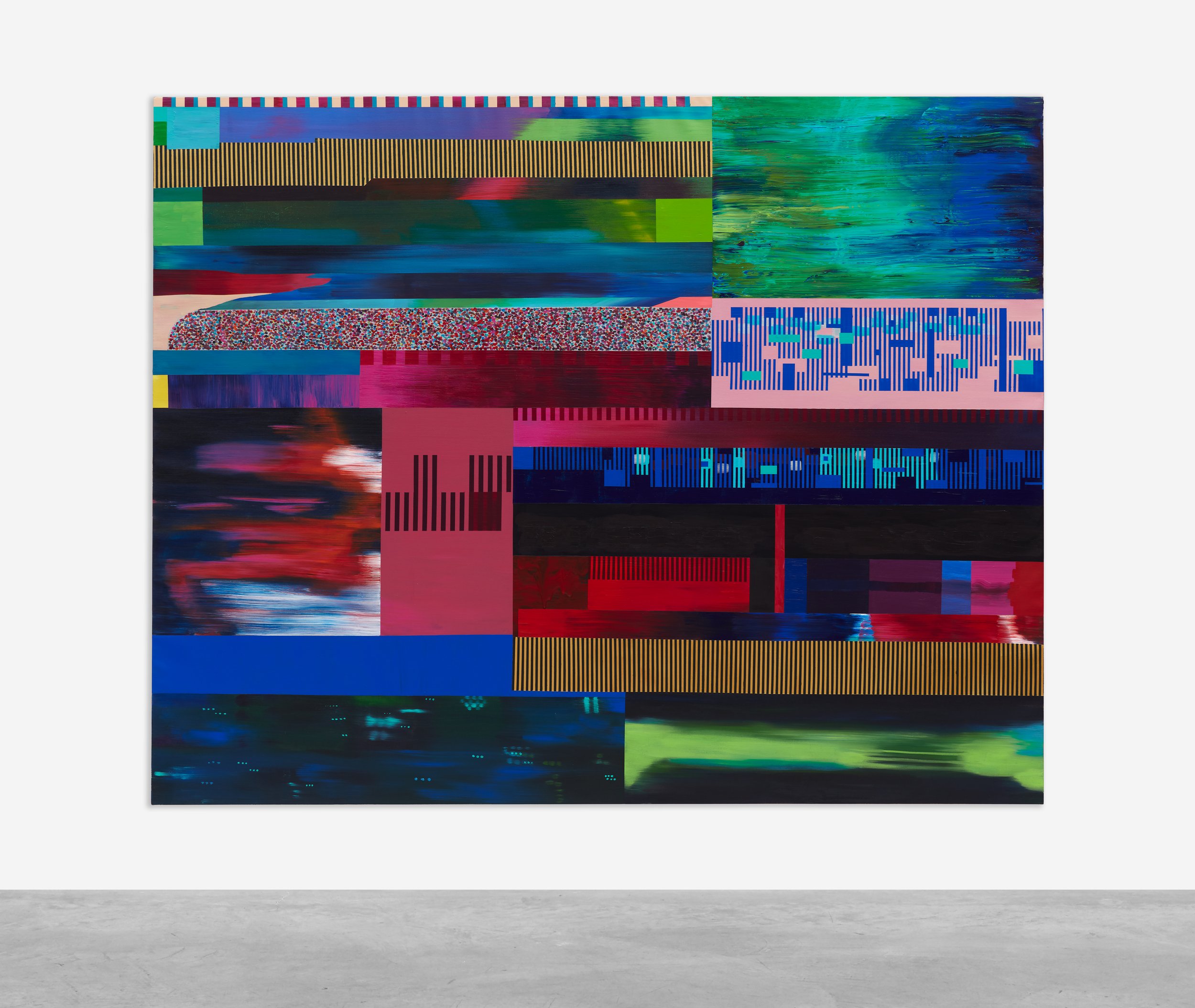
The series that includes The Glitch (2022) and its companion painting from 2023 connects to earlier works in Tan Mu's practice that address the interruption of information flow, works such as No Channel (2019) and No Signal (2019) and Off (2019), paintings that depict the screen when it is not displaying, the monitor when it has lost its signal, the television when it has been turned off, and these earlier paintings show the absence of the image, the blank screen, the blue field of the no-signal display, the static that fills the screen when the signal is lost, and The Glitch shows not the absence of the image but the distortion of the image, not the moment when the signal is lost but the moment when the signal is corrupted, and the corruption is more revealing than the absence, because the absent signal tells you only that the system is not working, while the corrupted signal tells you how the system works, it tells you that the image is composed of scan lines and color channels and compression algorithms, it tells you that the signal is encoded and transmitted and decoded, it tells you that the smoothness of the digital image is the product of processes that can fail, and the failure produces a new image, an image that belongs not to the content but to the medium, an image that shows the medium in the act of producing images, and the series also forms what Tan Mu has described as a conceptual connection with her Signal works, which focus on the physical infrastructure of information transmission, the submarine cables that carry the data across the ocean floor, and the connection is the connection of the material and the visual, the connection of the cable that carries the signal and the screen that displays the signal and the glitch that appears when the signal is disrupted, and the connection is the connection of the entire chain of transmission, from the physical infrastructure to the visual output, and the glitch is the moment when the chain becomes visible, when the invisible processes that connect the cable to the screen reveal themselves in the form of a distortion, and Tan Mu was a student at Alfred University when she first encountered the signal as a material that could be manipulated, working in the Expanded Media Studio Art program where she studied video production and signal manipulation, and in the studio she worked directly with signal control devices, "intentionally altering screen outputs to produce abstract distortions such as color displacement, inversion, noise, and fragmentation," and the experiments were not art projects, they were exercises in understanding the medium, exercises in learning what the signal was made of and what it could do when it was pushed beyond its intended parameters, and the knowledge that she acquired in those experiments is the knowledge that informs The Glitch, the knowledge that the signal is not a transparent carrier of information but a material with its own properties and its own behaviors and its own capacity to produce images that are not representations of the world but manifestations of the medium, and the paintings that she has made from this knowledge are paintings that preserve the moment of the glitch, the moment when the medium reveals itself, the moment when the smooth surface of digital experience cracks and the infrastructure beneath it becomes visible, and the crack is not repaired and the surface is not restored, because the painting holds the crack in place, it fixes the distortion on the canvas, it makes the revelation permanent, and the permanence is the gift of painting to the understanding of the digital world, the gift of a medium that does not self-correct, a medium that does not refresh, a medium that holds the image still and allows the viewer to see what the smoothness conceals, the fragility of the systems that produce the images that fill the screens that occupy the walls that the painting now occupies, the painting that shows the glitch that reveals the system that produces the smoothness that conceals the fragility that the painting makes visible, the painting that is the record of the moment when the system broke and the break was not an error but a disclosure, not a failure but a revelation, not a problem to be corrected but a condition to be witnessed, the condition of the infrastructure that sustains the digital world and the fragility that the infrastructure conceals and the glitch that makes the fragility visible and the painting that makes the glitch permanent.