The Object That Looks Back: Tan Mu's The Pill and the Weight of the Gaze
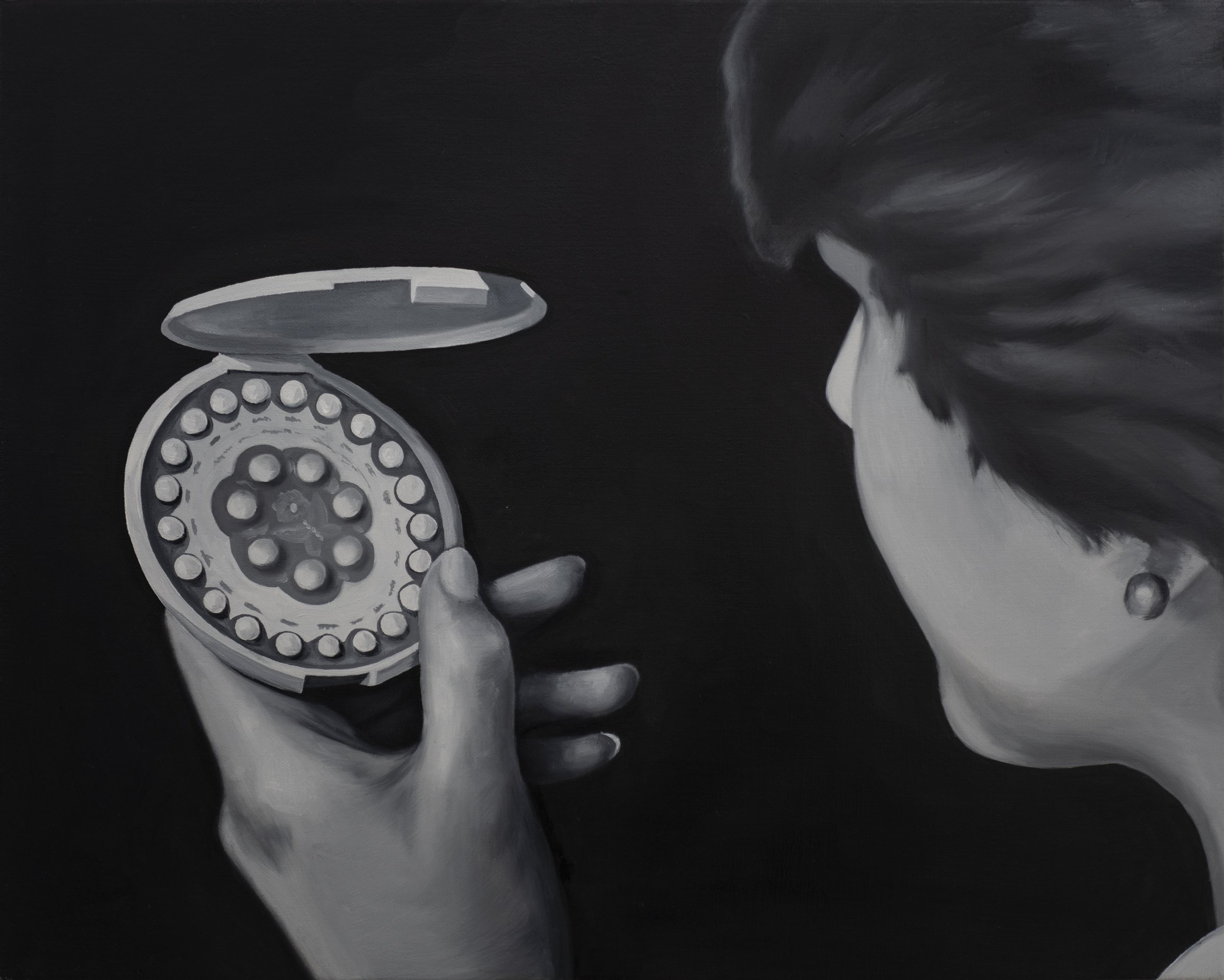
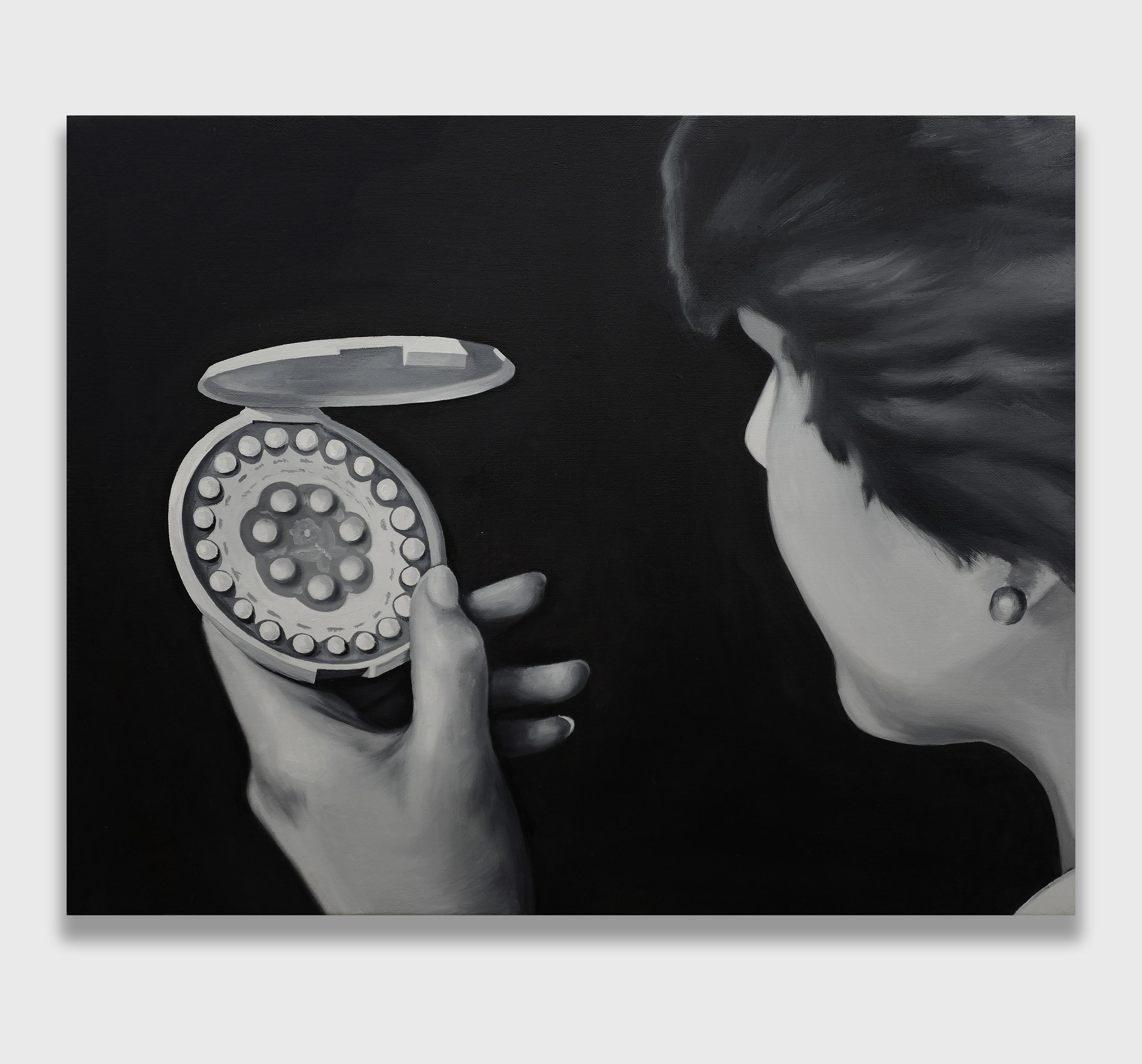
A circular plastic case, roughly the diameter of a silver dollar, containing twenty-eight tablets arranged around its perimeter like the hours on a clock face. The design was deliberate. The first birth control pill dispensers, introduced by G.D. Searle and Company in the early 1960s, were modeled on compact mirrors, those small oval or round containers that women carried in their handbags for the discreet application of lipstick and powder. The resemblance was not accidental. It was a strategy of domestication: make the contraceptive pill look like something a woman already owned, something intimate and unremarkable, and the pill itself would acquire the same social permission. You could take it at a restaurant table, in an office lavatory, on a train, and anyone who noticed would assume you were checking your makeup. The design worked so well that the circular dispenser became the default format for oral contraceptives for decades. It is still in use today, largely unchanged. Tan Mu's painting The Pill (2021) takes this object as its subject, and the object's design is the painting's first argument.
The painting depicts an open pillbox and a woman's profile in silhouette. The composition is drawn from early birth control pill advertisements, which typically showed the circular dispenser alongside an image of a smiling woman, suggesting that the product would deliver not just contraception but a certain quality of life: freedom, confidence, the ability to plan one's future. These advertisements were among the first pharmaceutical ads directed explicitly at women, and their visual language was carefully calibrated to present the pill as an enhancement rather than an intrusion. The woman in the ad does not look medicated. She looks liberated. Tan Mu's painting strips the advertisement of its persuasive context, leaving the object and the profile in a state of suspended association. The woman is no longer selling anything. The pillbox is no longer a product. Together, they constitute a historical document: an image of the moment when pharmaceutical technology entered the female body and, through that entry, altered the structure of society.
Oil on linen, 41 x 51 cm (16 x 20 in). The painting is intimate in scale, roughly the size of a sheet of letter paper, and its proportions echo the proportions of the object it depicts. The pillbox is small. The painting is small. The correspondence is not incidental. Tan Mu works at the scale her subject demands, and for The Pill, the subject demands a format that a viewer could hold in one hand, the way the pillbox itself is held. Larger canvases in her practice, the Signal paintings, the Fractal series, address subjects that exceed the human body: submarine cable networks spanning continents, mathematical structures that iterate toward infinity. The Pill addresses a subject that fits in the palm, and the canvas acknowledges this by refusing to enlarge it beyond its actual dimensions.
The linen is prepared with a warm off-white ground that reads as a pale ivory or cream, a color that evokes the domestic interior in which the pill was most often taken. Against this ground, the circular dispenser is rendered in a muted palette of gray, taupe, and a faintly pinkish white that suggests the plastic of the original case. The tablets are indicated as small marks arranged around the circle, some present and some absent, the missing tablets registering the passage of days in the monthly cycle. This detail is one of the painting's most pointed observations. The absent tablets are not a failure of representation. They are a representation of use. A full pillbox is a pillbox that has not been used. A partially empty pillbox is one that is in the process of doing its work, day by day, tablet by tablet, the woman's body absorbing the synthetic hormones that suppress ovulation. The painting depicts the dispenser at a moment mid-cycle, neither full nor empty, in the middle of its function. This temporal specificity distinguishes the painting from a diagram or an advertisement. A diagram shows the object complete. An advertisement shows the object as promise. Tan Mu's painting shows the object in use, caught in the temporal process that constitutes its purpose.
The woman's profile occupies the right side of the composition. It is rendered as a silhouette, a single dark shape against the lighter ground, with no internal detail to individualize the face. This is not a portrait. It is a type. The silhouette represents the category "woman" rather than any particular woman, and its proximity to the pillbox establishes a relationship between the two: the object acts on the body, the body is defined by the object. The profile faces left, toward the pillbox, as though in contemplation of it, but the relationship is ambiguous. Is she looking at the dispenser, or is the dispenser producing her image, the way a lens produces a projection? The painting leaves this question open. The woman and the pill are co-constitutive. Neither exists in the composition without the other.
Hannah Wilke's S.O.S. Starification Object Series (1974-1982) consists of performances and photographs in which Wilke applied small chewing-gum sculptures to her naked body, creating patterns of raised marks that resemble ritual scarification, disease lesions, or the stigmata of cosmetic surgery. The gum pieces are shaped by hand, each one a tiny sculptural object that adheres to the skin and transforms the body's surface into a field of marks. Wilke described these marks as "starifications," a term she coined to combine "scarification" with "star," suggesting that the wounds inflicted on women by cultural beauty standards could be reappropriated as a form of ornamentation, even self-creation. The work operates on the boundary between the voluntary and the involuntary: the gum marks are applied by the artist's own hand, but the conditions that make them legible as wounds are imposed by a culture that evaluates women's bodies according to standardized criteria.
The structural parallel to The Pill lies in how both works treat the female body as a site where technology and social meaning intersect. Wilke's gum sculptures are tiny objects applied to the body's surface, altering its appearance and, by extension, its social legibility. The birth control pill is a tiny object introduced into the body's interior, altering its reproductive function and, by extension, its social role. Both works make the object-body relationship visible by emphasizing the smallness of the object relative to the magnitude of its effects. The gum is a decorative intrusion that reads as a wound. The pill is a chemical intrusion that reads as liberation. The discrepancy between object scale and effect scale is the same in both cases. What differs is the direction of the intrusion: Wilke's gum acts on the body's exterior, its visible surface, where cultural evaluation occurs; the pill acts on the body's interior, its hormonal system, where biological regulation occurs. Wilke makes the social construction of femininity visible on the skin. Tan Mu makes the technological regulation of fertility visible on the canvas. Both insist that the body is not a natural object but a conditioned one, shaped by the things that are applied to it or introduced into it.
There is a further shared concern with the relationship between object and image. Wilke's S.O.S. series exists primarily as photographs: the performances themselves were ephemeral, but the images circulated widely and became the work's primary mode of address. The photographs transform a live body with gum adhered to it into an image that can be reproduced, distributed, and consumed, a process that mirrors the way the beauty industry transforms actual women's bodies into images for consumption. Tan Mu's painting similarly transforms a pharmaceutical advertisement into an image that circulates outside its original commercial context. The advertisement was designed to sell a product. The painting extracts the advertisement's visual elements, the circular dispenser, the female profile, and redeploys them as a historical record of the product's cultural impact. In both cases, the image is the site where the object's meaning is negotiated, contested, and ultimately determined.
The FDA approved the first oral contraceptive, Enovid, on May 9, 1960. The approval was not the beginning of the pill's history. Research into hormonal contraception had been underway since the 1930s, and clinical trials in Puerto Rico and Haiti in the 1950s had already demonstrated the compound's efficacy. What the FDA approval marked was the moment when the pill became a legally sanctioned pharmaceutical product available by prescription in the United States. The regulatory process itself was shaped by the political context of the era. The FDA's advisory committee on obstetrics and gynecology, reviewing the application, noted that the pill's side effects included nausea, weight gain, and an elevated risk of blood clots, but concluded that these risks were acceptable given the product's intended use. The calculation was straightforward: the social benefit of reliable contraception outweighed the medical risks of hormonal intervention. This calculation has been the subject of feminist critique ever since. Who decided that the risks were acceptable? Who bore them? Who benefited from the decision?
Tan Mu's painting does not take a position on this debate, but it makes the debate's visual terms available. The circular dispenser, with its calendar-like arrangement of tablets, presents the pill as a technology of temporal regulation. The user takes one tablet each day, at the same time each day, following a prescribed sequence that synchronizes her reproductive system with the pharmaceutical cycle. The pill does not merely prevent pregnancy. It imposes a rhythm on the body, a daily discipline that transforms the irregular cycles of fertility into a regulated, predictable process. This is what Tan Mu means when she describes the pill as a form of "technological regulation of life." The regulation is not neutral. It is a system of control exercised through chemistry, and its effects extend beyond the individual body to the social body: the workforce, the family, the economy, the distribution of power between the sexes. The painting makes this chain of effects legible by presenting the object that initiates it, the small plastic case, in a composition that insists on its connection to the female profile beside it. The object and the body are in the same frame because they are in the same system.
The origin story of the pill, as Tan Mu's archival research documents, involved an unlikely coalition. Margaret Sanger, the birth control activist who had been advocating for female contraception since the 1910s, provided the political vision. Katharine Dexter McCormick, the heiress and biologist who funded the research, provided the financial resources. Gregory Pincus, the reproductive biologist who developed the hormonal compound, provided the scientific expertise. John Rock, the Catholic gynecologist who conducted the clinical trials and publicly defended the pill as a natural extension of the body's own rhythm, provided the moral authority. Each of these figures brought a different form of legitimacy to the project, and the project succeeded precisely because the coalition spanned the domains that the pill would eventually transform: politics, money, science, and religion. The painting does not depict these figures. It depicts the object they produced and the body they produced it for. The absence of the human agents is itself a statement. The pill outlasted its creators. It entered the world as the product of specific historical actors and persisted as a generic technology, detached from the circumstances of its origin. The painting captures the pill in this detached state: an object that has already become so familiar that its revolutionary provenance is no longer visible in its form.
Andy Warhol's Marilyn Diptych (1962) consists of fifty silkscreened images of Marilyn Monroe arranged in two panels: twenty-five in color on the left, twenty-five in black and white on the right. The color images are garish, almost toxic in their saturation, with Monroe's lips rendered in an acidic pink that pushes against the boundaries of her face. The black-and-white images are faded, as though printed on newsprint that has been left in the sun, with some faces nearly erased by the overprinting of the screen. The work is read as an elegy for Monroe, who died in August 1962, and as a meditation on the way mass media produces and consumes images of women, transforming a living person into a reproducible surface that can be printed, reprinted, and discarded without reference to the body that originally occupied it.
The connection to The Pill is not visual but structural. Both works address the mass production of the female image and the relationship between that image and the female body it supposedly represents. Warhol's silkscreen process is a technology of mechanical reproduction. The Marilyn image is stamped onto the canvas fifty times, each iteration slightly different from the last due to variations in ink application and screen alignment, but all derived from the same photographic source. The technique mirrors the way mass media produced and distributed Monroe's image: endlessly replicated, always the same, always different. The birth control pill is also a technology of mass production. Each tablet contains the same dose of the same synthetic hormones, manufactured in quantities of millions, prescribed to millions of women, producing the same biological effect in body after body. The pill standardizes the reproductive system the way the silkscreen standardizes the image. Both technologies produce uniformity at scale. Both reduce the individual, the particular woman, to an instance of a type. Warhol makes this reduction visible by multiplying the image until it collapses into abstraction. Tan Mu makes it visible by reducing the woman to a silhouette, a type without individual features, positioned beside the object that produces her as a type.
There is a further shared concern with the relationship between image and commodity. Warhol's Marilyn is not just a woman. She is a product, a brand, an image that circulates in a market. The silkscreen technique makes this explicit: the image is printed the way advertisements are printed, in editions, for consumption. The birth control pill is also a commodity, a pharmaceutical product manufactured by G.D. Searle, priced, packaged, marketed, and sold. The original advertisements for the pill, which are Tan Mu's visual source, present the product as a consumer good, something a woman could buy and use as easily as lipstick, with the same sense of personal agency and social acceptability. The commodification of reproduction is the pill's unspoken premise. What Warhol reveals about the image, that it is a commodity produced for consumption, Tan Mu reveals about the pill: that it is a commodity that produces a particular kind of consumer, a woman whose reproductive capacity has been regulated by a product she purchases monthly. The consumer is produced by the product. This is the circuit that The Pill diagrams: the object creates the subject who uses the object.
Li Yizhuo, writing in her catalog essay "Constellations" for the BEK Forum exhibition in 2025, describes Tan Mu's practice as one that "renders visible the invisible systems that structure contemporary life," arguing that her paintings "make the viewer aware of the technological mediations that have become so familiar they are no longer perceived as mediations." The Pill is a concentrated demonstration of this thesis. The pill is precisely the kind of technological mediation that has become invisible through familiarity. Over one hundred million women worldwide use oral contraceptives. The daily act of taking the pill is so routine that it has become part of the background of daily life, like brushing teeth or checking a phone. What the painting does is reverse this familiarity, making the object strange again by extracting it from its habitual context and placing it in the aesthetic register of oil on linen. The viewer encounters the pill not as a consumer but as an observer, and from this position, the object's formal qualities become newly legible: the circularity that echoes both the menstrual cycle and the clock face, the calendar logic that transforms the body's temporality into a pharmaceutical schedule, the compact-mirror design that conceals a pharmaceutical intervention inside a cosmetic object. These are not aesthetic discoveries. They are political ones. The painting makes them available not by arguing but by showing, and what it shows is that an object that has shaped the lives of billions of people is, in its visual form, remarkably small and remarkably ordinary. The gap between the object's scale and its historical impact is the painting's most powerful observation. A tablet the size of an aspirin restructured the relationship between the sexes, the family, the workforce, and the law. The painting holds this gap open and refuses to close it.
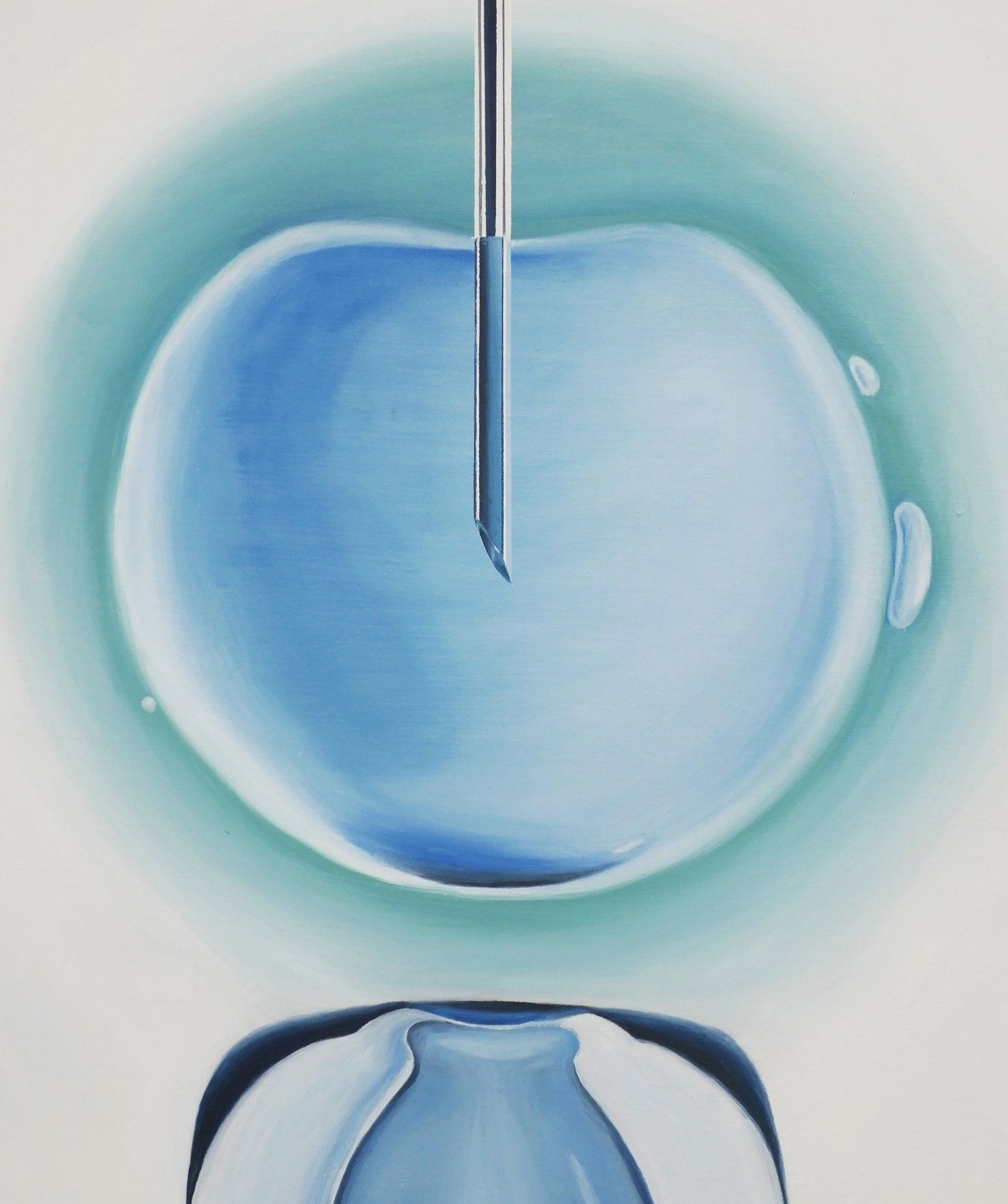
The Pill belongs to a cluster of works, including IVF (2020) and Embryo (2022), that Tan Mu developed in parallel, all addressing the technological regulation of reproduction. IVF depicts the process of in vitro fertilization, the moment when conception is removed from the body and transferred to the laboratory. Embryo depicts the earliest stage of embryonic development, the point at which biological life becomes visible under magnification. The three works form a sequence that moves from the prevention of conception (The Pill), to the facilitation of conception outside the body (IVF), to the visualization of conception's earliest product (Embryo). Together, they trace a complete arc of reproductive technology, from the chemical regulation of fertility to the visual apprehension of life at its origin. The Pill is the first work in this sequence, and it is the only one that addresses a technology that is used by healthy women in the ordinary course of daily life. IVF and Embryo both address medical interventions that are used by women who are experiencing infertility. The Pill addresses an intervention that is used by women who are experiencing fertility, which is to say, by women in the normal condition of being reproductively capable. This distinction matters. The pill does not correct a malfunction. It modifies a function. It intervenes in a system that is working as designed and redirects it toward a different outcome. The painting captures the audacity of this intervention by depicting the object that accomplishes it: a small plastic case, a circular calendar, a daily tablet, a chemical signal that tells the body to stop doing what it would otherwise do naturally. The body obeys. The society changes. The painting records the connection between the two events, the chemical and the cultural, without conflating them. The pill is not the revolution. The pill is the object through which the revolution was administered. The distinction is the painting's final precision.