The Distance Between Bodies: Tan Mu's Yoga Isolation and the Paradox of Communal Solitude
June 21, 2020, the summer solstice, the longest day of a year that already felt endless. In a park in Toronto, a group of people gathered to practice yoga. They arranged themselves on the grass with the careful spacing that had become second nature by then, each mat placed roughly two meters from its nearest neighbor, a geometry of public health imposed on an activity whose whole purpose is the dissolution of boundaries between bodies and breath. Someone photographed the scene from a slight elevation, perhaps a hillside or a raised walk, producing an image in which the figures read as discrete units in a sparse grid: together, unmistakably together, yet separated by a distance that the camera registers as social fact. Tan Mu found this photograph and recognized in it the central paradox of pandemic life, the coexistence of collective presence and enforced distance, and she decided to paint it. But she stripped the color away first.
Yoga Isolation (2022) is not the first painting in which Tan Mu translated a photographic source into monochrome. The Bikini Atoll and Trinity Testing works, both from 2020, employ the same strategy to different ends: in those paintings, black and white conveys the documentary gravity of the original images, the sense that what we are seeing already belongs to history. In Yoga Isolation, the monochrome does something subtler. It does not historicize. It suspends. The removal of color from a scene of people practicing yoga outdoors on a summer day produces an image that feels neither past nor present but something between the two, a memory that has not yet aged into nostalgia. The photograph captured a specific afternoon in a specific city during a specific phase of a global crisis. The painting captures the emotional temperature of that phase: the strangeness of ordinary activities carried out under extraordinary conditions, the comfort and the unease of routine persisting in a world that had stopped being routine. Tan Mu has described the feeling as "a strange and suspended quality, where ordinary activities took on a strange and suspended feeling." The doubling in her own description is telling. The strangeness is itself strange. The suspension is itself suspended. The painting holds that recursive quality without resolving it.
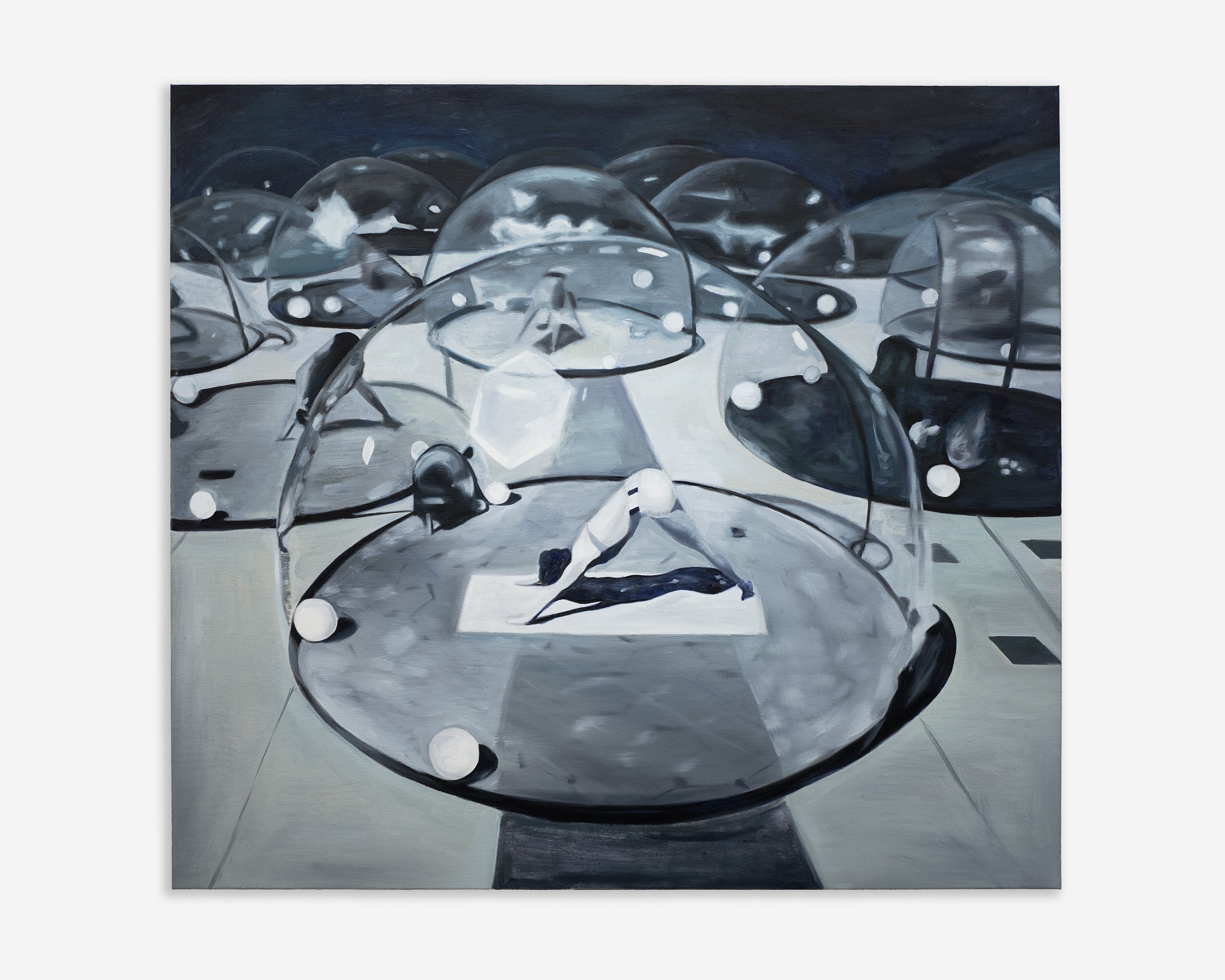
Oil on linen, 91 x 102 cm (36 x 40 in). The format is almost square, a proportion that does not privilege width over height and that allows the figures to be arranged across the canvas without the perspectival recession that a wider rectangle would impose. The linen is visible in the lighter passages, its weave creating a faint grid that echoes the spatial grid formed by the figures themselves. This is one of the painting's quiet structural coincidences: the support's material structure, the threads of the linen crossing at right angles, duplicates the social structure of the scene, the bodies arranged in rows and columns on the grass. The linen is not merely a ground for the image. It is a diagram of the image's subject.
The palette is narrow but not flat. Tan Mu works in a range of warm blacks, cool grays, and a gray-white that reads as the palest silver. The grass is rendered in a dark value that approaches the black of the figures' clothing, compressing the distinction between ground and figure and producing a visual field in which the bodies seem to float rather than stand. This compression is deliberate. In the original photograph, the green of the grass would have separated the figures from their setting, anchoring them in a specific place and season. In the painting, the absence of that green detaches the scene from any particular locale. The grass could be snow. The sky could be fog. The entire image drifts toward a condition of placelessness that matches the psychological state Tan Mu aims to evoke: the sense, widespread during the pandemic, of existing in a temporality that had been decoupled from ordinary spatial and seasonal markers.
The figures themselves are painted with a control that stops short of photorealism. Tan Mu does not reproduce the photographic image stroke for stroke. She paints each figure as a unit of tonal variation, a body-shaped region of slightly lighter or darker gray set against the darker ground. The brushwork in the figures is tighter than in the surrounding grass, where broader strokes suggest an undifferentiated surface. This difference in handling produces a perceptual effect: the figures come forward, the ground recedes, and the viewer's attention settles on the spacing between bodies rather than on the bodies themselves. What matters in this painting is not who these people are or what they are doing. What matters is the distance between them. The painting makes that distance visible by making it the only variable in a composition that otherwise minimizes contrast and differentiation.
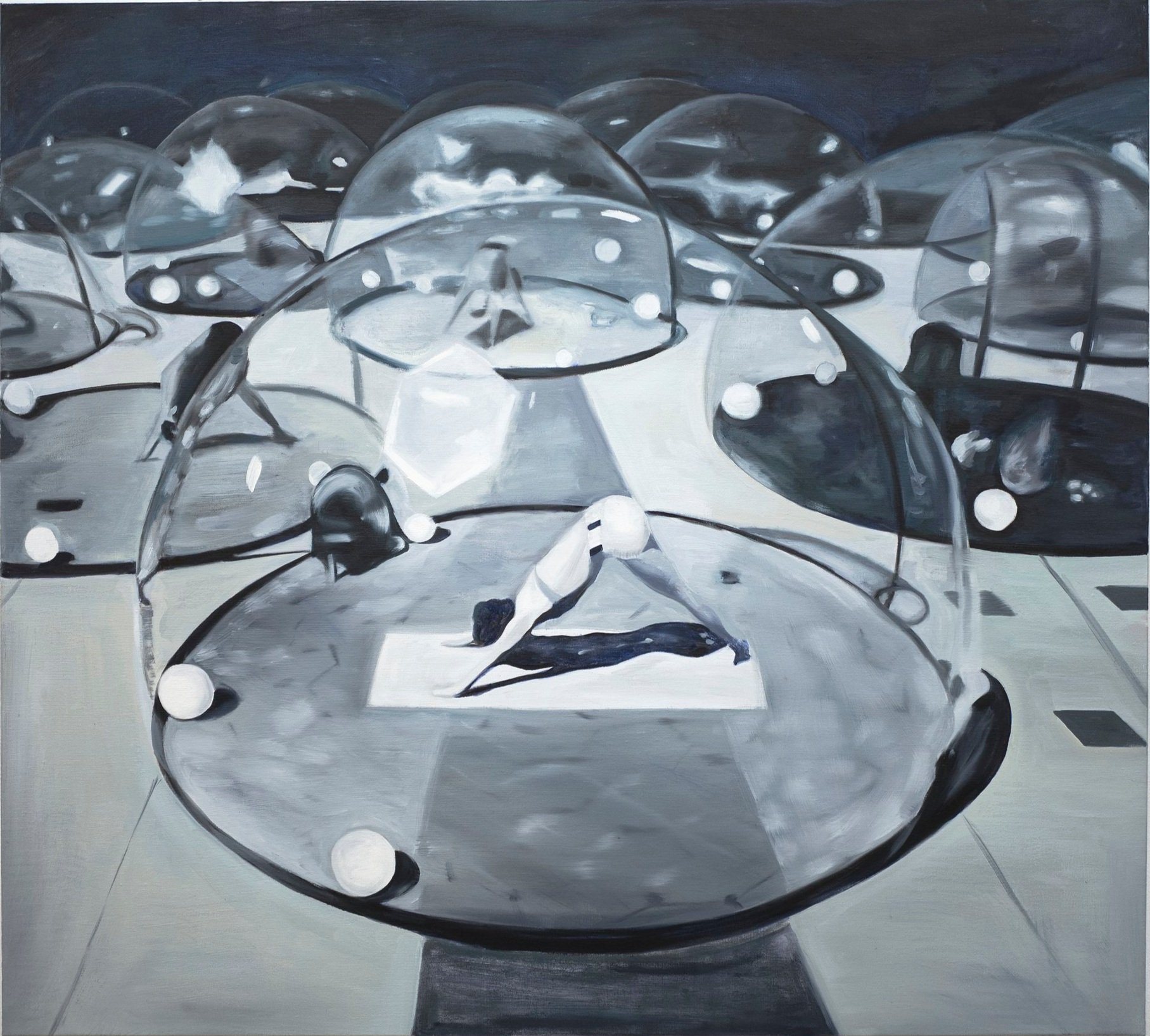
Edward Hopper's Nighthawks (1942) depicts four figures in a late-night diner: three customers and a server, arranged within the rectangular glow of fluorescent light that spills onto an empty street. There is no door visible in the diner's glass front. The figures are sealed inside their luminous box, visible to the street but inaccessible from it. The painting has become the canonical American image of urban isolation, and its influence on subsequent representations of loneliness in public space is so pervasive that it functions less as a reference than as a template. Every image of people alone together in a lit interior or on a dark street carries a trace of Hopper whether the maker intended it or not.
What distinguishes Yoga Isolation from the Hopper template is the nature of the isolation it depicts. In Nighthawks, the figures are isolated from each other even though they share the same enclosed space. The server speaks to one customer, but the other two sit in separate silences. The glass wall separates the diner's interior from the street, but the more significant barrier is the one that runs between the figures inside. The isolation is social, even psychological, produced by the absence of exchange. In Yoga Isolation, the isolation is physical, imposed from outside. The figures share the same open space, the same practice, the same orientation toward the same implied instructor. They are performing the same activity in the same moment. Their separation is not a failure of connection. It is a condition of connection. The pandemic protocols that kept them apart were, in their own austere logic, a form of care: you maintain distance because proximity would harm. Hopper's isolation is the isolation of indifference. Tan Mu's isolation is the isolation of obligation. Both are real. They feel completely different.
Hopper's diner exists at night, sealed against the darkness beyond its glass walls. Tan Mu's park exists in daylight, open to a sky that the painting's tonal compression renders indistinguishable from the ground. This difference in spatial logic matters. Hopper's figures are contained. Tan Mu's figures are exposed. The nighthawks cannot leave the diner; or if they can, the painting gives no evidence of an exit. The yoga practitioners can leave the park at any time, and their departure would not change the conditions that assembled them there. The containment in Hopper is architectural. The separation in Tan Mu is atmospheric, a condition that pervades the entire field of the canvas without being located in any specific feature of it. There is no wall. There is only the distance between bodies, which is both nothing and everything.
The source photograph for Yoga Isolation was taken on June 21, 2020, roughly three months after the World Health Organization declared the COVID-19 outbreak a pandemic. By that date, much of the world had undergone some form of lockdown, and many regions were in the early phases of reopening. The specific protocols varied by jurisdiction, but the principle of physical distancing, maintaining approximately two meters between individuals outside one's household, had become a near-universal prescription. The photograph from Toronto captures a moment in which the tension between the desire to resume communal activities and the obligation to maintain separation was particularly acute. Outdoor exercise was among the first activities to be permitted as restrictions eased, and yoga, with its emphasis on breath and bodily awareness, was an activity that made the new protocols viscerally legible. Every yoga class in the summer of 2020 was a demonstration of what the pandemic had done to the relationship between bodies in space.
Yoga itself carries a specific symbolic load in this context. The practice is rooted in traditions that emphasize union: the word "yoga" derives from the Sanskrit "yuj," meaning to yoke or join. The physical postures, or asanas, are only one limb of an eight-limbed system whose ultimate goal is samadhi, a state of meditative absorption in which the distinction between self and other dissolves. In ordinary circumstances, a group yoga session enacts this philosophy at the social level: practitioners move in unison, breathe in unison, and share the energy of a common practice. In the pandemic context, this communal dimension was precisely what had to be suppressed. The mats were placed at two-meter intervals. The instructor could not adjust a student's alignment by touch. The shared breath that is a feature of enclosed studio practice became a vector of potential transmission. Yoga, the practice of union, was performed under conditions that enforced separation. The paradox is not incidental to the painting. It is the painting's central proposition.
Tan Mu has described this paradox explicitly: "Yoga traditionally represents unity, harmony, and shared energy, but within the context of the pandemic, these meanings were reshaped. In Yoga Isolation, yoga becomes a paradoxical symbol. The practice remains communal in spirit, yet it is performed in isolation, with each individual contained within a clearly defined personal space." The passage is precise about the mechanism by which meaning is altered. The yoga did not change. The postures, the breath, the orientation toward an instructor, all of these remained the same. What changed was the spatial framework in which the practice occurred. The two-meter gaps between mats redefined the meaning of the activity without altering its form. The painting captures this redefinition by making the gaps themselves its primary visual content. The figures are rendered clearly enough to be legible as yoga practitioners, but the spacing between them dominates the composition. The gaps are not empty. They are the painting's subject.
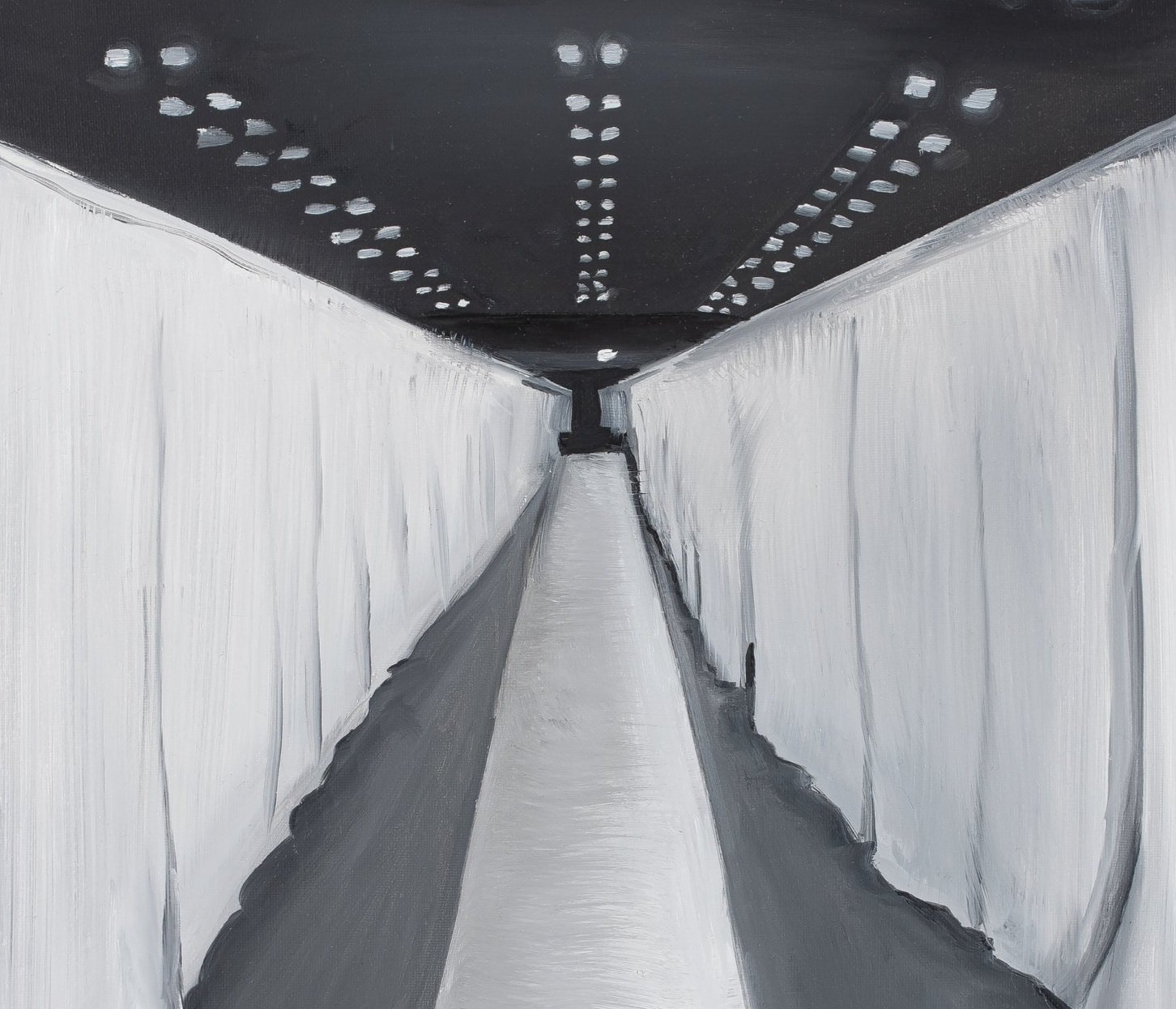
Gerhard Richter's October 18, 1977 (1988) is a cycle of fifteen paintings based on photographic sources related to the deaths of members of the Red Army Faction in the Stammheim prison. The series draws on police photographs, press images, and other documentary material, all of which Richter translates into a narrow gray palette that blurs the boundary between representation and abstraction. The individual canvases vary in scale and focus: some show figures, others show objects, one shows an empty staircase. What unifies them is the treatment of the photographic source. Richter does not reproduce the photographs. He paints them, and in painting them, he introduces the time and uncertainty that the photographs had frozen out. The blur in Richter's work is not a style. It is a method of introducing doubt into an image that had been produced to eliminate it. The photographs were evidence. The paintings are questions.
The structural parallel to Yoga Isolation lies in the relationship each work establishes between photographic source and painted outcome. Both Tan Mu and Richter begin with photographs that document a specific historical moment, and both use the translation from photograph to painting to alter the image's temporal and emotional register. Richter's grays introduce uncertainty into images that had been produced to certify fact. Tan Mu's monochrome introduces suspension into an image that documents a moment already defined by suspension. In both cases, the painting does not illustrate the source. It interprets it, and the interpretation changes what the source means. Richter's October cycle transformed the RAF deaths from news events into occasions for meditation on the limits of representation. Tan Mu's Yoga Isolation transforms a photograph of pandemic adaptation into an image of the psychological condition that adaptation produced.
There is a further shared concern with the political dimensions of photographic documentation. Richter's source photographs were produced by institutions with specific interests in how the events at Stammheim were represented. The police photographs were not neutral records. They were produced to support a narrative. Richter's painting acknowledges this by refusing to reproduce the photographs with the clarity that would authenticate their narrative. The blur is a refusal of the photograph's claim to transparency. Tan Mu's source photograph operates under a different kind of constraint. The image of yoga practitioners in a Toronto park was not produced by an institution. But the arrangement of the figures in the photograph was determined by public health policy. The two-meter spacing was not a natural arrangement. It was a prescribed arrangement, a spatial grammar imposed by the state on the relationship between bodies. Tan Mu's painting makes this grammar visible by eliminating the incidental details, the green of the grass, the warmth of the sunlight, that would naturalize the scene. What remains is the structure: bodies in rows, separated by prescribed distances, performing an activity whose meaning the structure has altered. The painting does not document an event. It documents a condition.
Saul Appelbaum, writing about Tan Mu's BEK Forum exhibition in 2025, introduces the concept of "arbitration," drawn from his architectural thesis on mediating between input and output. He argues that Tan Mu's paintings and the accompanying performance "unfold through a process of arbitration: deciding, judging, mediating between input and output," transforming data into "gestural constellations that oscillate between calculation and intuition." The term is particularly apt for Yoga Isolation. The painting arbitrates between the photograph's documentary function and the painting's emotional function. The input is the photograph, a record of a specific afternoon. The output is the painting, an image of a general condition. The arbitration occurs in the removal of color, which strips the photograph of its documentary specificity and opens it toward a more abstract register. Color is data. Monochrome is interpretation. The decision to paint in black and white is not an aesthetic choice. It is an epistemological one. It determines what kind of knowledge the image produces.
The painting's relationship to its source also arbitrates between the particular and the universal in a way that connects it to Tan Mu's broader practice. In the Signal series, submarine cable maps become paintings that are simultaneously about specific geographic routes and about the general condition of global connectivity. In the Fractal works, the Mandelbrot set becomes a painting about both a specific mathematical object and the general principle of infinite self-similarity. Yoga Isolation follows the same logic. It is simultaneously about a specific afternoon in Toronto and about the general condition of living under pandemic restriction. The particular and the universal are not in tension. They are the same image seen at different distances, which is, not incidentally, the way a fractal works. Tan Mu's practice has always been concerned with how close attention to a specific subject yields insight into a general condition. Yoga Isolation is one of the most direct expressions of this concern because the subject, a photograph of people doing yoga in a park, is so apparently modest. The modesty of the subject allows the painting's intellectual ambition to emerge without the amplification that a more dramatic subject would provide. There are no explosions, no cable landings, no particle collisions. There are just people on mats, in a park, on a summer day, separated by a distance that none of them chose.
Yoga Isolation belongs to a small group within Tan Mu's practice that includes Isolation (2020), A Sunday Afternoon in the Park (2022), and Torus (2020, 2021), works that address the spatial conditions of pandemic life. Isolation depicts the Javits Center in New York converted to emergency medical use, a 840,000-square-foot exhibition hall refitted as a field hospital in March 2020. The two paintings bracket the pandemic experience: Isolation captures the crisis at its most acute, when public spaces were being repurposed for emergency response; Yoga Isolation captures the phase of uneasy resumption, when public spaces were being cautiously returned to something like their ordinary function but under conditions that made ordinary function feel unfamiliar. The relationship between the two works is not illustrative. It is structural. They represent two moments in the same process: the repurposing of public space, first for emergency, then for adaptation. The Javits Center became a hospital. The park became a socially distanced yoga studio. In both cases, the space itself did not change. What changed was the set of rules governing how bodies could occupy it. The painting that captures the emergency is smaller, 51 x 61 cm, as though the crisis needed to be contained. The painting that captures the adaptation is larger, 91 x 102 cm, as though the longer, slower, more ambiguous phase required more room. The scale of the painting maps the duration of the condition it depicts.
What Yoga Isolation finally makes visible is not isolation itself but the form that isolation took when it entered public space. Isolation in private, alone in a room, is one experience. Isolation in public, surrounded by other isolated people, is another. The second experience is the one the painting addresses, and it is the one that proved most difficult to articulate during the pandemic because the language of isolation had been trained on the first. Solitude has a rich vocabulary. The condition of being alone among others, each person a separate unit in a sparse grid, had no name until the protocols gave it one: social distancing. The phrase is a paradox. Social distancing is not social. It is the negation of the social, performed in social space. Tan Mu's painting strips the paradox to its visual essence: bodies that are together but apart, in a space that is public but empty, performing an activity that is communal but individual. The painting does not resolve the paradox. It inhabits it. The distance between the figures remains. It will always remain. The summer afternoon is over. The photograph has been taken. The painting endures. What it preserves is not the event but the structure of feeling the event produced: the coexistence of presence and separation that defined a period no one would choose to repeat and no one who lived through it will forget. The mats are still two meters apart. The practice continues.