The Break That Shows the System: Tan Mu's The Glitch and the Visibility of Failure
A glitch is not an error. This is the first thing to understand, and it is the hardest, because the entire vocabulary of digital culture has trained us to see disruption as defect. Feature versus bug. Function versus malfunction. Signal versus noise. These binaries structure every interaction with a screen, and they are wrong. A glitch is not a mistake. It is a moment in which the system that normally remains invisible reveals itself. When the image on a monitor tears, when the color channels separate and the frame splits into offset bands of red, green, and blue, when the scan lines roll and the pixels cluster into artifacts that have no correspondence to the intended image, what is visible is not the absence of order but the presence of a different order, the order of the hardware, the signal path, the compression algorithm, the display protocol. The glitch does not destroy the system. It shows the system. It is the moment when the apparatus that normally renders itself transparent becomes opaque, when the machinery that organizes visual experience stops organizing and starts revealing. What it reveals is not chaos. It is the logic of the medium, laid bare by its own malfunction.
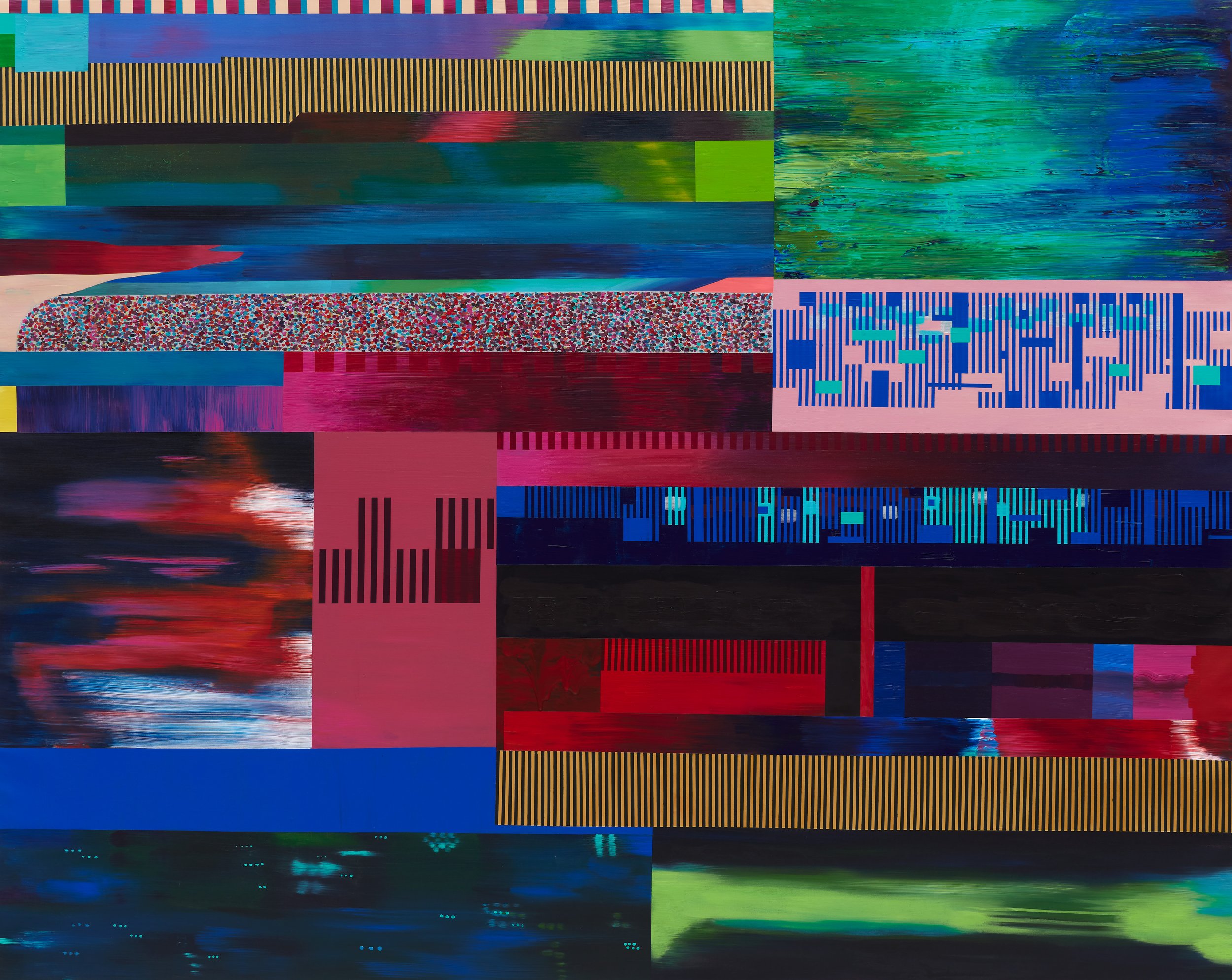
Tan Mu's The Glitch (2023) is a painting of this revelation. Oil and acrylic on linen, 193 x 244 cm (76 x 96 in), it is one of the largest works in her practice and one of the most physically assertive. The scale matters. At nearly two meters tall and two and a half meters wide, the painting occupies a wall with the authority of a screen, and this authority is deliberate: the work is in conversation with the display surface, not the depicted image. The painting does not represent a glitch in the way that a photograph represents a moment. It enacts a glitch in the way that a system enacts one: through displacement, fragmentation, and the disruption of expected continuities. The surface of the painting is divided into zones of sharply different visual behavior. Bands of saturated color, electric blue, crimson, amber, and a green that approaches the synthetic, run across the canvas in horizontal registers that recall the scan lines of a CRT monitor or the data rows of a spreadsheet. These bands are interrupted by vertical structures that slice through them at oblique angles, displacing the horizontal registers like fault lines through geological strata. In some passages, the color fields fragment into irregular tesserae, small rectangular units that approximate the pixel structure of a digital display. In others, the paint is applied in thick, impasto ridges that stand off the surface in relief, creating a physical topography that the viewer's eye cannot resolve into a flat image. The result is a surface that refuses to settle. It oscillates between legibility and disruption, between the coherent field and the broken field, between the image and the system that produces it.
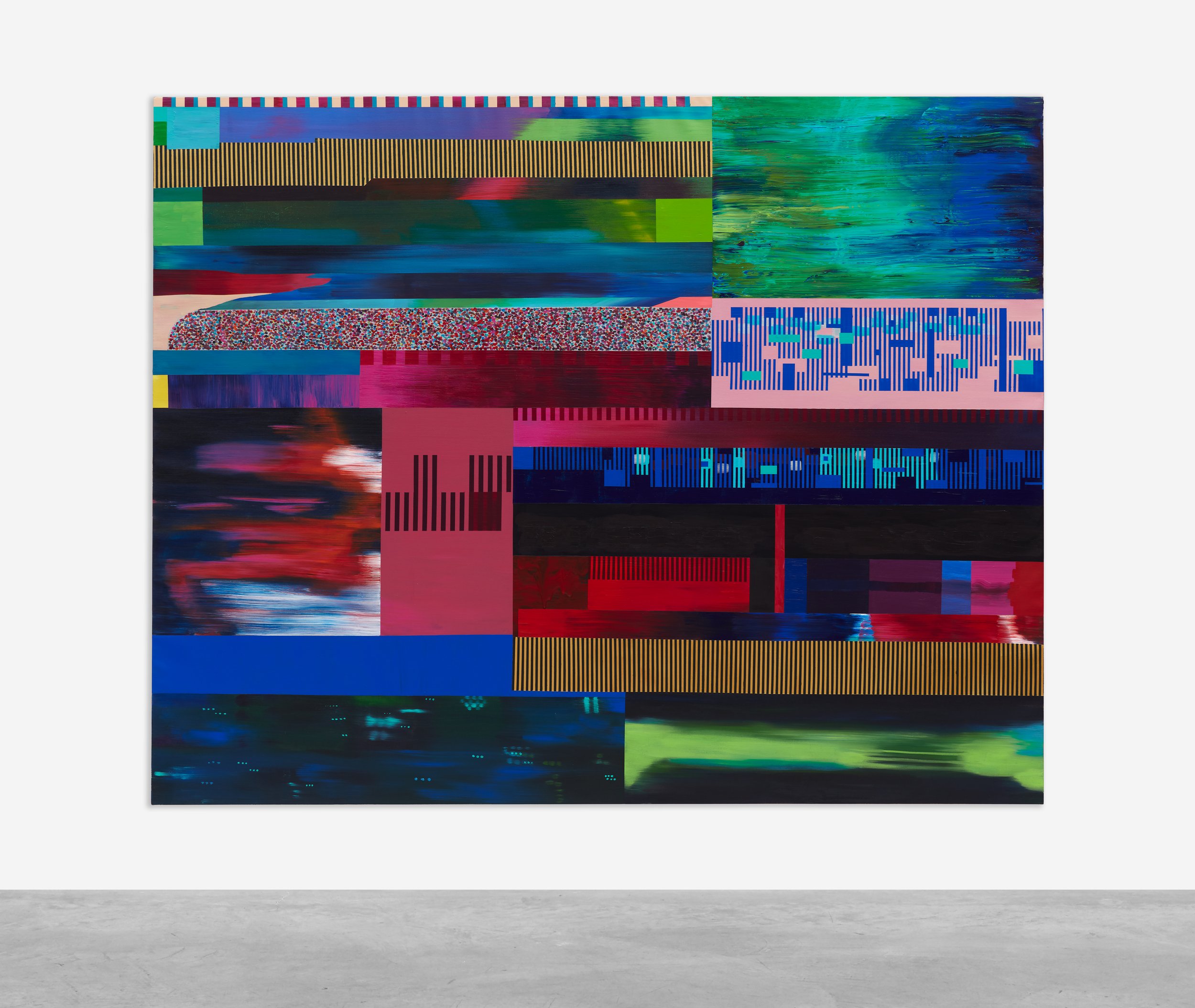
The painting's material structure mirrors its subject in ways that are more than illustrative. Tan Mu has described her process as one of layered application: acrylic is laid down first in broad fields, establishing the ground color and the horizontal registers, and then oil is applied on top in thinner, more precise passages that define the vertical interruptions and the fragmented tesserae. Masking techniques are used to create the sharp edges and abrupt color transitions that mimic the visual behavior of a corrupted display. The masking tape is applied to the acrylic ground before the oil layer is added, and when it is removed, it leaves behind edges of perfect geometric precision that contrast with the looser, more gestural passages of the underlying acrylic. This contrast between the mechanical and the manual is not accidental. It reproduces in paint the contrast between the designed system and the malfunction that disrupts it. The masked edges are the system working as intended. The impasto ridges, the visible brushwork, and the irregular boundaries where acrylic meets oil are the glitch: the moment when the designed behavior of the surface gives way to a different logic, one that is no less structured but is no longer the structure the viewer was expecting.
The color palette is worth pausing over because it is not the palette of naturalistic painting. The blues and reds and greens are synthetic, not mixed from earth pigments or organic lakes but drawn from the spectrum of the digital display, where color is produced by the excitation of phosphors or the filtering of backlight through liquid crystals. The specific electric blue that dominates several of the horizontal registers is the blue of the default error screen, the blue that Windows displays when the system has encountered a fatal exception and must stop. The crimson that appears in the displaced vertical bands is the red of the color channel that has shifted out of registration, the red that appears when a composite video signal loses its synchronization and the chrominance information separates from the luminance carrier. These are not colors that exist in nature. They are colors that exist on screens, and their presence in a painting that is emphatically not a screen, that is made of oil and acrylic on woven linen, is the first signal that the work is not representing a glitch so much as translating one medium's failure into another medium's material vocabulary.
Sigmar Polke's Rasterbilder (raster paintings), which he began producing in the mid-1960s and continued to develop for the rest of his career, take as their starting point the halftone dot, the fundamental unit of mechanical reproduction in newspapers, magazines, and cheap printed matter. Polke enlarged these dots to the point where they became the dominant visual element of the painting, transforming the minuscule printing units into monumental circles that hover on the surface of the canvas, at once recognizable as the constituent particles of a reproduced image and too large to coalesce into the image they are supposed to constitute. The result is a permanent oscillation between two readings: the dot as part of a representational system, the dot as a mark on a surface. Polke's dots refuse to resolve into either. They are simultaneously the means of image production and the image's undoing, the mechanism that makes the picture possible and the mechanism that makes it impossible to see the picture without also seeing the mechanism.
The connection to The Glitch operates at this structural level. Both Polke's raster paintings and Tan Mu's glitch paintings take the visual signature of a reproductive technology, the halftone dot in Polke's case, the scan line and the pixel artifact in Tan Mu's, and make it the subject of a painting that is itself produced through a different technology, oil and acrylic on linen. In both cases, the painting does not reproduce the image that the technology would normally produce. It reproduces the moment when that technology fails to produce the image, when the halftone dots become too large to resolve, when the scan lines displace and the color channels separate. The failure is the subject, and the failure is what reveals the system. Polke's raster paintings expose the halftone printing process by making its constituent unit visible. Tan Mu's glitch paintings expose the digital display process by making its failure mode visible. In both cases, the painting acts as a magnifying lens trained on the infrastructure of visual production, and the infrastructure is shown to be not a neutral conduit but a system with its own logic, its own vulnerabilities, and its own aesthetic.
There is an additional shared concern with the relationship between the mechanical and the manual. Polke's raster paintings are often described as mechanical because their dots are regular, uniform, and grid-like, the product of a screen or stencil rather than a brush. But the dots are never perfectly regular. They wobble. They vary in size. They cluster and spread. The hand is present in the mechanical, and the mechanical is present in the hand. The same tension operates in The Glitch, where the masked edges produce the illusion of machine-made precision while the impasto passages register the presence of a hand that is not interested in hiding itself. The painting is a hybrid of the systematic and the gestural, and the hybrid is the point: the glitch is where the system meets the hand, where the designed behavior of the machine gives way to something that the machine did not design but that the hand can make visible.
The subject of The Glitch is not the glitch itself but the system that the glitch reveals. Tan Mu has described the series as growing out of her time in the Expanded Media Studio Art program at Alfred University, where she studied video production and signal manipulation. In the studio, she worked directly with signal control devices, intentionally altering screen outputs to produce abstract distortions: color displacement, inversion, noise, fragmentation. These experiments, she writes, "revealed the hidden visual language of malfunction and became foundational to my practice." The word "revealed" is crucial. The signal manipulation did not create the visual language of malfunction. It revealed it. The language was already there, embedded in the hardware, in the protocols, in the difference between what the signal was supposed to produce and what it actually produced when the parameters were altered. The glitch is not an addition to the system. It is the system seen from a different angle, the system when its normal functioning is suspended and its underlying logic becomes legible.
This logic is the logic of infrastructure. The networks that carry our information, route our financial transactions, coordinate our transportation systems, and manage our healthcare records are designed to be invisible. They work best when they are not noticed. A power grid that is functioning correctly does not announce itself. A fiber-optic cable that is carrying data at full capacity does not draw attention to its existence. The network is designed to recede into the background of experience, to become the invisible substrate on which daily life is built. The glitch is what happens when this substrate surfaces. When a fiber cut in the Atlantic disrupts internet service across West Africa, when a routing error at a major provider takes down cloud services across the eastern United States, when a software update at a cybersecurity firm crashes millions of Windows computers simultaneously, the infrastructure that was invisible becomes visible in the moment of its failure. The network appears not as a seamless background condition but as a specific, fragile, and surprisingly localized system that can break in specific, fragile, and surprisingly localized ways. The glitch makes the network visible. It is the network's way of being seen.
Nam June Paik's work with television and video from the 1960s onward provides the most direct precedent for Tan Mu's practice of signal manipulation. Paik's Exposition of Music: Electronic Television (1963), presented at the Galerie Parnass in Wuppertal, was the first exhibition to include modified television sets as artworks. Paik had learned to manipulate the electronic signals that controlled the cathode-ray tubes, distorting the images on the screens by attaching magnets to the exterior of the sets, rewiring the internal circuitry, and feeding distorted signals through the video inputs. The result was not a representation of distortion but distortion itself, the actual electronic signal of the broadcast image deformed in real time by the artist's interventions. The television set, which was designed to render the broadcast invisible as a technology and present only the content, became a machine that displayed its own mechanism. The distortion was not a picture of a distorted image. It was a distorted image, produced by the same hardware and the same signal path that would normally produce a coherent broadcast, but with the parameters altered by the artist's hand.
The connection to The Glitch is structural, not stylistic. Paik's modified televisions and Tan Mu's paintings share a common logic: the artist intervenes in the signal that produces the image, and the intervention reveals the system that the image normally conceals. Paik reveals the television by making it malfunction. Tan Mu reveals the digital display by painting its malfunction. The medium is different, but the operation is the same: take the technology that renders itself invisible and force it into a state of visibility. Paik's intervention is electronic and real-time. Tan Mu's intervention is manual and delayed, translated through the slow medium of oil and acrylic on linen. But the result in both cases is the same: the viewer is no longer looking at the content. The viewer is looking at the system that produces the content, and the system is no longer functioning as designed. It is showing its workings. It is revealing its structure. It is, in the language of engineering, in an error state, and in the language of art, it is in a state of heightened legibility.
Paik's later work, particularly his multi-monitor installations such as TV Garden (1974) and TV Buddha (1974), extends this logic from the single screen to the network. In TV Garden, thirty television sets are arranged among live plants in a gallery space, each screen displaying Paik's video compositions. The work makes the television set into a natural object, or makes the natural object into a screen, and in doing so it removes the last vestige of the technology's invisibility. The TV is no longer a window into content. It is an object among objects, a screen among plants, a device that occupies space and demands attention as a physical thing. The Glitch does something similar by making the painting's surface insistently physical. The impasto ridges, the masking-tape edges, the visible weave of the linen where the acrylic has not covered it, these are the painting's way of refusing to be a transparent window onto the glitch. They remind the viewer that the surface is a surface, that the painting is a thing made of specific materials applied in specific ways, and that the glitch it depicts is not a digital malfunction but a manual translation of one. The painting is not a screen. It is a painting about a screen that has stopped being a screen, and the painting's own refusal to be transparent is part of its argument: the medium is the system, and the medium is showing its workings.
Saul Appelbaum, writing in the BEK Forum catalog in 2025, describes Tan Mu's practice as one in which "the painting is never about the technology in isolation" but about "the moment when the technology stops working and the human hand becomes visible again." The observation is precise, and it names something that The Glitch makes explicit. The painting's surface alternates between passages of mechanical precision, the masked edges, the uniform color fields, the regular horizontal registers, and passages of manual insistence, the impasto ridges, the visible brushwork, the irregular boundaries where one medium meets another. These alternations are not decorative. They are the painting's argument, enacted in material terms, that the glitch is the point where the system stops working and the hand reappears. The hand is always present in the system, of course. Every digital system was designed by human hands, built by human hands, maintained by human hands. But the system is designed to hide those hands, to present itself as autonomous, self-regulating, and transparent. The glitch is the moment when the hands become visible again, when the human labor that sustains the system surfaces in the form of an error that the system cannot correct on its own. The painting makes this surfacing literal. The masked edges give way to impasto. The acrylic fields are interrupted by oil. The machine-made surface yields to the hand-made surface. The transition is not smooth. It is abrupt, visible, and material. It is, in the language of the painting, a glitch: a point where the expected behavior of the surface gives way to a different logic, and the different logic is the logic of the hand.
The barcode-like vertical structures that appear in several passages of The Glitch are another instance of this revelation. Tan Mu has described these linear elements as references to barcode imagery, the systems of parallel lines that encode identity, value, and movement in contemporary commerce and logistics. Barcodes are among the most ubiquitous and least noticed information systems in daily life. They appear on every product, every shipping label, every boarding pass, and they are designed to be read by machines, not by humans. The human eye sees a pattern of bars; the scanner sees a string of digits that identifies the product, tracks the shipment, or admits the passenger. The barcode is a technology that, like the fiber-optic network, is designed to be invisible to the people who use it. It works best when it is not noticed. When it appears in The Glitch, it appears as a visual element that has been displaced from its context, a strip of encoded information that has been ripped from the product label and embedded in a painting, where it cannot be scanned, cannot be read by the machine for which it was designed, and cannot fulfill its function. It has become a decorative element, a pattern of vertical lines that no longer carries the data it was designed to carry. This is what the glitch does to information systems: it removes them from their functional context and places them in a context where they can be seen but not used. The barcode in the painting is visible in a way that the barcode on a product label is not. It is visible as a form, as a pattern, as a structure of bars and spaces, and in this visibility it reveals something that the functional barcode conceals: that every information system is also a visual system, that every encoding is also a drawing, and that the machine that reads the barcode and the eye that sees the painting are both engaged in the act of interpreting marks on a surface.
What The Glitch finally argues is that failure is a form of attention. The network that functions correctly is invisible. The screen that displays the intended image is transparent. The barcode that scans correctly at the checkout is unremarkable. It is only when these systems break that they become visible, and it is only in their visibility that they can be understood, questioned, and, perhaps, redesigned. The glitch is not an accident that happens to the system. It is the system's most legible moment. It is the instant when the infrastructure that organizes contemporary life stops being a background condition and becomes a foreground event, something to be looked at rather than looked through. Tan Mu's painting makes this legibility permanent. It takes the momentary failure of a digital display and extends it across a surface that does not refresh, does not crash, and does not recover. The glitch, frozen in oil and acrylic, becomes a stable condition rather than a transient one, and in its stability it becomes available for the kind of sustained attention that a screen failure, lasting only seconds before the system reboots, never permits. The painting is not a representation of a glitch. It is a glitch made permanent, a malfunction made available for contemplation, and in making it available it performs the same operation that the original glitch performed on the system: it makes visible what was designed to remain unseen.