The Darkness That Makes the Ring Visible: Tan Mu's Sagittarius A* and the Image Assembled from Absence
Twenty-six thousand light-years from Earth, at the center of the Milky Way, there is an object with a mass four million times that of the Sun compressed into a volume smaller than the orbit of Mercury. It is called Sagittarius A*, and it is the supermassive black hole around which our galaxy rotates. No light escapes it. No radiation leaves its event horizon. It produces no image of itself. What it produces instead is a shadow: a region of absolute darkness silhouetted against the incandescent ring of superheated gas that spirals into it at a significant fraction of the speed of light. On May 12, 2022, the Event Horizon Telescope collaboration released the first image of that shadow, assembled from radio data collected by eight telescopes on four continents over the course of several nights in April 2017. The data was too voluminous to transmit electronically. It was recorded onto half a ton of hard drives and shipped by air freight to correlator facilities at the Massachusetts Institute of Technology and the Max Planck Institute for Radio Astronomy, where it was processed over five years using custom algorithms. The image that resulted, an orange-gold ring of uneven brightness surrounding a dark center, is not a photograph. It is a reconstruction. A computation. A consensus among multiple independent imaging pipelines that all converged on the same basic structure: a bright ring, a dark hole, and a patch of enhanced brightness at the bottom of the ring where the relativistic jet of the accretion disk points roughly toward Earth.
The distance alone makes the observation extraordinary. The angular size of Sagittarius A* on the sky is roughly fifty microarcseconds, which is the equivalent of trying to read the date on a coin in New York from a vantage point in Dublin. No single telescope has the resolving power to see it. The Event Horizon Telescope is not a single instrument but an array: radio dishes in Chile, Hawaii, Arizona, Mexico, Spain, and the South Pole, all pointed at the same patch of sky at the same time, their signals combined through a technique called very-long-baseline interferometry to create the effective resolving power of a single dish the diameter of the Earth. Each station records the incoming radio waves with atomic-clock precision, and the correlations between the recordings are computed after the fact, during the years of data processing that follow each observing run. The image is assembled, not captured. It is the product of coordinated labor distributed across hemispheres and time zones, and it exists because hundreds of scientists agreed on a shared protocol for looking at something none of them could see.
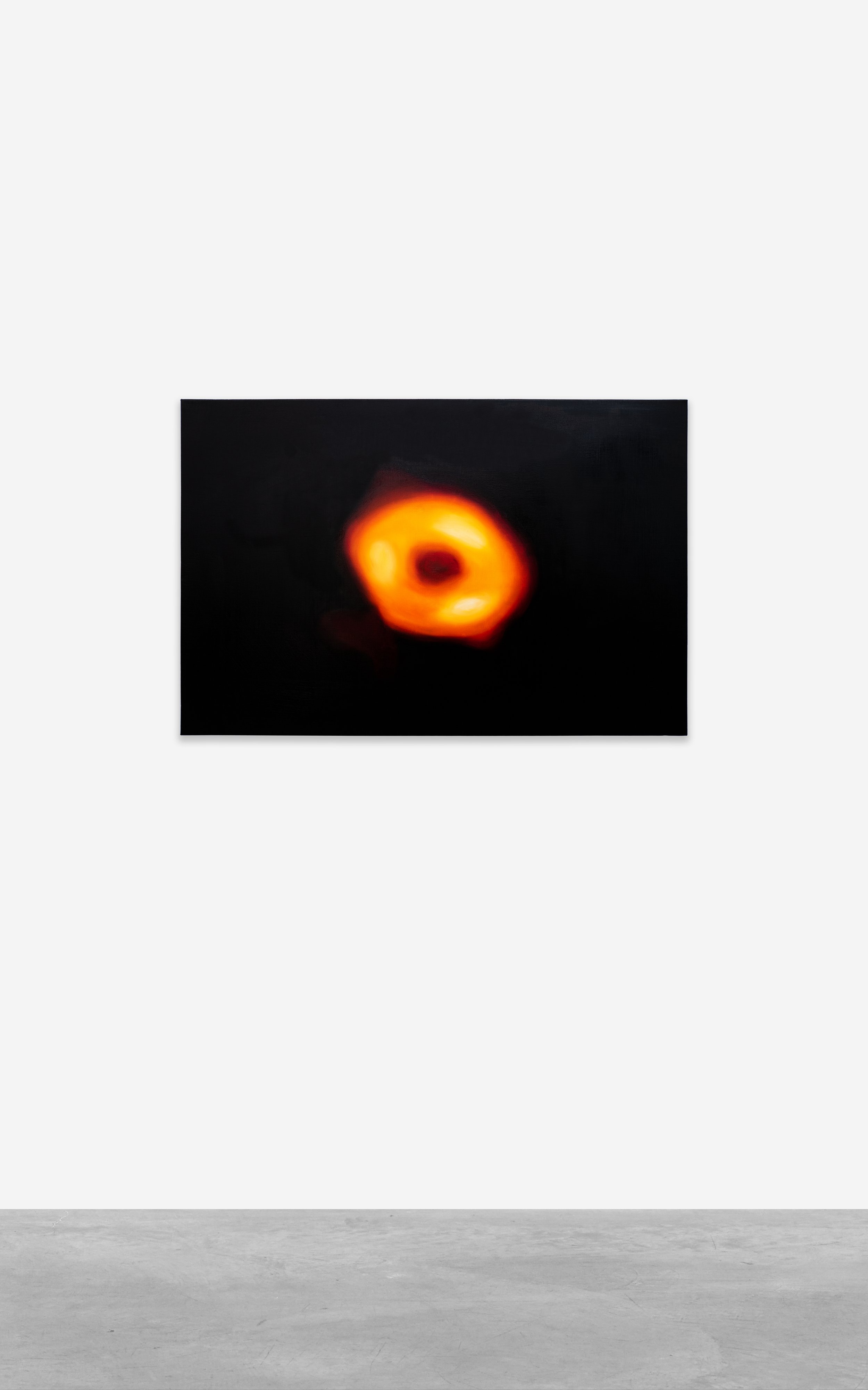
Tan Mu painted Sagittarius A* in 2022, the same year the image was released. The painting is oil on linen, 61 x 91 cm (24 x 36 in), a vertical rectangle that mirrors the landscape orientation of the EHT image as it appeared in press releases and scientific publications. Against a ground of deep black, the luminous ring of the accretion disk occupies the center of the canvas, rendered in gradations of orange, gold, and pale amber that describe the uneven brightness distribution of the source. The ring is not uniform. Its lower portion, the side nearest the relativistic jet, is brighter than its upper portion, where the gas curves away from the viewer and its emission is redshifted by the Doppler effect. Tan Mu reproduces this asymmetry with precision: the lower arc of the ring is painted in a hotter orange, nearly yellow at its densest point, while the upper arc thins into a cooler amber that seems to dissipate into the surrounding darkness. The central shadow, the black hole itself, is not painted. It is the absence of paint, the linen ground visible through the thin washes that edge the ring's inner boundary, a void that the surrounding luminosity defines by contrast.
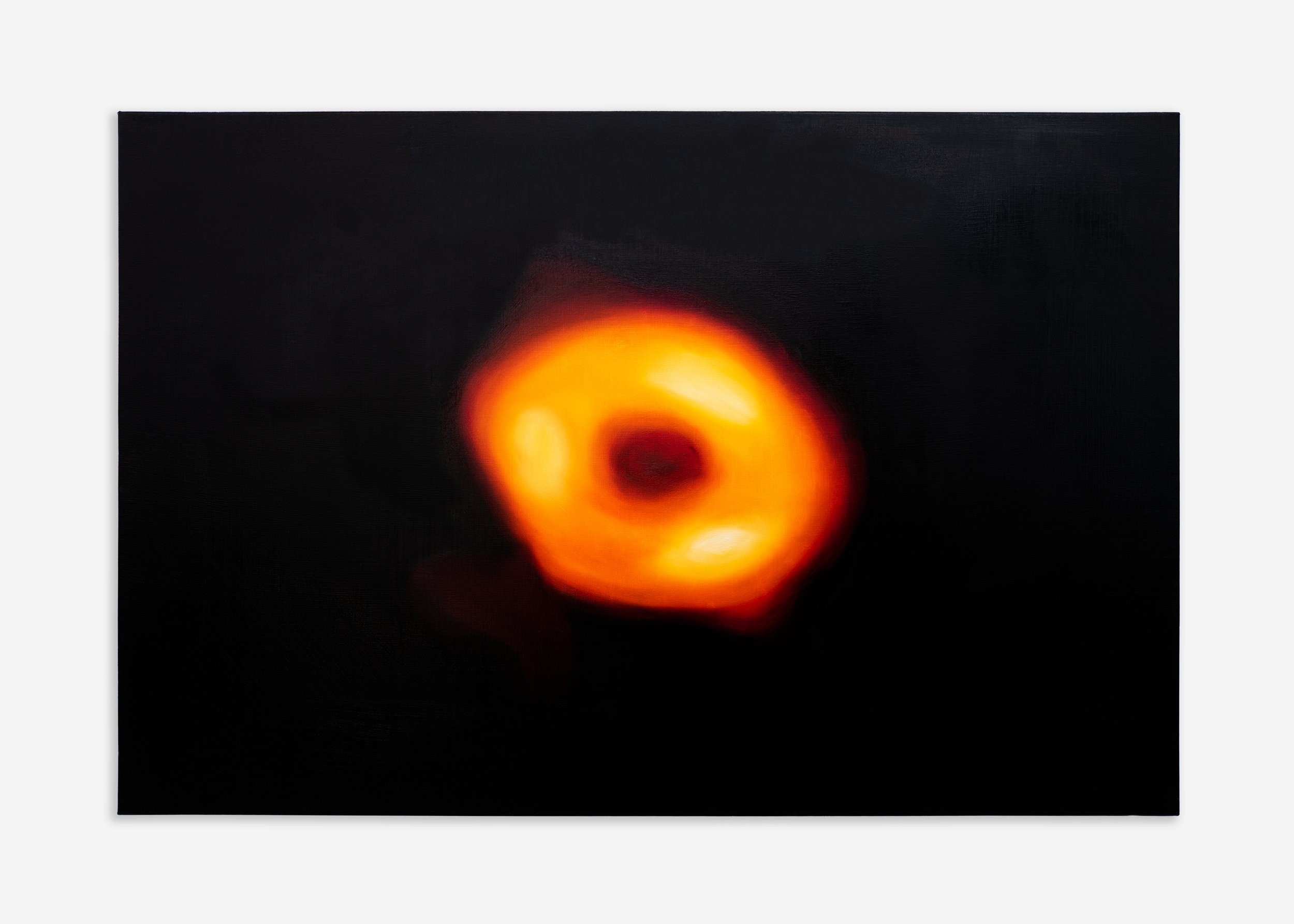
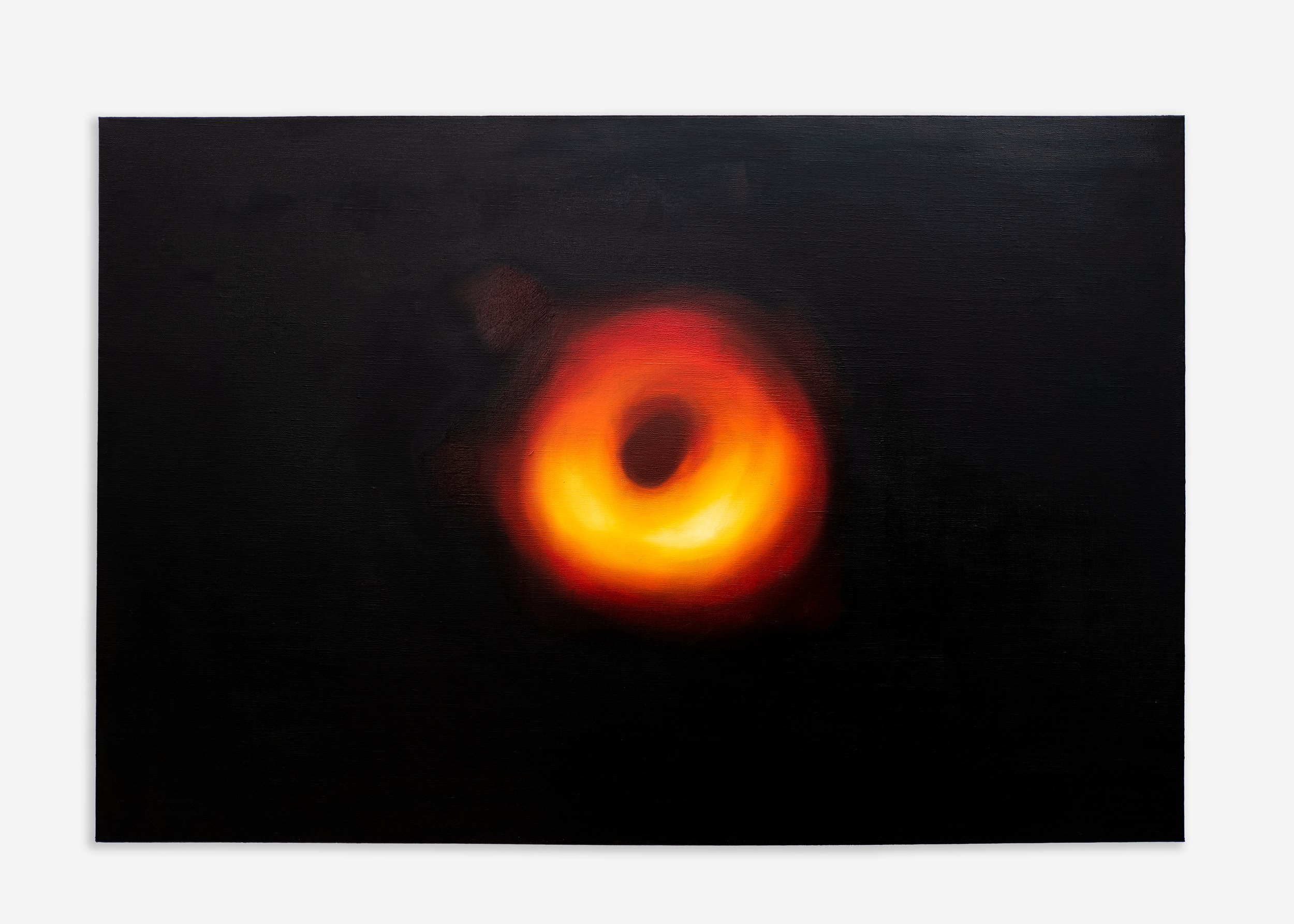
The brushwork distinguishes between two zones of the painting in a manner that directly serves its subject. In the accretion ring, the paint is applied in thin, overlapping layers that build the gradient from pale amber through deep orange to almost-white at the point of maximum brightness. Each layer modifies the one beneath it, producing a surface that reads as luminous rather than opaque, as though the light were emanating from within the paint film rather than reflecting off it. This is the same technique Tan Mu employed in her earlier black hole painting, Powehi (2022), which depicts the first image of the M87* black hole released in 2019. In both works, the luminous ring is built through incremental accretion, each layer of paint corresponding to an increment of radiated energy in the source. The paint accumulates the way the gas accumulates around the black hole: slowly, in concentric orbits, each pass adding density and heat. The outer boundary of the ring feathers into the black ground, individual filaments of orange pigment trailing into the darkness like the wisps of ionized gas that the EHT image resolves at its noise limit. These filaments are not decorative. They register the physical reality of an accretion disk that does not end at a sharp boundary but grades into the surrounding space, its outer regions cooler and thinner, its density falling off gradually until it becomes indistinguishable from the interstellar medium. The painting's edge treatment is a translation of a physical condition: the ring does not stop. It fades.
The black ground is the painting's most consequential decision. In the EHT image, the background is black because the data has been processed to remove all sources of emission except the emission from the immediate vicinity of the black hole. The black is not empty space. It is the result of a subtraction: everything that is not the signal has been removed. In the painting, the black ground carries the same structural function. It isolates the ring the way the data processing isolates the signal. It creates what Tan Mu has described as an "objectified space," a field in which the form can emerge with maximum clarity, free from the noise of context. But the black ground also does something the data processing does not: it registers the epistemological condition of the black hole itself. The center of the ring is dark not because the data was subtracted but because no information can escape from within the event horizon. The darkness is not an absence of data. It is an absence of possibility. No signal, no radiation, no photon that has crossed the event horizon will ever reach any detector in the observable universe. The shadow of Sagittarius A* is the most complete darkness that physics permits: not a region where nothing has been measured, but a region where nothing can ever be measured. The painting holds this darkness at its center as an irreducible fact. It is not the darkness of ignorance, which can be dispelled by better instruments. It is the darkness of a physical limit, beyond which knowledge cannot pass.
Caravaggio's The Conversion of Saint Paul (1601) occupies the Cerasi Chapel in Santa Maria del Popolo, Rome, alongside its companion piece, The Crucifixion of Saint Peter. The painting depicts the moment described in the Acts of the Apostles: Saul, on the road to Damascus, is struck by a light from heaven and falls from his horse. In Caravaggio's rendering, the light is not represented as a beam or a glow. It is registered only by its effects: the illumination of Saul's body, the brightness of his upturned face, the gleam on the horse's flank. The source of the light is outside the frame. It is invisible. What Caravaggio paints is not the light itself but the evidence of the light, the way it falls on surfaces and reveals forms that would otherwise remain in darkness. The surrounding space is consumed by shadow so deep that the background architecture, the road, the sky, and all contextual detail disappear. Only the figures remain, suspended in a darkness that has no location, no weather, no time of day. This is tenebrism, the technique Caravaggio developed from earlier Venetian and North Italian precedents into a method in which darkness becomes the dominant pictorial substance and light becomes the intruder, the anomaly, the revelation that breaks through an otherwise total obscurity.
The structural parallel to Sagittarius A* lies in how both paintings use darkness as the condition that makes the luminous form legible. In Caravaggio, the darkness is metaphysical. It is the darkness of the unredeemed world, the state of spiritual blindness from which the divine light rescues the convert. In Tan Mu, the darkness is physical. It is the darkness of the event horizon, the state of absolute unknowability from which the accretion disk's radiation rescues the image. In both cases, the luminous form does not exist independently of the darkness that surrounds it. The ring is defined by the void it encircles. The convert is defined by the blindness he leaves behind. Caravaggio's light and Tan Mu's ring share a common logic: they are both emergences, not presences. They do not fill the darkness. They interrupt it. They appear within it, and their appearance is contingent on the darkness that makes them visible. A Caravaggio painting in which the entire scene were evenly lit would not be a Caravaggio. A Sagittarius A* painting in which the background were filled with stars and nebulae would not depict a black hole. The darkness is not the setting. It is the subject's condition of possibility.
There is a further shared logic at the level of reception. Caravaggio's painting is often described in terms of the instant: the sudden illumination, the dramatic conversion, the moment when everything changes. But the painting also registers duration. The horse is mid-stride, its hooves still raised. The groom is still reaching for the reins. The conversion has not yet been processed. It is happening, not happened. The same temporal ambiguity operates in Tan Mu's painting. The accretion ring is not static. The gas in the disk orbits the black hole at relativistic speeds, completing a full revolution in a matter of minutes. The EHT image is a time-averaged composite: it smears the instantaneous structure of the disk across multiple orbits, producing a ring that is sharper than any single snapshot would be. The painting registers this averaging in its surface. The gradients of orange and amber do not resolve into distinct features. They remain smooth, continuous, as though the camera's exposure time were longer than the period of the gas's orbit. The painting depicts not a moment but a mean: the stable structure that emerges when the turbulence of the disk is averaged over time. This is the same kind of temporal compression that Caravaggio practices, the moment extended into duration, the instant stretched until it contains the time before and the time after. Neither painting shows what happened. Both show what can be seen when the event is allowed to accumulate.
Hiroshi Sugimoto's Seascapes series, begun in 1980 and ongoing, consists of hundreds of black-and-white photographs of ocean surfaces divided by a horizon line. Each photograph is made with an exposure time long enough to smooth the waves into a continuous field of tone, the water becoming a plane of even gray or black and the sky becoming a lighter or darker gray depending on conditions and exposure. The series is rigorously consistent in format: every image is bisected by a horizon, every image is shot from a low vantage point, every image excludes all evidence of land, ships, clouds, or human presence. The horizon is the only event in the frame. It divides the picture into two fields of nearly uniform tone and produces an image of extraordinary stillness, an image that could be mistaken for a painting by Mark Rothko or a drawing by Vija Celmins if the medium were not identified.
The Seascapes are connected to Sagittarius A* by a shared interest in the horizon as the limit of visibility and the structure that organizes what can be seen. In Sugimoto, the horizon is the line where water meets sky, the boundary between two media that are visually indistinguishable at certain times of day and in certain atmospheric conditions. The horizon is what makes the image legible. Without it, the photograph would be a field of undifferentiated gray. With it, the gray splits into two zones, one above and one below, and the viewer can parse the image as sky and sea. The horizon does not add information. It adds structure. It organizes what is already there into a form that perception can process. The event horizon of a black hole performs the same function in a different register. It is the boundary between the region from which light can escape and the region from which it cannot. It divides the observable universe into two zones: the exterior, from which information can reach a detector, and the interior, from which it cannot. The event horizon does not add information. It adds a limit. It specifies where information stops. And just as Sugimoto's horizon line is the only feature that prevents the image from collapsing into a uniform field, the event horizon is the only feature that prevents the black hole from being indistinguishable from empty space. Without the event horizon, there would be no shadow, no ring, no image. There would be only the dark, and no way to know that anything was there.
Sugimoto's long exposures also provide a model for thinking about the temporal structure of the EHT image and its translation into painting. Each Seascape is made with an exposure measured in hours, sometimes half a day. During that time, waves rise and fall, light shifts, clouds pass, and the surface of the water changes continuously. The resulting photograph does not record any single state of the ocean. It records the average of all those states, the stable structure that emerges when the transient variations are smoothed away. The horizon line holds firm across the entire exposure because it is the one feature that does not change: the boundary between water and air is always there, always in the same position, regardless of the wave amplitude or the wind speed. The EHT image operates on the same principle. Over the course of the observing run, the accretion disk of Sagittarius A* churns and flares. Individual features appear and disappear on timescales of minutes. But the event horizon does not change. The shadow does not fluctuate. The mass of the black hole is constant, and the diameter of the shadow is determined by the mass. The ring may brighten and dim, its asymmetry may rotate, but the shadow at its center remains fixed. The EHT image, like a Sugimoto exposure, records the stable structure that persists beneath the turbulence. And Tan Mu's painting, like the EHT image, is a time-averaged representation: it does not show the disk at any single moment but shows the disk as it looks when all the moments are superimposed, their variations smoothed into the continuous gradients of orange and amber that fill the ring.
Tan Mu has described the process by which the EHT collaboration assembled the image of Sagittarius A* as analogous to printmaking, "where fragmented information is gradually consolidated into a complete image." The comparison is precise. In etching, the artist incises lines into a metal plate, inks the plate, and presses it onto paper. The image does not exist in its final form until the moment of printing. Before that, it exists only as a system of marks on a surface, each one partial, each one contributing a fragment of the whole. The EHT data works the same way. Each telescope records a fragment of the signal. The correlators assemble the fragments. The imaging pipelines render the assembled data into a picture. The image does not exist at any single telescope. It exists only at the point of synthesis, when the fragments are combined and the whole emerges from the parts. The comparison to printmaking also locates the human labor inside the image. The EHT image is not a product of passive reception. It is a product of active construction. Hundreds of people designed the instruments, scheduled the observations, maintained the equipment during the Antarctic winter, shipped the hard drives, wrote the correlation software, developed the imaging algorithms, ran the validation tests, and argued about the results. The image carries all of that labor within it, the way a printed etching carries the pressure of the press and the viscosity of the ink. Tan Mu's painting adds another layer of labor to this chain: the slow, manual accumulation of oil paint on linen, each brushstroke a translation of a data point that was itself the product of a distributed observation. The painting is not a reproduction of the EHT image. It is a record of the same process the image records: the assembly of visibility from fragments, the emergence of form from coordinated attention.
Nick Koenigsknecht, writing in the BEK Forum catalog in 2025, describes Tan Mu's technology paintings as "self-portraits of the apparatus," arguing that the paintings "register not only what the instrument sees but the fact that an instrument was looking." Sagittarius A* is the most radical instance of this registration. The black hole cannot be seen. What can be seen is the apparatus that sees it: the network of dishes, the correlation pipeline, the imaging algorithm, the color map that translates radio intensity into orange and gold. The painting does not depict the black hole. It depicts the image of the black hole. And the image of the black hole is, as Koenigsknecht suggests, a portrait of the system that produced it. The asymmetry of the ring, the enhanced brightness at the bottom, the smooth gradients that fill the annulus: all of these are features not of the black hole itself but of the black hole as mediated by the telescope, the algorithm, and the conventions of scientific visualization. Tan Mu's painting preserves this mediation rather than collapsing it. It paints the image, not the object. It paints the reconstruction, not the reality. And in doing so, it makes visible a condition that the EHT collaboration itself acknowledges in its publications: that the image is a representation, not a direct record, and that its fidelity to the source depends on choices made during the reconstruction process that are not purely determined by the data.
The color of the EHT image is one such choice. The data collected by the telescopes is radio-frequency intensity at a wavelength of 1.3 millimeters, which is invisible to the human eye. The collaboration chose to map the intensity values to a warm color scale, from black at zero intensity through red, orange, and yellow at the highest values. This is a conventional choice, not a necessary one. The same data could have been rendered in blue, green, or grayscale. The orange-gold palette was selected because it communicates heat, energy, and dynamism, qualities that the collaboration wanted to emphasize in its public communication. Tan Mu's painting adopts the same color scheme, but it transforms it from a convention into a material condition. The orange and gold are no longer a color map applied to data. They are oil paint, with the density, viscosity, and luminosity that oil paint produces when it is built up in thin layers over a dark ground. The painting translates the color map back into the physical medium of light-reflecting pigment, and in doing so, it removes the arbitrariness of the color choice. The orange and gold are no longer arbitrary because they are now the result of a material process, not a software decision. The painting makes the color inevitable by making it physical. The same orange that was one option among many in the visualization software becomes the only possible color when the medium is oil on linen and the ground is black. The physics of paint and the physics of light converge: a warm-toned ring against a dark ground is what you see when you paint a luminous form in oil on a black surface. The EHT collaboration chose orange for rhetorical reasons. The painting produces orange for material reasons. The result is the same, but the pathway is different, and the difference matters because it relocates the image from the domain of data visualization, where color is a choice, to the domain of painting, where color is a consequence of the meeting between pigment and light.
What the painting holds that the EHT image does not is the duration of its own making. The telescope observed for a few nights. The correlators processed the data for five years. The image was released in a press conference. The painting took weeks, possibly months, each layer of orange applied and allowed to dry before the next was added, the luminosity building incrementally the way the signal was built from fragments. This slowness is not incidental to the painting's meaning. It is constitutive. The EHT image collapses five years of processing into a single frame. The painting extends the moment of the image's appearance into the time of its fabrication, spreading the instant of revelation across the weeks of the studio. The painting is not faster than the data. It is slower. And in its slowness, it registers something the data cannot: the fact that the image of a black hole, like the black hole itself, is defined by what surrounds it. The gas surrounds the void. The algorithm surrounds the data. The collaboration surrounds the scientist. The paint surrounds the canvas. Each layer of medium, whether radio waves or oil paint, contributes its own properties to the final image, and no image of a black hole will ever be free of the medium that produced it. The painting knows this. It does not pretend to show the thing itself. It shows the thing as it appears when it has passed through the full thickness of human attention: observed, correlated, imaged, published, seen, and painted. That thickness is the subject of the work, and it is the reason the painting is not a reproduction but a record, a document of the most ambitious act of collective looking in the history of astronomy, translated into the most ancient medium of visual record that human beings possess.