The Shape That Feeds Itself: Tan Mu's Torus and the Geometry of Return
A torus is a shape that contains itself. It is a surface of revolution generated by rotating a circle around an axis that lies in the same plane as the circle but does not intersect it. The result is a donut: a hole surrounded by a tube, a tube that curves back on itself, a surface that has no boundary, no edge, no beginning and no end. If an ant were placed on the surface of a torus and began walking in a straight line, it would eventually return to its starting point without ever crossing an edge or encountering a boundary. The surface is closed and continuous. It feeds back on itself. Energy enters at one pole, spirals through the center, exits at the opposite pole, curves around the outside, and returns to the first pole, completing a circuit that can repeat indefinitely without external input. This is why the torus is described as a self-sustaining energy system: it is a shape whose geometry implies circulation, and whose circulation implies the absence of a beginning or an end. It is a loop of return.
The torus is also the most common shape in nature. Every atom on Earth is part of a torus. The magnetic field that surrounds a bar magnet is toroidal. The magnetic field that surrounds the Earth is toroidal. The magnetic field that surrounds the Sun is toroidal. Tornadoes are toroidal. Whirlpools are toroidal. The rings of Saturn are the cross-section of a toroidal magnetic field. The event horizon of a black hole, when viewed from the perspective of its ergosphere, is toroidal. The vortices that form in the wake of an aircraft wing are toroidal. The smoke ring that rises from a cigarette is toroidal. The shape appears at every scale, from the subatomic to the galactic, and its recurrence is not coincidental. It is a consequence of the way energy behaves in three-dimensional space. Energy that flows in a circuit tends to organize itself into a torus, because the torus is the most efficient geometry for containing a circulating field within a bounded volume. It is the shape that nature selects when it needs to sustain a flow.
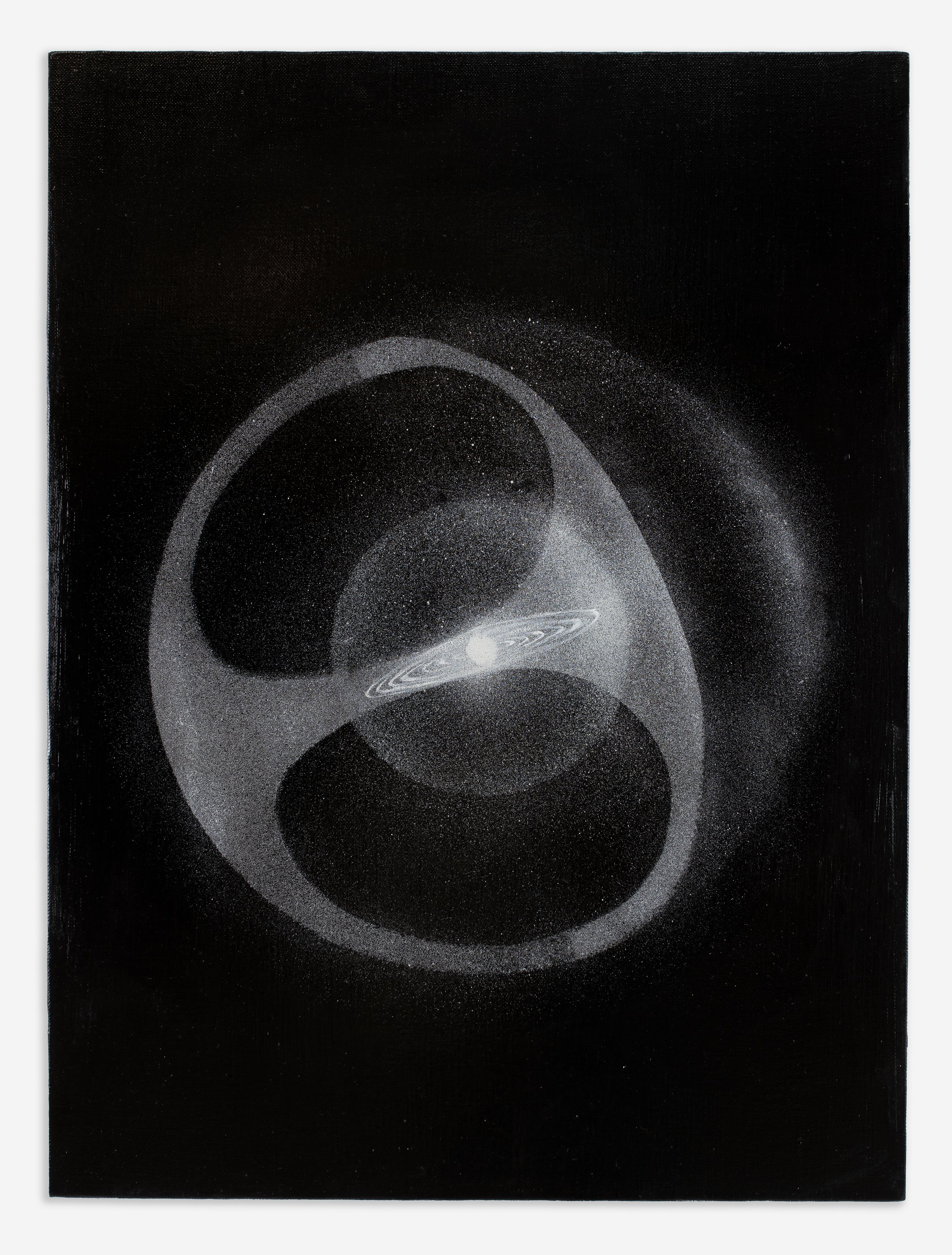
Torus (2021) is an oil painting on linen, 61 x 46 cm (24 x 18 in), that renders this shape in a monochrome palette of black and white so reduced that the painting approaches the condition of a diagram. The torus occupies the center of the composition, rendered in white and pale gray against a ground of deep black, its curved surface described by a dense field of points that vary in size and intensity to create the illusion of a three-dimensional form rotating in space. The points are not scattered randomly. They are organized along the curved lines of the torus surface, following the meridians and parallels of the topology, clustering more densely where the curvature is tightest and thinning where the surface opens outward toward the viewer. The effect is of a luminous, translucent form that seems to be made of light rather than of paint, a shape that glows from within against the absolute black of the surrounding void. The void is not an absence. It is the medium in which the torus operates. It is the space through which energy circulates. And the torus, in its self-sustaining rotation, generates its own light as a byproduct of its own motion, the way a dynamo generates electricity when it spins, the way a phosphor screen glows when an electron beam strikes it.
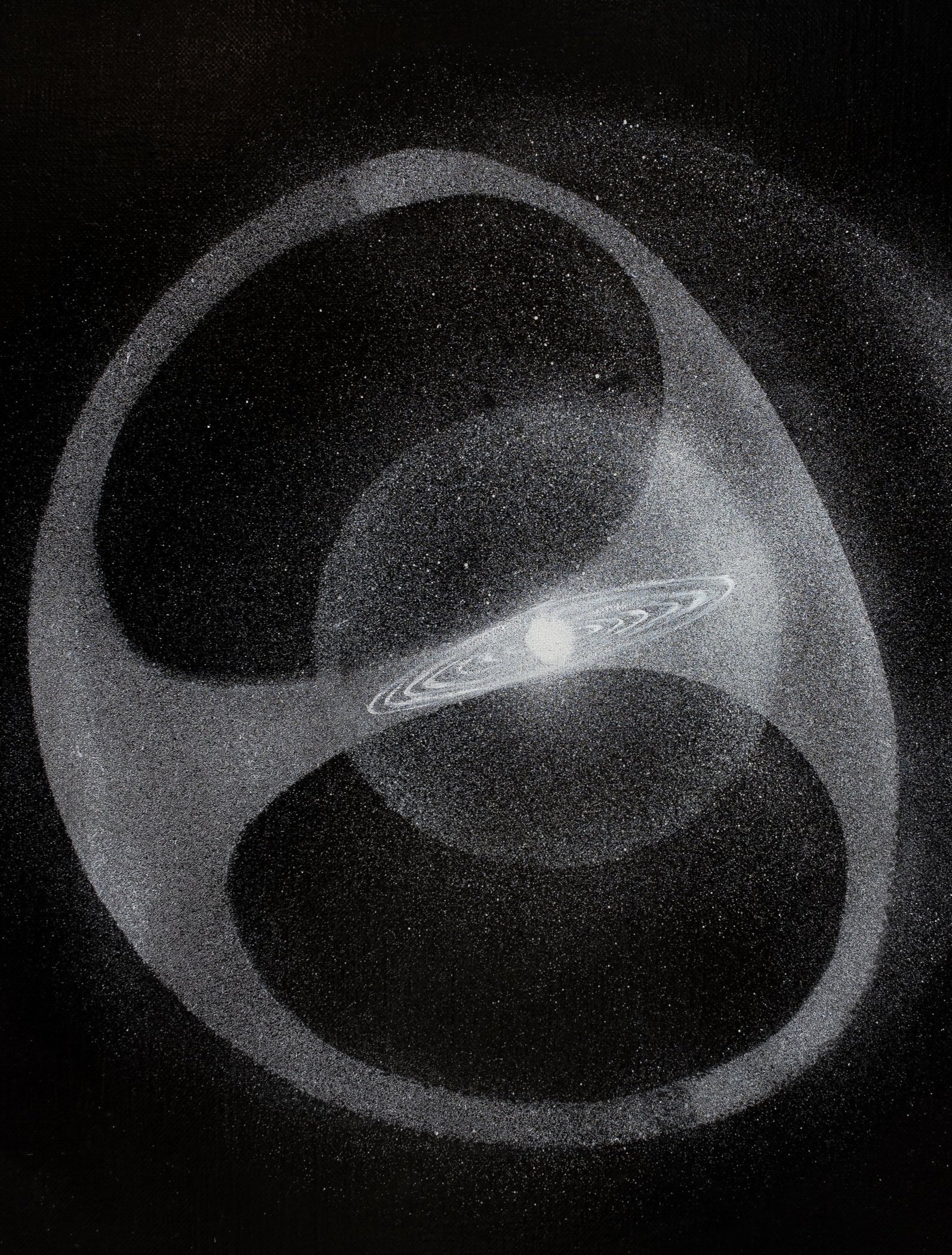
Tan Mu has described the choice of black and white as deliberate, explaining that she rejected the pseudo-color systems of scientific visualization in favor of a monochrome palette that "allows the form of the torus to appear more directly and objectively." By removing color, she eliminates the sensory distractions that pseudo-color systems introduce, and she directs attention toward structure, shape, and the flow of energy within the form. The decision is also a decision about lineage. Black and white places the painting in the tradition of scientific illustration, where monochrome has long been the norm for depicting structures whose significance lies in their geometry rather than their chromatic properties. The topology of a torus does not depend on its color. The fact that energy circulates in a toroidal pattern does not depend on whether the visualization uses red for hot and blue for cold. The black and white palette strips the form to its mathematical essence and presents it as what it is: a topology, a geometry, a shape that organizes energy in a particular way and that appears at every scale of the natural world because that way of organizing energy is the most efficient available.
The brushwork in Torus (2021) is distinct from the brushwork in Tan Mu's other paintings of cosmic and microscopic subjects. Where the black hole paintings of 2022 build their luminous rings through thin, overlapping layers of warm oil paint that create gradients from pale amber to deep sienna, Torus (2021) builds its form through the accumulation of individual points. Each point is a single application of paint, a dot of white or pale gray placed on the black ground at a specific location determined by the topology of the torus surface. The points vary in size: larger near the center of the form, where the surface curves most tightly and the density of the point field is greatest, and smaller at the edges, where the surface thins out and the curvature opens toward the viewer. This variation in point size produces a gradient of luminosity that gives the torus its apparent three-dimensionality. The form appears to rotate in space because the point field is denser on the side of the torus that faces the viewer and thinner on the side that recedes, creating the illusion of foreshortening without the use of perspective lines or tonal modeling. The technique connects Torus (2021) to Tan Mu's earlier work No Signal (2019), where points also function as the fundamental visual unit, and to the Signal series (2024-2025), where points represent data units, pixels, and noise in the undersea cables that carry global communication. In Torus (2021), the points serve a dual function: they are the visual units from which the form is constructed, and they are the markers of energy flow, the individual quanta of circulation that, when accumulated, produce the self-sustaining system that the torus represents.
Barbara Hepworth's Single Form (1961-62), the large bronze sculpture that stands in the courtyard of the United Nations Secretariat Building in New York, is a pierced oval, a flattened disc with a hole at its center. The form is derived from the standing stones and megaliths that Hepworth encountered in the landscape of Cornwall, where she lived and worked for most of her career, and it represents her mature engagement with the relationship between mass and void, between the solid body and the empty space that it encloses. The hole in Single Form is not an absence within the sculpture. It is the sculpture's generative principle. Hepworth described the hole as "the most important part" of her work, the element that transforms a solid mass into a form that breathes, that has interiority, that relates to the space around it rather than merely occupying it. The hole is what makes the sculpture a form rather than an object. Without the hole, the bronze would be a disc. With the hole, it becomes a form that contains within itself the logic of its own continuation, a form that implies the possibility of circulation, of passage, of energy moving through and around and back again.
The connection to Torus (2021) lies in this shared concern with the generative void. The torus is a surface that is defined by its hole. Without the hole, there is no torus. There is only a sphere. The hole is what transforms the sphere into a topology that can circulate energy back to its own origin. Hepworth's pierced forms, from the small carvings of the 1930s to the monumental bronzes of the 1960s, all share this structural logic: the void is not empty space. It is the space that makes the form work, the space through which light passes, air circulates, and the viewer's eye travels from one side of the sculpture to the other. The hole connects the front to the back, the inside to the outside, and in doing so it transforms the sculpture from a solid object into a system of relations. The torus takes this logic to its mathematical conclusion. The hole in the torus is not an opening in a disc. It is the central feature of a surface that has no boundary. Energy enters through the hole, circulates through the tube, and returns to the hole. The system is closed. The circulation is continuous. The form sustains itself.
Hepworth's insistence on the hole as a generative feature rather than a subtractive one also resonates with Tan Mu's decision to render the torus in a field of points rather than as a continuous surface. The points create the form by defining its topology, the same way Hepworth's holes define the form by carving passages through the mass. Each point in Tan Mu's painting is a marker of presence, a quantum of energy, a unit of the circulating field. The spaces between the points are not gaps in the form. They are the form's transparency, the spaces through which the background shows, the same way the background shows through Hepworth's holes. The points do not fill the surface of the torus. They trace it. They mark its path. They indicate where the surface is and where it curves and where the energy flows. The form that emerges from the accumulation of points is not a filled area but a traced trajectory, a path of energy that returns to its own origin, a loop of light in a field of darkness.
The self-sustaining quality of the torus is what distinguishes it from other topological forms and what gives it its philosophical resonance. A sphere is closed but it does not circulate. A cylinder is open at both ends. A Möbius strip has one surface and one edge. A torus is closed and it circulates. It takes in energy at one pole, passes it through the center, expels it at the other pole, and receives it back at the first. The circuit is complete. The system requires no external fuel. It is, in the language of thermodynamics, not a perpetual motion machine, which is impossible, but a topological structure that organizes whatever energy is available into a pattern of circulation that returns to its origin. This is why the torus appears at every scale of nature: it is the shape that energy takes when it circulates. Magnetic fields are toroidal because the equations that describe them, Maxwell's equations, produce solutions in which the field lines close on themselves, forming loops that circulate from one pole to the other and back. Atmospheric systems are toroidal because the convection currents that drive weather patterns rise from the surface, move through the upper atmosphere, descend at the opposite latitude, and return along the surface to their point of origin. The Van Allen radiation belts that surround the Earth are toroidal. The plasma torus that surrounds Jupiter is toroidal. The accretion disk that surrounds a black hole is the cross-section of a toroidal magnetic field. At every scale, from the magnetic field of a single atom to the magnetic field of a galaxy, the torus is the shape that energy assumes when it circulates. It is not one shape among many. It is the shape of circulation itself.
Gustav Metzger's auto-destructive art demonstrations of the 1960s were performances in which the artist subjected his own works to processes of dissolution: acid was poured on nylon canvases, liquid crystals were projected and then allowed to decay, and the works were designed to destroy themselves within a predetermined time frame. The most famous of these demonstrations took place at the Destruction in Art Symposium in London in 1966, where Metzger projected images of acid corroding nylon while he spoke about the relationship between destruction, creation, and the political conditions of the Cold War. Metzger's argument was that destruction is not the opposite of creation but its necessary counterpart. Every act of creation produces entropy. Every act of building produces waste. Every act of formation produces byproducts that must be eliminated before the system can continue to function. Auto-destructive art made this cycle visible by accelerating it, by making the destruction as visible as the creation and by insisting that the two processes are inseparable.
The connection to Torus (2021) is structural, not stylistic. Metzger's auto-destructive art and Tan Mu's torus painting share a concern with the cycle of creation and destruction as a continuous process. The torus is not a static form. It is a process made visible. Energy enters at one pole, passes through the center, exits at the other, and returns. The entry point is also the exit point. The creation of the form is simultaneous with its dissolution. The torus does not exist in a state of being. It exists in a state of becoming. It is always in the process of circulating, always in the process of feeding itself, always in the process of destroying the energy at one pole in order to create it at the other. This is the same cycle that Metzger made visible in his demonstrations: the creation and destruction are not separate events but simultaneous aspects of a single process. The auto-destructive artwork destroys itself in order to reveal the conditions of its own existence. The torus circulates its own energy in order to sustain its own form. Both are systems in which the output of one process becomes the input of another, and both are systems in which the boundary between creation and destruction is not a line but a loop.
Metzger's work also connects to Tan Mu's through the concept of the point as a unit of information. In the late 1950s and early 1960s, Metzger produced a series of paintings that he called "auto-creative" works, in which liquid crystals were projected onto screens and allowed to form patterns that evolved over time. These patterns were not designed by the artist. They emerged from the physical properties of the crystals and the conditions of their projection. The artist's role was to set the initial conditions and then to observe the result. Tan Mu's points in Torus (2021) function in a similar way. They are placed individually, each one a discrete application of paint, but their cumulative effect is a pattern that emerges from the topology of the form rather than from the artist's composition. The points are not arranged according to an aesthetic program. They are arranged according to a mathematical one. They mark the path that energy takes as it circulates through the torus, and the pattern that emerges from their accumulation is the pattern of the circulation itself, the topology made visible. The artist's hand places each point, but the logic that determines the point's position is not the logic of composition. It is the logic of topology, the logic of the shape that feeds itself.
Nick Koenigsknecht, writing in the BEK Forum catalog in 2025, describes Tan Mu's practice as one in which "the painting becomes a record of a process rather than a representation of an object," arguing that "the form is not depicted. It is enacted." Torus (2021) is the most concentrated instance of this enactment. The painting does not depict a torus the way a photograph depicts a donut. It enacts the torus's logic through its own construction. The points accumulate the way energy accumulates in the circulating field. The black ground is the void through which the energy passes. The luminous form is the field itself, generated by the accumulation of the points, sustained by their distribution, and dissolved at its edges where the points thin and the black ground reasserts itself. The painting is not a picture of a self-sustaining system. It is a self-sustaining system, or at least it is the closest that a static object, a painting on linen, can come to being one. The points are the energy. The black is the void. The circulation is implied by the topology, which is traced by the points, which are placed by the hand, which is guided by the mathematics, which is the logic of the shape that feeds itself. The chain is closed. The system is complete. The loop of return is intact.