The Spiral That Moves the Ship: Tan Mu's The Wave 03 and the Geometry of Propulsion
In March 1934, the Museum of Modern Art in New York opened an exhibition called Machine Art. Curated by Alfred H. Barr, Jr., the museum's founding director, the exhibition displayed 425 industrial objects on the museum's walls and pedestals: ball bearings, cooking pans, laboratory flasks, springs, propellers, and other manufactured items, each presented as an aesthetic object and each selected for what Barr called "the beauty inherent in functional design." The propellers on display were less than one meter in diameter. They were small enough to be mounted on a wall and treated as sculptures, their twisted blades and polished surfaces inviting the kind of contemplative looking that the museum normally reserved for Brancusi and Picasso. The exhibition was a declaration that the machine age had produced objects of genuine beauty, and that the museum had a responsibility to recognize this beauty and to display it alongside the more conventional arts of painting and sculpture. It was also a declaration about scale. The objects in Machine Art were domestic, manageable, proportioned to the human hand and the domestic interior. The propellers were beautiful because they were small enough to be seen whole, because their geometry could be taken in at a glance, and because their function, to move air through a fan housing or to propel a small boat through calm water, was modest enough to be comprehensible.
Ninety years later, the propellers that move container ships through the world's oceans are not modest. They are not domestic. They are not proportioned to the human hand. A modern ship's propeller can reach eight meters in diameter and weigh over a hundred tons. It is fabricated from nickel-aluminum-bronze alloys designed to resist corrosion in salt water, and it is installed by crane onto a shaft that descends through the hull into the water below. It is never seen by the passengers aboard the ship. It operates in darkness, below the waterline, in a medium that is opaque, turbulent, and hostile to human presence. The propeller is the hidden engine of globalization. Every container ship that crosses the Pacific, every oil tanker that rounds the Cape of Good Hope, every bulk carrier that transits the Suez Canal is driven by a propeller whose geometry determines how efficiently the ship converts fuel into forward motion, and whose wake determines how much energy is wasted in turbulence and cavitation. The propeller is the point where the ship meets the ocean, and the ocean does not yield.
The Wave 03 (2024) is a painting of this meeting. Oil on linen, 51 x 77 cm (20 x 30 in), it is one of three works in the Wave series, each of which depicts the propeller of a ship as a form that exists at the intersection of mechanical design and natural force. The propeller in The Wave 03 is rendered in warm golden tones that dominate the center of the composition, its curved blades spiraling outward from a dark central hub in a pattern that reads simultaneously as a mechanical object and as a natural form. The golden surface is built up through multiple thin layers of oil, each one slightly warmer or cooler than the last, producing a luminosity that shifts depending on the viewing angle and the ambient light, an effect that mirrors the way a polished bronze propeller catches and refracts light when it is hauled from the water, still wet, still gleaming with the residue of the ocean it has just left. The blades curve in a spiral that is not decorative but functional. The twist of each blade, its pitch and rake, is determined by the hydrodynamic requirements of moving a specific volume of water at a specific speed of rotation. The geometry of the propeller is not the geometry of art. It is the geometry of physics, and yet, as Tan Mu's painting makes clear, it is also the geometry of art, because the spiral that the propeller describes is the same spiral that appears in the growth patterns of shells, the arrangement of seeds in a sunflower head, the structure of DNA, and the arms of spiral galaxies. The propeller is a mechanical object that recapitulates a natural form, and the painting insists on this recapitulation, rendering the propeller with a warmth and a luminosity that make it impossible to see it as merely industrial.
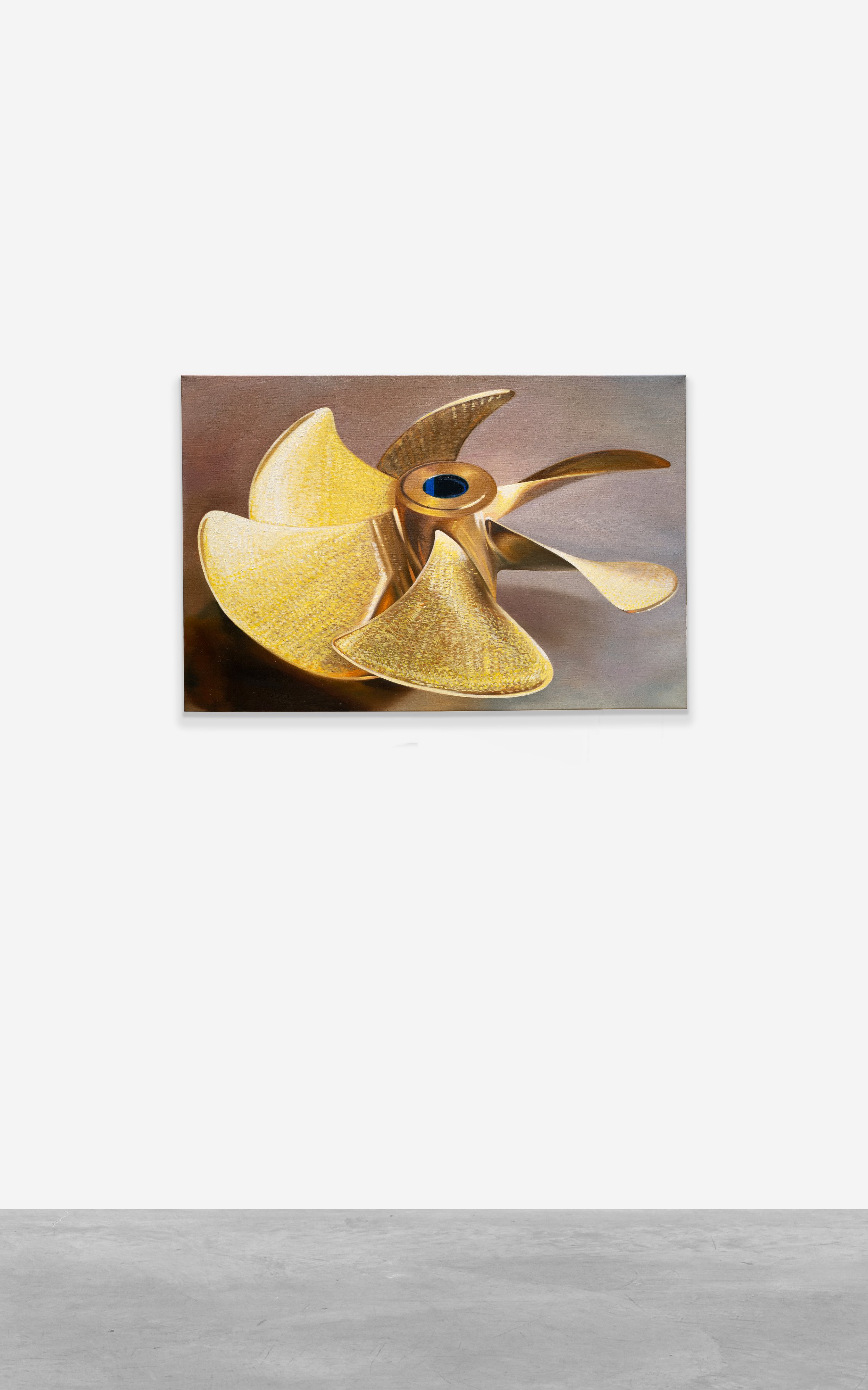
The background against which the propeller appears is a field of deep, saturated blue that approaches but does not reach black. This is the blue of deep water, the blue that begins where the light from the surface can no longer penetrate, and it serves as the medium through which the propeller operates. The blue is not uniform. It modulates across the surface of the canvas, darker at the edges and slightly lighter near the propeller blades, as though the kinetic energy of the rotating propeller were disturbing the water around it, generating currents and vortices that lighten the blue by introducing turbulence into the otherwise still field. These modulations are achieved through the same technique of layered oil that produces the golden luminosity of the propeller, and they create a visual relationship between the propeller and its medium that is central to the painting's argument: the propeller and the ocean are not separate entities. The propeller exists in the ocean and through the ocean. Its shape is determined by the properties of water, its function is to move water, and the wake it produces is a modification of the water's state. The painting renders this interdependence by making the boundary between the golden blades and the blue water a zone of transition rather than a line of separation. Where the propeller meets the water, the colors merge and blend, the gold bleeding into the blue, the blue rising into the gold, as though the propeller were not an object placed in water but a condensation of the water's own energy, a knot in the current, a point where the ocean's force becomes concentrated enough to take on a metallic sheen.
Marcel Duchamp's Bicycle Wheel (1913) consists of a front wheel and fork from a bicycle mounted upside down on a painted wooden stool. It is one of the earliest of what Duchamp would later call readymades, ordinary manufactured objects that the artist designated as works of art by signing them, displaying them in galleries, and refusing to modify them beyond the act of selection. The wheel spins on its fork when pushed, and its spinning produces a visual effect that Duchamp described as a source of visual pleasure, a distraction, something to watch the way one watches a fire. The wheel is a machine part, designed for a specific function, but mounted on the stool and removed from the bicycle, it becomes an object of contemplation, its rotation now purposeless, its geometry now visible in a way that it never was when it was attached to a frame and moving a rider down a street. The act of removing the wheel from its functional context and placing it in an aesthetic context does not change the wheel. It changes the conditions under which the wheel is seen. The same object that was invisible when it was part of a bicycle becomes visible when it is placed on a stool in a gallery. The function has been subtracted, and the form has been revealed.
The connection to The Wave 03 lies in this act of decontextualization and the revelation it produces. Duchamp took a bicycle wheel, an object designed to roll along a surface, and removed it from the bicycle, revealing its geometry and its capacity for motion as aesthetic properties. Tan Mu takes a ship's propeller, an object designed to rotate in water and generate thrust, and removes it from the ship, revealing its geometry and its spiral structure as a form that exists at the boundary between the mechanical and the natural. The propeller in The Wave 03 is not depicted in situ, attached to a hull and submerged beneath a ship. It is depicted in isolation, floating against a blue ground that represents the water it moves through but that also functions as an abstract field, a space of pure color against which the spiral form can be seen clearly. This removal from context is the same operation that Duchamp performed with the bicycle wheel. It is an act of designation: this object, removed from its functional setting and placed in an aesthetic one, is worth looking at. Its form is worth attending to. Its geometry is worth seeing.
There is a further shared concern with what might be called the aesthetics of motion. Duchamp's Bicycle Wheel is a stationary object that implies motion. Its spokes are arranged in a radial pattern that produces a shimmering effect when the wheel spins, and this effect is a consequence of the wheel's design, not of any artistic intervention. The wheel looks the way it does because it was designed to be light, strong, and aerodynamic, and these design requirements produced a visual form that Duchamp found compelling. The propeller in The Wave 03 is also a stationary object that implies motion. Its blades are arranged in a spiral pattern that produces a swirling effect when the propeller rotates, and this spiral is a consequence of the hydrodynamic requirements of thrust generation, not of any decorative intention. The propeller looks the way it does because it was designed to move water efficiently, and these hydrodynamic requirements produced a visual form that Tan Mu found compelling. In both cases, the artist identifies an object whose functional design has produced an aesthetic form, removes the object from its functional context, and presents the form as worthy of sustained contemplation. The question that both works raise is whether the form was always aesthetic, present in the object but invisible when the object was serving its function, or whether the form becomes aesthetic only through the act of decontextualization. Duchamp's position was clear: the form was always there. The readymade does not create beauty. It reveals it. Tan Mu's position, rendered in paint rather than in selection, is the same. The propeller's spiral was always there. It took a painting to make it visible.
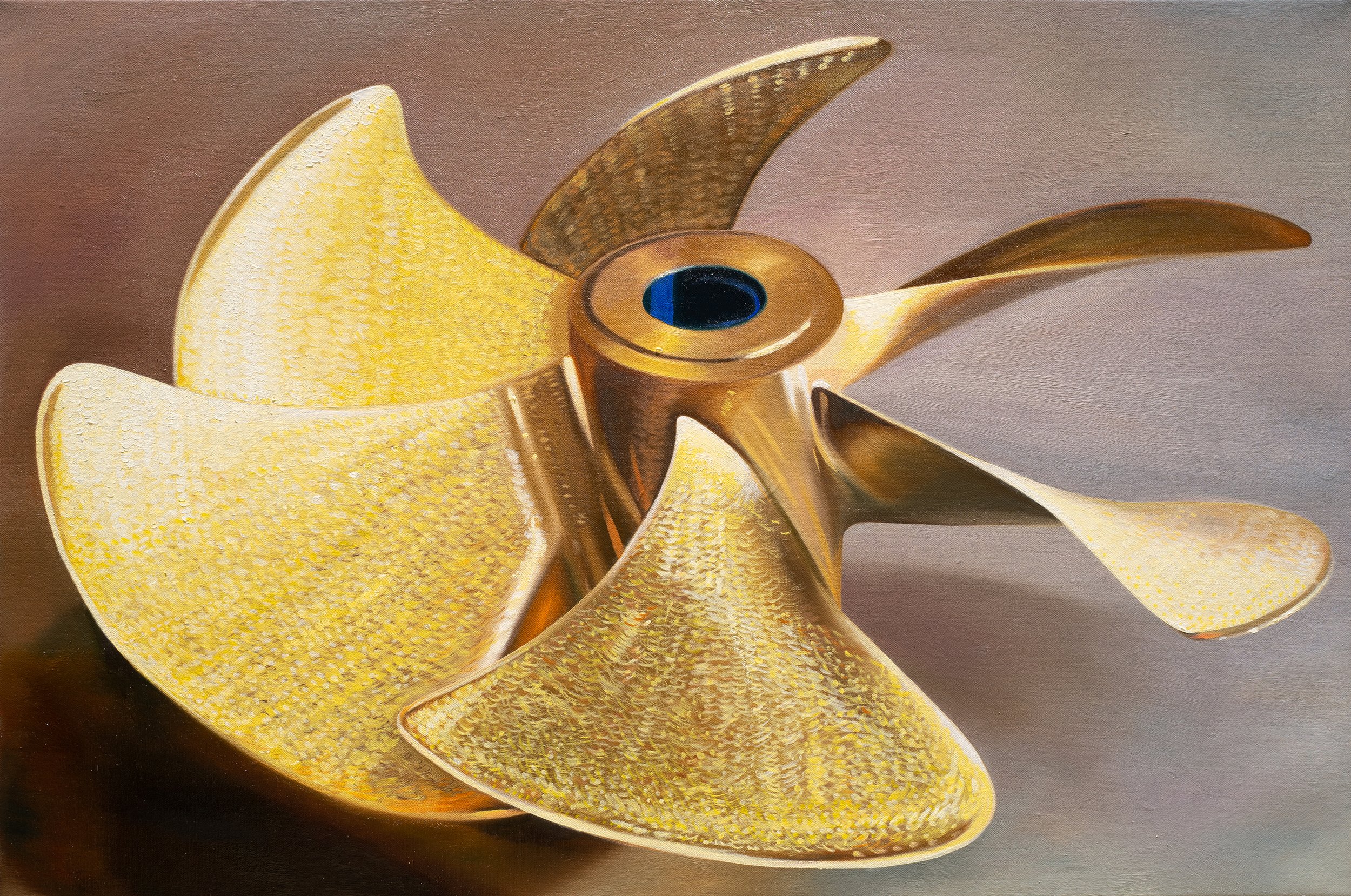
Tan Mu has described the propeller in The Wave series as a convergence of nature and machinery, a mechanical object whose function relies on fluid dynamics, turbulence, and flow, and whose spiral form echoes natural systems such as ocean currents, air circulation, and biological structures like DNA. This convergence is not metaphorical. It is structural. The propeller blade is shaped by the same mathematical principle that shapes the nautilus shell and the spiral galaxy: the logarithmic spiral, a curve that maintains a constant angle between its tangent and the line connecting any point on the curve to its center. The logarithmic spiral is a form that appears throughout nature because it is an efficient way to distribute force, material, and growth. It allows a shell to grow larger without changing its shape. It allows a plant to pack seeds into the smallest possible area. It allows a propeller to convert rotational motion into linear thrust by presenting each blade to the water at an angle that maximizes the transfer of momentum. The same equation that describes the growth of a sunflower head describes the twist of a propeller blade. The same geometry that determines the arrangement of leaves around a stem determines the pitch of a marine screw. The propeller does not imitate the spiral. It is the spiral, arrived at through engineering rather than biology, but governed by the same mathematical constraints that produce the spiral in every other context where it appears.
This structural connection between the mechanical and the natural is what the painting makes visible. The golden propeller against the deep blue ground could be a nautilus shell viewed from above, or it could be a galaxy seen from a distance of a hundred million light years. The ambiguity is deliberate. Tan Mu has noted that the spiral and toroidal structures of the propeller connect directly to forms that recur throughout her practice: the Gaze series, the paintings of cells, atoms, black holes, and cosmic phenomena, and earlier works such as Torus (2020-2021). These forms reflect what she describes as "a continuous energy cycle that exists across scales, from the microscopic to the cosmic." The Wave series is not an outlier in this practice. It is a continuation, a specific instance of a recurring preoccupation with the spiral as the fundamental geometry of energy transfer in both natural and mechanical systems. The propeller is not a departure from the cosmic or the microscopic. It is their midpoint, the scale at which the spiral becomes visible to the unaided eye, the scale at which the same forces that shape galaxies and DNA become large enough to push a ship across an ocean.
Caspar David Friedrich's The Sea of Ice (1824) depicts a shipwreck in the Arctic, the shattered hull of a vessel crushed between enormous slabs of ice that have piled into a jagged formation in the center of the composition. The painting is one of the most radical landscapes of the nineteenth century, a work that replaces the conventional shipwreck scene, in which human figures cling to wreckage while waves crash around them, with a vision of nature so vast and so indifferent that the ship is reduced to a minor detail, barely visible against the monumental ice formations that dominate the canvas. Friedrich had never been to the Arctic. He constructed the scene from his knowledge of accounts of polar expeditions and from his study of ice formations on the Elbe during the harsh winters of the 1820s. The result is a painting that does not depict a specific event but rather a general condition: the condition of human ambition confronted with the scale and indifference of natural force.
The Sea of Ice and The Wave 03 share a concern with the relationship between human technology and the ocean, but they approach this relationship from opposite directions. Friedrich depicts the moment when the technology fails, when the ship is crushed by the ice, when the vessel that was designed to carry human beings and their cargo across the water is reduced to splinters by the same water in its frozen state. The ocean is the antagonist. The ship is the victim. The technology is inadequate. Tan Mu's painting depicts the moment before the failure, the moment when the technology is working, when the propeller is spinning, when the ship is moving, when the human-engineered object is in full command of its medium. The ocean in The Wave 03 is not the antagonist. It is the medium through which the propeller operates, the substance that the propeller moves, the partner in the dance of thrust and resistance. The relationship is not adversarial but cooperative. The propeller does not conquer the water. It works with the water, channeling its resistance into forward motion, converting the ocean's density and viscosity into the energy that carries the ship across the surface. Friedrich's painting is about the limit of technology. Tan Mu's painting is about its operation. Friedrich shows what happens when the technology stops working. Tan Mu shows what it looks like when it is working perfectly.
And yet the two paintings share something that transcends their opposition. Both are paintings about scale. Friedrich's ice formations dwarf the ship not because the ship is small in absolute terms but because the ice is so large that it renders the ship insignificant. The relationship between the human object and the natural world is one of disproportion: the world is too big, the ship is too small, and the gap between them is the space where catastrophe occurs. Tan Mu's painting inverts this relationship. The propeller is depicted in isolation, removed from the ship, removed from any context that would establish its scale, and it fills the canvas with a presence that makes it difficult to determine whether the object is small or large. Is this a propeller small enough to be mounted on a wall at MoMA, as it would have been in 1934? Or is it an eight-meter industrial screw that weighs a hundred tons and drives a container ship through the Pacific? The painting does not say. The spiral form is the same at both scales. The geometry does not change. The logarithmic curve that describes the blade of a one-meter propeller also describes the blade of an eight-meter propeller. The painting renders the form without specifying the scale, and in doing so it makes visible a truth that is normally hidden by the difference in size: the propeller that fits on a pedestal in a museum and the propeller that drives a ship across an ocean are the same object, governed by the same mathematics, producing the same spiral, and the difference between them is a difference of degree, not of kind. This is what The Wave 03 shares with The Sea of Ice. Both paintings ask the viewer to confront the relationship between the human object and the natural world, and both make that confrontation visible by manipulating scale. Friedrich makes the ship small to make the ice large. Tan Mu makes the propeller large to make the spiral visible. The result, in both cases, is a painting that asks the viewer to see the technology not as a tool but as a form, and to see the form not as a decorative accident but as the consequence of mathematical laws that govern both the natural and the artificial world.
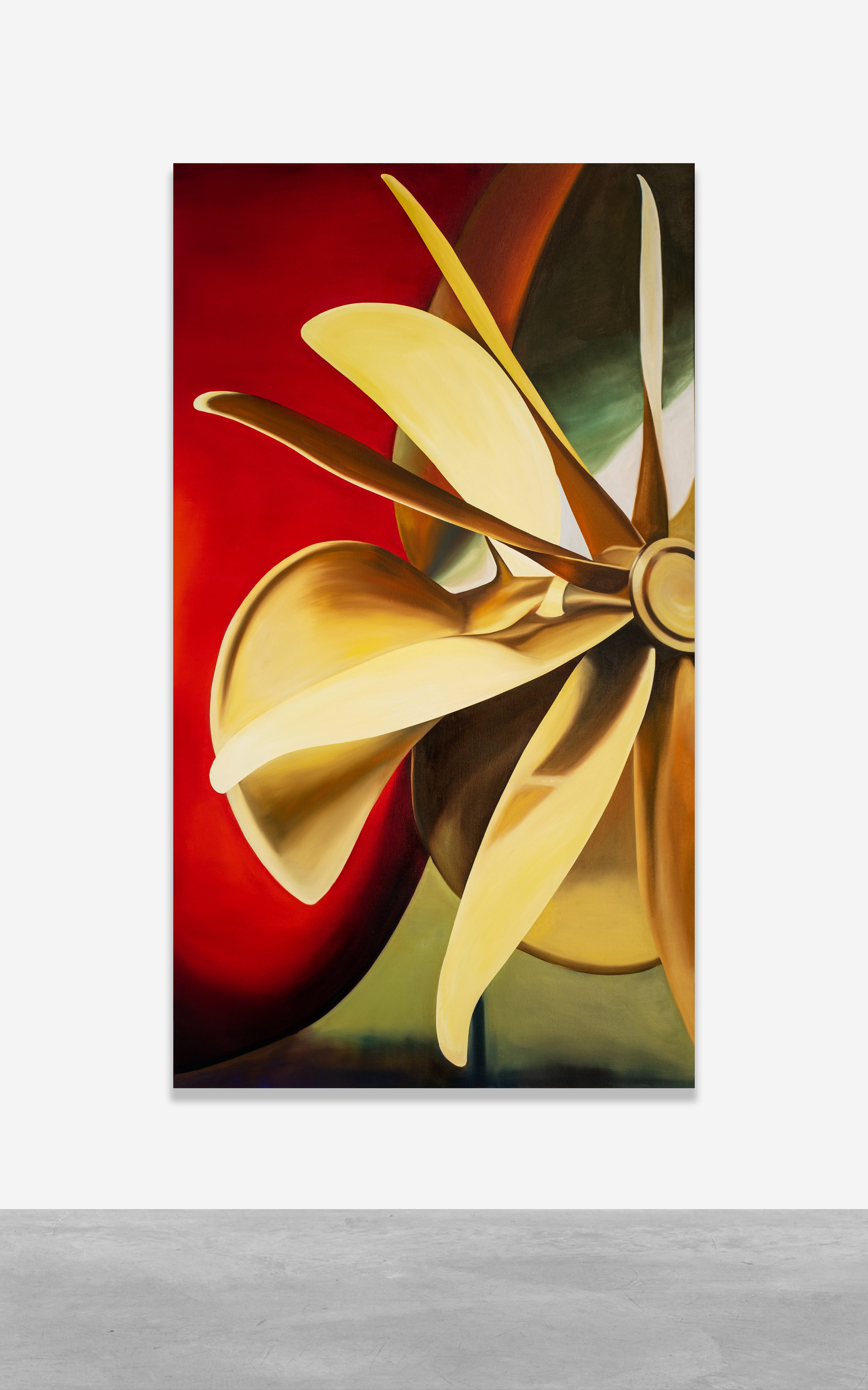
The personal dimension of The Wave series connects it to a deeper history than the history of propeller design. Tan Mu's maternal great-grandfather was a maritime trader during the Republican era in China, traveling between Chinese and Korean ports, spending much of his life on international waters. Through his stories, the artist became aware that the ocean is not only a route for goods but also a carrier of culture, memory, and exchange. The propeller in The Wave 03 is not an abstract form suspended in an abstract blue. It is the object that moves ships across the same waters that the great-grandfather navigated, the same routes between China and Korea, the same straits and channels that have carried trade goods, people, and ideas across the western Pacific for centuries. The painting does not depict the great-grandfather or his ship. It depicts the mechanism that makes the ship move, the hidden engine of the crossing, the spiral that converts fuel into distance. This is what the propeller means in the context of the series: not just a mechanical object but the thing that makes connection possible, the thing that turns the ocean from a barrier into a route, the thing that transforms the water from a medium of isolation into a medium of exchange.
Li Yizhuo, writing in the BEK Forum catalog in 2025, describes Tan Mu's ocean-related works as addressing "the hidden infrastructures that sustain global systems," arguing that "what lies beneath the surface, whether cables or propellers, is always more consequential than what floats above it." The observation names the structural logic of The Wave 03 with precision. The propeller is beneath the surface. It operates in darkness, below the waterline, in a medium that no passenger ever sees. The ship's hull, the container stacks, the bridge, the radar mast: these are visible. The propeller is not. It is the hidden engine of the system, the mechanism that converts energy into motion, the spiral that turns fuel into distance. The painting makes this hidden engine visible, and in making it visible, it makes visible the entire infrastructure of maritime trade, the system of propellers and hulls and shipping lanes and container ports that carries ninety percent of global trade across the world's oceans. The propeller is not a detail of this system. It is the point of contact between the system and the medium through which the system operates. It is where the ship meets the water, where the manufactured object confronts the natural force, where the spiral of human engineering meets the turbulence of the ocean and converts it into the forward motion that carries goods, people, culture, and memory from one shore to another. The Wave 03 paints this point of contact as a luminous golden spiral against a deep blue field, and in doing so, it makes the hidden engine of globalization not only visible but beautiful, not only consequential but worthy of the sustained attention that only a painting can give.