The Command That Watched Us Back: Tan Mu's Play and the Screen That Stayed
The word "play" appears on the screen after you insert the videotape. It is not an invitation. It is a command. On the VCRs and early televisions that populated living rooms from the 1980s through the early 2000s, the word surfaced in green capital letters against a black field, sometimes accompanied by a right-pointing triangle, sometimes alone, the triangle absorbed into the geometry of the text itself. The green was not the green of grass or foliage. It was the green of phosphor, the specific, slightly bluish green that cathode ray tubes produced when they excited the phosphor coating on the inside of their glass screens. This green carried a charge. It was the green of military radar, of early computer terminals, of the night-vision displays that showed soldiers and pilots a world rendered in a single synthetic wavelength. When it appeared on the television screen in your living room, it carried that charge with it. The command to play was not neutral. It told you what to do. And it told you what you were: a viewer, a consumer, someone seated in front of a screen waiting to be addressed by an interface that had already decided what you were there for.
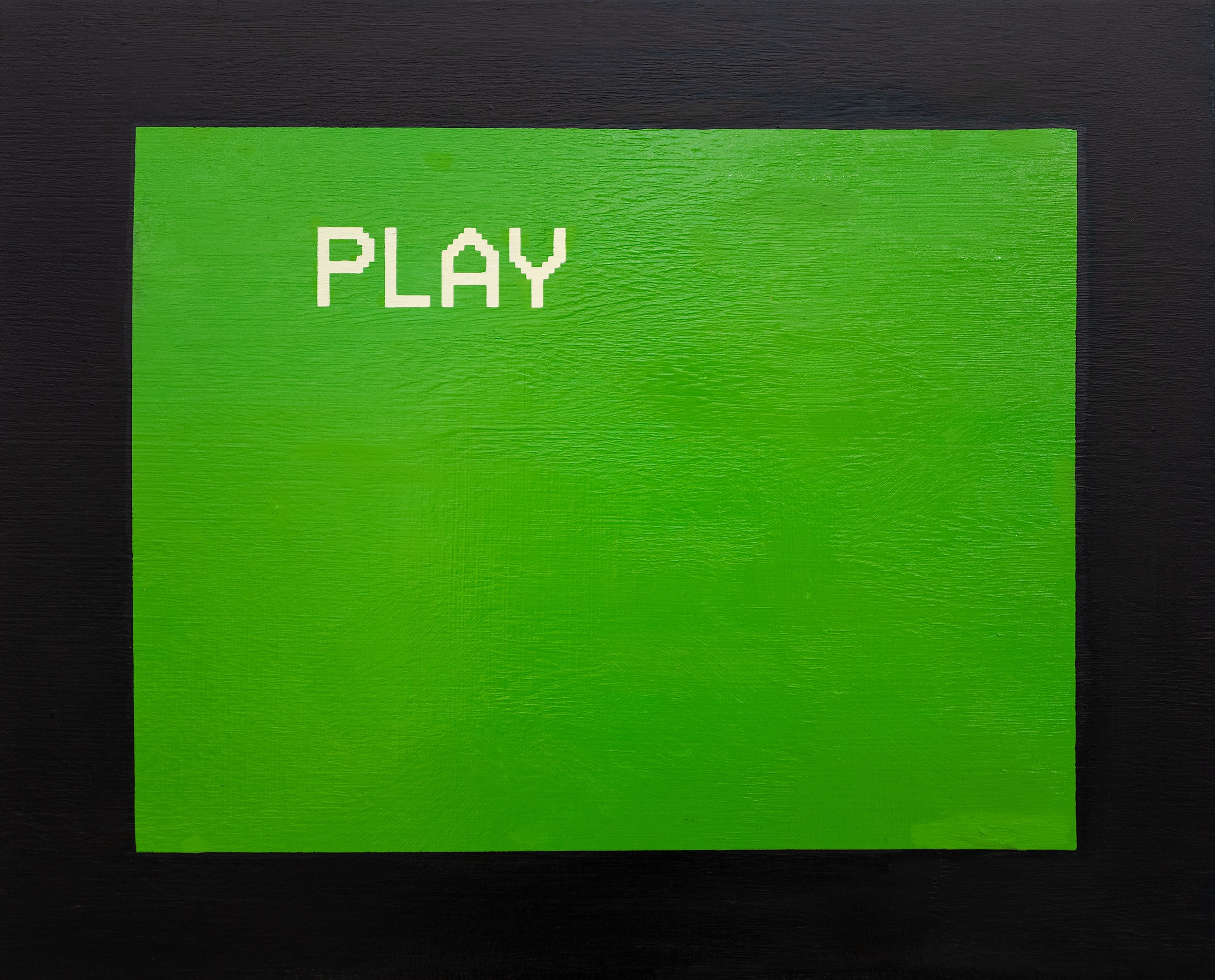
Tan Mu's Play (2022) is an oil painting on linen, 41 x 51 cm (16 x 20 in), that renders this command as a static image. The painting is small, the dimensions of a book or a laptop screen, and it presents the word "PLAY" in thick green letters against a field of deep black. The letters are not printed. They are painted, each one built up from horizontal strokes of green oil paint applied over a black base layer that was allowed to dry completely before the green was laid on top. The green pigment is dense and tactile. It sits on the surface of the linen with a physical presence that the screen image it depicts never had. The VCR screen was luminous and weightless, a pattern of light emitted by electrons striking phosphor. The painting is heavy with pigment, a material object that occupies space and catches light from the room in which it hangs, rather than emitting light of its own. This is the first paradox of the work: it takes an image that existed only as emitted light and remakes it as an object that absorbs and reflects light, translating a luminous, ephemeral screen event into a dense, material surface that will remain exactly as it is for as long as the linen and the oil paint endure.
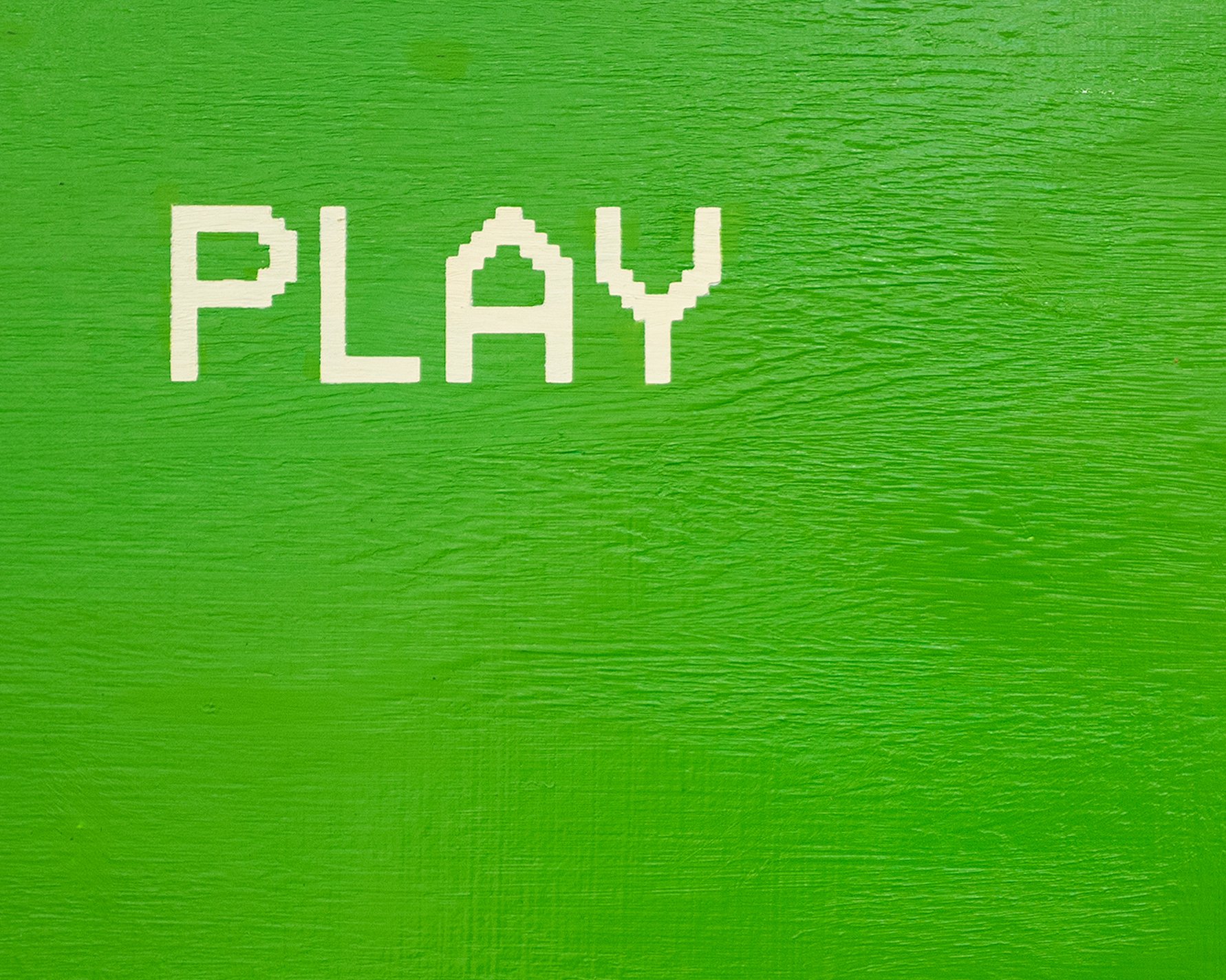
The horizontal strokes that make up the green field are not uniform. They vary in width and density, creating a ripple-like texture that mimics the scan lines of a CRT display. Where a cathode ray tube refreshes its image by sweeping an electron beam across the phosphor coating from left to right, line by line, 30 or 60 times per second, Tan Mu's brush does the same thing in reverse: it deposits pigment in horizontal bands that echo the scan line structure of the original display technology. The effect is visible at close range. Step forward and the green field dissolves into individual strokes, each one a separate decision by the painter's hand, each one a horizontal mark that corresponds to the horizontal scan of the electron beam that produced the original image. Step back and the strokes resolve into the uniform green field of a VCR display, the scan lines becoming a texture rather than a structure, the painting becoming the screen it depicts. This dual reading, close and far, is where the painting does its most precise work. At arm's length, the surface is a field of gestures, each one visible as a discrete event. At two meters, it is a screen. The painting enacts, in the distance between the viewer and the canvas, the same transition that the VCR itself enacted: from the material specificity of a technology to the seamless image it produced, and back again.
The word "PLAY" sits at the center of the composition in capital letters, rendered in the same green as the background but differentiated by a slight shift in tone and a border of darker green that separates the text from the surrounding field. The letters are blocky and sans-serif, the exact typography of early on-screen displays, which were limited to a single character set built into the hardware. The VCR could not display italic or script. It could not display lowercase. It could only display what its ROM chip had been programmed to produce: a fixed set of characters in a fixed typeface, each one constructed from a grid of pixels that was identical across every VCR manufactured during that era. This typographic uniformity is part of what gives the image its authority. The word "PLAY" does not look like it was chosen from a menu of options. It looks like it was the only word that could appear in that position, the inevitable result of pressing the button on the remote control. The interface has no style. It has no personality. It has function. And the function is to tell you what to do next.
Harun Farocki spent the last four decades of his career documenting what he called operational images: photographs and videos produced by machines for machines, images that were never intended for human eyes. In I Thought I Was Seeing Convicts (2000), he assembled surveillance footage from prison yards, border checkpoints, and military installations into a single-channel video that makes visible the apparatus of observation that surrounds and structures daily life. The cameras that produce these images do not compose. They do not select. They record. A surveillance camera at a prison gate does not decide what is worth looking at. It records everything within its field of view, and the resulting image is a visual record that has no aesthetic intention behind it, no compositional logic, no gesture toward beauty or meaning. It is an image that functions as instruction. It tells the guard who is moving, where, and when. It tells the automated system whether to open the gate or keep it locked. The image is not a representation of reality. It is a component of the system that produces that reality.
The connection to Play (2022) is structural. The word "PLAY" as it appeared on a VCR screen is an operational image in Farocki's sense. It was not designed to be looked at. It was designed to be read and acted upon. It was part of an interface that mediated between the human viewer and the machine, telling the viewer what state the machine was in (playing, paused, stopped, recording) and what action the viewer had just commanded. The word itself is not representational. It does not depict anything. It instructs. It is a piece of operational language that has been removed from its operational context and placed on a gallery wall, where its instructional function has been suspended and its visual properties have been made available for contemplation. What Farocki's work makes visible about surveillance imagery, Tan Mu's work makes visible about the VCR interface: the degree to which the images that structure everyday experience are not neutral carriers of content but active components of the systems that produce them. The green "PLAY" command is not a transparent window into the movie on the tape. It is a layer of mediation that shapes how the viewer experiences what comes after it. It frames the experience of watching as an experience of being instructed, of being addressed by a machine that has already determined what the viewer is there to do.
Tan Mu has described the inspiration for Play as emerging from the visual memory of early television screens, "particularly the moment when the word 'Play' surfaced after inserting a videotape." She notes that the word "operates on multiple levels. It is a technical instruction, but it is also a symbol of entertainment, consumption, and information delivery." The painting does not separate these levels. It holds them together in a single image. The word "PLAY" is the command you press on the remote to begin playback. It is also the condition that playback establishes: a state of being entertained, of being receptive, of being positioned in front of a screen that is delivering content. And it is also, in English, the opposite of work, the realm of leisure, the time that is not productive, the space in which nothing is required of you except your attention. The painting compresses all three of these meanings into a single green word on a black field. The compression is not an interpretation added by the painter. It is already present in the word itself. "Play" was always a command and a condition and a category of experience, all at once. The VCR interface simply made the compression visible by displaying the word in isolation, stripped of the context that would have resolved its ambiguity. When "PLAY" appears on the screen, you do not know whether it is telling you what you have done, what the machine is doing, or what you are about to experience. It is all three. And that confusion is not a bug in the interface. It is its most powerful feature.
The green of the painting is not a color chosen for aesthetic reasons. It is the color of the phosphor that early CRT displays produced when they were not displaying an image. It is the color of the screen in its default state, the color of the interface when it is not showing the content that the viewer has come to see. This green is the color of the machine asserting itself. It is the color of the medium interrupting the message. It is the color of the system reminding you, before the movie starts and after it ends, that the screen you are watching is not a window but a device, and that the content it delivers is passing through a layer of mediation that is itself a form of content. Tan Mu's decision to paint this green, rather than to reproduce it digitally or to find a commercial paint that matches it, is a decision about material specificity. The green of a VCR display was produced by a particular technology at a particular moment. It was the color of phosphor in the 1980s and 1990s. It is not the green of an OLED screen or an LCD panel. It is not the green of a contemporary interface. Painting it in oil on linen preserves the color as a material fact rather than a digital reproduction, anchoring it in a specific technology, a specific decade, and a specific set of cultural conditions that have since been superseded by newer screens and newer interfaces but that continue to shape how we think about what a screen is and what it does.
Andy Warhol's relationship to television was not critical. It was devotional. He watched television constantly. He recorded it. He left a television running in every room of his house, including the bathroom. He appeared on it. He made films that mimicked its pace and its indifference. And in the mid-1960s, he began making sculptural works that placed actual televisions in the gallery space, turning the medium into the subject by removing it from the living room and putting it on a plinth. The most significant of these is the series of works he produced between 1966 and 1968 in which he installed functioning television sets in plain wooden cabinets or on simple metal stands and invited viewers to watch whatever was broadcasting at the time. The television was not showing Warhol's content. It was showing the same content that every other television in the city was showing. The artwork was the fact of the television itself, its presence in a gallery, its removal from the domestic context that gave it its familiarity and its power. By putting a television in a gallery, Warhol made visible what the living room had concealed: that the television is not a neutral delivery system for content but an object that structures attention, organizes time, and produces specific forms of passivity and engagement. The television in the gallery does not need to be showing anything in particular because its significance lies in its existence as a machine, not in the images it transmits.
Tan Mu's Play is a painting of what Warhol put on a plinth. Where Warhol installed the physical object, the television set, in a gallery and asked viewers to consider its presence, Tan Mu has painted the image that the television produces when it is not showing content and asked viewers to consider its meaning. The VCR's "PLAY" screen is the television in its moment of maximum self-assertion, the moment when it is not delivering a movie or a broadcast but simply being itself: a green command on a black field, an interface without content, a machine telling you that it is ready to receive your instruction. Warhol's television sculptures and Tan Mu's Play share a structural logic: both remove the screen from its habitual context and force the viewer to confront it as an object of attention rather than a transparent medium. But they differ in a crucial respect. Warhol's sculptures retain the object. They give you the television set, the cabinet, the screen, the whole apparatus. Tan Mu gives you only the image, and she gives it to you in a medium, oil paint on linen, that is the opposite of the medium that produced it. The painting is not a screen. It does not emit light. It does not refresh. It does not change. It is a fixed record of a transient image, a permanent mark left by a temporary event. And that transformation, from emitted light to applied pigment, from electronic display to handmade surface, is what makes the painting something more than a reproduction. It is a translation of one medium into another that preserves the content of the original while changing its conditions of experience. You cannot watch Play. You can only look at it. The command that once told you to begin playback now hangs on a wall, motionless, permanent, commanding nothing.
Tan Mu has described the painting as a response to Neil Postman's Amusing Ourselves to Death, the 1985 book that argued television had transformed public discourse from reasoned argument into entertainment, replacing the sequential, logical structure of print with the fragmentary, emotional structure of the image. Postman's argument was not that television content is trivial. It was that the medium itself, regardless of content, restructures thought. A news broadcast presented on television is not the same news as a news broadcast presented on radio or in print, because television requires that all information be rendered as visual spectacle, and visual spectacle favors brevity, emotion, and drama over complexity, nuance, and sustained argument. The format shapes the content. The container determines what can be contained. Play (2022) is a painting of the container. It is not a painting of the movie that plays after you press the button. It is a painting of the button itself, the moment before the content arrives, the moment when the interface is all you see. And in that moment, the interface reveals its nature. It is not transparent. It is not a window. It is a green command on a black field that tells you what to do. It is the machine's voice, speaking in the only language it knows.
Yiren Shen, writing in 10 Magazine about the Signal series and its relationship to infrastructure, notes that Tan Mu's paintings "do not aim at diagnosing the modern spectacles from a distance. They conjure up a kind of vitality and depth of their own." The observation applies to Play as well. The painting does not diagnose the VCR or the television or the media culture they produced. It does not stand at a distance and issue a critique. It enters the space of the screen and remakes it as a painting, translating the ephemeral into the permanent, the digital into the manual, the emitted into the applied. In doing so, it conjures a vitality that the VCR display never possessed. The VCR "PLAY" screen was functional, transitional, disposable. It appeared for a few seconds before the movie started and then it was gone. The painting preserves it indefinitely and gives it a physical presence that rewards the sustained attention the screen image never invited. The scan lines that Tan Mu built stroke by stroke across the surface of the linen are not visible on a functioning VCR display unless you press your face against the glass. They are a feature of the technology that the technology itself conceals. Painting reveals what the screen hides: the material substrate, the line-by-line construction, the hand that made each mark. The painting does not critique the screen. It excavates it. It shows you what was always there but what you were never meant to see.
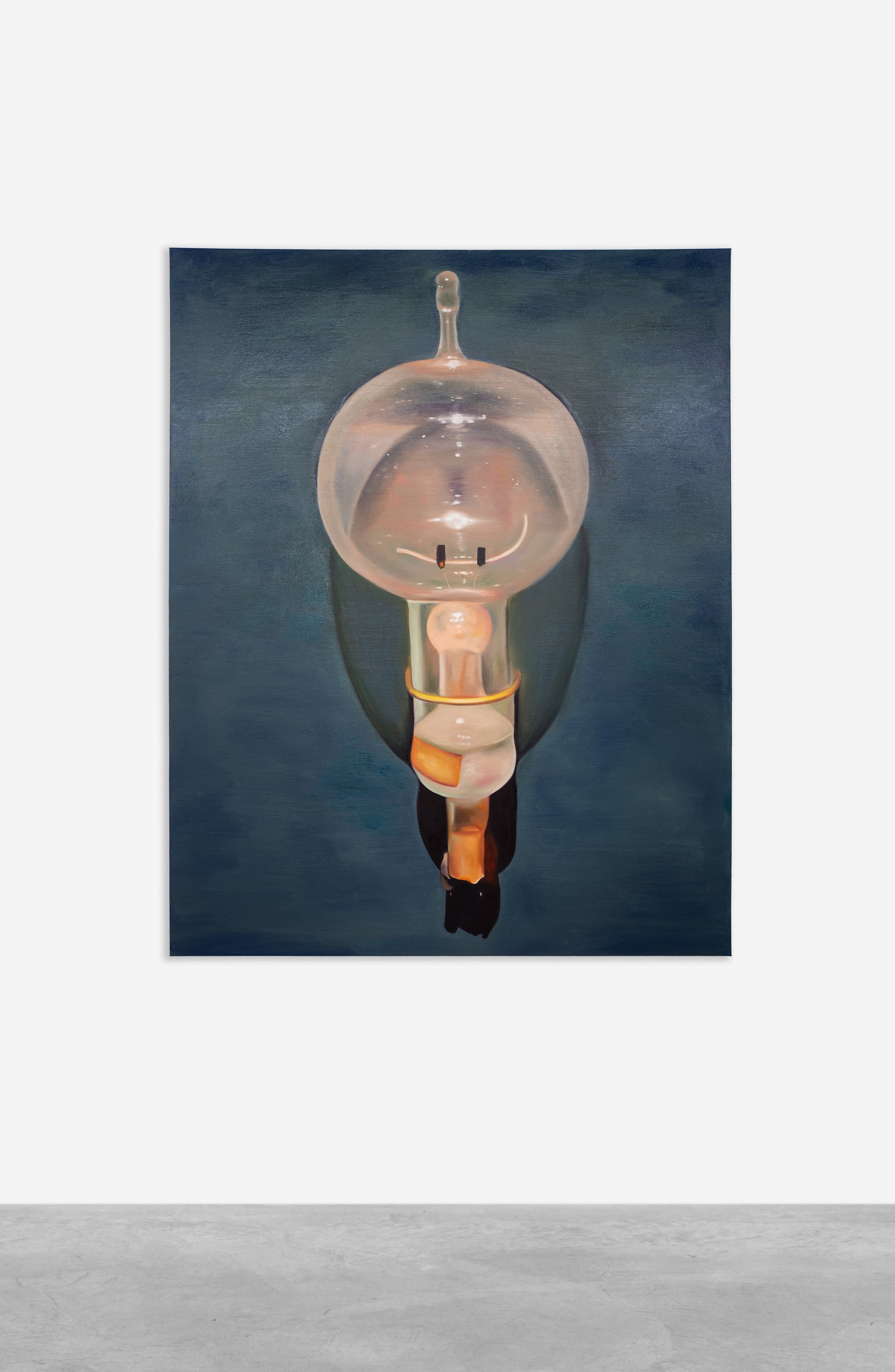
Play (2022) is part of a cluster of works from 2022, including Illuminate, Error, and Logic Circuit, that share a concern with the visual language of technology at its moment of maximum simplicity, when the interface reduces itself to a single word, a single icon, a single gesture. Illuminate (2022), which depicts Thomas Edison's first public demonstration of the light bulb in 1879, shares Play's interest in the image of a technological spectacle that commands attention. Edison's demonstration was not merely a display of a new invention. It was a performance, staged for an audience of journalists and investors, designed to produce a specific reaction. The light bulb was not just a source of illumination. It was a demonstration of power, a proof of concept, a visual argument for the future that electric light would make possible. The "PLAY" command on a VCR screen serves a similar function. It is not just a label. It is a demonstration of the machine's readiness, a visual guarantee that the technology is working and that the experience it promises is about to begin. Both paintings depict moments when technology asserts itself as image, when the medium becomes the message not because the content is trivial but because the medium, at that moment, is the only thing visible.
The painting's dimensions, 41 x 51 cm, are smaller than a laptop screen and roughly the size of a hardcover book held at reading distance. This is not an accident. The painting refuses the monumentality that is available to a work depicting a screen. It could have been larger. It could have been the size of a television set, or a movie screen, or the wall-sized monitors that have replaced the televisions it depicts. Instead, it is the size of a domestic object, something you hold in your hands or hang in a hallway, something that occupies the same spatial category as the devices it depicts. The VCR itself was a small machine, a black box that sat on top of or beneath the television, connected by cables, operated by a remote control that you held in your hand. The painting is small in the same way. It does not loom. It does not overwhelm. It sits where you put it, the way the VCR sat where you put it, and it waits for you to look at it the way the VCR waited for you to press play. The scale of the painting is the scale of the experience it depicts: domestic, intimate, routine. You did not go to the television. It came to you. It lived in your living room. The painting lives on your wall. The word "PLAY" is the same size it would have been on the screen, maybe smaller, but it is the only thing in the frame, and the frame is the only thing on the wall, and the wall is where you live, and the word is waiting.