The Stamp That Hides in Plain Sight: Tan Mu's Privacy 1 and the Ornament of Concealment
Stand close to the painting and the surface begins to speak. Letters emerge, fragmented and partial, the tops and bottoms of characters that have been only partially obscured by the pattern that overlays them. A numeral here, a fragment of an address there, the ghost of a name that the stamp has not quite managed to erase. The privacy protection stamp is a tool designed to render information illegible, and it works by depositing a layer of ink over the text in a pattern dense enough to break the continuity of the characters beneath it. But the stamp does not erase the text. It obscures it. The text is still there, under the ink, and if the viewer moves close enough and spends enough time and has enough patience, the text can be partially reconstructed from the fragments that remain visible between the stamped marks. This is the paradox of the privacy stamp: it is a tool of concealment that produces evidence of what it conceals. The fragments that remain are not random. They are the traces left by a process that was not thorough enough to eliminate every trace of the original. The stamp is a guarantee of privacy only if the viewer is far enough away to see the pattern and not the fragments. At arm's length, the surface is an abstract composition of gold and dark marks, rhythmic and decorative, a field of ornament that could be a textile or a wallpaper or a page from a pattern book. Close up, it is a record of information that has been partially destroyed.
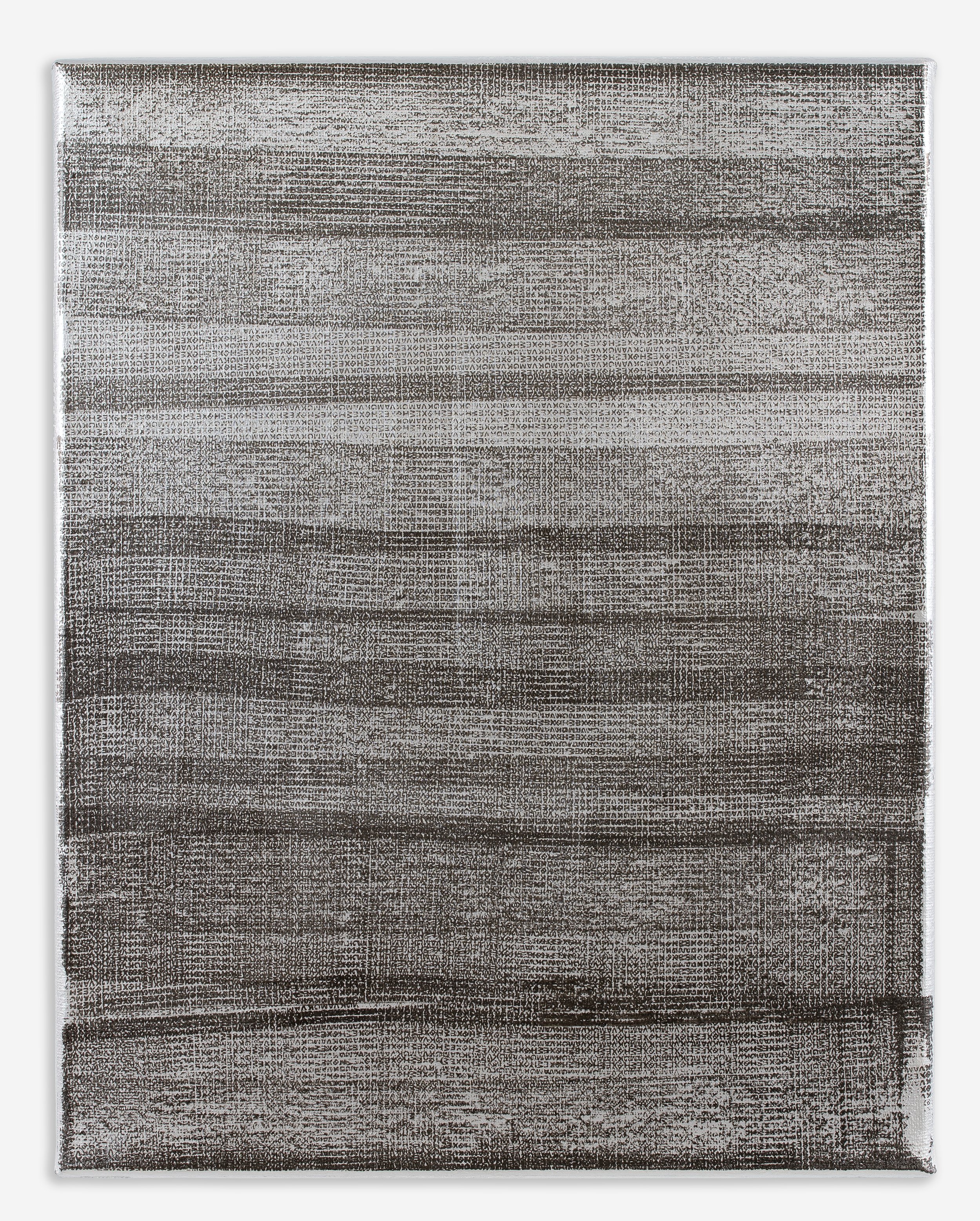
Privacy 1 (2021) is an acrylic and ink work on linen, 36 x 28 cm (14 x 11 in), that uses a privacy protection stamp as its primary tool. The painting is small, the size of a document or a certificate, and it is built in layers. The first layer is a base of gold acrylic, applied to the linen canvas as a luminous ground that catches and reflects the light of the room in which the painting hangs. The gold is not a flat field. It has depth and variation, the result of the acrylic medium settling into the weave of the linen in ways that produce subtle shifts in tone and surface quality across the canvas. The second layer is the ink, applied with the privacy stamp, rolled across the surface in repeated passes that build up a dense pattern of overlapping marks. The stamp Tan Mu used is the same kind of stamp that offices and households use to obscure personal information on documents before they are discarded: a roller stamp impregnated with ink that deposits a pattern of characters, symbols, and decorative marks over whatever text lies beneath. The pattern is designed to be dense enough to render the underlying text illegible at normal reading distance. The stamp is not a seal. It does not authenticate or authorize the document. It conceals it. It is a tool of negation, a device for making information disappear, and Tan Mu has taken this tool and used it as a paintbrush, applying its marks to a canvas in a gallery where the marks will be looked at rather than looked through.
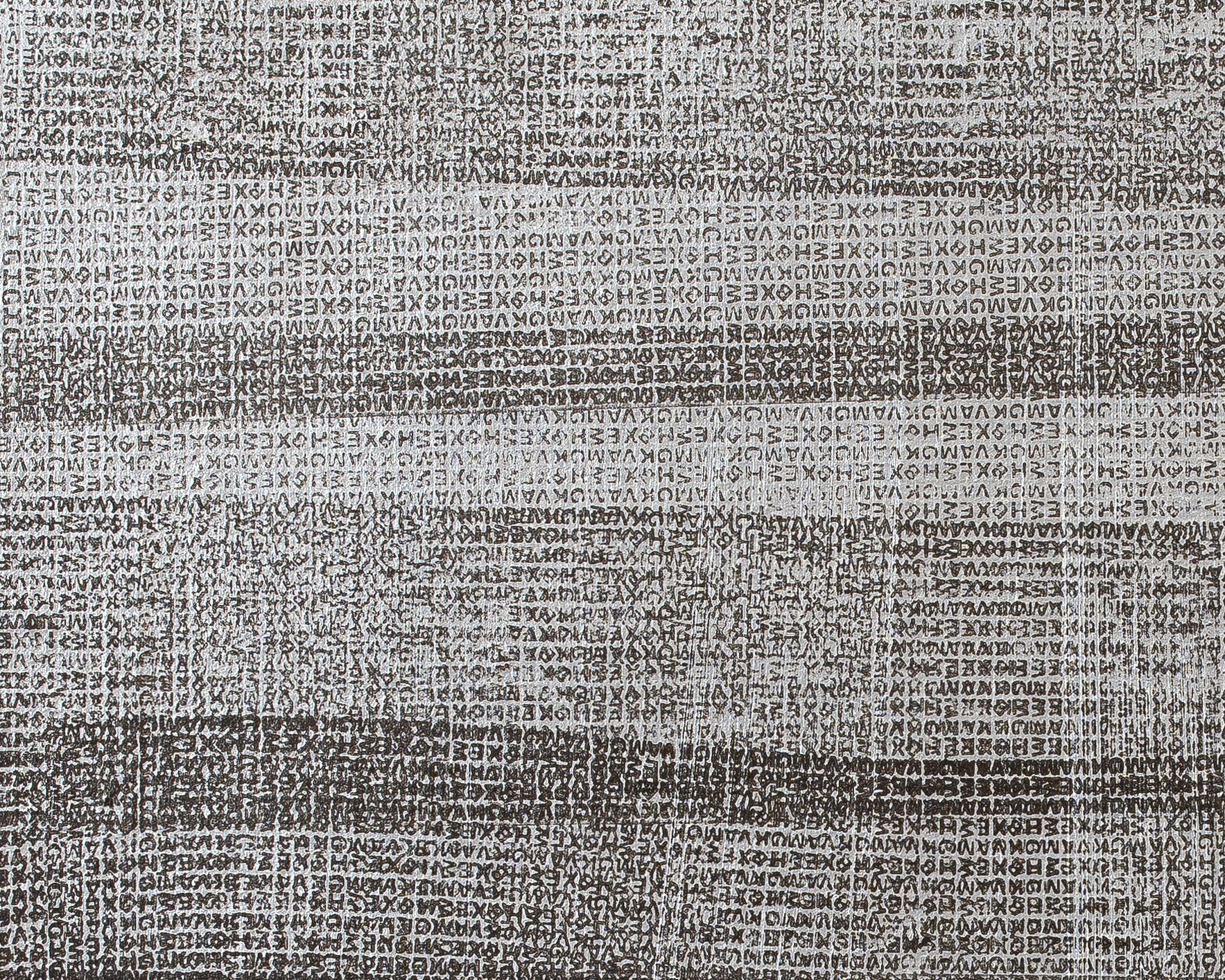
The ink marks from the stamp are dark against the gold, and they create a pattern that is at once chaotic and ordered. The chaos comes from the process. The stamp is rolled by hand, and the hand does not move with mechanical precision. Each pass of the stamp overlaps with the previous pass at a slightly different angle, a slightly different speed, a slightly different pressure. The ink deposits unevenly. Some areas are dense and opaque. Others are thin, allowing the gold ground to show through. The variation is not controlled. It is the product of the hand's inconsistency, the same inconsistency that makes a handwritten signature different every time it is written and that makes a fingerprint different from every other fingerprint. The order comes from the stamp itself, which produces the same pattern of marks each time it is applied. The stamp is a manufactured object, produced in quantity, identical across every unit. The pattern it produces is the pattern that its manufacturer designed, a pattern that is intended to be effective at concealment, that is intended to be dense enough and regular enough to render the underlying text illegible. The tension between the order of the stamp and the chaos of the hand is the tension that makes the surface of the painting visually alive. The pattern repeats, but it does not repeat exactly. The marks are the same, but their spacing and their density vary from one area of the canvas to the next. The result is a surface that looks like a printed pattern from across the room but that reveals itself as a handmade artifact when the viewer moves close enough to see the variation in the ink.
The gold of the acrylic base is not a neutral choice. Gold is the material of value. It is the material of currency, of religious icons, of jewelry, of the frames that surround paintings in museums. Gold says: this is precious. Gold says: this is worth protecting. When Tan Mu applies a privacy stamp over a gold ground, she is placing concealment over value, obscurity over preciousness. The gold is what is being protected. The ink is what protects it. And the ink, which is the tool of concealment, is itself a visual element that contributes to the beauty of the surface. The stamp that was designed to erase information produces a pattern that is, from a distance, ornamental. The concealment is decorative. The protection is beautiful. This is not a contradiction. It is a condition. Privacy, in the world that the painting depicts, is both a necessity and an aesthetic, a practice of hiding information that has been incorporated into the visual language of everyday life. The privacy stamp is not only a tool. It is a motif, a decorative element that appears on envelopes and packages and documents, a visual sign that says: something here has been hidden. The painting takes this motif and gives it a surface that rewards the attention it was designed to deflect.
Marcel Duchamp's 3 Standard Stoppages (1913-14) is a work about the relationship between control and chance. Duchamp dropped three threads, each one meter long, from a height of one meter onto a canvas, and he fixed each thread in the position it assumed when it landed. He then used the three curved forms produced by the fallen threads as templates for a series of works, including the Large Glass and several readymades. The drop was controlled: the height was fixed, the length of the thread was fixed, the procedure was the same each time. The result was not controlled: the threads fell in curves that were determined by the air resistance, the weight of the thread, the slight movements of the hand that released it, and every other variable that the controlled procedure could not eliminate. The 3 Standard Stoppages are a record of what happens when a controlled process produces an uncontrolled result. They are also a record of what it means to accept the uncontrolled result as the product of the process rather than as a failure of the process. Duchamp did not try to straighten the threads. He did not try to make the curves conform to a predetermined pattern. He fixed the threads in the positions they assumed and he used those positions as the basis for subsequent work. The chance element was not a mistake. It was the result.
The connection to Privacy 1 (2021) is in the relationship between the controlled tool and the uncontrolled mark. The privacy stamp is a manufactured object that produces a predetermined pattern. It is designed to produce the same result each time it is applied. But the hand that applies it cannot replicate the conditions of application with mechanical precision, and the result is a surface that is ordered at the level of the individual mark and variable at the level of the overall pattern. This is the same condition that Duchamp documented in the 3 Standard Stoppages: the controlled procedure produces an uncontrolled result, and the uncontrolled result is not a failure of the procedure but a feature of it, a record of the variables that the procedure could not eliminate and that make each application unique. The privacy stamp that Tan Mu uses is the equivalent of Duchamp's meter-long thread. It is the standardized unit, the controlled input. The pattern that the stamp produces on the canvas is the equivalent of the curve of the fallen thread. It is the result of the input passing through the variables of the physical world and emerging on the other side as something that the input did not predict but that the input made possible. Duchamp called the 3 Standard Stoppages a "canned chance," a phrase that captures the condition of a process that is both controlled and random, both designed and accidental, both repeatable and unique. The privacy stamp is a form of canned chance. The pattern it produces is both the product of design and the product of accident, and the painting holds both conditions simultaneously, the way Duchamp's work holds both the controlled length of the thread and the uncontrolled curve of its fall.
The privacy stamp is an instrument of the information economy. It is designed to protect personal data from unauthorized access, and it operates by obscuring the text that carries that data. The stamp does not encrypt the text. It does not transform the text into a coded form that can be decrypted by someone who holds the key. It simply covers the text with a layer of ink dense enough to prevent the text from being read at normal distance. The protection is physical, not cryptographic. It is the protection of the envelope, not the protection of the cipher. And like the protection of the envelope, it is a protection that can be defeated by anyone who is sufficiently motivated and sufficiently close. Move the document close to your eyes and you can read the text through the gaps in the stamp pattern. Hold the document up to a strong light and you can see the text through the ink. The privacy stamp is a form of security that works by making the information inconvenient to access rather than impossible to access. It is a speed bump, not a wall. It is the visual equivalent of the fence around a yard: it keeps out the casual intruder, but it does not keep out the determined one. And it produces, as a byproduct of its operation, a visual pattern that is both decorative and informative. The pattern tells you that something has been hidden. It does not tell you what has been hidden, but it tells you that something has been hidden, and that knowledge is itself a form of information. The stamp that obscures the text also announces the presence of text that has been obscured. The concealment is visible. The privacy is public.
Christopher Wool's paintings from the late 1980s and early 1990s use stamps, rollers, and other industrial tools to produce surfaces that hover between the decorative and the informational. In works such as Untitled (1989), Wool rolled a patterned roller across a large canvas, producing a surface of repeated motifs that look, from a distance, like wallpaper or fabric, and that reveal, on closer inspection, the marks of the tool that made them, the places where the roller skipped or ran dry or was pressed too hard or not hard enough. The result is a surface that is both pattern and record, both decorative and documentary, both an image of a design and a record of the hand that applied it. Wool's interest was in the tension between the mechanical and the manual, between the reproducible pattern and the unique event, between the surface that looks like it was printed and the surface that was actually made by a person moving a tool across a canvas. The pattern in a Wool painting is never as regular as it appears from across the room. It is always the record of a process that introduced variation into the repetition, and the variation is what makes the surface worth looking at.
Tan Mu's Privacy 1 participates in the same tension, but it brings a different content to it. Where Wool's rollers were designed for decoration, Tan Mu's stamp was designed for concealment. Where Wool's patterns reference wallpaper and textiles and the decorative traditions of the applied arts, Tan Mu's pattern references the visual language of privacy protection, the marks that appear on the envelopes and documents of the information economy, the signs that say: something here is hidden. The stamp is not a decorative tool pressed into the service of painting. It is a security tool pressed into the service of painting, and the service it performs is the same service it performs in the world outside the gallery: it obscures information. But the information it obscures in the painting is not personal data. It is the gold ground itself, the surface of value and preciousness that the stamp covers and protects and partially conceals. The painting is a depiction of privacy in the same way that a portrait is a depiction of a person: not by showing you the thing itself but by showing you the conditions under which the thing exists. Privacy 1 does not show you the private information. It shows you the apparatus of its protection, the visual language that surrounds it, the marks that both conceal and announce its presence. The painting is a portrait of privacy, not a display of what privacy contains.
Saul Appelbaum, writing in the BEK Forum catalog in 2025, describes Tan Mu's practice as one in which "the arbitrary gesture is never meaningless, it generates new systems of relation, where noise becomes form and connection becomes composition." The observation applies precisely to the privacy stamp. The stamp's pattern is arbitrary. It was designed by a manufacturer who chose a pattern that would be dense enough to obscure text, and the specific arrangement of marks in the pattern was determined by considerations of efficiency and manufacturability, not by considerations of aesthetics or meaning. The pattern is functional, not expressive. But when Tan Mu applies the stamp to a canvas, the pattern becomes a visual element, a compositional unit, a mark that enters into relations with the other marks around it and with the gold ground beneath it. The noise of the stamp's pattern becomes the form of the painting. The concealment becomes the composition. The arbitrary gesture of the manufacturer who designed the stamp pattern and the arbitrary gesture of the hand that rolled the stamp across the canvas both contribute to the final surface, and neither gesture is meaningless, because both have produced a mark that is now part of a painting that exists in a gallery and is available for contemplation. The privacy stamp has been translated from the world of utility into the world of attention, and in the translation, its function has changed from concealment to revelation. It reveals, in the context of the painting, what it was designed to conceal in the context of the document: the structure of the pattern, the beauty of the mark, the tension between the order of the tool and the variation of the hand. The stamp that was made to hide information has become the information that the painting displays.
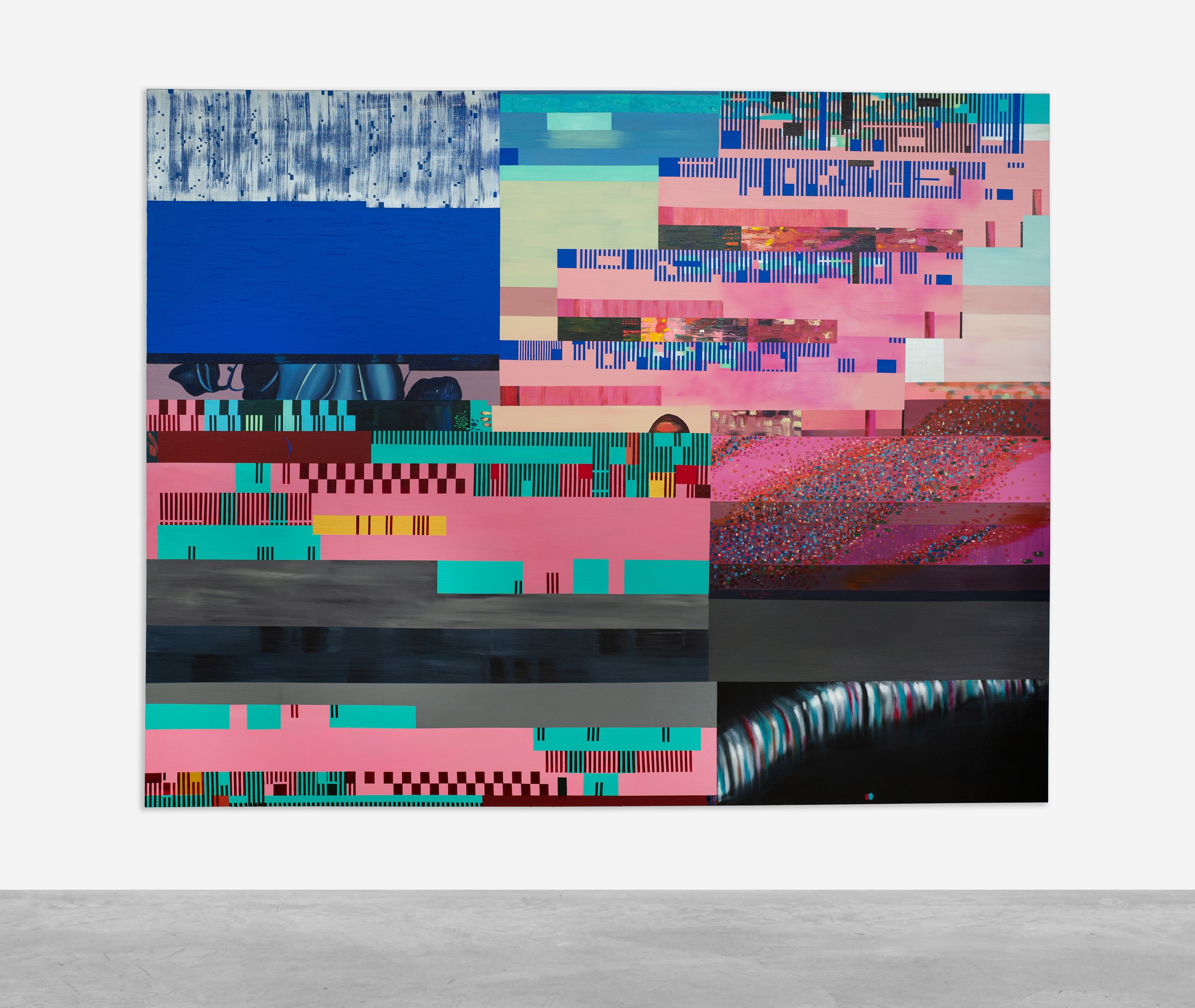
Privacy 1 (2021) and The Glitch (2022) are, as Tan Mu has described them, companion works that address two aspects of information security. Privacy is about concealment, protection, and control. The Glitch is about failure, leakage, and breakdown. Together they form a pair that covers the full range of conditions that information can occupy in the systems that store and transmit it: protected or exposed, intact or corrupted, hidden or revealed. But the relationship between the two works is not merely complementary. It is dialectical. The privacy stamp that protects information also produces the evidence that information has been protected. The glitch that reveals information also reveals the system that was supposed to protect it. Both works are about the visibility of the systems that handle information. Privacy makes the system visible by showing you its protective apparatus. The Glitch makes the system visible by showing you its failure. In neither case is the information itself the subject of the painting. The subject is the system that contains the information, and the painting makes the system visible by removing the information from the frame and leaving only the structure that held it. The gold ground in Privacy 1 is the value that the system protects. The ink marks are the system of protection. The fragments of text that emerge between the marks are the traces of what the system was designed to conceal. The painting holds all three elements in a single surface, and the viewer's movement from close to far and back again produces the experience of concealment and revelation that the privacy stamp was designed to produce in the world of documents and envelopes and personal data. The difference is that the painting does not want to protect you from the information. It wants you to see the protection, to see the structure, to see the apparatus of concealment as it operates, and to recognize that the apparatus is not invisible, that it has a form, and that the form is beautiful, and that the beauty is not separate from the function but is produced by it, and that the function, when it is made visible, is itself a form of information.