The Stretch Between Isolation and Community: Tan Mu's Yoga Isolation and the Ritual of Distance
The photograph was taken in June 2020, outdoors, in Toronto. It shows figures in yoga poses on a stretch of grass or open ground, their bodies extended in the familiar geometries of sun salutations and warrior stances, their mats separated by intervals of bare earth. The spacing between the mats is not casual. It is prescribed. The people in the photograph are practicing yoga, which is a practice of the body and of attention, and they are practicing it during a pandemic, which is a condition of enforced separation. The two things are happening simultaneously on the same piece of ground. The bodies are engaged in the same sequence of movements. They are breathing in unison, or something like unison, the breath that yoga makes visible as a practice of synchronizing the body with itself and with whatever is around it. But they are separated by empty air, and the empty air is what the pandemic has made present. It is the medium through which the virus travels and the medium that separates the bodies from each other. The empty air is not a background. It is the subject of the painting.
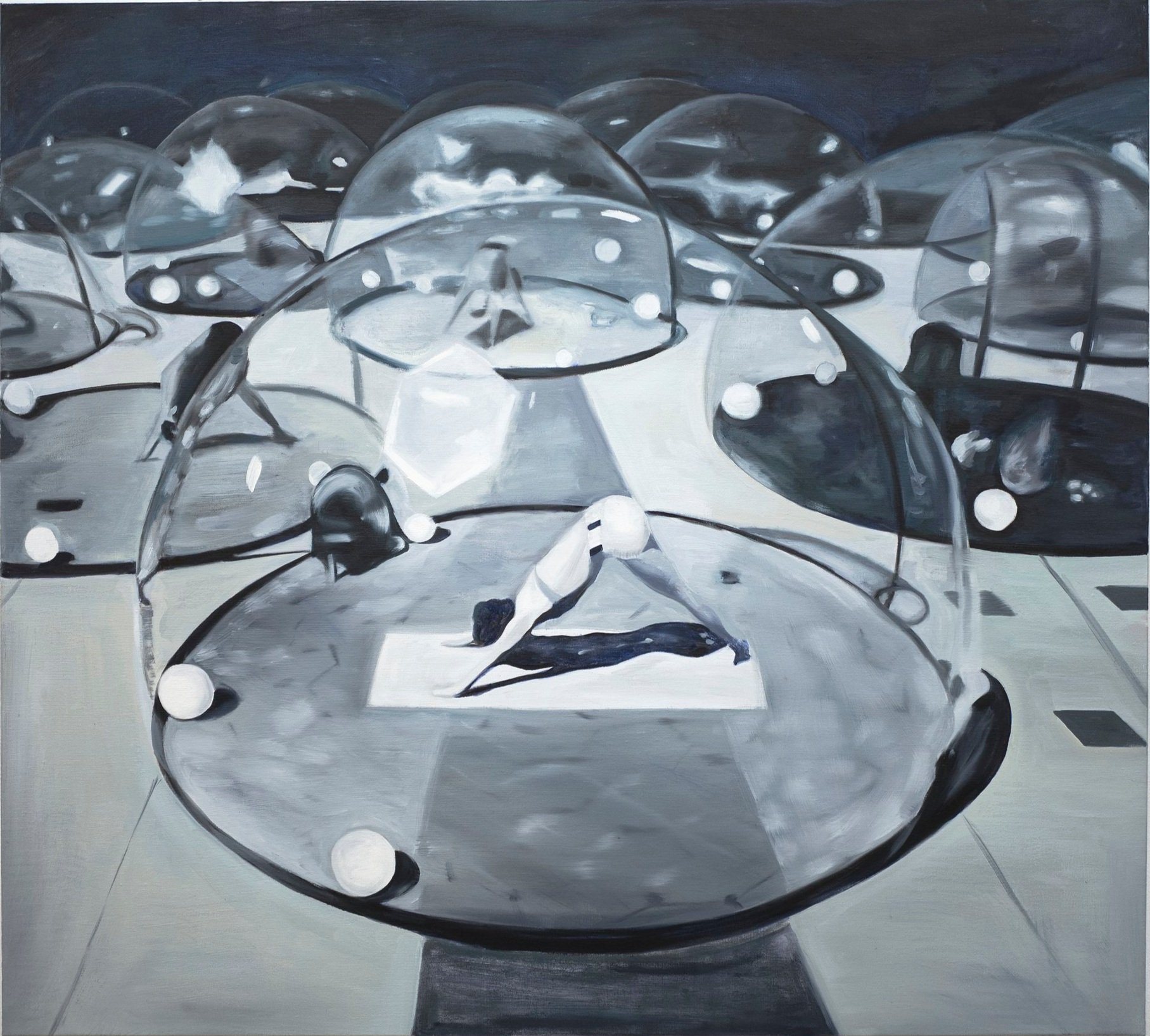
Tan Mu did not paint the photograph in color. She extracted the color from the original image and rendered the scene in monochrome shades, producing an effect that she has described as evoking the atmosphere of vintage science fiction posters. The vintage science fiction poster is a specific visual register. It is the aesthetic of the pulp magazine cover, the chromolithographic space operas of the 1950s, in which figures are suspended against dark grounds, isolated in the act of doing something that requires equipment or training or physical discipline, and the dark ground behind them is not a background but an environment, a space that is itself hostile or indifferent or vast. The monochrome in Yoga Isolation (2022) serves a similar function. It removes the scene from the category of the documentary photograph and places it in the category of the allegorical image, the image that means something other than what it depicts. A color photograph of people doing yoga outdoors in 2020 is a record of what people did during the pandemic. A monochrome rendering of the same scene is a meditation on what it means to practice a discipline of the body when the body has become a vector of transmission, when the body's proximity to other bodies is the condition of the danger, when the practice that trains the body to be present to itself must be performed at a distance from other bodies performing the same practice.
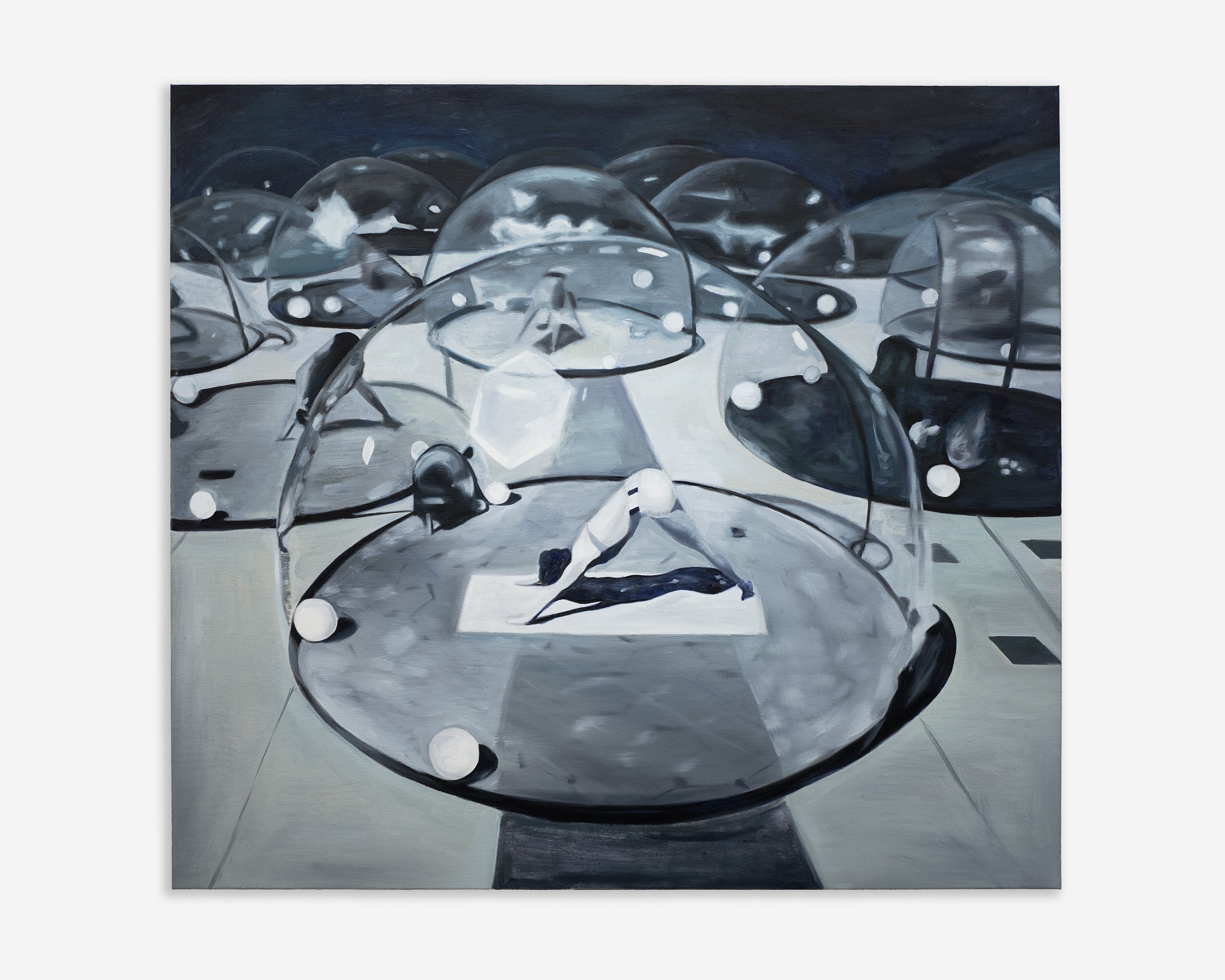
The painting does not show faces. This is not an incidental detail. It is a structural choice that aligns the figures in Yoga Isolation with the anonymity of the science fiction poster, where the human figure is often a generic type rather than an individual, a body engaged in an activity rather than a person with a history and a context. The anonymous figure is available for projection. The viewer can occupy the space that the figure occupies. The figure in the vintage science fiction poster is often a technician or an astronaut or a scientist, someone who is doing something that requires specialized training and specialized equipment, and the viewer watches from outside the activity, admiring the skill or the courage or the discipline required to perform it. The anonymous figure in the yoga pose is doing something similar. The yoga pose requires training. It requires discipline. It requires the willingness to submit the body to a practice that shapes it into forms that are not natural but acquired, forms that the body learns to hold and to move through, forms that take time and repetition to make available to the body as its own. The figure in the painting is not identified. The viewer can project themselves into the pose, or they can watch from outside, the way they would watch a science fiction protagonist suspended against the stars. The position of the viewer in front of the painting is not the same as the position of the practitioner on the mat. It is the position of the observer, the outsider, the person who is not doing yoga but who recognizes what yoga looks like from the outside.
Tan Mu has described the experience of isolation during the pandemic as a fragmentation of everyday rhythms, and she has described the Yoga Isolation painting as an attempt to process that experience through visual language. The word processing here is precise. The painting is not a record of what the pandemic was like. It is an attempt to work through the emotional and psychological conditions that the pandemic produced, to use the discipline of painting as a way of coming to terms with what had happened to the experience of daily life. The bodies in the painting are in yoga poses, which is a form of practice, which is a form of discipline, which is a way of training the body to be present to itself. But the practice is happening under altered conditions. The studio has been replaced by the outdoors. The proximity of other practitioners has been replaced by the prescribed distance between mats. The rhythm of the class has been interrupted by the rhythm of the pandemic, which is a rhythm of contraction and expansion, of lockdown and reopening, of collective presence and enforced separation. The painting holds all of these interruptions simultaneously. The bodies in their yoga poses are a testament to the persistence of practice under altered conditions. The empty air between them is a testament to what the altered conditions have required. And the monochrome palette is a testament to the strangeness of the moment, its quality of being a historical event that is also a personal experience that is also a visual record that is also an allegory about what it means to be a body practicing presence in a world where the presence of other bodies has become a condition of danger.
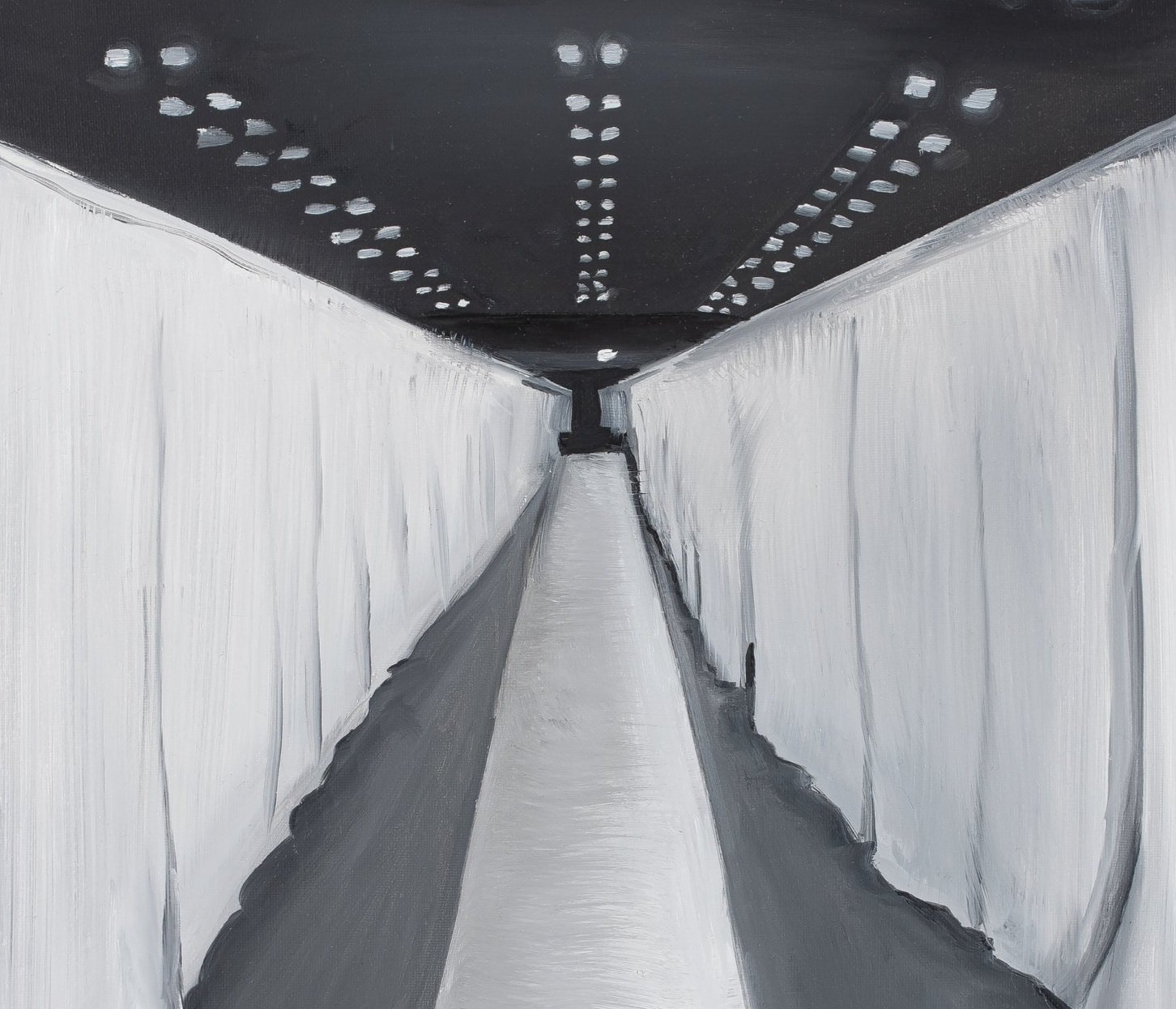
Edward Hopper painted loneliness. Not solitude, which is a condition that a person might choose and that can be productive or generative. Loneliness is a condition imposed by absence, by the gap between the presence of a body and the absence of connection with other bodies. Hopper's paintings are full of figures who are in the same room as other people or in the same space as other people and who are nevertheless alone, separated from those other people by whatever it is that separates people who are in the same place but not in the same world. In Morning Sun (1952), a woman stands at a window in a hotel room, her back to us, her face invisible in the light from the window. The room is sparse, modern, full of the furniture of transience. She is alone in it. There is a radiator and a chair and a window that looks out onto something that the painting does not show us. She is standing at the window with her face turned toward the light, but the light is not reaching her face. The face is in shadow. She is present to the window but not to us. She is alone in a room that has been designed for transience, a room that belongs to the category of spaces that are occupied temporarily, and the temporariness of the space is the temporariness of her presence in it, and the loneliness that the painting records is not the loneliness of isolation in the wilderness. It is the loneliness of a person who is in the same room as everyone else and who is nevertheless unreachable.
The connection to Yoga Isolation (2022) is in the quality of enforced separation that both works record. Hopper's figures are separated from other people not by a virus but by the conditions of modern urban life, by the architecture of the hotel room and the office and the diner, by the social structures that make it possible for people to occupy the same space without entering each other's worlds. Yoga Isolation shows figures who are separated by empty air that is not empty of danger. The virus has made proximity itself a risk. The bodies that are practicing yoga in the painting are doing the same thing, at the same time, on the same piece of ground, and they cannot come closer to each other because the prescribed distance is the condition of their safety. Hopper's figures are separated from each other by the structures of modern life. Tan Mu's figures are separated from each other by a virus that has changed the meaning of proximity. Both separations produce the same result: the body in the painting is alone even when it is in the same room as other bodies. The difference is that Hopper's loneliness is a condition of modernity and Tan Mu's loneliness is a condition of the pandemic, and the pandemic is a condition that emerged from modernity, from the movement of bodies and goods and viruses across a connected world, from the same forces of globalization and urbanization that produced Hopper's lonely modern figures. The virus that separated the bodies in the painting was not a natural disaster in the old sense. It was a consequence of the connected world, a product of the conditions that make it possible for a virus to travel from a market in Wuhan to every city on earth within a year. The separation that it required was a withdrawal from the connected world, a sudden and enforced solitude that was the opposite of everything that modernity had been building toward.
Li Yizhuo, writing in the BEK Forum catalog in 2025, describes Tan Mu's pandemic-era paintings as works in which "the body becomes the site of both vulnerability and resistance." She argues that Tan Mu's paintings of the COVID period are not elegies for a lost normal life but investigations of how the body adapts to conditions that would have been unthinkable before they arrived, how the body incorporates the altered conditions of the pandemic into its practice and makes them available as form. The yoga poses in Yoga Isolation are not poses that were invented for the pandemic. They are the same poses that yoga practitioners have performed for centuries, the same sequences of movement and breath that the practice has always produced. What has changed is not the practice but the conditions of its performance. The bodies are practicing the same yoga that they would have practiced in a studio, in a room with other bodies close to them, in an atmosphere that was not charged with danger. But they are practicing it outdoors, on mats separated by prescribed distances, in air that is no longer just air but a medium of potential transmission. The body that adapts to these conditions is a body that has incorporated the pandemic into its practice, that has made the conditions of the pandemic into a new context for the same ancient discipline. The painting records this incorporation without dramatizing it, without adding pathos or urgency to what the figures are doing. They are doing yoga. They are six feet apart. The painting holds both facts in the same frame, and the frame is monochrome, and the monochrome makes the scene strange enough to hold the viewer's attention long enough to make them ask why the figures are alone together in the light.
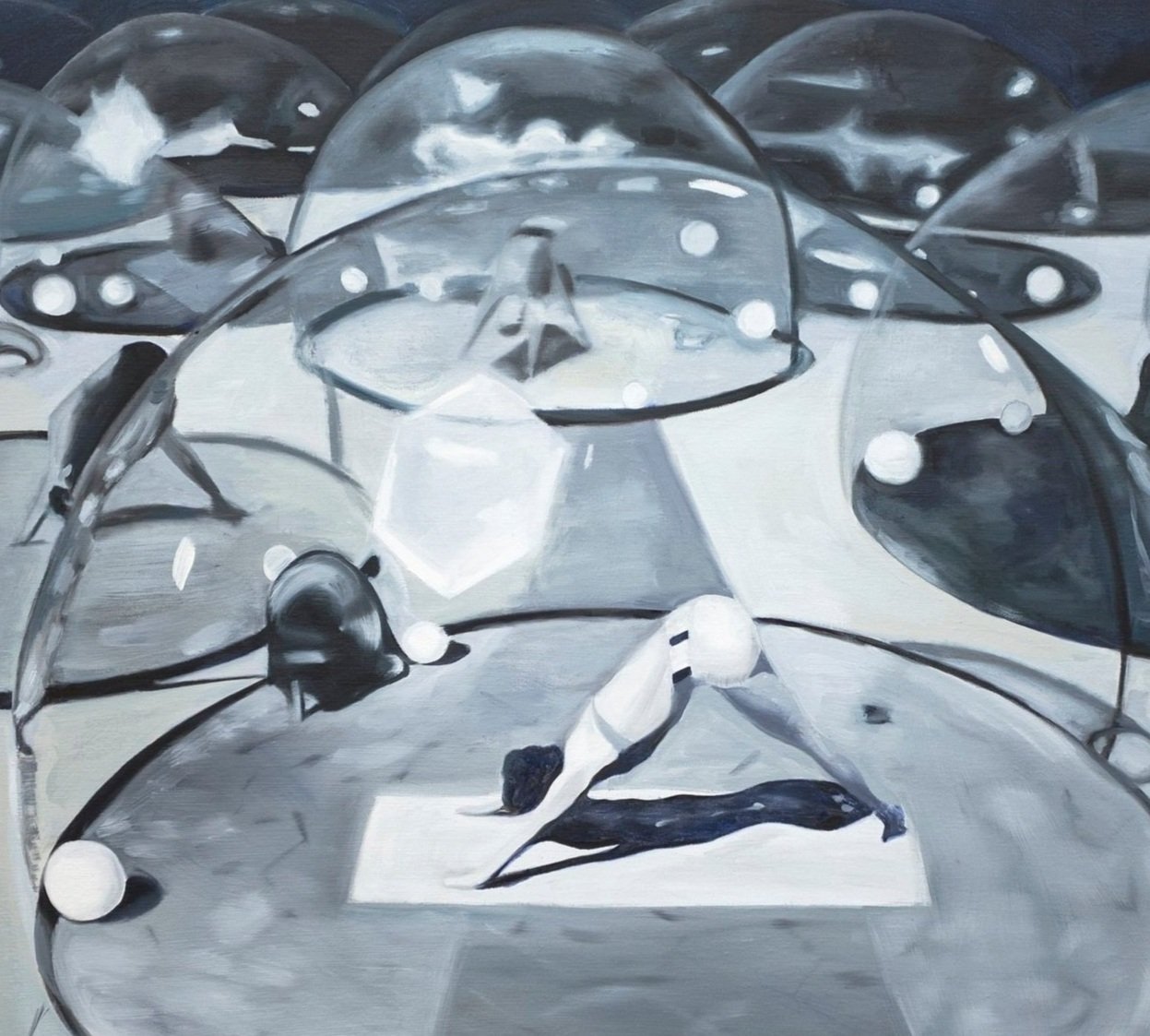
The monochrome palette also connects Yoga Isolation to the tradition of the scientific illustration, to the visual language of technical documents and technical photography in which the removal of color serves to direct attention toward structure rather than appearance. Tan Mu has used monochrome in several paintings that deal with technological subjects, including Thermal Imaging (2022), which depicts the infrared radiation emitted by the human body in the same monochrome palette that thermal cameras produce. In Yoga Isolation, the monochrome does a similar job: it removes the scene from the register of the everyday photograph and places it in the register of the technical document, the record of a procedure or a process. The yoga class in the painting is being documented. It is being recorded as evidence of something that happened: the fact that people were practicing yoga outdoors during a pandemic, the fact that they were maintaining distance, the fact that the discipline of the body persisted even when the conditions of the body had changed. The monochrome palette is the visual code of the technical record. It says: this is information. This is not sentiment. The figures in the painting are data points in a record of how people adapted to an unprecedented condition, and the painting holds the record with the same precision and the same restraint that a technical document would use, the same refusal of embellishment or dramatic coloring, the same commitment to the factual surface of what happened.
Danni Shen, writing in Emergent Magazine in 2024, describes Tan Mu's studio practice during the pandemic as one in which "painting became a form of care work, a way of attending to what was happening by translating it into form." The description applies with particular force to Yoga Isolation. The painting is an act of care for the experience it depicts. It does not stand at a distance from the pandemic and issue a judgment about it. It enters the experience of the pandemic from the inside, using the discipline of painting to come to terms with what the pandemic did to the experience of daily life, to the experience of practicing a discipline of the body when the body had become a site of danger, to the experience of trying to maintain the rhythms and practices that give life structure and meaning when the conditions of life have changed so radically that the practices themselves have become acts of adaptation. The yoga class in the painting is practicing adaptation. The bodies are in poses that are the same as the poses they would have held in a studio, but the ground is different and the distance between the bodies is different and the air they are breathing is different. They are practicing the same discipline in a different world. The painting does not say this explicitly. It shows the bodies in their poses and the empty ground between them and the monochrome light that falls on them from an unseen source, and it trusts the viewer to recognize what the scene is a record of: the persistence of practice under altered conditions, the willingness of the body to continue training itself even when the training has to happen in conditions that were designed to prevent the body from being close to other bodies. The yoga is still yoga. The isolation is still isolation. And the painting holds both in the same frame, the way the pandemic held both in the same breath.
What remains after the painting is finished and the viewer steps back from it is the question of what it means to practice together while staying apart. The yoga practitioners in the painting are doing the same thing at the same time, and they are separated by the empty air that the pandemic has made dangerous, and the empty air is also the medium through which they are still connected, because they are breathing the same air even if they cannot share it, and the practice they are practicing is a practice of the breath, and the breath is the thing that both connects them to each other and marks the danger of their proximity. The paradox of Yoga Isolation is that the thing which separates the bodies in the painting is the same thing that connects them to each other. They are sharing the same ground. They are breathing the same air. They are practicing the same discipline. The distance between them is the condition of their being able to practice together at all. Without the distance, they would not be allowed to practice together. The distance is what makes the community possible. And the community is what the distance is protecting, or pretending to protect, or failing to protect. The painting holds this paradox without resolving it. The figures are on the same ground and separated by empty air and they are doing yoga, which is a practice of presence, which is the opposite of what the pandemic allowed. The painting is not a record of failure. It is a record of what the body does when the body is given a new set of conditions and told to keep practicing. It does not say that the pandemic was good or bad. It says that the body adapted. The body always adapts. The body in the painting is proof of that. The stretch of a muscle held in a pose for thirty seconds or a minute, the breath that comes in and goes out, the discipline that persists in the altered conditions because the discipline is what the body has made itself into, and the body does not stop being what it has made itself into just because the world around it has changed. The yoga is still yoga. The isolation is still isolation. The stretch continues.