The Stone That Fell Fifteen Million Years Ago: Tan Mu's Moldavite and the Time Capsule in the Hand
Li Yizhuo, writing about Tan Mu's paintings in 2022, observed that the canvases "do not aim at diagnosing the modern spectacles from a distance. They conjure up a kind of vitality and depth of their own." The observation was made in the context of the DAWN-era paintings, the works that depict cells and embryos and nuclear tests, and it was meant to distinguish Tan Mu's practice from the kind of art that comments on technology or science from the position of a critic who stands outside the subject and judges it. But the observation applies with particular force to Moldavite (2020), which is not a painting about technology or science in the way that Quantum Computer or The Glitch are paintings about technology and science. It is a painting about a stone. The stone happens to be a meteorite, and the meteorite happens to have been formed fifteen million years ago by a cosmic impact, and the cosmic impact happens to have produced a material that is rare and translucent and green and that carries within its physical structure a record of the event that created it. But the painting does not diagnose the stone from a distance. It holds the stone at the distance of the hand, the way you would hold a stone that you had picked up and turned over and examined, and it asks what it means to look at something that has existed for fifteen million years and that will exist for fifteen million more after you have put it down.
Moldavite (2020) is an oil painting on linen, 36 x 28 cm (14 x 11 in), that depicts a single piece of moldavite, a rare green tektite, rendered in close-up against a dark background. The composition fills the canvas with the form of the stone, cropping it at the edges so that the meteorite extends beyond the boundaries of the painting, as if the canvas were a window that the stone were being held up to. The stone is not sitting on a shelf or resting on a surface. It is floating. The dark ground behind it is not a table or a display case or a geological context. It is the void from which the stone came and to which, in the logic of the painting, it still belongs. The moldavite is depicted in translucent green, its surface described by a network of ridges and grooves that follow the contours of the stone's natural texture, the patterns that were produced when the molten material was ejected from the impact crater and solidified in the atmosphere as it fell back to earth. These patterns are not decorative. They are the record of the process that made the stone. Each ridge is a line of faster cooling. Each groove is a line of slower cooling. Each variation in the surface is a variation in the temperature and pressure conditions that the material experienced as it fell through the atmosphere fifteen million years ago. The surface of the stone is a document. The painting is a copy of a document that was written in molten glass by the atmosphere of the earth.
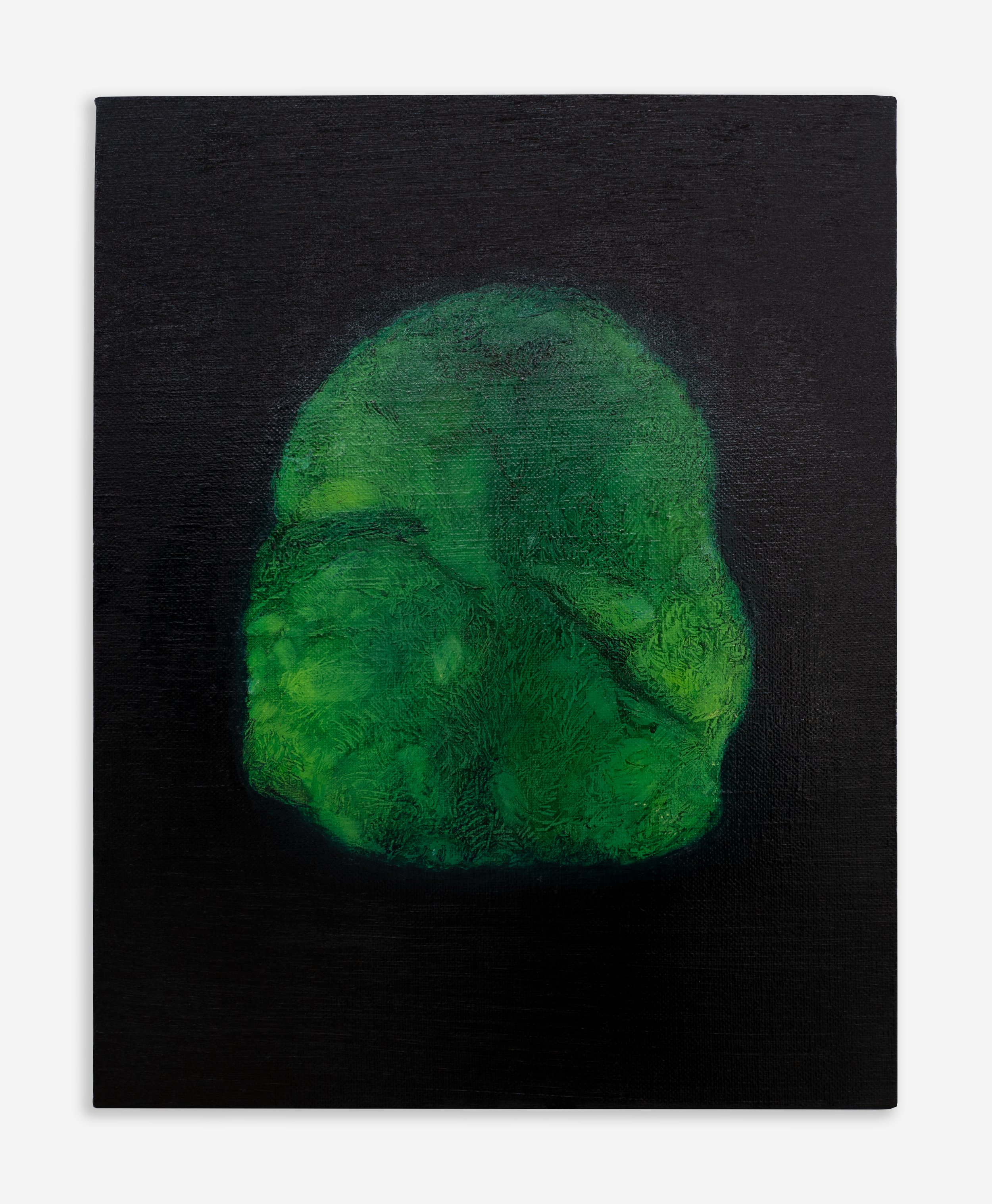
The green of the moldavite is not the green of the landscape paintings that preceded it in the history of oil painting. It is not the green of grass or trees or the sea. It is the green of silicate glass, the specific, slightly yellowish green that is produced when silicon dioxide is superheated to a temperature above its melting point and then cooled rapidly enough to prevent crystallization. The green is caused by trace amounts of iron and other elements that were present in the original material, and the exact shade varies from one piece of moldavite to another depending on the specific composition of the material that was ejected from the crater. The green in Tan Mu's painting is the green of the particular piece of moldavite that she holds in her personal collection, the first Czech meteorite she acquired, and the painting is a record of that particular stone, not a generic representation of moldavite as a class of objects. This specificity matters. The painting is not about moldavites in general. It is about this moldavite, the one that the artist held in her hand, the one whose surface she examined at close range, the one whose weight and temperature and texture she experienced as a physical presence before she began to paint it. The painting is a translation of that experience into oil paint, and the translation preserves the particularity of the stone even as it removes the stone from the hand and places it on the wall.
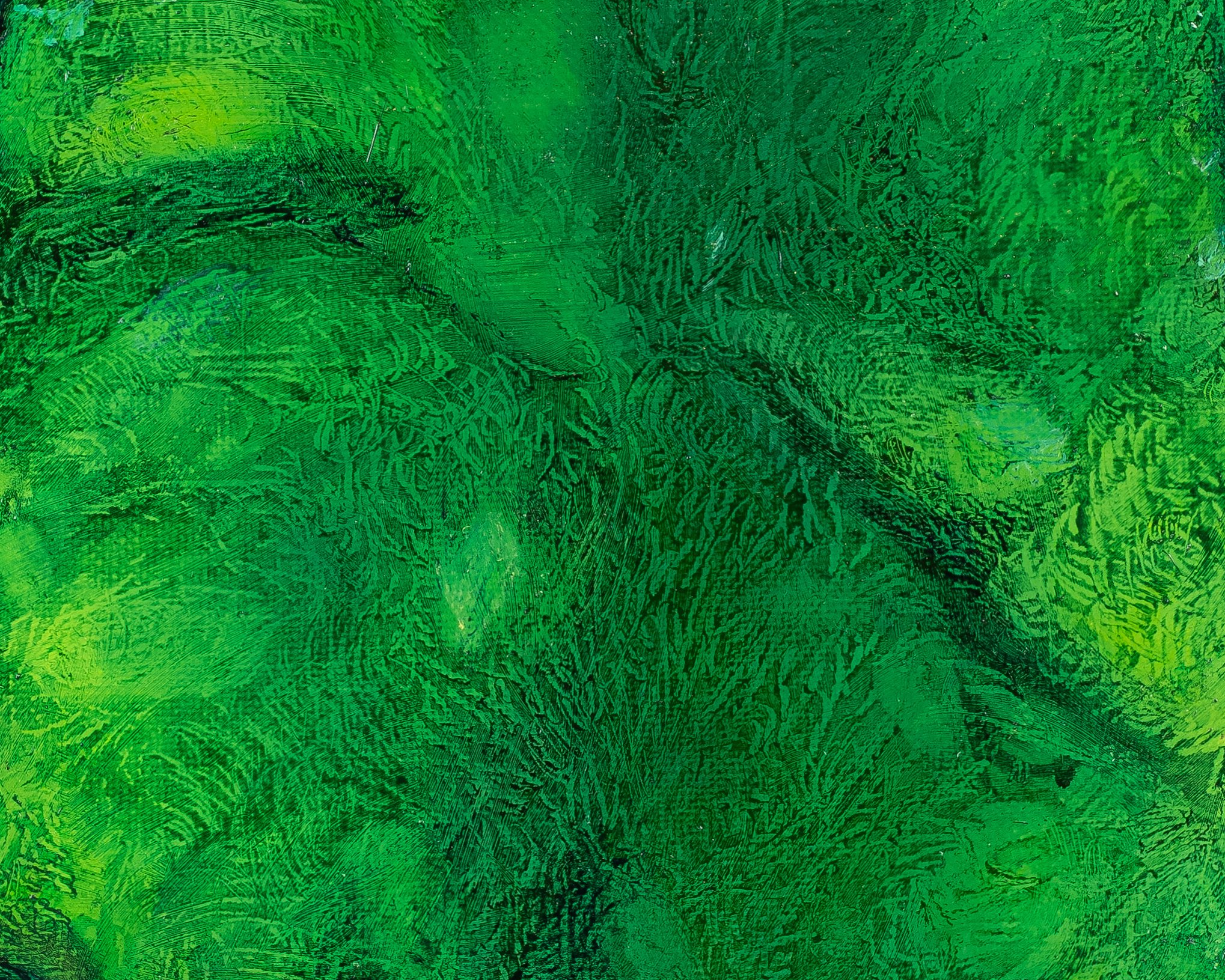
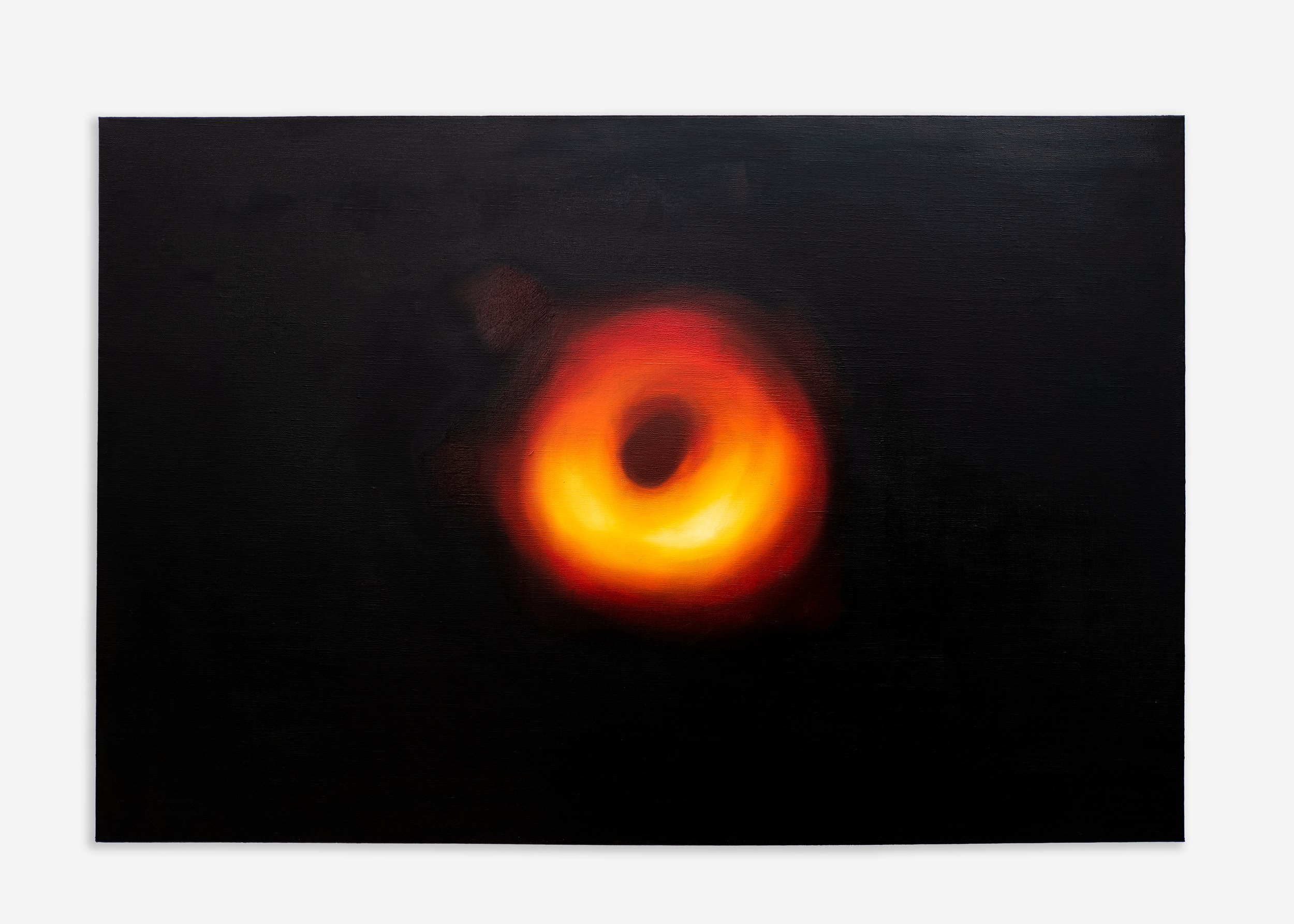
The brushwork in Moldavite (2020) is different from the brushwork in Tan Mu's paintings of cosmic subjects such as Sagittarius A* (2022) or Powehi (2022). Where those paintings build their luminous forms from fields of individual points that accumulate into gradients of light, Moldavite builds its surface from thin, overlapping layers of green and dark oil paint that create the illusion of translucency, the quality of light passing through the stone rather than reflecting off its surface. The translucent green is achieved by allowing the dark ground to show through the thin layers of green paint, producing the effect of depth within the stone itself, as if the viewer were looking into the interior of the tektite rather than merely at its surface. This technique is the opposite of the technique used in the black hole paintings, where the luminous form is built on top of the dark ground, each point of light a separate application of paint that sits on the surface and catches the light of the room. In Moldavite, the light seems to come from within the stone, passing through the layers of paint and emerging at the surface as the specific, slightly yellowish green that characterizes the material. The painting is not a depiction of light striking a surface. It is a depiction of light inhabiting a material.
Anish Kapoor's Void Field (1989) consists of sixteen blocks of Cumbrian sandstone, each one carved with a shallow depression in its upper surface that has been filled with a dark blue pigment. The blocks are arranged in a grid on the floor of the gallery, and the viewer walks among them, looking down into the depressions, which appear to be empty, to be holes in the stone that descend into an immeasurable depth. The pigment that Kapoor uses is the same pigment that he has used throughout his practice, a deep, light-absorbing blue that creates the illusion of a surface that recedes infinitely into the material, a void that the eye cannot resolve into a bottom. The stone blocks are not empty. They are solid sandstone with a shallow depression carved into them. But the pigment transforms the shallow depression into an apparent abyss, a hole that the eye follows downward until it loses the ability to perceive depth and the depression becomes a void, an absence that is more present than the stone that surrounds it. The void in Void Field is not a representation of nothingness. It is an experience of nothingness produced by the material conditions of the object: the pigment, the depression, the stone, the light, and the viewer's eye following the surface down into a depth that is not there.
The connection to Moldavite (2020) is in the relationship between the material object and the cosmic depth that the object implies. Kapoor's stone blocks are blocks of sandstone, a common material that has no particular cosmic significance. But the voids that Kapoor carves into them transform the blocks from geological specimens into cosmic objects, objects that contain depths that exceed their physical dimensions. The moldavite in Tan Mu's painting operates in the same way. It is a small stone, a fragment of glass that could fit in the palm of a hand. But the dark ground behind it and the translucent green that seems to emanate from within it transform the stone from a geological specimen into a cosmic object, a fragment of a meteorite impact that connects the hand that holds it to a cosmic event that occurred fifteen million years ago and that reshaped the surface of the earth in ways that are still visible in the landscape of southern Germany. The stone is not a symbol of the cosmos. It is a piece of the cosmos, a fragment of the meteorite that has been preserved in its current form for fifteen million years, and the painting holds it against the dark ground in the same way that Kapoor holds the void in the stone: as a material presence that implies a depth that exceeds its physical dimensions, a depth that is not visible but that the object makes available for contemplation.
The meteorite that produced the moldavite fell in what is now the Nordlinger Ries crater in southern Germany, approximately fifteen million years ago. The impact ejected molten terrestrial material into the atmosphere, where it cooled and solidified as it fell back to earth, forming the translucent green glass that is now found in the Czech Republic and surrounding regions. The moldavite is not a fragment of the meteorite itself. It is a fragment of the earth that was melted and ejected and reformed by the impact. It is a terrestrial material that was transformed by a cosmic event. It is a product of the collision between the earth and something that came from space, and the collision produced a material that is neither entirely terrestrial nor entirely extraterrestrial but is something in between, a fusion of the two realms that carries the record of the event that fused them. Tan Mu has described the stone as carrying a timespan of approximately fifteen million years, and she has described the experience of holding it as one that placed human history, technological progress, and social conflict into a much smaller perspective. The fifteen million years that the moldavite carries is a timespan that exceeds human time by several orders of magnitude. The oldest human artifacts are a few hundred thousand years old. The oldest human civilizations are a few thousand years old. The oldest human technologies are a few hundred years old. The moldavite is fifteen million years old. It was formed before the human species existed. It has existed for longer than the entire history of the genus Homo. It will exist for longer than the species that now holds it. The painting does not make this timespan visible in any representational sense. It makes it present through the material conditions of the object: the green of the stone, the dark of the ground, the close-up that fills the canvas with the form of the stone and prevents the viewer from seeing anything else.
Georgia O'Keeffe's Pelvis Series, painted between 1943 and 1947, depicts the bones of animal pelvises held up against the sky. The bones are not lying on the ground. They are held up, suspended in the frame of the painting, so that the openings in the bone, the obturator foramina and the acetabular sockets, become windows through which the sky is visible. The sky in an O'Keeffe pelvis painting is not a background. It is a presence that the bone frames, the same way a window frame frames the landscape beyond it. The bone is the frame. The sky is what is seen through it. The small object, the bone that a person could hold in their hand, becomes a portal through which the vastness of the sky is accessible. O'Keeffe was not painting bones. She was painting the sky as it appeared through the specific architecture of a bone, and the bone was the instrument that made the sky visible in a particular way, the way a lens makes light visible by focusing it. The bone was not a symbol of death or mortality or the transience of the body. It was a frame for the infinite, a structure that gave form to formlessness, a piece of the finite that made the infinite available to the eye.
The connection to Moldavite (2020) is structural. The moldavite in Tan Mu's painting operates the way O'Keeffe's pelvis bones operate: as a small object that frames a vast depth. The moldavite is not a window. It does not have a hole through which the dark ground is visible. But the translucent green of the stone creates the effect of depth within the material itself, and the dark ground behind the stone creates the effect of a void from which the stone has emerged and to which it could return. The stone is the frame. The void is what is seen around it. The close-up composition, which crops the stone at the edges of the canvas, reinforces this relationship: the stone fills the frame, and the void appears only at the margins, the way the sky appears at the margins of O'Keeffe's pelvis paintings, pressing in around the bone, filling the spaces that the bone does not occupy. Both artists use the small object as a way of making the vast depth accessible to the eye. Both understand that the small object is not a representation of the vast depth but a point of entry into it, a piece of material that has been shaped by forces that exceed the human scale and that carries within its form the record of those forces. The moldavite was shaped by a cosmic impact. The pelvis was shaped by evolution. Both carry the record of their formation in their physical structure, and both make that record available to the viewer as a way of entering a depth that would otherwise be inaccessible to the hand or the eye.
Tan Mu has described Moldavite as one of her earliest experiments with the dark background and close-up perspective that would become a signature of her practice. The dark field, she says, intensifies the form and texture of the meteorite, creating a sense of depth and mystery. The close-up composition allows the viewer to focus on the fine surface details, the permanent traces left by the impact that formed the stone. This approach, which she developed in Moldavite and carried forward into Silicon (2021) and Powehi (2022), is not merely an aesthetic choice. It is a methodological one. The dark background removes the stone from every context except the void from which it came. The close-up removes the stone from every scale except the scale of the hand. The result is a painting that holds the stone in a condition of maximum presence and maximum isolation, present to the eye as a physical object that can be examined in detail, isolated from every context that would explain what it is or where it came from or what it means. The painting does not explain the moldavite. It does not provide a geological context or a historical narrative or a scientific framework. It places the stone against the dark ground and asks the viewer to look at it, to examine its surface, to trace the ridges and grooves that record the cooling process, to recognize the translucent green as the color of silicate glass that was formed in the atmosphere fifteen million years ago, and to hold all of that information in the same gaze that holds the stone as a physical object that is present in the room and available to the eye. The painting does not make the fifteen million years visible. It makes the stone that carries them visible, and it trusts the viewer to understand that the stone and the years are the same thing, that the surface of the stone is the record of the time, and that looking at the surface is looking at the time, and that the time is in the stone, and the stone is in the hand, and the hand is holding fifteen million years, and the hand will be gone long before the stone is.