The Cable at the Bottom of the Ocean: Tan Mu's Twenty Thousand Leagues Under the Seas and the Nervous System Beneath the Water
Stand six inches from the canvas and the painting is all surface. The linen is visible, its weave rising and falling under layers of dark oil paint, a texture that the light catches and releases in shallow ridges that follow the threads. The color at this distance is not a single color but a population of colors: deep navy, midnight blue, greenish black, a faint violet that appears where the thinner layers allow the white of the ground to breathe through. The brushwork is visible as variations in the thickness of the paint, some passages where the brush has laid down a thin wash that pools in the low points of the weave, others where the paint has been built up in thicker layers that sit on top of the linen and catch the light differently. There are lighter passages, not bright but lighter, areas where a thin strand of pale paint crosses the dark field, a line that might be a cable or might be a current or might be nothing more than a brushmark that the artist decided to keep. At six inches, the painting is an object. It is a piece of linen stretched over a wooden frame and covered with oil paint. It measures 182 x 152 cm (72 x 60 in), and it occupies a wall the way a window occupies a wall, with the same implication that there is something on the other side. Step back and the surface resolves into depth. The lighter passages coalesce into forms. The lines become cables. The dark field becomes water. The painting becomes the bottom of the ocean, and the cables that cross it are the cables that carry nearly all of the world's international data traffic across the floors of the Pacific and the Atlantic and the Indian Ocean, the fiber optic strands that transmit the messages and the images and the financial transactions and the video calls and the medical records and the military communications that constitute the substance of contemporary global life.
Twenty Thousand Leagues Under the Seas (2023) is an oil painting on linen, 182 x 152 cm (72 x 60 in), and it is one of the largest works in Tan Mu's practice. The scale is not incidental. The painting depicts a landscape that exists at the bottom of the ocean, a landscape that is not visible to the human eye and that can be known only through sonar maps and cable route charts and the reports of the remotely operated vehicles that maintain the cables. The scale of the painting is an attempt to make that landscape present to a viewer who will never see it, to give it a physical dimension that approaches the dimension of the experience of standing at the edge of something vast and not being able to see where it ends. The dark water fills the canvas from edge to edge. There is no horizon. There is no surface. There is no sky. The painting is entirely underwater, and the cables that cross it run from one side to the other, entering the frame at one margin and exiting at the other, as if the canvas were a window that had been cut into the ocean floor and the cables were the first thing visible when you looked through it. The cables are rendered as thin lines of lighter paint, some of them taut and straight, others curving slightly as they follow the contours of the seabed. They are not all the same color. Some are a pale grey that suggests the polyethylene sheathing that protects the fiber optic strands inside. Others carry a faint blue or green that might be the color of the cable itself or might be the color of the light that has traveled down from the surface and been filtered through hundreds of meters of seawater before it reaches the depth where the cables lie. The cables are not the only forms in the painting. There are also lighter patches that suggest the topography of the ocean floor, ridges and valleys and plateaus that the cables navigate as they cross from one continent to another. These forms are rendered with the same thin, layered brushwork that produces the dark water, the lighter passages emerging from the dark ground the way that the seabed emerges from the sonar map, a gradual accumulation of data points that resolves into terrain.
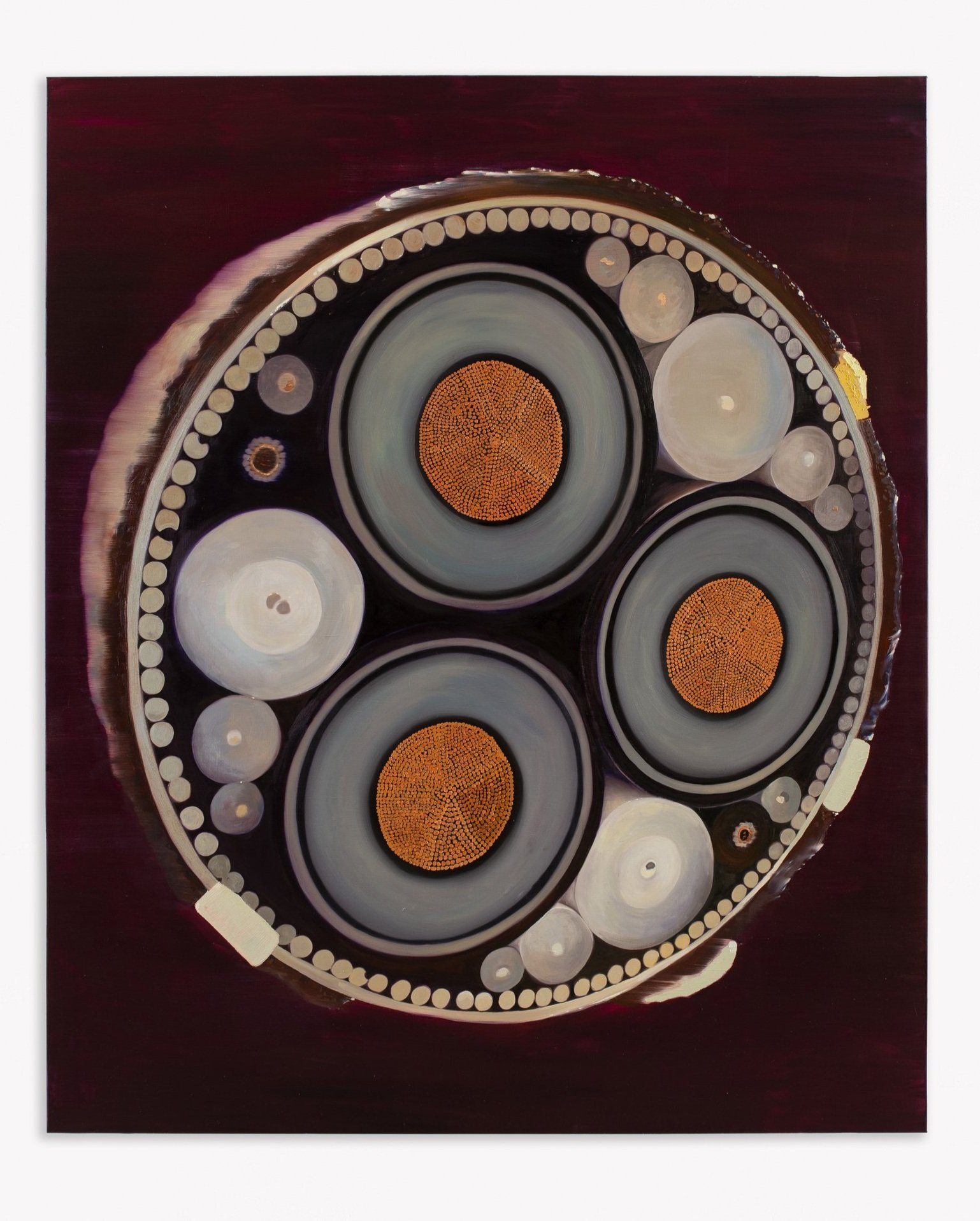
The brushwork that produces the dark water is not the brushwork that Tan Mu uses in her paintings of cosmic subjects. In Sagittarius A* (2022) and Powehi (2022), the luminous forms are built from individual points of paint that accumulate into gradients of light, each point a separate application of the brush. In Twenty Thousand Leagues Under the Seas, the dark water is built from broad, overlapping strokes that cover the canvas in thin layers, each layer modifying the color and value of the layers beneath it without obscuring them entirely. The effect is a dark field that is not flat but deep, not a single color but a composite of many colors that the eye reads as a single dark tone at normal viewing distance but that resolves into its constituent colors when the viewer approaches the canvas. The technique produces a surface that behaves like water: it appears uniform from a distance, but close inspection reveals that it is composed of countless variations in color and value that produce the illusion of depth and movement and the play of light through a medium that absorbs most of the light that enters it. The cables are painted on top of the dark water, but they are not painted as separate objects that sit on top of a background. They are painted as forms that exist within the medium of the water, the way that a fish exists within the water or a current exists within the water, as something that the water contains and that would not exist without the water to contain it. The thinness of the cable lines, their slight variation in color, their occasional curvature as they follow the contours of the seabed, all of these details suggest that the cables are not foreign to the water but are held by it, suspended in it, as much a part of the ocean as the current that moves above them and the sediment that settles below them.
Mark Rothko's No. 14 (1960) is a large painting, approximately 290 x 272 cm, that consists of two rectangular fields of color, one above the other, floating on a dark ground. The upper field is a deep, saturated orange. The lower field is a dark blue. The ground that surrounds them is a darker blue, almost black, and the two rectangles seem to hover in front of it, suspended in the dark space like two windows that open onto different kinds of light. The painting is not a representation of anything. It does not depict a landscape or an object or a scene. But it produces an experience that is analogous to the experience of standing in front of something vast and not being able to see where it ends. The edges of the color fields are not sharp. They blur and soften, the orange dissolving into the dark ground at its edges, the blue fading into the darker blue that surrounds it. The effect is of color that is not contained by its borders, color that extends beyond the rectangle that the artist has painted, color that the eye follows outward until it loses the ability to distinguish between the color field and the dark space that surrounds it. The painting produces the experience of immersion, of being surrounded by color and light and dark, of standing in front of something that does not end at the edges of the canvas but that continues outward into the space of the room and the mind of the viewer.
The connection to Twenty Thousand Leagues Under the Seas (2023) is in the production of depth through the interaction of color fields and dark ground. Rothko's painting produces depth by placing two luminous rectangles against a dark field and allowing the edges of the rectangles to dissolve into the darkness that surrounds them. The depth is not perspectival. It is not produced by the convergence of lines toward a vanishing point. It is produced by the relationship between the color and the darkness, the way that the color seems to float in front of the darkness and the darkness seems to recede behind the color. Tan Mu's painting produces depth in the same way. The cables are the luminous forms. The dark water is the ground. The cables float in front of the darkness, and the darkness recedes behind them, and the viewer's eye follows the cables into the depth of the water the way that the viewer's eye follows Rothko's orange rectangle into the depth of the dark ground. The experience of standing in front of Twenty Thousand Leagues Under the Seas is the experience of immersion, of being surrounded by a dark space that is not empty but that contains forms that are visible and forms that are not visible, and of understanding that the visible forms, the cables, are only a fraction of what the space contains, and that the rest, the vast majority of what the ocean holds, is not visible and will never be visible to the human eye. The painting produces the experience of depth not as a spatial illusion but as a condition of knowledge: the knowledge that there is more beneath the surface than the surface can show.
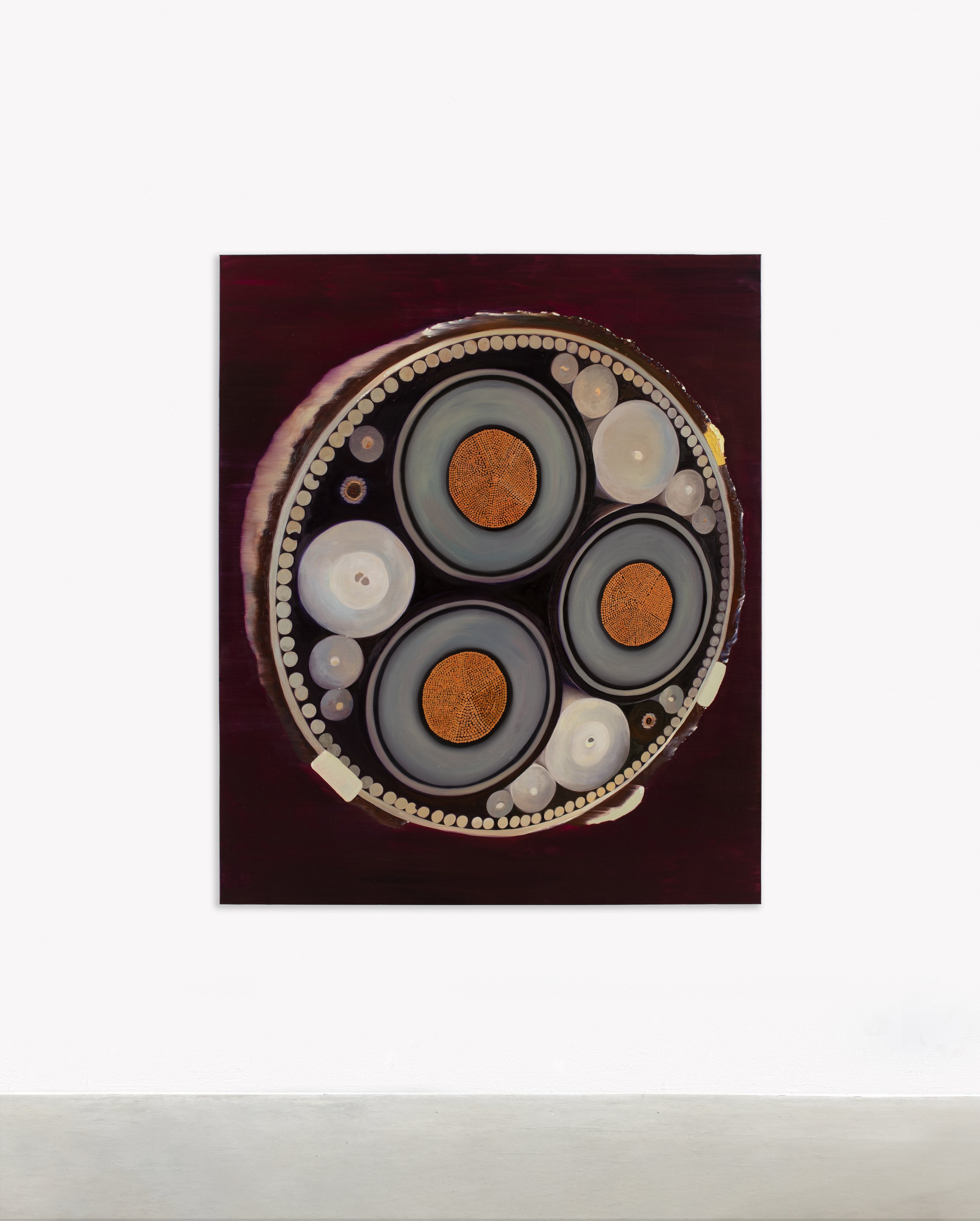
Tan Mu has described the moment that led to this painting as a moment of disconnection. In January 2022, the volcanic eruption of Hunga Tonga Hunga Ha'apai damaged the submarine cables that connected Tonga to the rest of the world and cut the island off from global communication. The eruption was the first event that made Tan Mu fully aware that most of the world's international data traffic travels not through satellites but through physical cables laid across the ocean floor. The realization stayed with her. It became the origin of the Signal series, the body of work that would occupy her practice for the next three years and that would produce some of the most ambitious paintings in her catalogue. Twenty Thousand Leagues Under the Seas (2023) is the work that bridges the initial moment of awareness and the ongoing series. It takes the submarine cable, the object that was revealed by its absence when the cables were cut and the island went silent, and makes it the subject of a painting that is large enough to convey the scale of the system that the cables constitute. The painting is not about the eruption. It is about the cables. But the cables are understood, in the painting, as the condition of connection, and the condition of connection is understood as something that is visible only when it fails, the way that the circulatory system is visible only when it bleeds. The painting makes the cables visible not because they have failed but because the artist has understood, through the experience of their failure, that they exist, and that they exist at the bottom of the ocean, and that they carry nearly everything that the modern world depends on, and that almost no one knows they are there.
The submarine cables that cross the floors of the world's oceans carry more than ninety percent of all international data traffic. The figure is so widely cited that it has become a kind of shorthand for the invisible infrastructure of the modern world, the way that the phrase "the internet is not a cloud" has become a shorthand for the material reality of data centers and server farms and the electrical grids that power them. But the figure does not convey what the cables actually do. A single modern fiber optic cable can carry multiple petabits of data per second. A petabit is one quadrillion bits. The cable that crosses the Atlantic from New York to London carries, at any given moment, the financial transactions of the world's stock exchanges, the diplomatic communications of the world's governments, the medical records of the world's hospitals, the video calls of the world's families, the military communications of the world's armed forces, the scientific data of the world's research institutions, and the entertainment that the world watches when the work is done. The cable is not a single strand. It is a bundle of fiber optic filaments, each one thinner than a human hair, encased in layers of protective material: polyethylene, steel wire, copper tubing, nylon, more polyethylene. The layers are designed to protect the fiber from the pressure of the water above it, which at the depths where the cables are laid can exceed ten thousand pounds per square inch, and from the anchors of fishing vessels and the jaws of sharks, which are apparently attracted to the electrical fields that the cables produce, and from the currents that scour the ocean floor and can expose a cable that was buried beneath the sediment when it was laid. The cable lies on the seabed or is buried in a trench that was cut by a plow towed behind a cable laying ship, and the cable laying ship is a specialized vessel that carries the cable in enormous tanks and pays it out over the stern as the ship moves across the ocean at a speed of a few knots, and the cable sinks to the bottom and comes to rest on the seabed or in the trench, and the ship moves on, and the cable lies there, at the bottom of the ocean, carrying the world's data through glass filaments that are thinner than a human hair, and almost no one knows it is there.
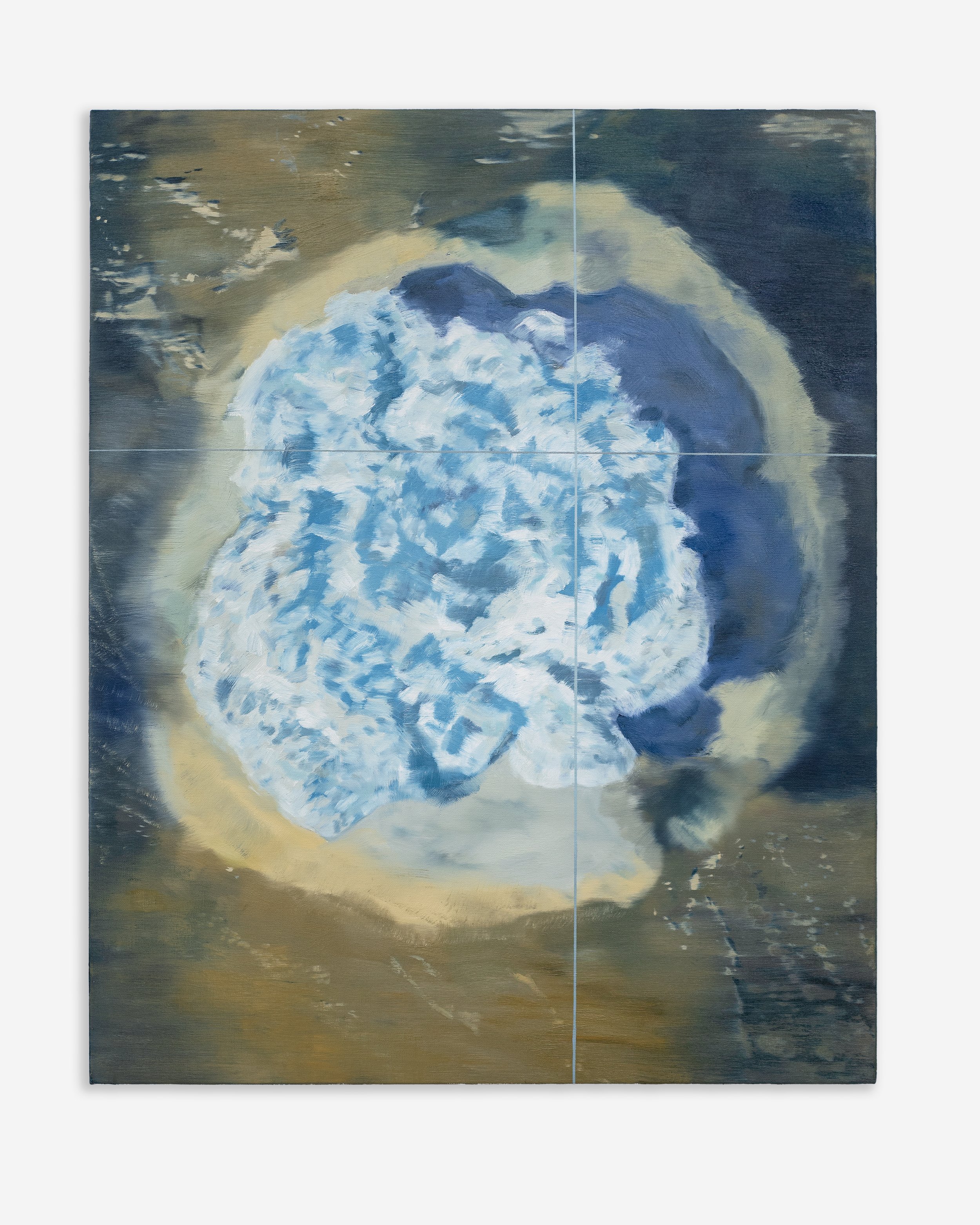
Walter De Maria's The Lightning Field (1977) is a work of land art consisting of four hundred stainless steel poles planted in a grid pattern across a remote desert plateau in western New Mexico. The poles are approximately two inches in diameter and are sharpened to a point at the top. They are spaced two hundred and twenty feet apart, and the grid measures one mile by one kilometer. The work is intended to be visited over an extended period of time, and the visitor is encouraged to spend at least twenty four hours in the cabin that the Dia Art Foundation maintains near the site, watching the poles as the light changes, waiting for the conditions that will produce lightning, which the poles are designed to attract. The lightning does not come every day. It comes when the conditions are right, and the conditions are right only occasionally, and the visitor who waits for the lightning may wait for days and never see it. The work is not the lightning. The work is the poles and the grid and the desert and the sky and the waiting. The lightning is what the work makes visible, what the poles bring into contact with the ground, what the grid translates from a meteorological event into an aesthetic one. But the work exists whether the lightning comes or not. The poles are there. The grid is there. The desert is there. The work is an infrastructure for the perception of something that is not always visible and that becomes visible only when the conditions are right.
The connection to Twenty Thousand Leagues Under the Seas (2023) is in the relationship between the infrastructure and the phenomenon that the infrastructure makes visible. De Maria's poles make lightning visible by providing a path for it to follow. Tan Mu's painting makes the submarine cables visible by depicting them against the dark water that conceals them. Both works are about the conditions under which something that is normally invisible becomes visible. The cables are invisible because they are buried beneath the ocean. The lightning is invisible because it is a discharge of atmospheric electricity that lasts for a fraction of a second and that occurs only when the conditions are right. Both works provide a structure for the perception of the invisible: De Maria provides the poles, Tan Mu provides the canvas. Both works understand that the invisible is not absent. It is present but unavailable to the eye, and the work of art is the mechanism that makes it available. The Lightning Field makes the lightning available by attracting it. Twenty Thousand Leagues Under the Seas makes the cables available by painting them. Both works understand that the visibility of the invisible is not guaranteed. The lightning may not come. The cables may not be seen. The painting may not be understood. But the infrastructure is there, whether it is perceived or not, and the work of art is the invitation to perceive it, to stand in front of the dark water and follow the cables with the eye and understand that the cables are carrying something that is not visible in the painting but that the painting makes present through the act of depicting the cables themselves: the messages, the images, the financial transactions, the medical records, the video calls, the military communications, the scientific data, the entertainment, the love letters, the death notices, the everything that flows through the glass filaments at the bottom of the ocean at speeds that exceed the capacity of the human eye to follow.
Saul Appelbaum, writing in the BEK Forum catalog in 2025, described Tan Mu's paintings of cables as a form of hagiography, a devotion to the hidden and the overlooked that elevates infrastructure into the condition of the sacred. The observation was made in the context of the Signal series, but it applies with particular force to Twenty Thousand Leagues Under the Seas, which is the work in which the cables are most fully submerged, most fully invisible, most fully dependent on the painting itself for their visibility. The painting does not show the cables in the way that a photograph shows them, because there are no photographs of the cables at the bottom of the ocean in the way that this painting depicts them. The painting shows them the way that a painting shows anything: by translating the physical presence of the object into the material conditions of the medium, by replacing the glass and the steel and the polyethylene with oil paint and linen, by replacing the ocean with a dark field that is not the ocean but that produces the experience of standing in front of something vast and dark and deep. The painting is not a document. It is not a map. It is a record of the experience of understanding that the cables are there, at the bottom of the ocean, and that they carry everything, and that they are invisible, and that the invisibility is not a condition of their unimportance but a condition of their importance, because the things that are most essential to the functioning of the modern world are the things that are least visible, and the things that are least visible are the things that most require the attention of the painter, and the painter, by making them visible, does not make them less essential or less invisible in the world but makes them available to the viewer who stands in front of the canvas and follows the thin pale lines across the dark field and understands, perhaps for the first time, that the bottom of the ocean is not empty, and that the cables are there, and that they have been there for longer than most people have been alive, and that they will be there long after the painting has been taken down from the wall and the linen has been rolled up and the paint has begun to crack, and that the data will still be flowing through the glass filaments, in the dark, at the bottom of the sea.