The Weight of One Hundred Trillion Connections: Tan Mu's Emergence and the Brain That Contains the Cosmos
The human brain weighs approximately 1.4 kilograms. It occupies roughly 1,200 cubic centimeters of volume. It consumes about twenty watts of power, which is less than the power consumed by a single lightbulb. It contains approximately one hundred billion neurons, each of which maintains between one thousand and ten thousand connections to other neurons, producing a total of approximately one hundred trillion synaptic connections. One hundred trillion is a number that exceeds the number of stars in the Milky Way galaxy by a factor of one thousand. It exceeds the number of seconds that have elapsed since the beginning of the universe by a factor of three hundred. The brain contains this number of connections inside an organ that weighs less than a bag of flour and that runs on less energy than a desk lamp. The disproportion between the scale of the network and the scale of the organ that contains it is not a metaphor. It is a physical fact. The network exists. The connections exist. The brain that contains them is small enough to hold in two hands. The painting that depicts this network, however, is not small. Emergence (2022) measures 193 x 244 cm (76 x 96 in). It is one of the largest works in Tan Mu's practice, and it occupies its wall the way that a landscape occupies a wall, with the same implication of depth and distance and the same resistance to being taken in at a glance. The painting does not shrink the brain to the scale of the canvas. It expands the network of neurons to the scale of the painting, and the painting is large enough that the network can breathe.
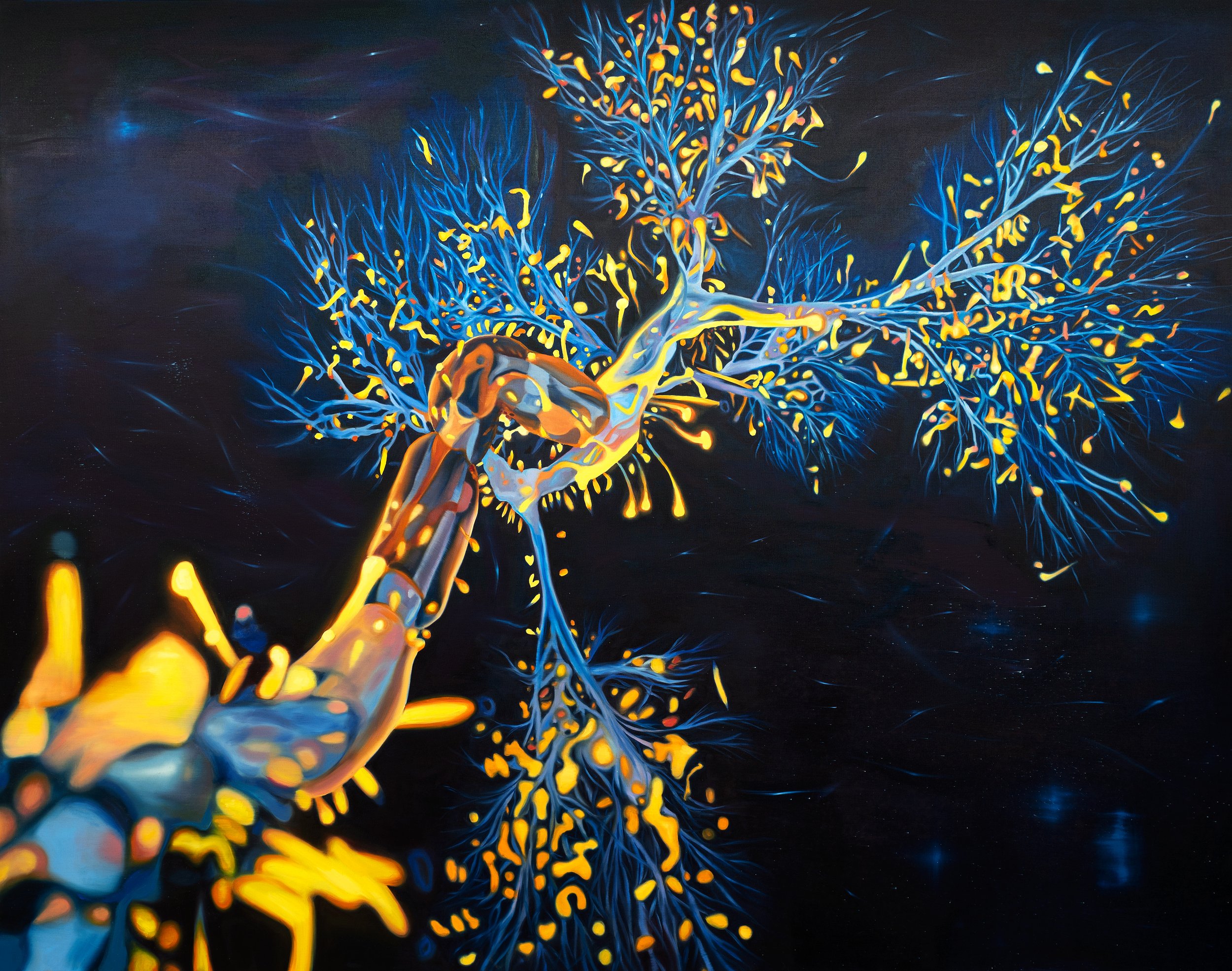
The surface of Emergence (2022) is an oil painting on linen, and the linen is visible in the areas where the dark ground has been left uncovered, particularly at the edges and in the interstices between the branching forms that constitute the painting's subject. The composition fills the canvas from edge to edge. There is no border. There is no margin. There is no background against which the neural forms are set. The neural forms and the dark ground are interlocked, the way that the brain and the space around the brain are interlocked in a cross section, the gray matter and the white matter and the cerebrospinal fluid all occupying the same frame without a clear boundary between them. The dominant colors are blue and yellow. The blue represents the neurons, their axons and dendrites extending outward to form dense networks that spread across the canvas like roots or branches or rivers seen from above. The yellow represents the luminous particles that surround the neurons, the neural signals that move through the network, the electrical and chemical activity that constitutes the brain's constant communication with itself. The yellow is not applied in continuous fields. It appears as individual points of light, small marks of paint that accumulate in clusters around the branching blue forms, the way that stars accumulate in clusters around the arms of a spiral galaxy. The blue forms are not solid. They are built from thin, overlapping strokes of paint that follow the branching paths of the axons and dendrites, each stroke a segment of a path that begins at one edge of the canvas and ends at another, or that branches and rebranches until it becomes indistinguishable from the forms that surround it. The overall effect is of a network that has no center and no edge, a system of connections that extends in all directions and that cannot be traced from beginning to end because the network has no beginning and no end, only the constant activity of signals passing from one node to another across the vast interior of the canvas.
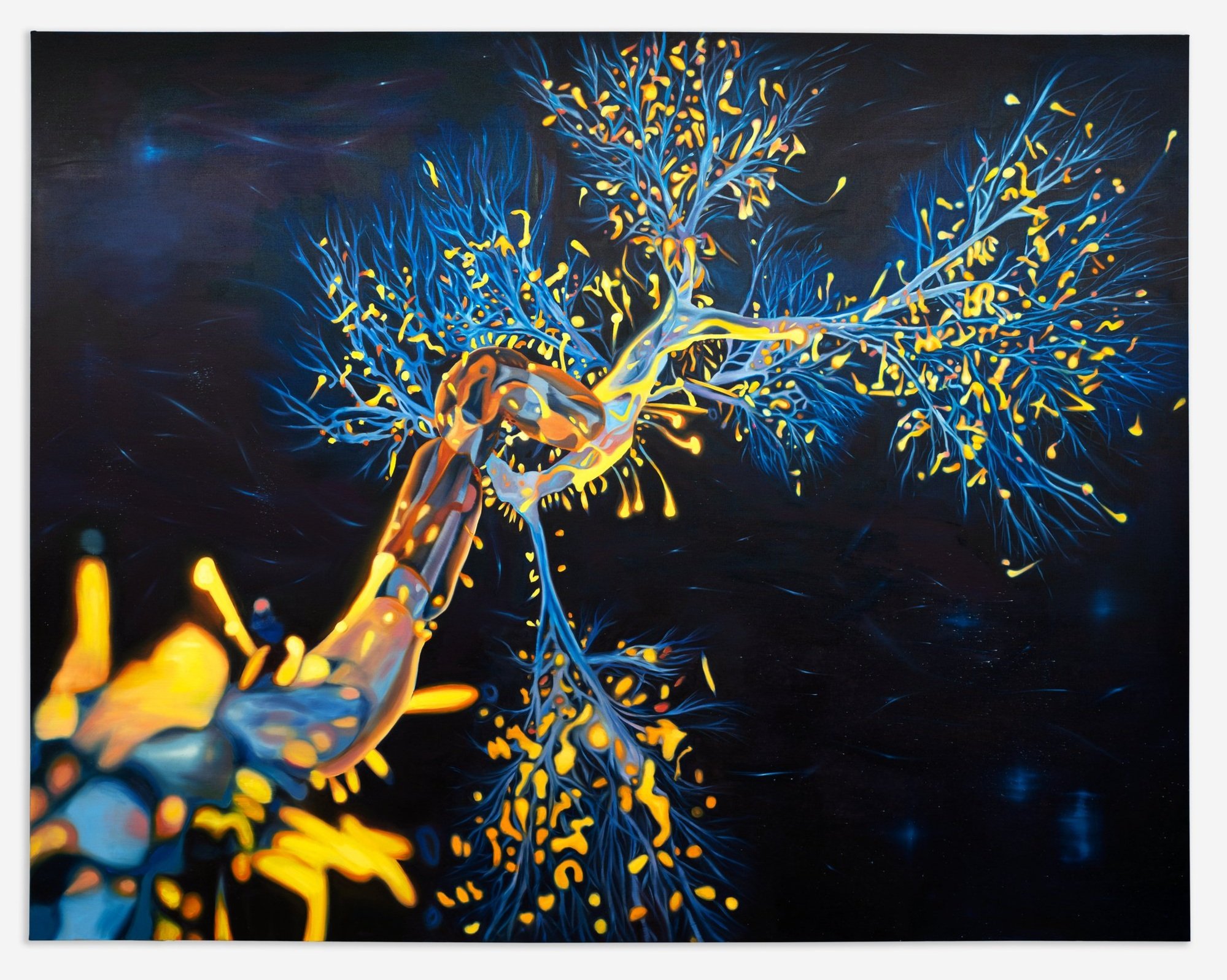
The brushwork in Emergence is different from the brushwork in Tan Mu's paintings of individual objects. In Moldavite (2020) and Blue Box (2021), the brushwork is controlled and precise, each mark placed to describe the surface of a single object against a dark background. In Emergence, the brushwork is rapid and iterative. The blue strokes that form the neurons and their extensions are applied in thin, quick marks that follow the branching paths of the dendrites, each mark a segment of a longer path that was laid down in a single gesture and then extended by subsequent gestures, the way that a river extends its tributaries by following the contours of the land. The yellow points that represent the neural signals are smaller marks, each one a single touch of the brush, applied with a rapidity that suggests the speed at which signals pass through the nervous system, not the slow accumulation of paint that characterizes the surface of a still life or a portrait but the quick, dispersed application of paint that characterizes the surface of a field, a field of activity, a field of signals, a field of connections that is not contained by the boundaries of the canvas but that extends beyond them, the way that the brain's network extends beyond the boundaries of any single cross section that could be taken from it. The dark ground between the blue and yellow forms is not empty. It is built from layers of dark paint, deep navy and greenish black and faint violet, the same population of dark colors that appears in Twenty Thousand Leagues Under the Seas (2023) and Sagittarius A* (2022), the dark field that represents the space in which the network operates, the space between the neurons, the space through which the signals travel, the space that is not empty but that is not yet occupied by the forms that will eventually fill it.
Jackson Pollock's Number 1A, 1948 is a painting that occupies approximately 173 x 244 cm of canvas and that consists of an all-over field of dripped and flung paint, with no center and no edge, no focal point and no hierarchy of forms. The paint has been applied by pouring and dripping from above, the brush or the stick never touching the canvas, the paint falling through the air and landing on the surface in lines and spatters and pools that accumulate into a dense, interwoven field of marks that extends from one edge of the canvas to the other. The painting has no subject in the traditional sense. It does not depict a person or a landscape or an object. It depicts a field of activity, a record of the movements of the artist's hand and arm as they passed over the surface of the canvas, distributing paint in patterns that are determined by the speed and direction and angle of the gesture, the viscosity and weight of the paint, the distance between the brush and the canvas, and the force of gravity. The result is a surface that is not a representation of anything but that is, in the terms that Pollock himself used, a record of the activity that produced it, a trace of the movements that the artist made while standing above the canvas and pouring paint onto it from above.
The connection to Emergence (2022) is in the all-over composition, the field of marks that extends from edge to edge without a center or a hierarchy, and in the relationship between the marks and the activity that they record. Pollock's dripped lines are the record of the artist's physical gestures. Tan Mu's branching blue forms are the record of the brain's neural activity. Both paintings produce the experience of a field that is not contained by the boundaries of the canvas but that extends beyond them, a network of connections that continues outside the frame, the way that the brain's neural network continues beyond the boundaries of any single cross section that could be taken from it. The difference is in the relationship between the marks and what they represent. Pollock's marks do not represent anything external to the painting. They are the record of the artist's own movements. Tan Mu's marks represent the movements of signals through a neural network, movements that are not the artist's own but that the artist has translated into paint through the process of observation and interpretation. The marks in Emergence are not abstract. They are representational. They represent specific structures, neurons, axons, dendrites, synaptic connections, and the signals that pass between them. But the way that they are applied, the rapidity and dispersion of the brushwork, the accumulation of individual marks into a field of activity that has no center and no edge, produces an experience that is closer to the experience of standing in front of a Pollock drip painting than to the experience of standing in front of a conventional representation of a brain. The painting does not depict the brain. It depicts the activity of the brain, and the activity of the brain, when it is rendered at the scale of the canvas, becomes a field, and the field becomes the painting.
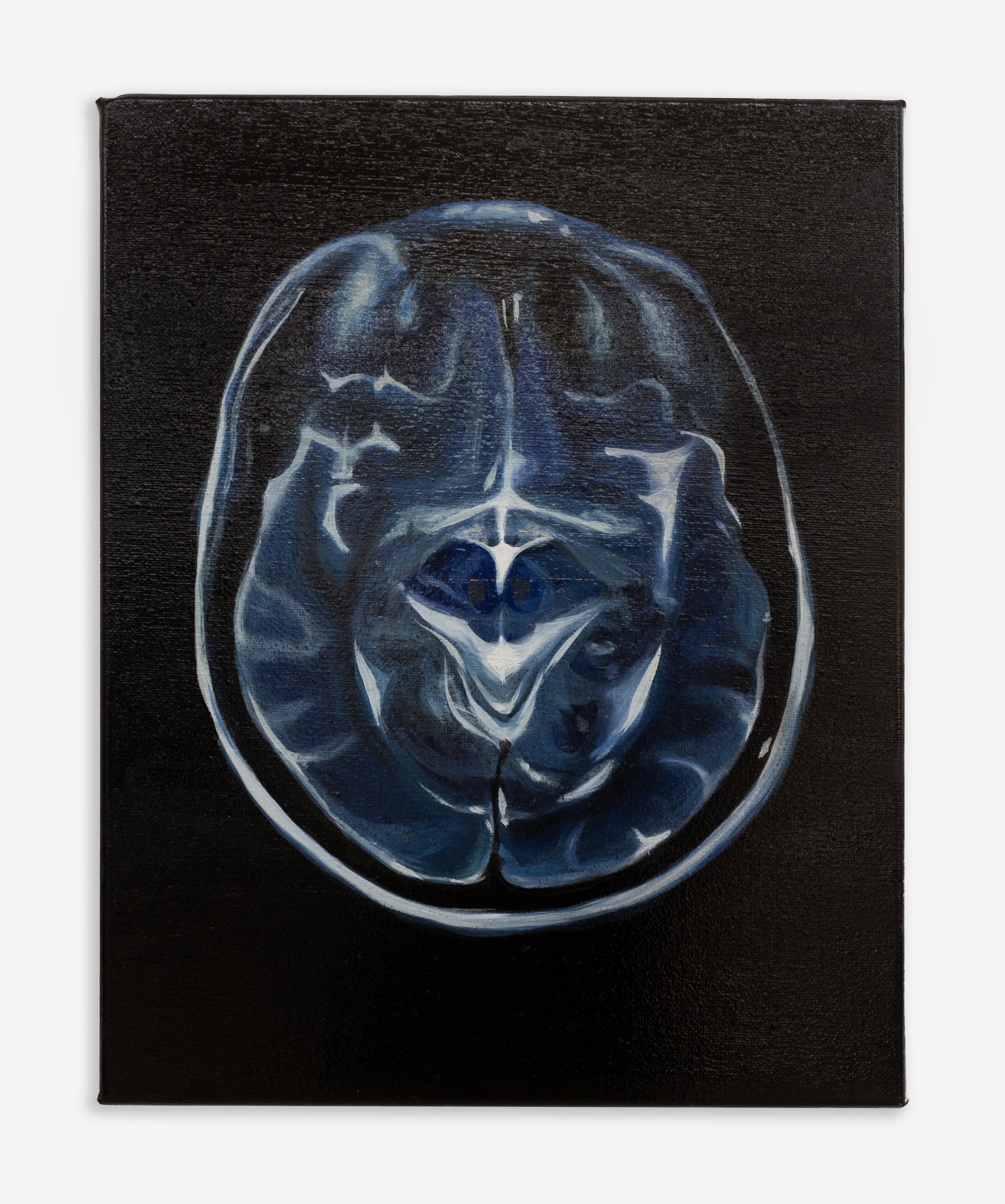
Tan Mu has described the origin of Emergence as a direct consequence of a personal experience of cerebral hypoxia during a deep dive, an incident that temporarily impaired her memory. The experience of losing memory, of finding that the organ that produces and stores memory is itself vulnerable to the conditions that memory records, led to the creation of MRI (2021), the painting that depicts the brain as it appears in a magnetic resonance image, and then to Emergence (2022), the painting that depicts the brain as it appears when its neural network is rendered at the scale of the cosmos. The progression from MRI to Emergence is a progression from the outside of the brain to the inside of the brain, from the organ as it appears in a medical scan to the organ as it appears when its internal structure is magnified to the point where the individual neurons and their connections become visible as individual marks of paint. The scale of Emergence, 193 x 244 cm, is not an aesthetic choice. It is a consequence of the subject. The brain contains one hundred trillion connections. To render those connections at a scale where individual marks of paint can represent individual synaptic events requires a canvas that is large enough to contain the network without compressing it into a diagram. The painting is the size it is because the network is the size it is, and the network, when it is rendered at a scale where the individual marks are visible to the naked eye, requires a surface that approaches the size of a wall.
The subject of the painting, as Tan Mu has described it, is not only the brain but the structural parallel between the brain and the cosmos. The neural network, with its one hundred billion neurons and one hundred trillion connections, resembles the cosmic web, the network of galaxies and dark matter that constitutes the large-scale structure of the universe. The resemblance is not decorative. It is structural. The brain and the cosmic web are both networks. They both consist of nodes connected by filaments. They both exhibit the same statistical properties, the same distribution of connection lengths, the same ratio of nodes to filaments, the same pattern of clustering and void that appears in networks that organize themselves from the bottom up, without a central authority that determines the positions of the nodes or the lengths of the connections. The painting does not illustrate this parallel. It produces it. The blue forms that extend across the canvas like the arms of a spiral galaxy are the same blue forms that represent the dendrites of a neuron. The yellow points that cluster around the blue forms like stars around the arms of a galaxy are the same yellow points that represent the signals that pass between neurons. The painting does not switch between the neural and the cosmic. It holds both registers simultaneously, and the viewer who stands in front of it sees a network that could be either or both, a network that is not one thing or the other but that is the structure itself, the structure of a system that connects nodes through filaments and produces activity through the signals that pass along those filaments, whether the nodes are neurons or galaxies and whether the filaments are axons or dark matter bridges.
Agnes Martin's The Islands (1961) is a series of six paintings, each measuring approximately 30 x 30 inches, each consisting of a square canvas covered with a pale wash of color, over which Martin has drawn a grid of faint lines in pencil. The lines are barely visible. They are so faint that the viewer must stand close to the painting to see them, and even then, they are not lines in the conventional sense but marks, traces of the pencil's passage across the surface, each one a record of a hand moving across the canvas at a specific moment in a specific direction with a specific pressure. The grids are not identical from one painting to the next. The spacing varies. The pressure varies. The color of the wash varies. But the structure is the same: a square canvas, a wash of color, a grid of pencil lines, and an overall impression of calm and order that is produced not by the regularity of the grid but by the slight irregularity of the hand-drawn lines, which are almost regular but not quite, which are almost straight but not quite, which are almost evenly spaced but not quite. The almost is what makes the painting alive. A mechanically perfect grid would be dead. Martin's grid is alive because the hand that drew it was alive, and the traces of the hand's movement are visible in the slight variations of the lines, the slight waverings, the slight deviations from the perfectly straight and the perfectly even that constitute the difference between a grid that was made by a machine and a grid that was made by a person.
The connection to Emergence (2022) is in the relationship between the underlying order and the visible surface. Martin's paintings are about the order that is not immediately visible, the grid that is present in the painting but that requires close attention to perceive, the structure that organizes the surface without announcing itself, the regularity that is almost perfect but not quite, the system that is present but that does not impose itself on the viewer. Tan Mu's painting is about the same kind of order, but the order is not a grid. It is a network. The network is present in the painting, and it is visible, but it is not visible all at once. The viewer who stands at a distance from the canvas sees a field of blue and yellow marks on a dark ground, a field that appears chaotic and unstructured, a field that looks the way that the night sky looks from a city, a confusion of points of light that seems to have no pattern and no order. The viewer who approaches the canvas and begins to follow the blue forms across the surface begins to see the network, the branching paths that connect one mark to another, the filaments that extend from one cluster of yellow points to the next, the structure that organizes the field and that gives it the quality of a system, not a random distribution of marks but a network of connections that has a logic and a direction and a purpose, even if that logic and that direction and that purpose are not immediately apparent from a distance. The order in Emergence, like the order in Martin's paintings, is an order that reveals itself gradually, that requires the viewer to spend time with the work, to move closer and then step back, to follow the connections from one mark to the next and to understand that the marks are not isolated points but nodes in a network, and that the network, when it is seen in its entirety, is not chaotic but organized, not random but structured, not a field of noise but a system of signals that is carrying information from one point to another across the vast interior of the canvas, the same way that the brain carries information from one neuron to another across the vast interior of the skull, and the same way that the cosmos carries information from one galaxy to another across the vast interior of the universe.
Nick Koenigsknecht, writing in the BEK Forum catalog in 2025, described Tan Mu's technological paintings as portraits that do not depict the technology itself but the condition of being shaped by it, the way that the tools and systems that we build to extend our perception and our reach end up restructuring the very perception and reach that they were designed to extend. The observation was made in the context of the Signal series, the submarine cable paintings, but it applies to Emergence with a specific force that Koenigsknecht's observation may not have anticipated. Emergence is a painting of a brain, but it is also a painting of a network, and the network is not only the neural network of the brain. It is the network of cables that crosses the ocean floor, the network of galaxies that crosses the cosmos, and the network of marks that crosses the surface of the canvas. The painting holds all of these networks in the same field, and the field, because it has no center and no edge, because it extends from one margin of the canvas to the other without a focal point that organizes it, produces the experience of a network that is not contained by the painting but that extends beyond it, into the wall, into the room, into the viewer's own neural network, which is, at this moment, processing the light that is reflected from the surface of the canvas and converting it into the experience of seeing, the experience of standing in front of a painting and following the blue forms across the dark ground and understanding that the forms are not only what they appear to be but are also the record of a system that is operating right now, inside the skull of the person who is looking at them, and that the system inside the skull is the same kind of system that is depicted on the canvas, a network of nodes and filaments and signals, and that the network inside the skull is looking at a network on the canvas, and the network on the canvas is looking back, not because the painting has eyes but because the painting is a depiction of the same kind of network that is doing the looking, and the looking is the activity that the network produces, and the network produces it continuously, without ceasing, the way that the neural signals in the painting move continuously through the blue forms and the yellow points, and the way that the signals in the viewer's brain move continuously through the neurons and the synapses, and the way that the signals in the cosmos move continuously through the galaxies and the dark matter bridges, and all of these networks are the same kind of network, and all of them are operating at the same time, and the painting is the point where they intersect, the point where the neural network and the cosmic network and the network of paint on canvas all converge in the same field of blue and yellow marks on a dark ground, and the viewer stands in front of this field and sees it and knows that what is being seen is not a representation of a network but a network itself, a network of marks that is connected to a network of neurons that is connected to a network of galaxies, and the connections are not metaphorical, they are structural, and they are the same, and the painting is not about the brain, it is not about the cosmos, it is about the structure that they share, the structure that produces the activity that the viewer is performing right now, the activity of seeing and understanding and standing in front of a painting and knowing that the painting is looking back.