The Eye That the Universe Made: Tan Mu's Gaze: Observable Infinity and the Map That Looks Back
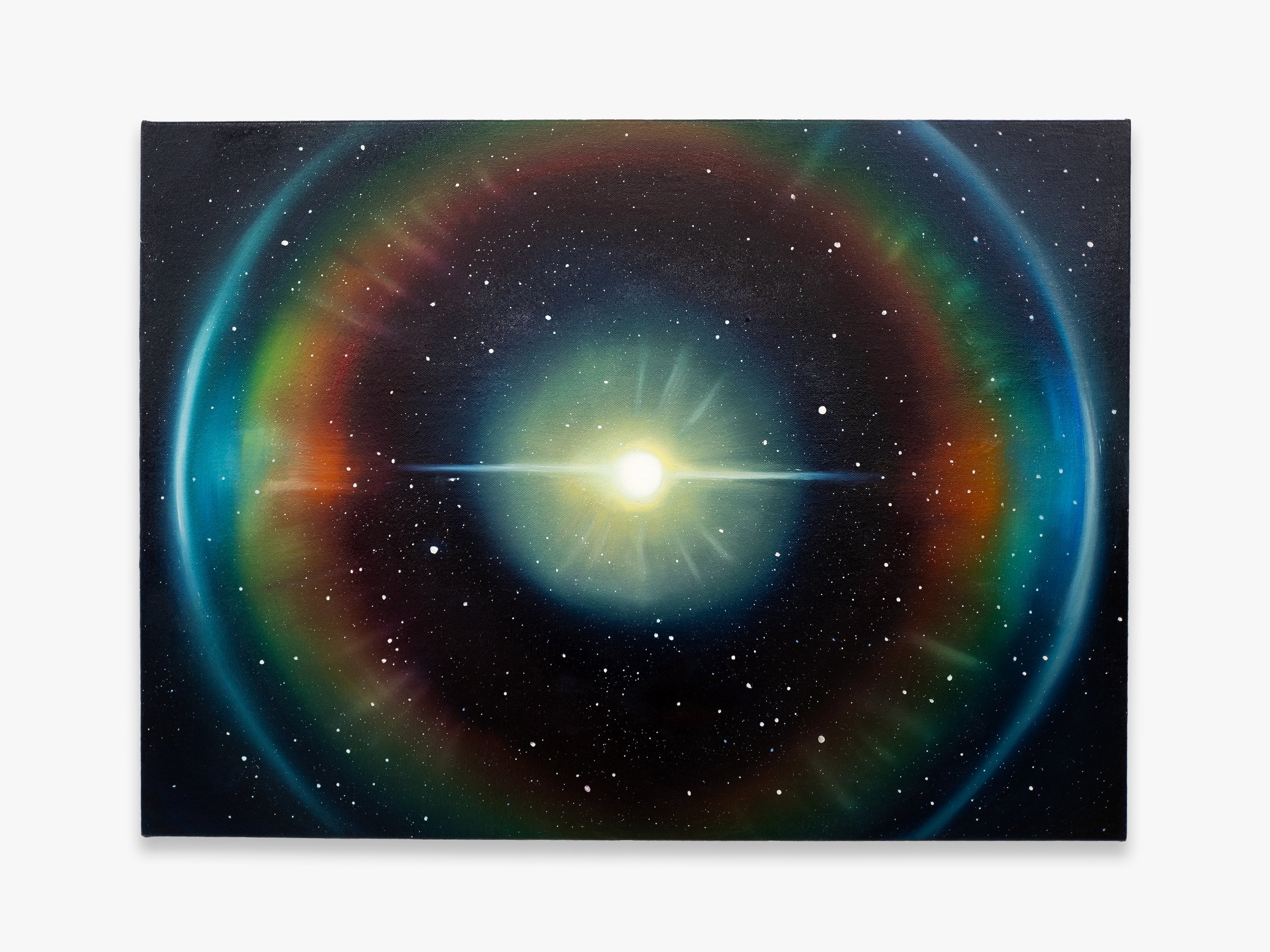
What you see is a circle. The center is bright, a radiant pale gold that bleeds outward into orange, then red, then a deep violet that is almost black, and then into darkness that is not the darkness of the canvas but the darkness of the void, the darkness that the circle is carved out of, the darkness that surrounds the edge of the visible universe and that is not empty but that is the region where light has not yet reached, the region where the signals that could tell us what is there have not yet arrived, the darkness that is not a failure of the painting but a statement about the nature of what is painted, a darkness that extends beyond the edge of the canvas and that continues in all directions for forty-six billion light years in every direction, a darkness that is not empty because it contains dark matter and dark energy and the potential for galaxies that have not yet formed and stars that have not yet ignited and signals that have not yet been emitted, a darkness that is not nothing but that is the largest part of what exists and that is visible in the painting only as the absence of color, the absence of light, the absence of information, the form that the invisible takes when it is placed next to the visible and the viewer is asked to understand that the invisible is there and that it is not the same as the visible and that the visible is only the part of the whole that light has managed to deliver to the place where the eye is waiting to receive it.
Gaze: Observable Infinity (2024) is an oil painting on linen, 40 x 55 cm (16 x 22 in), that depicts the map of the observable universe as it would appear if flattened into a two-dimensional image, the circular projection that cosmologists use to represent the region of space that is accessible to our observation, bounded not by the edge of the universe but by the limit of what light has had time to travel since the beginning of the universe, a boundary that is not a wall but a horizon, a horizon that moves outward at the speed of light and that therefore recedes from any observer at exactly the speed that the observer can travel, meaning that every observer, wherever they are in the universe, sees themselves at the center of their own observable universe and sees the horizon at the same distance in every direction, a horizon that is not a property of the universe but a property of the relationship between the observer and the universe, a geometry of perception as much as a geometry of space. The painting places the viewer at the center of this horizon. The viewer is looking at a map of the universe with themselves at its center, which is exactly where the viewer is, which is exactly where every observer is, which means that the painting is not only a map of the observable universe but a portrait of the observer who is looking at it, and the observer who is looking at it sees themselves at the center of something vast and mostly invisible, and the seeing is the act that the painting is about, the act of looking at a map that has the looking eye at its center.
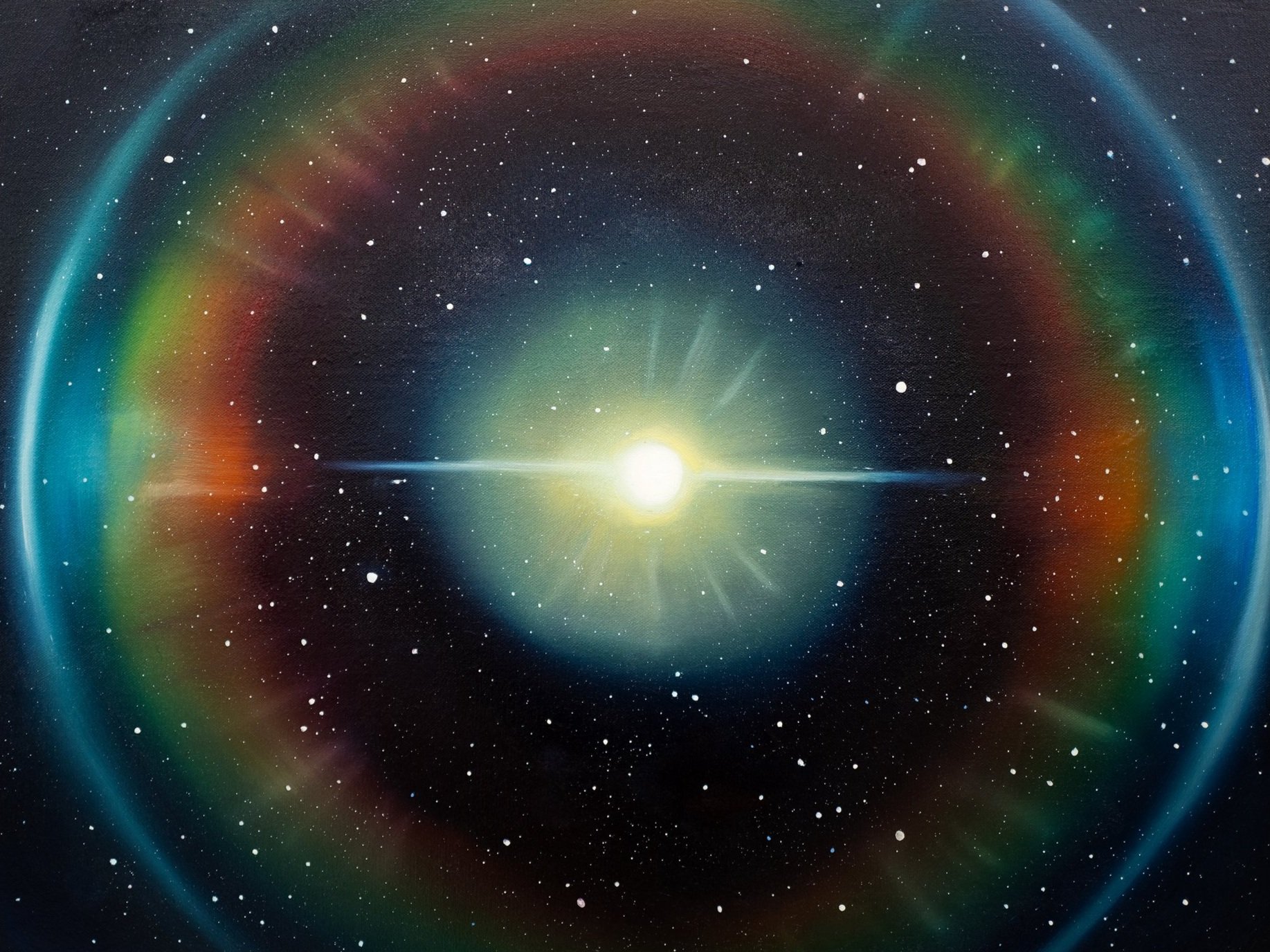
The color palette of Gaze: Observable Infinity moves from warm to cool along the radius of the circle, from the gold and orange of the center outward through red and violet into the dark ground that surrounds the circular form. The transition is gradual, not abrupt. There are no hard edges. The layers of color overlap and bleed into one another, each one slightly different in value and hue from the one that it borders, the way that the layers of the atmosphere overlap and bleed into one another as the sun sets, the way that the rings of a tree trunk are not separate rings but a continuous field of growth that can be divided into rings only by an artificial act of counting. The brushwork that produces this gradual transition is visible in the texture of the surface, particularly in the darker regions where the thin layers of paint allow the weave of the linen to show through, the threads of the ground rising and falling under the paint in a pattern that catches the light differently as the viewer moves relative to the canvas. The paint is applied in radial strokes, strokes that begin at the center and move outward along the radius of the circle, each stroke a slightly different color and slightly different value from its neighbors, the way that the rings of color around the center of the painting are not concentric circles but a continuous field of color that has been organized around a point, the way that the rings of a tree are not separate rings but a record of the continuous activity of the cambium layer that produced them, cell by cell, year by year, the growth that produced the rings being the same growth that the painting represents, the same activity that the universe is engaged in as it expands and the horizon moves outward and the light from more distant regions arrives at the eye of the observer who is looking at the painting and seeing themselves at the center of a circle that has no center, a horizon that has no edge, a map that is not a representation of something external but a portrait of the looking eye itself.
James Turrell's Quaker / Rose (1970) is a piece of colored canvas that is mounted on a wall and illuminated from behind by a single light source positioned so that the light falls on the canvas at a shallow angle, producing a field of color that seems to recede into the wall behind it, a color that is present and active in the room but that does not appear to be a surface so much as an atmosphere, a condition of the air that fills the space between the viewer and the wall. The work is not about the canvas or the frame or the wall. It is about the experience of looking at light that has no source that is visible to the eye, light that arrives at the retina from a surface that reflects it uniformly in all directions and that therefore appears to be a source of light rather than a surface that is reflecting light, the distinction between emission and reflection being one of the things that the eye learns to make and that Turrell's work asks the eye to unmake, to experience the reflected light as if it were emitted light, to see the surface as if it were a source, to stand in front of a canvas that is glowing with color and to understand that the glow is not coming from the canvas but that the canvas is holding light that is coming from somewhere else and returning it to the room, and that the experience of the color in the room is the same whether the light is emitted or reflected, and that the eye cannot tell the difference, and that Turrell has designed this inability of the eye to distinguish emission from reflection as the content of the work, the experience of looking at light that seems to come from a surface but that is in fact reflected from a surface that is illuminated from a position that the viewer cannot see.
The connection to Gaze: Observable Infinity (2024) is in the experience of looking at a surface that appears to be a source but that is in fact a receiver. The center of the painting, the bright gold region that is the focal point of the composition, appears to be the source of the light that fills the canvas. It is not. It is the point where the light from the early universe arrives at the present moment, the point where the signals that were emitted fourteen billion years ago by the first hot plasma that filled the infant universe arrive at the place where the observer is located, the point where the cosmic microwave background radiation, which is the oldest light in the universe, reaches the eye that is looking at the painting. The gold center is not emitting light. It is receiving light, the same way that the eye receives light, the same way that the iris receives light and converts it into a signal that travels to the brain. The center of the painting is an iris. Tan Mu has said that the starting point for the work was a map of the observable universe that she encountered and that struck her by its resemblance to an iris, the way that the circular boundary of the observable universe, with its warm center and dark edges, resembles the circular form of the iris with its radiating fibers and its dark pupil at the center. The resemblance is structural. Both are circular forms that organize color around a center, with the center being the point where the signals arrive and the edges being the boundaries of what can be seen. The eye that looks at the painting sees the center of the observable universe, and the center of the observable universe, by a coincidence that may be a coincidence and may not, looks back at the eye.
The pale gold at the center of Gaze: Observable Infinity is not the color of a galaxy or a star. It is the color of the cosmic microwave background, the radiation that was emitted when the universe first became transparent, approximately 380,000 years after the Big Bang, when the hot plasma that filled the early universe cooled to the point where electrons could combine with atomic nuclei and the photons that had been scattered by the plasma were free to travel in straight lines for the first time since the beginning of the universe. The photons have been traveling ever since. They have been stretched by the expansion of the universe from the high-frequency gamma radiation that they were when they were emitted to the microwave radiation that they are now, a redshift by a factor of approximately 1,100, a cooling from a temperature of approximately 3,000 Kelvin to a temperature of 2.725 Kelvin above absolute zero. The photons are now arriving at the positions that observers occupy throughout the universe, arriving as a uniform bath of microwave radiation that comes from every direction equally, a radiation that is the oldest signal in the universe, a signal that carries the imprint of the conditions that existed in the early universe, a photograph of the moment when the universe stopped being opaque and started being transparent, the first image that the universe ever produced of itself, and the image is not a picture of what was there but a picture of the moment when the there became visible, when the darkness that was not yet darkness because there was no light because the photons were trapped in the plasma became the darkness that is visible now, the darkness that surrounds the gold at the center of the painting and that is the same darkness that surrounded the first photons when they were emitted, the darkness that has always been there and that is now, in the painting, surrounding the oldest light, holding it in, containing it, the darkness that is the ground of the observable universe and the ground of the painting and the ground of the eye that is looking at the painting and seeing, for the first time in the history of the universe, the moment when the light that is now arriving at the eye was first released from the plasma that contained it, the moment when the universe became visible to itself.
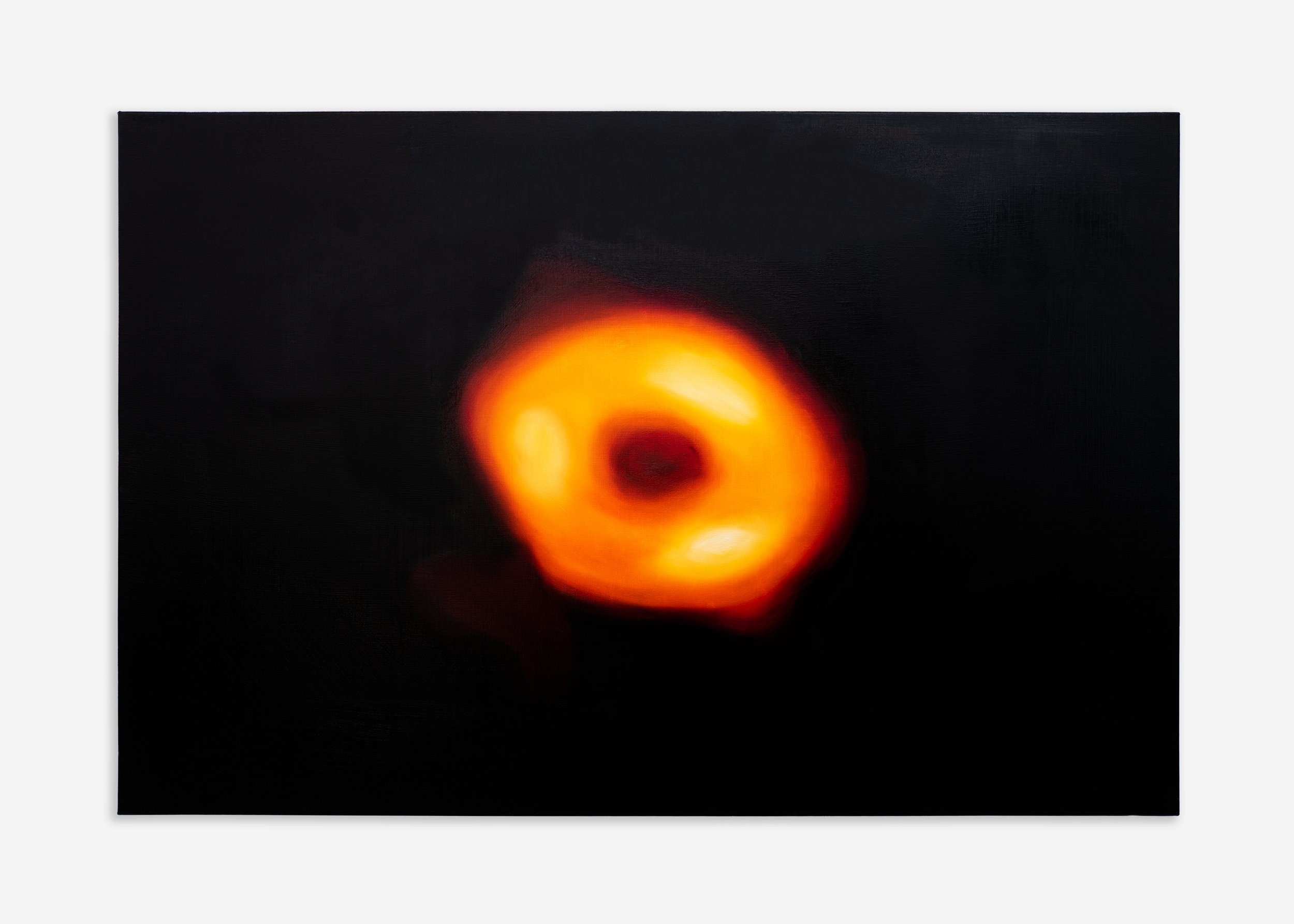
Leonard da Vinci's Sfumato Studies (c. 1490) are a series of drawings and paintings that explore the technique of sfumato, the method of representing forms through gradual transitions from light to dark rather than through outlines, the method that produces the effect of a form emerging from or dissolving into the surrounding atmosphere rather than being defined by a boundary that separates it from the atmosphere. The word sfumato comes from the Italian word for smoke, and the effect is of a form that is visible through a haze, a form that is present but not sharply defined, a form that occupies a region of the visual field rather than a point on the visual field. Da Vinci's studies of the sfumato technique, which include his famous drawings of light sources and the fall of light on surfaces, are investigations of how the eye perceives depth and form, how the brain interprets the patterns of light and shadow that reach the retina, how the experience of solidity and atmosphere is produced by the differential stimulation of the retina by light that arrives from different directions and at different intensities. The eye does not see outlines. It sees differences in brightness and color. The brain interprets those differences as surfaces and depths. The outline is a construction of the brain, not a property of the visual world. Sfumato is a technique that exploits the brain's tendency to construct forms from gradients, that presents the gradients without the outlines and lets the brain do the constructing, and that produces an experience of form that is more realistic than the experience of form that is produced by outlines, because the visual world does not contain outlines, it contains gradients, and the technique that represents gradients produces a more accurate account of visual experience than the technique that represents outlines.
The connection to Gaze: Observable Infinity (2024) is in the method of representing depth through the gradual transition of color rather than through the sharp definition of boundaries. The observable universe in the painting does not have an outline. It has a boundary, but the boundary is not a line. It is a region, a transition from the light that is visible to the darkness that is not visible, a transition that is as gradual as the transition from the lit side of a face to the shadowed side of a face in a da Vinci portrait, the transition that sfumato is designed to capture, the transition that occurs at the edge of the observable universe when the light from the most distant galaxies shifts from the visible to the redshifted, when the photons that are arriving at the eye carry information about galaxies that are receding from us faster than the speed of light, not because they are moving faster than light but because the space between us and them is expanding faster than light can travel through it, a limit that is not a physical barrier but a condition of the expansion of space, a condition that produces a horizon beyond which no signal can reach the observer because the distance between the observer and the signal is increasing faster than the signal can close it, and the signal never arrives, and the region where the signal never arrives is the darkness at the edge of the painting, the darkness that is not empty but that is full of the potential for signals that will never arrive, the darkness that sfumato represents as the atmosphere that surrounds the form and that is not the absence of the form but the condition of the form, the condition of the observable universe and the condition of the painting and the condition of the eye that is looking at both.
Li Yizhuo, writing about Tan Mu's practice in 2025, observed that the paintings do not aim at diagnosing modern spectacles from a distance but conjure up a vitality and depth of their own, a quality that distinguishes the work from the kind of art that comments on technology or science from the position of a critic who stands outside the subject and judges it. The observation applies with particular force to Gaze: Observable Infinity. The painting is not a comment on the observable universe. It is not a diagram that illustrates the concept of the observable universe for viewers who do not know what the observable universe is. It is a painting that holds the observable universe as a presence, that places the viewer in front of a circular field of color and asks the viewer to understand that the color is not only color but is also information, is also the record of the state of the universe at the moment when the oldest light in the universe was emitted, is also a portrait of the looking eye that is at the center of the circle and that sees itself as the center of a vast and mostly invisible structure that extends in every direction for forty-six billion light years and that is held in the painting as a small bright center and a gradually darkening circumference, a circle that fits on a canvas that is 40 x 55 cm, a painting that is small enough to hold in two hands and that contains the entire observable universe and the looking eye that is at its center, the eye that is looking at the painting and seeing the universe and seeing the eye that is looking at the universe and understanding that the seeing is the subject, that the reciprocal gaze is the subject, that the eye at the center of the observable universe is looking out at everything that is visible and the everything that is visible is looking back at the eye, and the painting is the place where this reciprocal gaze is made visible, not as a concept but as a color, a gold center and a dark edge and a gradient between them that is the gradient of time as well as space, the gradient that goes from the moment when the first light was released to the present moment when the eye is looking at the painting and the painting is the present moment and the eye is the present moment and the light that arrived at the eye from the center of the painting left the early universe 380,000 years after the Big Bang and traveled for fourteen billion years to reach the eye and the eye is the end of the journey and the painting is the record of the arrival and the gold at the center is the signal and the dark around it is the silence between signals and the circle is the horizon and the viewer is at the center of the circle and the center of the circle is looking back.