The Grid That Learned to Listen: Tan Mu's OXO and the First Conversation Between Human and Machine
Function produces form. It is not a new observation, but it is one that acquires a specific weight when the function in question is the function of a machine that is being asked, for the first time, to respond to a human input in real time. The year is 1952. The machine is the Electronic Delay Storage Automatic Calculator, the EDSAC, one of the first stored-program computers, built at the University of Cambridge. The program is OXO, a digital simulation of tic-tac-toe, written by Alexander Shafto Douglas as part of his doctoral thesis on human-computer interaction. The user does not have a keyboard. There is no mouse. The input device is a rotary dial, the kind that was used on telephones, and a set of buttons. The user rotates the dial to move a cursor across a three-by-three grid that is displayed on a cathode-ray tube, the same kind of screen that was used for radar displays during the war, and presses a button to place a mark. The computer calculates its response and places its own mark. The grid updates. The user moves the cursor again. The computer calculates again. The grid updates again. The exchange continues until one player wins or the board is full. The entire interaction, from the first cursor movement to the final mark, is the first real-time graphical game ever played on a computer. It is also the first time that a human being sat in front of a screen and received a visual response to an input that they had made, and the screen changed, and the human made another input, and the screen changed again, and the loop of action and feedback and action continued until the interaction reached its conclusion. The form that this interaction produced, a three-by-three grid of illuminated green dots on a dark cathode-ray tube, was not designed for its aesthetic qualities. It was designed because the EDSAC could not produce any other form. The grid was what the machine could do. The dots were what the screen could show. The green was the color of the phosphor that coated the inside of the cathode-ray tube. The aesthetic was a consequence of the hardware. And the hardware, because it could not do anything else, produced an image that was, in its spareness and regularity and the precision of its spacing, more compelling than many images that were produced deliberately for their beauty.
OXO (2021) is an oil painting on linen, 46 x 61 cm (18 x 24 in), that depicts the screen of the EDSAC as it would have appeared during a game of tic-tac-toe. The composition is centered on a three-by-three grid rendered in pale green dots against a dark ground, the same configuration of marks that the original cathode-ray tube would have produced when the program was running. The grid is not drawn with a ruler. The dots are not mechanically identical. The painting is not a pixel-perfect reproduction of a screenshot. It is a painting of a screen, and the distance between the screen and the painting, the distance between the phosphor dot and the mark of paint, is the distance that the medium of oil paint introduces into every image that it transcribes. The green of the dots is a mixed green, built from layers of yellow and blue over the dark ground, the same technique that Tan Mu uses in her paintings of luminous objects against dark backgrounds, from the translucent moldavite to the neural signals of Emergence (2022). Here the green is not translucent. It sits on the surface of the canvas, catching the light of the room the way that a phosphor dot catches the light of the electron beam that excites it, a small bright mark on a dark field that produces the illusion of a point of light. The dark ground is the dark of the cathode-ray tube when it is turned off, the dark of the glass screen before the beam scans it, the dark of the room in which the machine sits, waiting for input. The grid lines that connect the dots are rendered in the same pale green, but thinner, the paint applied in narrow strokes that follow the paths that the electron beam would have traced as it scanned the surface of the tube, building the grid from a sequence of horizontal and vertical passes.
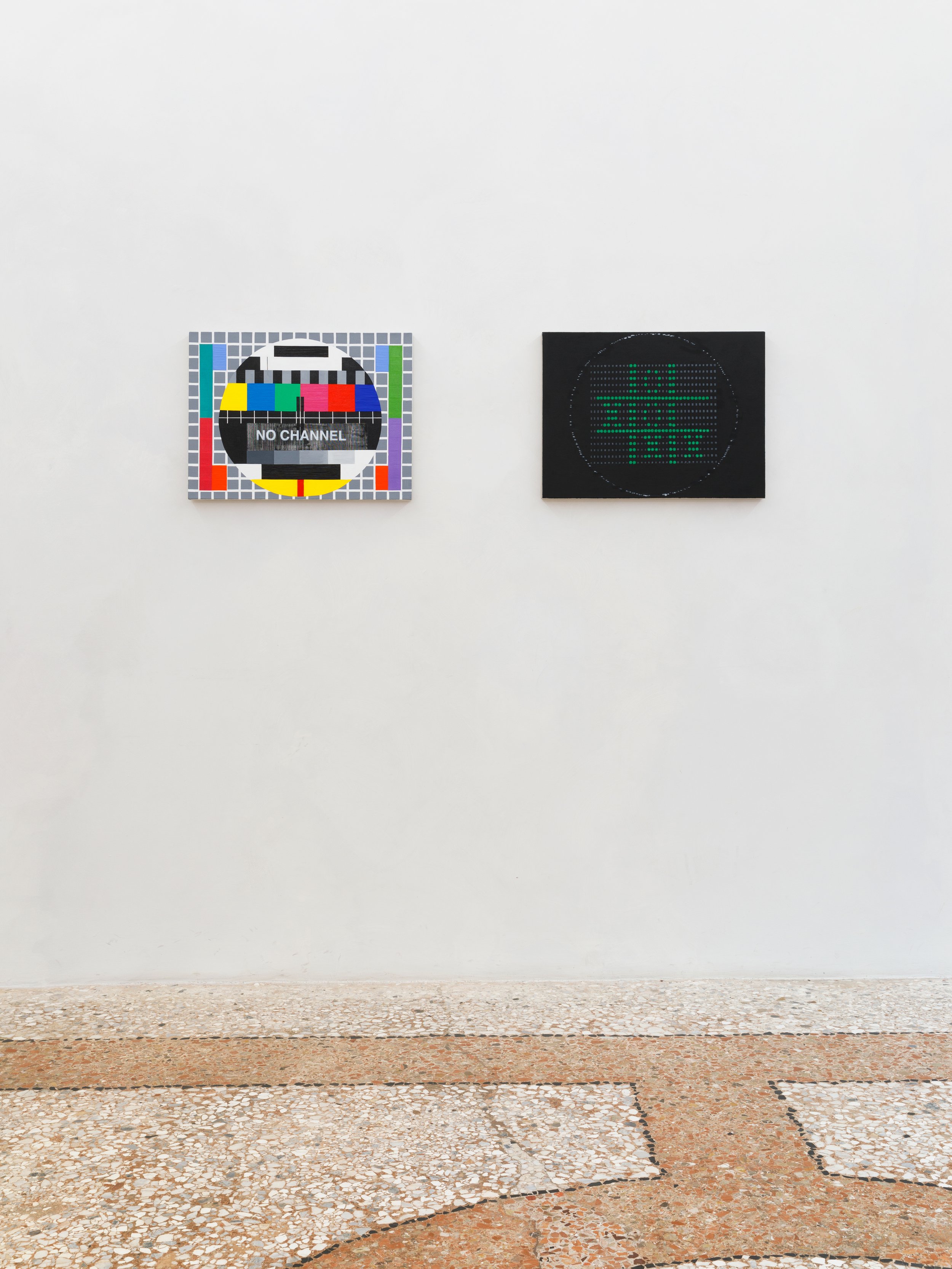
The brushwork in OXO is more controlled than the brushwork in Tan Mu's paintings of natural forms. The dots of the grid are individual marks, each one a single touch of the brush, each one slightly different from its neighbors in size and shape and density, the way that the phosphor dots on a cathode-ray tube are slightly different from one another because the electron beam does not excite every point on the screen with exactly the same intensity. The variation is not a failure of technique. It is a record of the hand, the same hand that produced the marks, and the presence of the hand in a painting of a machine-made image is the point where the painting departs from the screen and becomes something else, a painting that is not a reproduction of a screen but a translation of a screen into a different medium, a medium that retains the trace of the body that made it. The grid lines are painted in longer strokes, the brush moving across the canvas in a single pass, the way that the electron beam moves across the phosphor screen in a single scan, but the stroke of the brush is not as uniform as the scan of the beam. It thickens and thins. It accelerates and decelerates. It bears the marks of the hand that held it, the way that the beam bears the marks of the circuit that controls it. The painting is not the screen. The painting is a record of the experience of looking at the screen, and the experience of looking at the screen includes the awareness that the screen was made by a machine and that the painting was made by a hand, and that the hand and the machine are both producing marks on surfaces, and that the marks are the same kind of thing, marks that carry information, marks that are read by someone who is looking at them, marks that constitute a visual language that was not designed for beauty but that has acquired beauty because beauty is what happens when function finds its form and the form persists long enough to be seen as something more than the record of the function that produced it.
Vera Molnar's Des Ordres (1974) is a series of drawings and paintings that are produced by a simple algorithm: a square is divided into concentric squares, and each successive square is rotated by a small random angle relative to the square that contains it. The result is a grid of forms that are almost regular but not quite, a field of squares that should be concentric but that drift and wobble and overlap because the random perturbation that Molnar introduces into the algorithm prevents the squares from aligning perfectly with one another. The work is generated by a computer program that Molnar wrote herself, one of the earliest artists to adopt the computer as a tool for making images, and the program executes the algorithm with the precision that only a machine can achieve, producing forms that are exactly as irregular as the algorithm specifies, no more and no less. The visual result is a surface that appears to be hand-drawn, because the slight irregularities of the concentric squares resemble the slight irregularities that a human hand would produce if it were trying to draw a perfectly regular grid of concentric squares and failing, as a human hand always fails, to achieve the mechanical perfection that it intends. The resemblance between the computer-generated image and the hand-drawn image is not accidental. It is the consequence of the algorithm that Molnar chose, an algorithm that introduces randomness into a regular system and thereby produces a result that looks like the work of a human hand because the human hand is also a system that introduces randomness into its regular intentions.
The connection to OXO (2021) is in the relationship between the machine-made image and the hand-made image, and in the specific way that each work holds both registers simultaneously. Molnar's Des Ordres is a machine-made image that looks like a hand-made image. Tan Mu's OXO is a hand-made image that looks like a machine-made image. Both works produce their meaning from the tension between the two registers, the tension between the precision of the algorithm and the imprecision of the hand, the tension between the regularity of the grid and the slight variations that the hand introduces into it, the tension between the form that the function intended and the form that the medium produced. Molnar uses the computer to generate an image that looks hand-drawn, and the viewer who knows that the image was computer-generated sees the hand in the machine, the trace of the human body in the output of the algorithm. Tan Mu uses the hand to generate an image that looks machine-made, and the viewer who knows that the image was hand-painted sees the machine in the hand, the trace of the algorithm in the stroke of the brush. Both works understand that the boundary between the machine-made and the hand-made is not a boundary but a continuum, and that every image, whether it is produced by a hand or a machine, carries the trace of the system that produced it, and that the trace is what the viewer reads, and that reading the trace is the act of seeing that constitutes the experience of the work.
The EDSAC was built at the Mathematical Laboratory of the University of Cambridge and became operational in 1949. It was one of the first computers in the world to implement the stored-program concept, the architecture in which the instructions that the machine executes are stored in the same memory as the data that the machine processes, the architecture that remains the foundation of every computer in use today. The machine occupied an entire room. It contained three thousand vacuum tubes, arranged in racks along the walls, and it consumed fifteen kilowatts of power, which required a dedicated cooling system that blew air through the racks to prevent the tubes from overheating. The memory was a set of mercury delay lines, long tubes filled with liquid mercury through which acoustic pulses circulated, each pulse representing a bit of data that could be read and written by the processor as the pulse passed the read-write head. The memory capacity was five hundred and twelve words of thirty-six bits each. The machine could perform approximately six hundred additions per second. It was, by the standards of its time, a powerful computer. By the standards of any subsequent time, it was absurdly limited. The limitations of the hardware determined the form of the programs that could be run on it, and the form of the programs determined the form of the images that could be produced on its display. The display was a cathode-ray tube, the same technology that was used in oscilloscopes and radar screens, and the image that the tube could produce was limited to points and lines that were drawn by an electron beam scanning the phosphor-coated surface. OXO was one of the first programs to use this display for a purpose other than debugging or data output. It used it for a game. The game was tic-tac-toe, the simplest of all two-player games, a game that can be played on paper with a pencil and that requires no equipment beyond a surface and a writing implement. The choice was not arbitrary. Tic-tac-toe was chosen because it could be implemented within the constraints of the EDSAC's memory and processing power, and because the three-by-three grid that the game requires was the simplest graphic that the cathode-ray tube could produce with the resolution available to it. The function determined the form. The form was the function. The game was the machine, and the machine was the game, and the interaction between the human and the machine, the input of the rotary dial and the output of the cathode-ray tube, was the first conversation between a person and a computer that was conducted in the language of images rather than the language of numbers.
The green dots that represent the cursor positions in OXO are not decorative. They are functional elements of the game interface, markers that indicate where the human player has placed a mark and where the computer has placed its response. But Tan Mu has identified these functional elements as the origin of a visual language. "These elements feel familiar," she has said, "because they are embedded in our shared technological history." The observation is precise. The green dot on a dark ground, the dot that represents a cursor or a data point or a pixel, has become one of the most recognizable visual elements of the digital age, not because it was designed to be recognized but because it was the most efficient way to represent information on a cathode-ray tube, and the cathode-ray tube was the display technology that was available when the first computer interfaces were being designed, and the designers used what was available, and what was available was the phosphor dot, and the phosphor dot was green, and green on a dark ground became the visual language of computing, and the visual language of computing became one of the visual languages of the modern world, and the language was not designed for beauty but it acquired beauty, the same way that the grid of OXO acquired beauty, because beauty is what happens when function finds its form and the form persists long enough to be seen as something more than the record of the function that produced it, and the painting holds that moment, the moment when the green dot on the dark ground stops being a marker of a cursor position and starts being a mark of paint on linen, a mark that carries the memory of the screen that it depicts and the memory of the hand that made it and the memory of the machine that produced the screen and the memory of the function that produced the machine, all of them present in the same mark, all of them visible in the same green dot that sits on the surface of the canvas and catches the light of the room.
Marcel Duchamp's The Bride Stripped Bare by Her Bachelors, Even (The Large Glass), produced between 1915 and 1923, is a work that consists of two glass panels mounted in an aluminum frame, with materials applied to both sides of the glass, including lead wire, lead foil, dust, and varnish. The upper panel contains the Bride, an abstract form that Duchamp described as a motor, a being that converts her own desire into the gasoline that powers the operation of the apparatus below her. The lower panel contains the Bachelors, nine forms that Duchamp described as molds, each one a container that receives the Bride's instructions and processes them according to its own logic. Between the Bride and the Bachelors is a region that Duchamp called the Region of the Nine Malic Molds, a space through which the Bride's signals pass on their way to the Bachelors, who process them and return a response. The Large Glass is not a painting in the traditional sense. It is a machine, or rather it is a diagram of a machine, an apparatus that converts desire into information and information into action, a system of inputs and outputs that operates according to a logic that Duchamp spent years elaborating in the notes that accompany the work. The notes, which Duchamp collected in the Green Box, describe the operation of the apparatus in terms that borrow from physics and engineering, a vocabulary of currents and transformers and gasoline and ignition, a vocabulary that treats the Bride and the Bachelors as components of a system that processes information and produces output.
The connection to OXO (2021) is in the apparatus that waits for input. Duchamp's Large Glass is an apparatus that is designed to operate but that does not operate, a machine that is depicted in a state of readiness, waiting for the Bride to initiate the process that will set the Bachelors in motion. The EDSAC running OXO is also an apparatus that waits for input, a machine that sits in a dark room with its screen blank, waiting for the user to rotate the dial and press the button that will initiate the process of calculation and display that constitutes the game. Both the Large Glass and the EDSAC are systems that require an external input to begin their operation. Neither is autonomous. Neither can act without the intervention of a user, a player, a Bride who sends the signal that sets the apparatus in motion. The difference is that Duchamp's apparatus is a fiction, a machine that exists only in the glass and the notes, while the EDSAC is a real machine that actually processed inputs and produced outputs and played tic-tac-toe with a human user who sat in front of its cathode-ray tube and watched the green dots appear and disappear as the game progressed. But the painting of the EDSAC, the painting called OXO, is also a fiction. It is a painting of a machine, not the machine itself, and the painting, like the Large Glass, presents the apparatus in a state of suspended readiness, the grid drawn and the dots placed and the screen dark and the machine waiting, waiting for the input that will never come because the input is not a rotary dial or a button press but the gaze of the viewer, who stands in front of the painting and reads the green dots and recognizes the grid and remembers the game and understands that the painting is not a record of a game that has been played but a record of a system that is ready to be played, a system that is waiting for the hand that will turn the dial and the finger that will press the button and the eye that will read the screen and the mind that will understand that the green dots are not just dots but the first words of a language that the machine learned to speak when a human sat in front of it and taught it to listen.
Danni Shen, writing in Emergent Magazine in 2024, observed that Tan Mu's paintings operate at the intersection of memory and materiality, where the image of a technological object becomes a site for the activation of collective memory, the recognition that the forms that populate our technological history are not merely functional artifacts but shared visual experiences that carry the weight of the culture that produced them. The observation applies to OXO with a precision that is almost uncomfortable. The green dot on a dark ground is a shared visual experience for anyone who grew up in the second half of the twentieth century, a form that is as recognizable as a stop sign or a dollar bill, a form that was not designed to be recognized but that became recognizable because it was the form that the technology of its time could produce, and the technology of its time was the technology that shaped the visual environment of a generation. The painting does not reproduce the screen. It activates the memory of the screen. It places the green dot on the dark ground in the same configuration that it occupied on the cathode-ray tube of the EDSAC, and the viewer who recognizes the configuration recognizes it not because they played OXO in 1952, which almost no one did, but because they have seen a green dot on a dark ground before, in a different context, on a different screen, in a different decade, and the configuration triggers the memory of all the screens that the viewer has ever looked at, all the cursors that they have ever moved, all the grids that they have ever filled in, all the games that they have ever played, all the conversations that they have ever had with a machine that was listening and responding and placing its mark in the square that the human had left open, the conversation that began in 1952 and that has not yet ended, the conversation that is continuing right now, on every screen that is turned on and waiting for input, the conversation that OXO started and that the painting holds still, a green dot on a dark ground, a mark of paint on linen, the first word of a language that the machine learned to speak and that we learned to hear, and the hearing is what the painting makes possible, and the possibility is what the painting is.