The Rock That Thinks: Tan Mu's Silicon and the Invisible Language Inside the Machine
Silicon is the second most abundant element in the earth's crust. It constitutes approximately twenty-eight percent of the crust by mass, exceeded only by oxygen, which constitutes approximately forty-six percent. It is not found in its pure form in nature. It occurs as silicon dioxide, which is sand, and as silicates, which are the minerals that constitute the majority of the earth's rocks. To obtain the silicon that is used in semiconductor manufacturing, the silicon dioxide must be reduced in a carbon arc furnace at temperatures above two thousand degrees Celsius, a process that consumes enormous amounts of electricity and that produces carbon dioxide as a byproduct. The resulting metallurgical-grade silicon is approximately ninety-eight percent pure. For semiconductor applications, this is not nearly pure enough. The silicon must be refined to a purity of 99.999999999 percent, which is eleven nines, a purity that is achieved through a series of chemical processes, including the Siemens process and the Czochralski process, which involve the conversion of the silicon into a gas, the purification of the gas, and the redeposition of the silicon from the gas onto a seed crystal that is slowly withdrawn from a molten bath of purified silicon, producing a single crystal ingot that is sliced into wafers that are less than a millimeter thick and that are polished to a flatness that is measured in fractions of the wavelength of light. The wafers are then processed in fabrication facilities that cost billions of dollars to build and that require clean rooms where the air is filtered to remove particles larger than a few hundred nanometers, because a single particle of dust that lands on a wafer during fabrication can destroy the circuit that is being built on it. The entire process, from the reduction of the sand in the arc furnace to the production of the finished wafer, is one of the most complex and energy-intensive manufacturing processes that human beings have ever devised, and the product of this process, the purified silicon wafer, is the foundation upon which the entire digital world is built, every computer, every smartphone, every server, every router, every satellite, every piece of electronic equipment that contains a semiconductor chip is built on a wafer of purified silicon that was produced by this process, and the process is invisible to almost everyone who uses the devices that the process makes possible, the same way that the silicon itself is invisible, hidden inside the chips and the circuit boards and the cases that conceal it from the eyes of the people who carry it in their pockets and hold it against their ears and stare at it for hours every day without ever seeing the material that makes the staring possible.
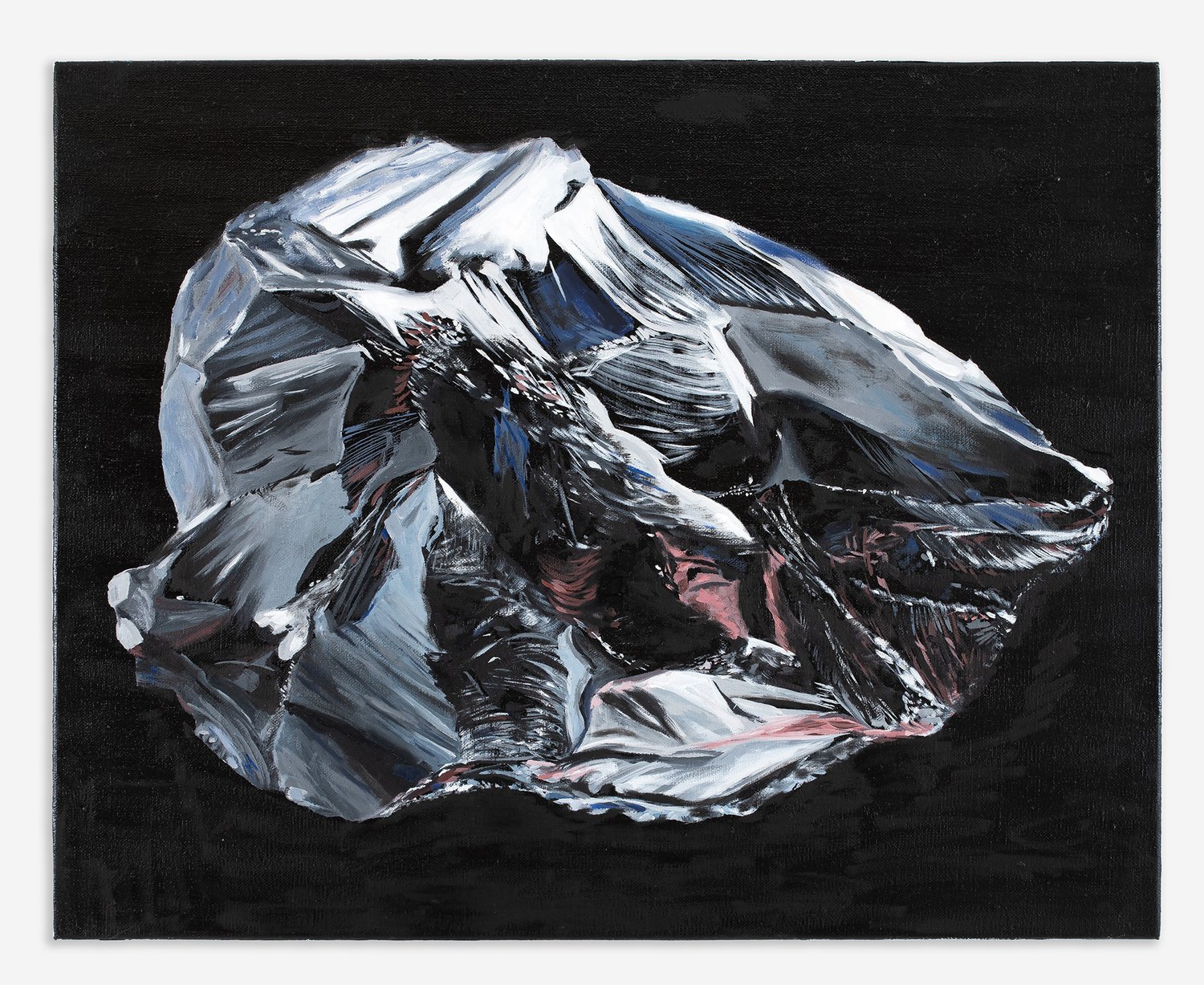
Silicon (2021) is an oil painting on linen, 40.6 x 50.8 cm (16 x 20 in), that depicts a piece of purified silicon stone. The composition fills the canvas with the form of the stone, cropping it at the edges so that the silicon extends beyond the boundaries of the painting, the same way that the moldavite and the blue box extend beyond the boundaries of their respective canvases. The silicon is rendered against a dark background, the same dark field that Tan Mu uses for her technological and cosmic subjects, a ground that represents the context from which the object emerges and the void into which it could return. The surface of the silicon, when viewed from a distance, resembles a crystalline structure under laboratory lighting. The colors are cool and metallic: silvery grey, pale blue, a faint green that suggests the presence of trace elements in the crystal lattice. The edges of the crystal are sharp, rendered with a precision that reflects the industrial origin of the material, the way that purified silicon is grown in controlled conditions that produce a single crystal with a defined geometry, a geometry that is the product of the atomic structure of the silicon itself, the diamond cubic crystal lattice that determines the angles at which the crystal cleaves and the planes on which it can be sliced. The sharp focal points of the source image, as Tan Mu has described them, create an aggressive visual tension, a sense of rigidity and precision that is appropriate to a material that is manufactured to tolerances measured in nanometers.
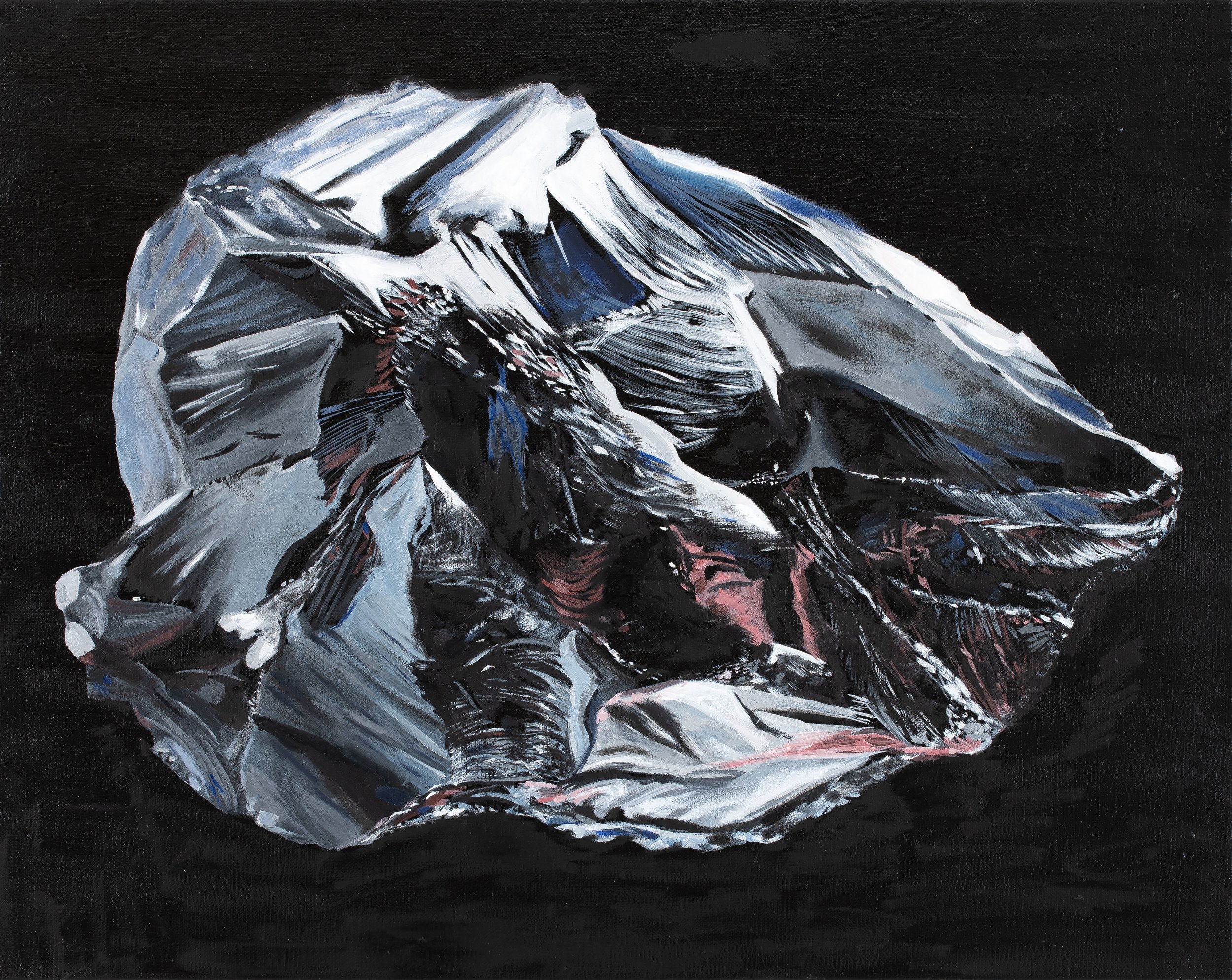
But the surface of the painting, when the viewer moves closer, does not remain cool and metallic. The rigidity dissolves. Subtle flesh pink tones emerge beneath the cooler hues, tones that suggest warmth and organic presence in a material that is the product of industrial refinement and that is associated in the popular imagination with machines and circuits and digital logic. These pink tones are not arbitrary. They are built into the painting through the layering of the oil paint, the same technique that Tan Mu uses in her paintings of moldavite and other translucent objects, where thin layers of paint allow the color of the ground or of adjacent layers to show through and modify the perceived color of the surface. Here the pink does not represent a property of the silicon itself. It represents a property of the painting, a quality that emerges when the industrial material is translated into the medium of oil paint and the hand of the painter introduces a warmth that the industrial process does not produce. The flesh pink is the trace of the hand in the machine, the trace of the body in the crystal, the trace of the human in the material that was refined to serve the human but that has been rendered so pure and so precise that the human has been purified out of it, and the painting puts the human back in, not as a narrative or a symbol but as a color, a warmth, a pink that glows beneath the grey and the blue and the green like a heartbeat beneath a laboratory smock.
Alongside these warmer tones, jewel-like blues flicker across the surface like brief electrical pulses. Tan Mu has described these blues explicitly, and the description is precise: the blues are not continuous fields but individual points of light, small marks of bright blue paint that appear at intervals across the surface of the silicon, the way that electrical pulses appear at intervals along a circuit, the way that signals appear at intervals along a fiber optic cable, the way that data appears at intervals along a transmission channel. The blues are the visual representation of the activity that the silicon enables, the on and off switching that constitutes the logic of computation, the binary logic that is embedded in the silicon chips that regulate information flow and that, as Tan Mu has said, quietly structure our perception of reality. The blues do not pulse. They flicker. They appear and then they are gone, the way that an electrical pulse appears and then is gone, the way that a signal appears and then is gone, the way that a thought appears and then is gone, the transient activity that passes through the permanent structure, the flash of light that travels through the dark fiber, the information that passes through the inert material and that makes the material alive for as long as the information is passing through it, a life that is not biological but that is real, a life that is the life of the machine, the life that the silicon sustains and that the painting renders visible as blue points of light that flicker across the grey surface of the crystal and that give the crystal the quality of something that is not merely present but active, not merely solid but conducting, not merely a rock but a rock that thinks.
Ad Reinhardt's Blue Painting (1953) is a canvas approximately 152 x 102 cm that is covered with a single field of blue paint. The blue is not a uniform blue. It is a population of blues, a surface that appears at first glance to be a single color but that resolves, when the viewer stands close to the canvas and allows the eye to adjust, into a complex composition of subtly different blues, blues that vary in value and hue across the surface of the painting, blues that are organized in a grid pattern that is almost invisible from a distance but that becomes apparent when the viewer's eyes adapt to the low contrast between the adjacent squares of the grid. The painting is a meditation on the threshold of perception, the point at which the eye can no longer distinguish between two colors that are almost identical but not quite, the point at which the visual system gives up and reports a single uniform field where there is in fact a complex structure of differences. The painting is also a meditation on the distance between the viewer and the surface, because the structure of the grid is visible only when the viewer is close to the canvas, and when the viewer steps back, the structure disappears and the surface becomes a single field of blue, the same way that the structure of a crystal lattice is visible only through a microscope and disappears when the crystal is viewed with the naked eye, the same way that the structure of a silicon chip is visible only through an electron microscope and disappears when the chip is viewed as a component on a circuit board.
The connection to Silicon (2021) is in the surface that changes as the viewer changes their distance from it. Tan Mu has described the surface of Silicon as one that resembles a crystalline structure under laboratory lighting when viewed from a distance but that reveals layered colors and rhythmic textures when the viewer moves closer, the same way that Reinhardt's Blue Painting reveals its grid structure only when the viewer approaches the canvas and allows the eye to adjust. Both paintings are about the distance between the visible and the invisible, the distance between what the eye can perceive at a glance and what the eye can perceive when it is given time to adjust, the distance between the surface that the material presents to the casual observer and the structure that the material conceals beneath that surface. Reinhardt's painting is a painting of blue that is also a painting of the grid that the blue conceals. Tan Mu's painting is a painting of silicon that is also a painting of the warmth and the activity that the silicon conceals, the pink beneath the grey and the blue flickers across the surface, the life that the industrial material hides and that the painting reveals to the viewer who is willing to move close enough to see it.
The production of semiconductor-grade silicon is one of the most energy-intensive manufacturing processes on the planet. The reduction of silicon dioxide in the carbon arc furnace requires temperatures above two thousand degrees Celsius and consumes approximately fifty kilowatt-hours of electricity per kilogram of silicon produced. The subsequent purification processes, including the Siemens process and the Czochralski process, require additional energy inputs at each stage, and the fabrication of the silicon wafers into integrated circuits requires further energy for photolithography, etching, deposition, and doping, processes that occur in clean rooms where the air is continuously filtered and the temperature and humidity are precisely controlled, all of which requires energy for the HVAC systems that maintain the conditions that the manufacturing process demands. The total energy cost of producing a single silicon wafer, from the reduction of the sand to the finished product, is difficult to calculate precisely because the supply chain is distributed across many countries and many facilities, but estimates suggest that the semiconductor industry consumes approximately one hundred terawatt-hours of electricity per year, which is roughly the same as the annual electricity consumption of the Netherlands. The environmental cost of this energy consumption is not visible in the painting. The painting shows only the silicon, the purified crystal, the product of the process, not the process itself. But the process is present in the painting as an absence, the same way that the environmental cost of the digital devices that we use every day is present in our lives as an absence, a cost that we do not see and that we do not think about because the cost is incurred far from the places where the devices are used, in the power plants that generate the electricity and the smelters that reduce the ore and the fabrication facilities that process the wafers, facilities that are located in countries where the electricity is cheap and the environmental regulations are lax and the labor is inexpensive, a geography of cost that is as invisible as the silicon itself, a geography that the painting does not depict but that the silicon in the painting implies, the same way that the submarine cables in Twenty Thousand Leagues Under the Seas (2023) imply the ships that laid them and the labor that maintains them and the energy that powers the signals that travel through them, the same way that the Blue Box (2021) implies the telephone network that it exploits and the switching system that it bypasses, the same way that every technological object in Tan Mu's practice implies the infrastructure and the labor and the energy that produced it, an implication that is not stated but that is present in the material conditions of the object itself, the object that is the product of a process that the viewer is invited to contemplate by looking at the object and thinking about what it is made of and how it was made and what it makes possible and what it costs.
Alberto Giacometti's portrait sculptures of Annette, his wife, produced throughout the 1950s and early 1960s, are figures that appear at first glance to be solid and present but that dissolve, when the viewer examines them closely, into a surface that is not solid but agitated, a surface that is covered with the marks of the artist's fingers and thumbs, the ridges and grooves of the clay that was pressed and pinched and pulled into the form of a head, a form that is recognizable as a head but that is not a representation of a head so much as it is a record of the process of making a head, a record of the hands that shaped the clay and the eyes that guided the hands and the mind that directed the eyes. The sculptures are not fragile in the physical sense. They are cast in bronze, which is one of the most durable materials available to a sculptor. But they appear fragile, because the surface is so agitated, so marked by the process of its making, that the figure seems to be in the process of dissolving, or in the process of assembling, or in the process of becoming, a figure that is not yet finished and that will never be finished because the process of making it was the process of failing to make it perfectly, of coming close to the form and then losing it and then coming close again, a process of approximation that produces a surface that is alive with the traces of the approximations that produced it, a surface that is both present and dissolving, both solid and vulnerable, both there and not quite there, a figure that is the most present thing in the room and the most ephemeral, a figure that is made of bronze and that looks like it is made of smoke.
The connection to Silicon (2021) is in the surface that is both rigid and vulnerable, both precise and alive. Tan Mu has described the silicon in the painting as a material that oscillates between rationality and sensitivity, between the industrial precision of the purified crystal and the warmth of the flesh pink tones and the flicker of the jewel-like blues. Giacometti's sculptures oscillate in the same way, between the solidity of the bronze and the fragility of the surface, between the presence of the figure and the dissolution of the form, between the material that endures and the process that produced it, a process that is visible in the agitated surface of the sculpture the same way that the process of refining silicon is visible in the layered surface of the painting, the pink beneath the grey and the blue flickers across the crystal, the traces of the hand in the machine, the traces of the body in the crystal, the traces of the life that the industrial process was designed to serve and that the painting restores to the material that the industrial process produced, a life that is not biological but that is real, a life that is the life of the painting, the life that the painting gives to the silicon by rendering it in oil paint and linen and the hand of the painter, a life that the silicon does not have when it is a wafer in a fabrication facility but that the silicon acquires when it is a subject of a painting, a subject that is looked at and thought about and translated into a medium that preserves the trace of the looking and the thinking and the translating, a medium that makes the invisible visible and the rigid vulnerable and the industrial personal, a medium that takes the most refined and purified and precise material that human beings have ever produced and gives it back the warmth and the complexity and the instability that the process of refinement was designed to remove, and the painting holds both registers at once, the precision and the warmth, the industry and the body, the silicon and the pink, the rock and the thought, and the viewer who stands in front of the painting and moves closer and sees the pink emerge and the blues flicker and the surface dissolve from a crystalline structure under laboratory lighting into something that is no longer a crystal but a painting of a crystal, a painting that is more than the crystal because it contains the crystal and the hand that made it and the eye that looks at it and the warmth that the hand put back into the material that the hand's own technology had refined the warmth out of, a painting that is the silicon and the pink and the blue and the dark ground and the linen and the oil and the frame and the wall and the room and the viewer, all of them present in the same field, all of them organized by the same invisible language, the language that silicon speaks and that the painting translates, the language that is not spoken but that is conducted, the language that passes through the crystal like a pulse of electricity through a chip, the language that is the on and the off, the one and the zero, the signal and the silence, the life and the machine, and the painting holds both, and the holding is the painting.