The Machine That Hunts the Smallest Thing: Tan Mu's Large Hadron Collider and the Altar Built From Collective Labor
On July 4, 2012, at a seminar held at CERN, the European Organization for Nuclear Research, two independent teams of physicists presented the results of their search for the Higgs boson, the particle that had been predicted almost fifty years earlier as the mechanism by which other particles acquire mass. The teams, which called themselves ATLAS and CMS, had each analyzed approximately eight hundred trillion proton-proton collisions produced by the Large Hadron Collider, the world's largest and most powerful particle accelerator, a ring of superconducting magnets and accelerating cavities that is buried in a tunnel twenty-seven kilometers in circumference at a depth of approximately one hundred and seventy-five meters beneath the border between France and Switzerland. Each team had found a new particle. The particles that the two teams had found were consistent with each other and with the properties that the Higgs boson was predicted to possess. The room in which the seminar was held was not large enough to contain the audience. Physicists stood in the corridors and sat on the floor and watched the presentation on screens that had been set up in the overflow rooms. When the results were announced, people wept. Peter Higgs, who had proposed the existence of the particle in 1964, was in the audience. He wiped his eyes. François Englert, who had independently proposed the same mechanism in the same year, was also in the audience. The two men had not spoken to each other for decades. They embraced. The discovery of the Higgs boson confirmed the Standard Model of particle physics, the theoretical framework that describes the fundamental forces and particles that constitute the material universe. It was the culmination of a project that had taken twenty years to plan, ten years to build, and three years to operate. It had cost approximately thirteen billion dollars. It had required the collaboration of more than ten thousand scientists from over one hundred countries. It was, by any measure, one of the most ambitious collective endeavors that the human species had ever undertaken, and it had succeeded.
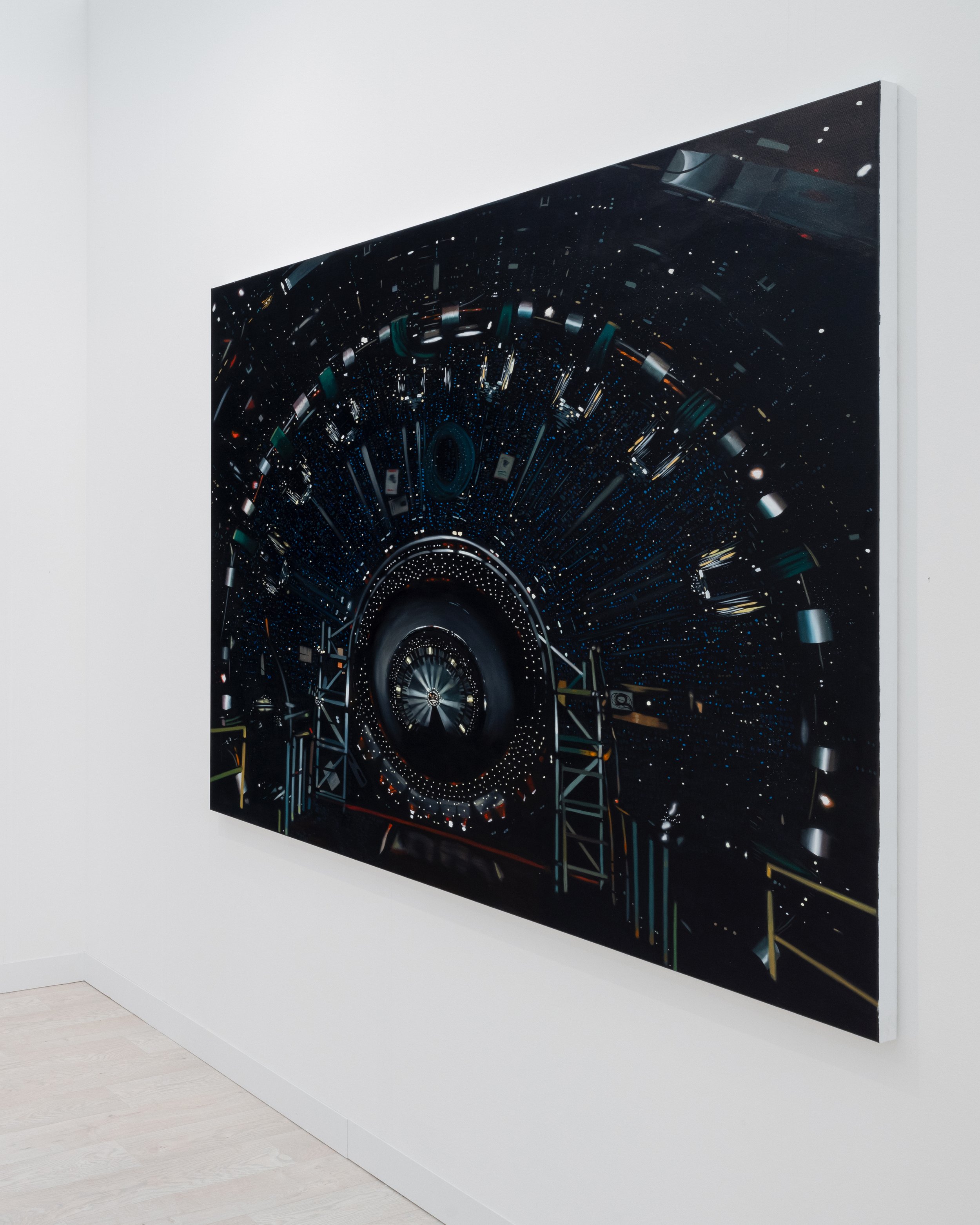
Large Hadron Collider (2023) is an oil painting on linen, 153 x 183 cm (60 x 72 in), that depicts the machine that made that discovery possible. The painting is one of the largest works in Tan Mu's practice, second only to Emergence (2022) in the scale of its canvas, and the scale is not incidental. The Large Hadron Collider is the largest machine that human beings have ever built for the purpose of understanding the physical world. It is a machine that occupies twenty-seven kilometers of underground tunnel and that accelerates particles to within a fraction of a percent of the speed of light. The painting that depicts it occupies 153 x 183 cm of canvas. The disproportion between the machine and the painting is enormous, but the painting does not attempt to reproduce the machine at the scale of the machine. It attempts to hold the machine at the scale of the hand, the same way that Tan Mu held the moldavite in her hand before she painted it, the same way that she held the blue box in her hand before she painted it, the same way that she holds every object that she paints, examining it at close range and translating its physical presence into the material conditions of oil paint on linen. The LHC cannot be held in the hand. It cannot even be seen in its entirety, because it is buried underground and because its circumference exceeds the distance that the eye can take in from any single vantage point. But the painting holds it, the way that a map holds a continent, by reducing the scale and preserving the structure, and the structure is what matters, the structure of the machine, the ring and the detectors and the beam pipes and the magnets and the cooling system and the data cables and all the other components that constitute the apparatus that produces the collisions that produce the data that produces the knowledge that the machine was built to acquire.
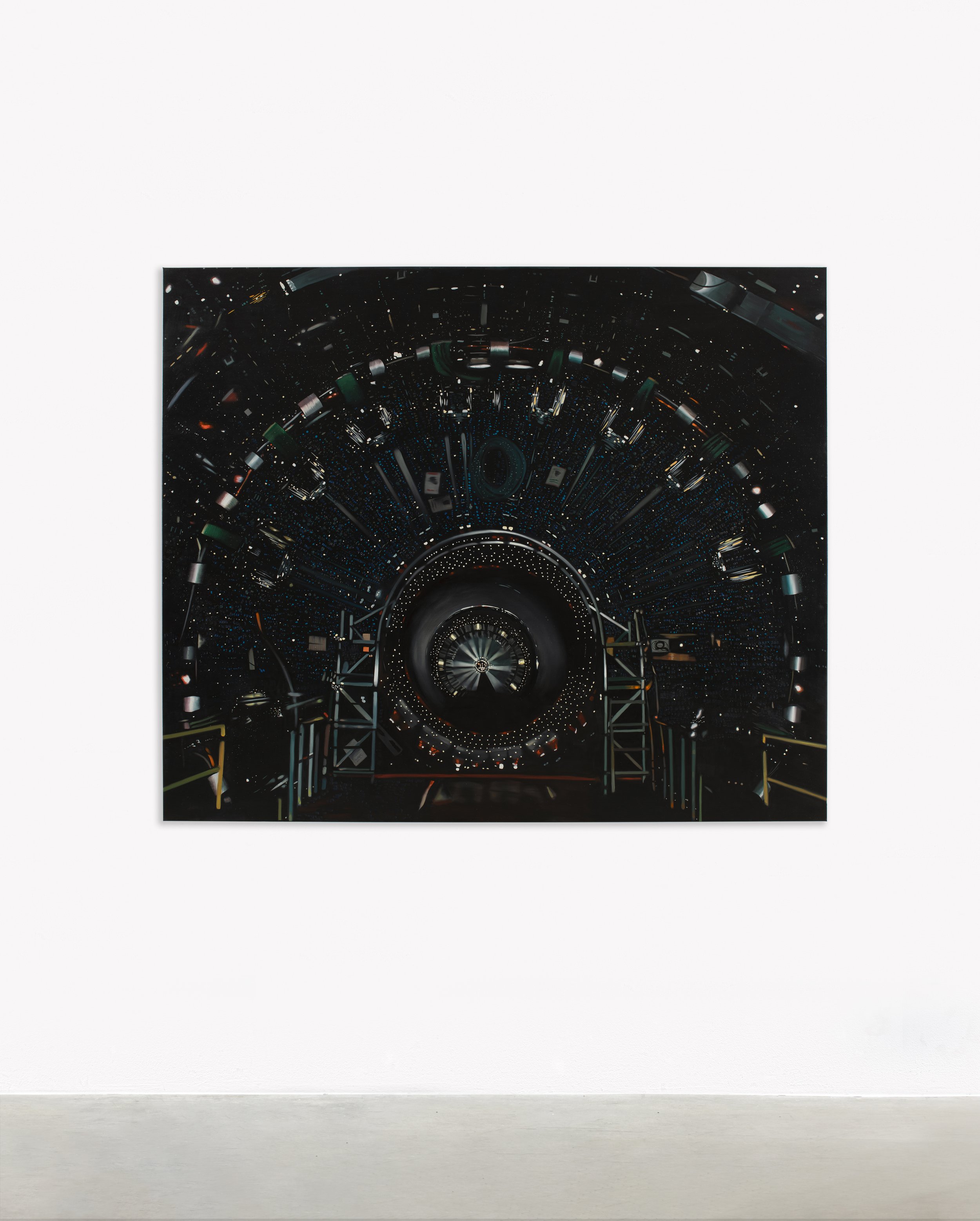
The painting places the structure of the collider against a black background, the same dark ground that Tan Mu uses for her cosmic and technological subjects, a ground that represents the void from which the signals emerge and into which they disappear. The linear elements that reference the physical structure of the collider are rendered in pale, thin strokes of paint, lines that trace the paths of the beam pipes and the geometry of the detector arrays. These lines are precise and deliberate, each one placed with the same attention to structural accuracy that characterizes Tan Mu's paintings of circuit boards and punched cards and logic gates. The lines are not schematic. They are not a diagram. They are a transcription of the machine's architecture into the medium of paint, a translation that preserves the spatial relationships between the components while replacing the steel and the copper and the superconducting niobium-titanium alloy with thin marks of oil paint that sit on the surface of the linen and catch the light of the room. Against this precise linear structure, the painting introduces more dynamic gestures, areas where the brushwork becomes looser and the colors shift, subtle passages of blue and violet and faint gold that suggest the energy released when particles collide at velocities approaching the speed of light. These passages are not representations of specific particle events. They are evocations of the conditions that the machine produces, the conditions of extreme energy and extreme brevity that exist inside the detector when two protons traveling at nearly the speed of light meet head-on and dissolve into showers of secondary particles that scatter in all directions and that are tracked and measured and reconstructed by the detector arrays and the data acquisition systems and the thousands of physicists who spend their careers analyzing the patterns that the collisions produce.
The contrast between the precise linear structure and the dynamic color passages is the central tension of the painting. Tan Mu has described this tension as the contrast between stillness and motion, between the silent and stable machine and the particles that are moving at near the speed of light inside it. The machine does not move. The ring of magnets that bends the beam around the circumference of the tunnel is fixed in place. The detectors that surround the collision points are fixed in place. The cooling system that maintains the superconducting magnets at a temperature of 1.9 Kelvin, colder than the vacuum of outer space, is fixed in place. The entire apparatus is static, a monument of engineering that sits in its underground chamber and does not move. But the particles that travel through the apparatus are not static. They are moving at 99.9999991 percent of the speed of light, which is 299,792,455 meters per second, which is fast enough to travel from Geneva to the moon and back in less than three seconds. The particles complete eleven thousand circuits of the twenty-seven-kilometer ring every second. The collisions that the detectors are designed to capture occur at a rate of approximately one billion per second. The machine is still. The particles are not. The painting holds both registers at once, the stillness of the structure and the motion of the events that the structure produces, the same way that the machine holds both, the same way that a church holds both the stillness of the stone and the motion of the liturgy, the same way that an altar holds both the stillness of the marble and the motion of the sacrifice.
Panamarenko's The Aeromodeller (1969-71) is a work that consists of a full-size flying machine, built by the artist over a period of two years, using bamboo, fabric, rubber, and a small engine. The machine is not a model of a flying machine. It is a flying machine, or rather it is a machine that was designed to fly and that was exhibited as a sculpture before it was ever tested. Panamarenko, who was born in Antwerp in 1940 and who spent his career building machines that were designed to achieve flight, to navigate underwater, and to travel through space, never claimed that his machines would work. He built them because he wanted to build them, because the act of building a machine that was intended to transcend the limits of the human body was, for him, an act of art, an expression of the desire to exceed the boundaries that physics and biology and gravity impose on the species that builds machines. The Aeromodeller is a large object. It occupies a significant amount of floor space when it is exhibited. It is not a representation of a flying machine. It is a flying machine, or at least it is an attempt at a flying machine, an apparatus that was designed to carry a person into the air and that was constructed with the same attention to engineering that a real aircraft would require, but that was built by an artist rather than an engineer and that was exhibited in a gallery rather than a hangar. The machine did fly, once, briefly, in 1971, at an airfield in Belgium, before it was damaged and retired to the museum where it now resides.
The connection to Large Hadron Collider (2023) is in the machine as an expression of the human desire to exceed the limits of perception and knowledge. Panamarenko's flying machine is an apparatus that was built to transcend the limit of gravity. The Large Hadron Collider is an apparatus that was built to transcend the limit of observation, the limit of what the unaided human eye can perceive, the limit of what the unaided human mind can know about the structure of the material world. Both machines are attempts to go beyond what the body can do unaided. Both are expressions of a desire that is not satisfied by the conditions that nature has imposed on the species, a desire to see what cannot be seen, to know what cannot be known, to go where the body cannot go. Both machines are also collective objects, objects that required the collaboration of many people to build, objects that are larger than any single person could have produced alone. Panamarenko built his Aeromodeller with the help of a small team. The Large Hadron Collider was built by ten thousand scientists from over one hundred countries. The scale of the collaboration differs by orders of magnitude, but the principle is the same: the machine is a collective object, an object that exists because many people wanted it to exist and worked together to make it exist, and the painting that depicts it is a record of that collective desire, a portrait of the machine that the collective desire produced.
The Large Hadron Collider accelerates protons to energies of 13 tera-electronvolts, which is approximately 6.5 trillion times the energy of a photon of visible light. The protons travel in two beams that circulate in opposite directions around the ring, each beam containing approximately three hundred billion protons grouped into bunches that are spaced 25 nanoseconds apart. When two bunches cross at one of the four collision points, approximately forty protons from each bunch undergo a collision, producing a cascade of secondary particles that spray outward from the collision point in all directions. The detectors that surround the collision points, which are called ATLAS and CMS and ALICE and LHCb, are designed to track these secondary particles as they travel outward from the collision, measuring their energies and momenta and charges and types, and to reconstruct the events that produced them, working backward from the measured properties of the secondary particles to the properties of the primary collision that generated them. The reconstruction is a form of archaeology, a digging through the debris of an event to determine what caused it, a method of inference that proceeds from the visible to the invisible, from the particles that the detectors can measure to the particles that the detectors cannot measure, the particles that are produced in the collision but that do not interact with the detector material and that pass through the detector without leaving a trace, the particles that are inferred from the missing energy and momentum that their absence creates in the measured data, the particles that are known only by the gap that they leave, the absence that is as informative as the presence, the silence that is as meaningful as the signal. The LHC does not observe the fundamental particles directly. It observes their effects, the way that an astronomer observes the effects of a black hole, the way that a seismologist observes the effects of an earthquake, the way that a painter observes the effects of light on a surface and infers the source of the light from the pattern of its reflections.
Piero della Francesca's The Flagellation of Christ (c. 1455-60) is a small painting, approximately 59 x 82 cm, that depicts a scene from the Passion of Christ in the background while three figures stand in the foreground, their relationship to the scene behind them uncertain and their identities debated for centuries. The painting is celebrated for its rigorous geometric composition, the way that the architectural space of the scene is organized according to the principles of linear perspective, the way that the floor tiles and the columns and the ceiling beams all recede toward a single vanishing point that is located at the center of the composition, creating a space that is mathematically precise and that gives the viewer the impression of looking into a room that extends beyond the surface of the panel. The geometric precision of the composition is not a decorative feature. It is the structure of the painting, the framework that organizes the figures and the architecture and the space into a coherent whole, a framework that is as invisible as the laws of perspective that govern it but that is as essential to the painting as the laws of physics are essential to the operation of the Large Hadron Collider, a framework that the viewer cannot see but that the viewer can feel, the same way that the viewer can feel the geometry of a well-proportioned room, a geometry that is present but that is not announced, a structure that organizes the visible without being visible itself.
The connection to Large Hadron Collider (2023) is in the invisible structure that organizes the visible. Piero's painting is organized by the laws of perspective, a mathematical framework that determines the positions and sizes and relationships of every element in the composition. The LHC is organized by the laws of physics, a mathematical framework that determines the energies and momenta and relationships of every particle that the machine produces. Both frameworks are invisible. Neither can be seen directly. Both are inferred from their effects, from the positions of the figures on the panel and the tracks of the particles in the detector. The painting and the machine are both systems of inference, systems that proceed from the visible to the invisible, from the measurable to the theoretical, from the data to the structure that the data implies. The painting does not show the laws of perspective. It shows the figures that the laws of perspective have organized. The LHC does not show the laws of physics. It shows the particles that the laws of physics have produced. Both the painting and the machine are instruments of knowledge, apparatuses that are designed to reveal the invisible structures that underlie the visible world, and both are, in their different ways, works of collective labor, the painting produced by the tradition of perspective that Piero inherited from his predecessors and the machine produced by the tradition of particle physics that the CERN collaboration inherited from its predecessors, both traditions accumulating knowledge and technique and method over centuries of collective effort, both producing objects that are more than any single person could have produced alone, both producing objects that are, in Tan Mu's words, sites where humanity gathers knowledge, belief, and effort in order to confront questions that have existed for thousands of years.
Saul Appelbaum, writing in the BEK Forum catalog in 2025, described Tan Mu's technological paintings as portraits of the condition of being shaped by the tools that we build, the way that the instruments we construct to extend our perception end up restructuring the perception that they were designed to extend. The observation applies to Large Hadron Collider with a specific and almost theological force. The LHC is an instrument that was built to answer questions about the fundamental structure of matter, questions that are as old as philosophy, questions that Democritus asked in the fifth century BCE when he proposed that all matter is composed of indivisible particles that he called atoms, questions that have been asked and re-asked in every century since, questions that the LHC has been built to answer by a method that Democritus could not have imagined, the method of building a machine that is larger than any machine that has ever been built and that smashes particles together at energies that are higher than any energies that have ever been produced in a laboratory and that measures the debris that the collisions produce with detectors that are more sensitive than any detectors that have ever been constructed, all of this collective labor, all of this engineering, all of this collaboration, all of this money and time and effort and patience, directed toward the answer to a question that a philosopher asked twenty-five centuries ago, a question about what matter is made of, a question that the painting holds at the scale of the canvas, a question that the machine holds at the scale of the tunnel, a question that is the same question whether it is asked in a Greek agora or a Swiss laboratory or a painting on linen, a question about the structure of the thing that the questioner is made of, the structure of the matter that is asking the question, the particle that is hunting the particle, the machine that is hunting the smallest thing, the altar that the species has built from its collective labor, the altar where the question is the offering and the answer is the sacrifice and the machine is the priest and the painting is the record of the ceremony, the record of the moment when the collective labor of ten thousand scientists produced a particle that existed for ten to the minus twenty-two seconds and that was detected by a machine that had been built to detect it and that confirmed a theory that had been proposed forty-eight years earlier by a man who was sitting in the audience and weeping when the result was announced, and the painting holds that moment, the moment when the question was answered and the answer produced a new question, because every answer in particle physics produces a new question, every discovery reveals a new mystery, every particle that is found implies a particle that has not yet been found, every structure that is revealed implies a structure that lies beneath it, and the machine continues to operate, and the collisions continue to occur, and the detectors continue to measure, and the data continues to accumulate, and the questions continue to multiply, and the painting continues to hold the machine, the machine that hunts the smallest thing, the smallest thing that the machine can find, the thing that is smaller than the smallest thing that any machine has ever found, the thing that is still there, beneath the Higgs and the quarks and the gluons and the leptons, the thing that the next machine will hunt, the thing that the next painting will hold, the thing that has always been there, the thing that the questions are made of.