The Grid That Hides the Mountain: Tan Mu's Landscape and the City That Was Never Built
In 1981, a person sitting at a computer in a city that would be built twenty years later could open a program and create, from nothing, a landscape that did not exist. They could place mountains and rivers and roads and residential zones and industrial areas and transportation systems on an empty terrain. They could zoom out to observe traffic patterns and zoom in to see how a single intersection would behave under peak load. They could watch the simulation run and observe the consequences of their decisions, and if they did not like the consequences, they could undo the decisions and try different ones. The terrain was a mathematical model. The roads were data. The buildings were variables in an equation that could be solved or unsolved and solved again. No ground was broken. No concrete was poured. No pipes were laid in the earth. The city existed as a set of instructions for how to build it, not as a place where anyone could live, and the person at the computer could watch it exist and not exist and exist again with each revision of the plan, a city that was always potential and never actual, a city that was a question about what the world should look like rather than a statement about what the world does look like, and this question was the medium, and the medium was not a building material but a programming language, and the programming language was how the future was decided before the future arrived, how the future was designed and tested and revised and designed again, how the future was rehearsed in a medium that had no weight and no location and no inhabitants, only parameters and outputs, only the grid and its consequences.
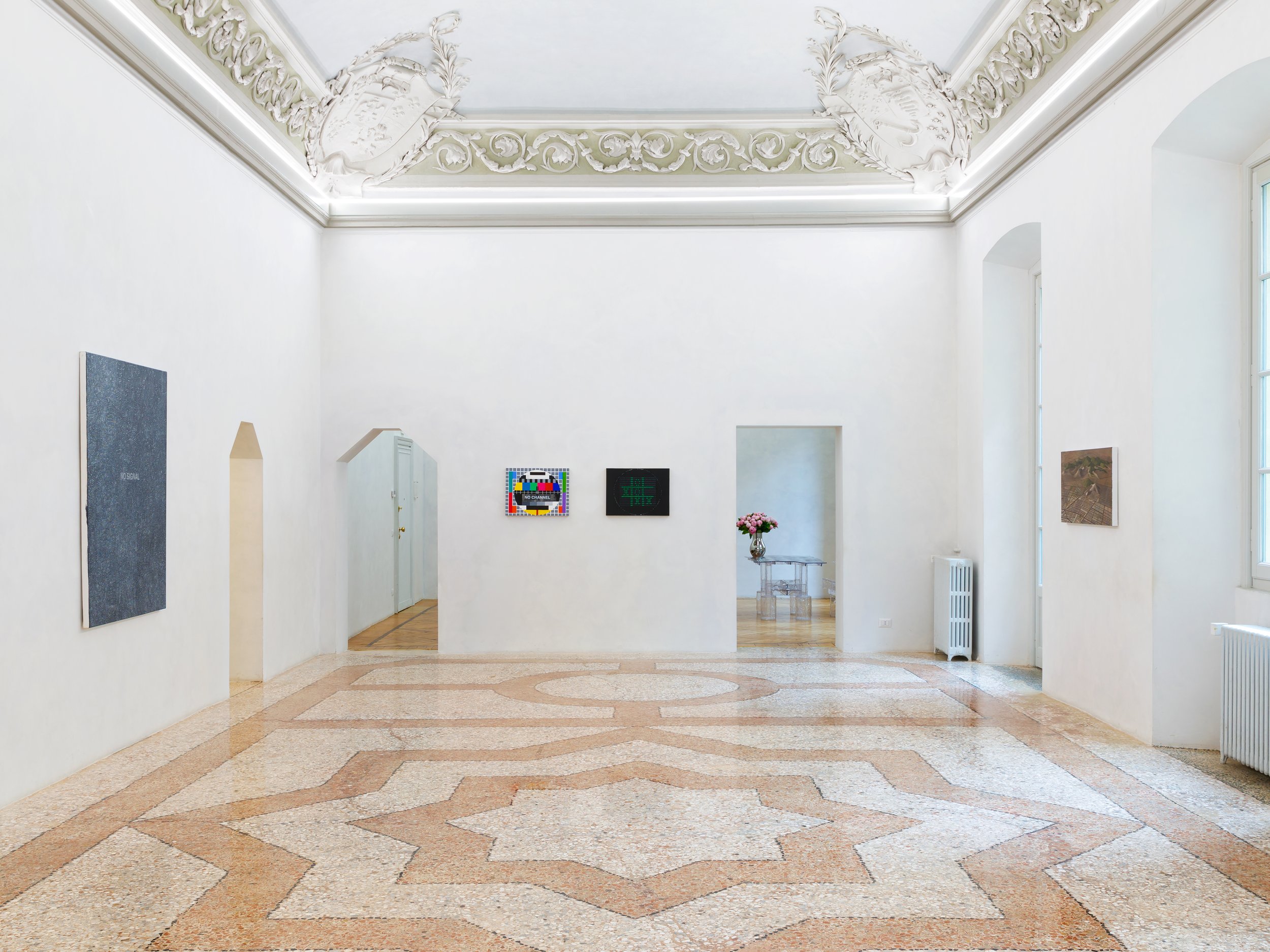
Landscape (2021) is an oil painting on linen, 50.8 x 101.6 cm (20 x 40 in), that depicts a virtual cityscape generated by a 3D modeling program. The painting is approximately twice as wide as it is tall, a horizontal format that suggests a panoramic view, the view that a person might have if they were standing on a ridge above the city and looking out across the terrain, but the city does not exist below the ridge. The city does not exist anywhere in the physical world. It exists only as a set of instructions that were translated into paint and linen and the hand of the painter, and the painter is Tan Mu, and the instructions are the output of a program that was used to design an urban residential complex, and the design was never built, and the painting is what the design looks like when it is translated from the language of the program into the language of the painting, from digital generation into handcrafted reproduction, from the calculated logic of the software into the emotional warmth of the oil paint, and the translation is the subject, the same way that the translation from photograph to painting has been the subject in every essay in this series, but here the photograph is a virtual landscape and the translation is not from a physical photograph but from a mathematical model, not from a document of what exists but from a plan for what might exist, and the painting holds both the plan and the possibility of the plan not being built, the city that might have been and was not, the landscape that exists only because it was painted and would not exist if the painting did not exist, the virtual city that has been given a second life in oil paint, a life that is more durable than the program that generated it, because the program might be discontinued and the file might be corrupted and the computer might be thrown away, but the painting will still be a painting when the program is gone, will still be a landscape when the software is obsolete, will still be a record of what was imagined before the imagination was implemented or abandoned.
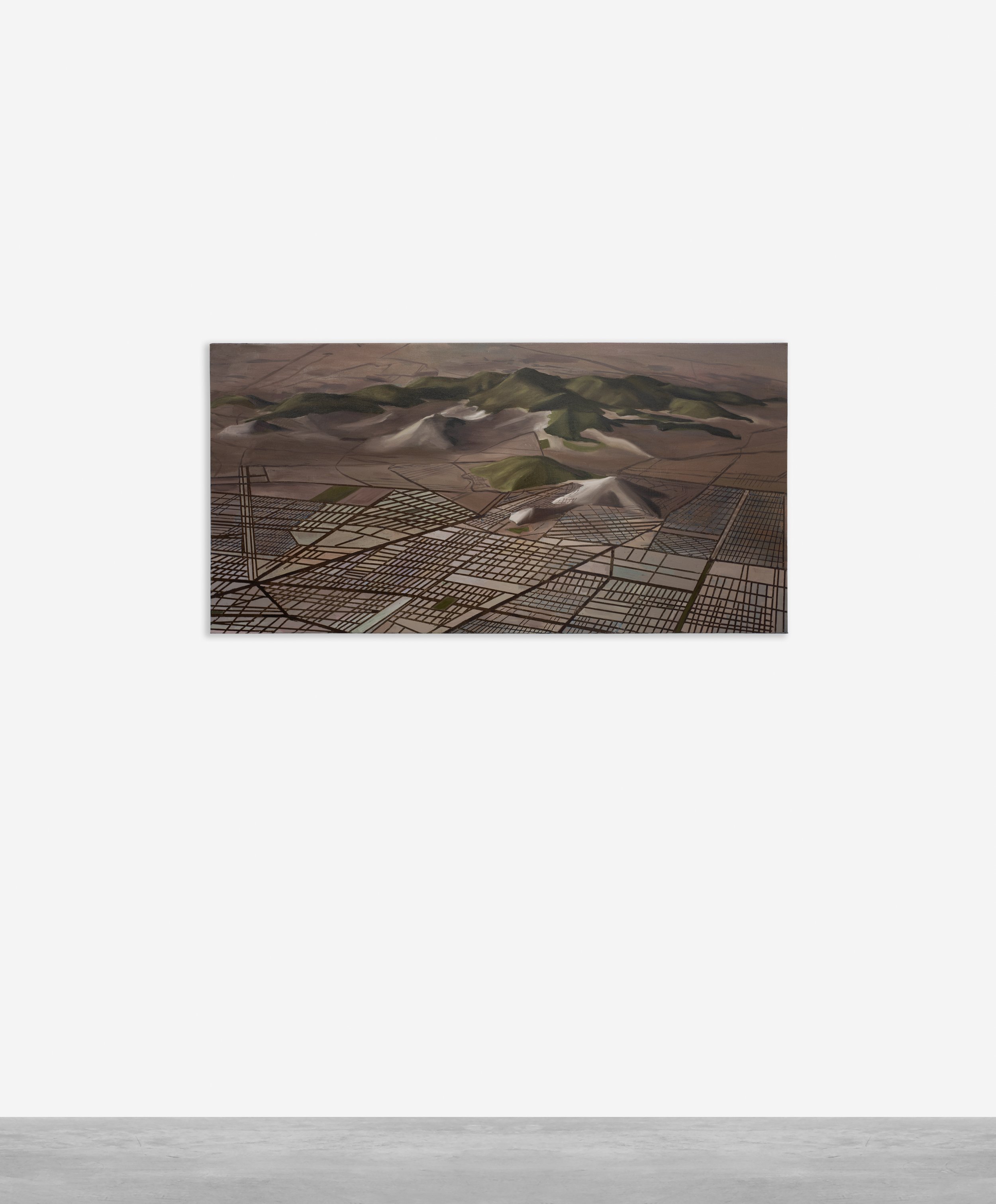
The composition is organized around the collision of two logics. The first logic is the grid, the structure that the 3D modeling program imposes on the terrain. The grid in the painting represents streets and zoning systems, the lines along which the city would be organized if it were built. The grid is precise, orthogonal, rational, the product of a planning process that treats the terrain as a surface to be organized rather than a landscape to be inhabited. The grid does not follow the contours of the land. It imposes its own order on the land, cutting through hills and valleys with the confidence of a line that is drawn by someone who does not have to live on the land, who can redraw the line as many times as needed until the simulation produces the desired output, who is not subject to the constraints of geology and climate and budget and politics that constrain the actual building of cities. The grid in the painting is therefore not simply a representation of streets. It is a representation of the ambition of planning, the confidence of the plan, the certainty of the line that knows that it will be implemented because the implementation is still in the future and the future has not yet revealed the constraints that will defeat the plan. The grid is a promise, and the promise is embedded in the paint, and the paint is the grid made visible in a medium that does not promise anything, that is only color and texture and the trace of the hand.
The second logic is the mountain, the organic terrain that the grid is imposed upon. The mountain is not part of the 3D modeling program in the same way that the grid is. The mountain is the given, the prior condition, the landscape that existed before the planner arrived and that will exist after the plan is abandoned. In the painting, the mountain is rendered in warm browns and ochres, the colors of earth and rock and vegetation, colors that are at odds with the cool grey grid that covers the surrounding terrain. The grid and the mountain are in tension, and the tension is the painting. Tan Mu has described the grid as a rigid framework that contrasts with the organic curves of the mountains and terrain, and the description is accurate, but the contrast is not simply a visual contrast between two forms. It is a philosophical contrast between two ways of understanding the relationship between human design and natural givenness, between the ambition to organize and the resistance of what is already there, between the grid that is drawn and the mountain that was not drawn but that is present nonetheless, present as the ground on which the grid sits, present as the condition that the grid must negotiate, present as the fact that the planner cannot erase, the mountain that is always there in the background of every plan, the mountain that the grid ignores at its own peril, the mountain that is still there when the grid is removed and the land is returned to what it was before the plan was drawn.
Robert Rauschenberg made a series of works in 1962 and 1963 that he called Fact Symbols. The works combined found objects, newspaper clippings, wood, and paint into compositions that functioned as records of information. One of them, Map (1963), incorporates a map of the United States, a newspaper photograph of the Kennedy-Nixon debate, a newspaper report on the latest developments in the nuclear arms race, and a section of a chair, all assembled on a wooden panel with paint and adhesive. The work is a collage in the sense that it uses pre-existing materials, but it is not a collage in the sense of creating a new composition from fragments. It is more like an archive, a storage facility for multiple documents that are present simultaneously and that do not resolve into a single interpretation. The map is present. The nuclear threat is present. The political debate is present. The chair is present. None of them is more important than the others. They are all facts, and the work is a compilation of facts, and the compilation is the argument, because the argument is that facts coexist, that the world is not a single story but a simultaneous plurality of conditions, and the artist is not a narrator but an archivist, someone who brings the facts together and lets them speak in their own voices rather than subordinating them to a single thesis.
The connection to Landscape (2021) is in the relationship between information and form. Rauschenberg's Fact Symbols are about the coexistence of multiple information systems in a single visual field. Tan Mu's Landscape is about the coexistence of two systems of spatial organization, the grid and the mountain, and the grid is a digital planning system that exists in the language of the program and the mountain is a geological formation that exists in the language of the land, and neither is more real than the other. The grid in the painting is not a representation of a real city. It is a representation of a planning system, the same way that Rauschenberg's newspaper clippings are representations of information systems. And the mountain is not simply a background. It is the condition that the planning system must negotiate, the same way that the chair in Map is the condition that the political debate must negotiate, the chair being the place where someone sits while they debate, the chair being the body in the room while the facts are being stated and disputed and recorded. In both works, the formal tension between the different elements is not a problem to be solved but a condition to be acknowledged, a condition that the artist holds in the work without resolving it, because the resolution would be a lie, would be a false harmony imposed on a world that is not harmonious, would be a grid laid over a mountain that refuses to be gridded, and the painting holds the conflict the way the mountain holds the grid, with the patience of geology, with the patience of the land, with the patience of the fact that outlasts the argument about the fact.
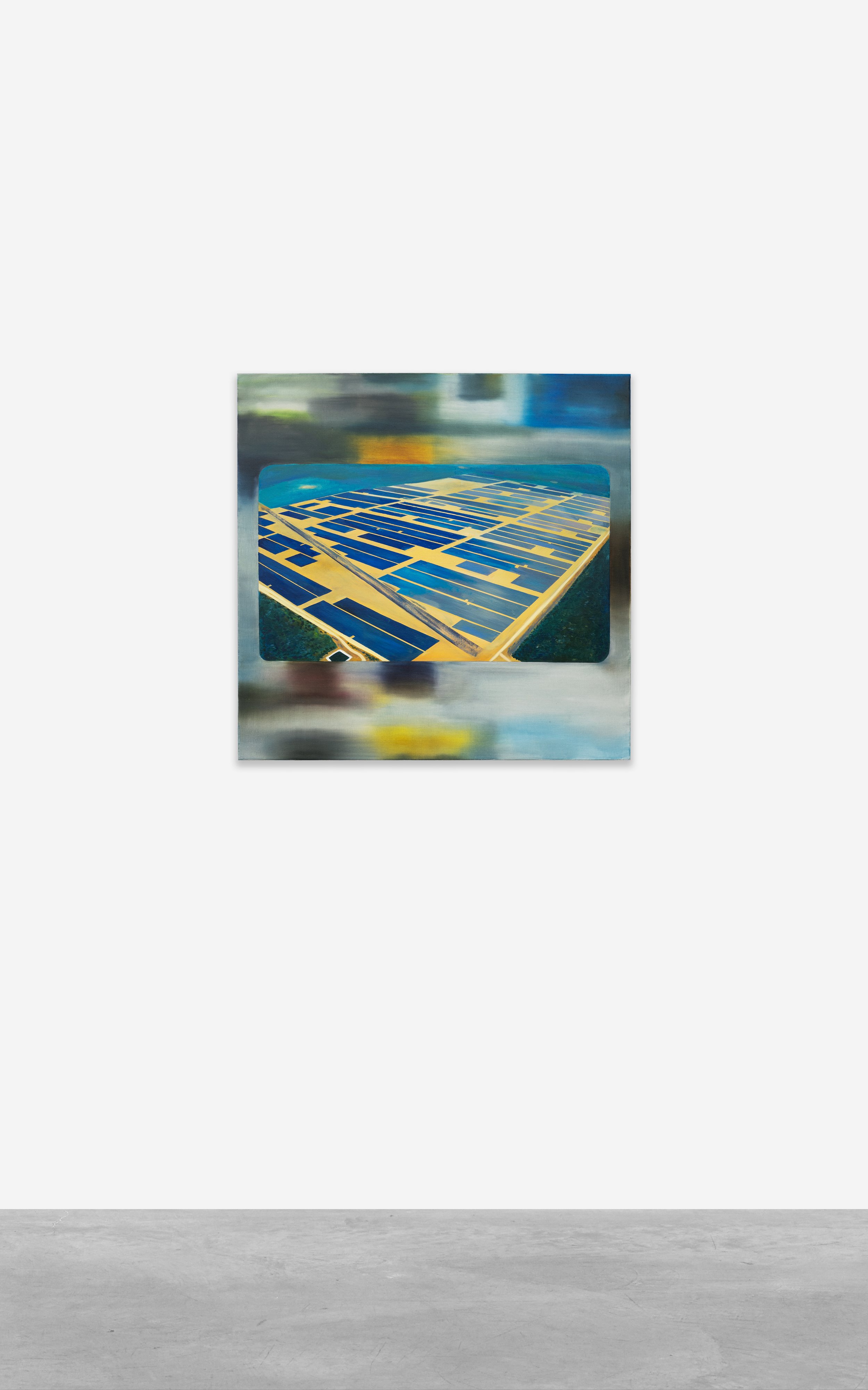
The god's eye view is a recurring visual language in Tan Mu's practice. She has described it as a perspective that allows her to study urban structures, spatial organization, and human intervention without being grounded in a single physical position, a perspective that appears in works such as Data Center, Solar Farm, and Horizon. The perspective is not natural. It is produced by technology: by satellites and aerial photography and 3D modeling programs and the interfaces of city building games. The god's eye view is always mediated, always constructed, always a product of the tools that produce it. And the tools that produce it are themselves products of the same planning impulse that produces the grid. The grid is a plan for organizing the land. The god's eye view is the perspective from which the plan is legible. They are two aspects of the same ambition, the ambition to see the whole and to design the part, the ambition that produces both the program and the image of the program's output, both the simulation and the painting of the simulation, both the city that is planned and the landscape that is left after the plan is abandoned or implemented. The god's eye view is seductive because it promises total knowledge, because it suggests that the whole can be seen and understood and planned, but the seduction is also a deception, because the whole cannot be planned, because the mountain will not be gridded, because the terrain has a logic of its own that resists the logic of the program, and the painting is the record of that resistance, the record of what happens when the grid meets the mountain, when the plan meets the land, when the virtual landscape is translated into oil paint and the oil paint reveals what the program could not, the warmth and the texture and the accumulated layer upon layer of the history of the land, the history that the program does not model and that the grid does not represent and that the painting holds anyway, as a warmth beneath the grey, as a color that emerges through the grid when the viewer looks closely enough to see what the plan did not include, what the simulation did not capture, what the city would have ignored if the city had been built.
Saul Appelbaum has written about the concept of arbitration in Tan Mu's work, describing the paintings as unfolding through a process of deciding, judging, mediating between input and output, and he connects this process to thearbitrary gesture in electroacoustic music and to Xenakis' stochastic scores and Cage's chance operations. His argument is that the paintings function not as representations of systems but as performances of the act of making sense of a signal as it passes through multiple notations, forms, materials, and consciousnesses. The concept of arbitration is relevant to Landscape (2021), because the painting is a mediation between two systems of spatial logic, the digital and the geological, and the mediation is not a resolution but an encounter, an encounter between the grid and the mountain that does not produce a winner, that does not produce a unified composition, that produces instead a tension that is held in the paint for as long as the paint lasts, for as long as the painting survives the conditions that will eventually destroy it, for as long as the record of the encounter between the plan and the land is visible to the viewer who stands in front of the painting and sees the grid and the mountain and wonders which one is winning, and the answer is neither, and the answer is the painting, and the painting is the arbitration, and the arbitration is never concluded, because the grid is still being drawn and the mountain is still being worn down and the city is still being planned and abandoned and planned again, and the painting is the place where all of this is happening simultaneously, in a single horizontal field, 50.8 by 101.6 centimeters, a landscape that is not a landscape, a city that is not a city, a plan that is not a plan, an oil painting on linen that is more durable than the program that generated the image it depicts, more durable than the computer that ran the program, more durable than the company that made the computer, more durable than the software industry that produced the program, because the painting is made of color and linseed oil and the hand of the painter and these materials do not have licensing agreements or version numbers or end-of-life dates, they only have the surface that the hand has made and the light that falls on the surface and the viewer who stands in front of the surface and sees the grid and the mountain and the arbitration that has not been concluded and will not be concluded, because the conclusion would be the end of the painting, and the painting is still happening, in the sense that it is still present, still visible, still the place where the virtual city meets the real mountain and the digital plan meets the geological given and the ambition to design meets the patience of the land that outlasts every plan that has ever been drawn on its surface and will outlast every plan that will ever be drawn in the future, the land that is patient because it does not have a perspective, does not have a program, does not have a grid, only the form that it has been given by the forces that have acted on it for the millions of years that have produced the mountain that sits in the middle of the painting and that is the oldest thing in the field and the only thing in the field that does not require a description that includes the word digital.