The Explosion as a Still Life: Tan Mu's Bikini Atoll and the Compression of Destruction Into an Object
A mushroom cloud at a distance looks like a snowball. This is not a metaphor. It is an observation that Tan Mu made while studying the archival photographs of the nuclear tests conducted at Bikini Atoll in the Marshall Islands, and the observation is not original to her, it is an observation that anyone can make who looks at the photographs with sufficient detachment, sufficient distance from the event, sufficient time between the photograph and the looking, and the detachment and the distance and the time are the conditions that make the observation possible, the conditions that allow the mushroom cloud to be seen as a snowball, as cotton candy, as a small and harmless and even beautiful object, an object that could be held in the hand, an object that could be placed on a table, an object that could be painted in a format that is 41 by 51 centimeters, which is approximately the size of a sheet of letter paper, which is approximately the size of a face, which is approximately the size of a still life, which is the genre that Tan Mu chose for the painting, the genre of the still life, the genre of the object on the table, the genre of the flower in the vase and the fruit on the cloth and the skull on the desk, the genre that was invented to depict the small and the intimate and the domestic, and the painting uses this genre to depict the largest and the most destructive and the most public event that a technology has ever produced, the detonation of a nuclear weapon, and the detonation is not depicted as a landscape, which would be the genre of the vast and the panoramic, but as a still life, which is the genre of the small and the intimate, and the choice of genre is the argument of the painting, the argument that the mushroom cloud can be compressed, that the immense can be reduced, that the destructive can be contained, that the public can be made private, and the compression is not a diminishment but a recontextualization, a recontextualization that moves the mushroom cloud from the genre of the history painting, where it is surrounded by the rhetoric of heroism and catastrophe and the sublime, to the genre of the still life, where it is surrounded by the rhetoric of contemplation and intimacy and the mundane, and the recontextualization raises the question that Tan Mu has stated explicitly, the question of control, the question of who has the authority to define, manage, and control the immense energy that the mushroom cloud represents, and the still life is the format in which this question is asked, the format in which the immense is held in the hand and examined at close range, the format in which the snowball is turned over and its surface is studied and its weight is felt and its temperature is registered and its fragility is understood, and the understanding is the still life, and the still life is the painting, and the painting is 41 by 51 centimeters of oil on linen, and the mushroom cloud is the object on the table.
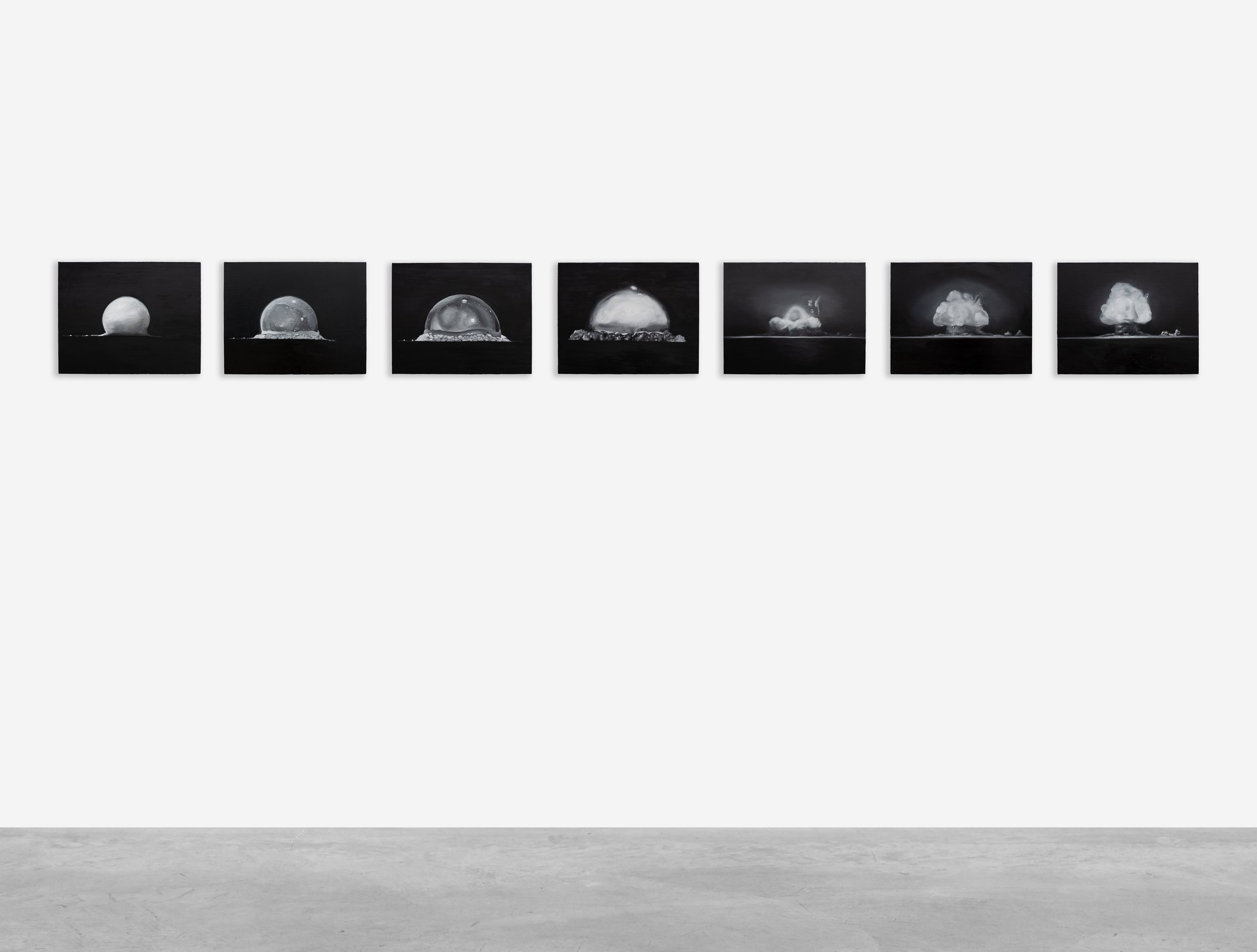
Bikini Atoll (2020) is an oil painting on linen, 41 x 51 cm (16 x 20 inches), that depicts the mushroom cloud produced by a nuclear detonation at Bikini Atoll. The painting is small, intimate, the size of a still life, and the format is deliberate, because the mushroom cloud is treated as an object rather than a vast scene, compressed and contained within the boundaries of a canvas that could be held in the hands, a canvas that could be placed on a shelf, a canvas that could be looked at from a distance of a few feet, a canvas that does not require the viewer to stand back and take in the panorama of the explosion but that invites the viewer to come close and examine the surface of the cloud as one would examine the surface of a fruit or a flower or a skull, and the examination is the purpose of the painting, not the spectacle of the explosion but the contemplation of the cloud as an object, an object that has a surface and a texture and a form and a weight, an object that can be studied and understood, an object that can be held in the mind the way a still life is held in the hand.
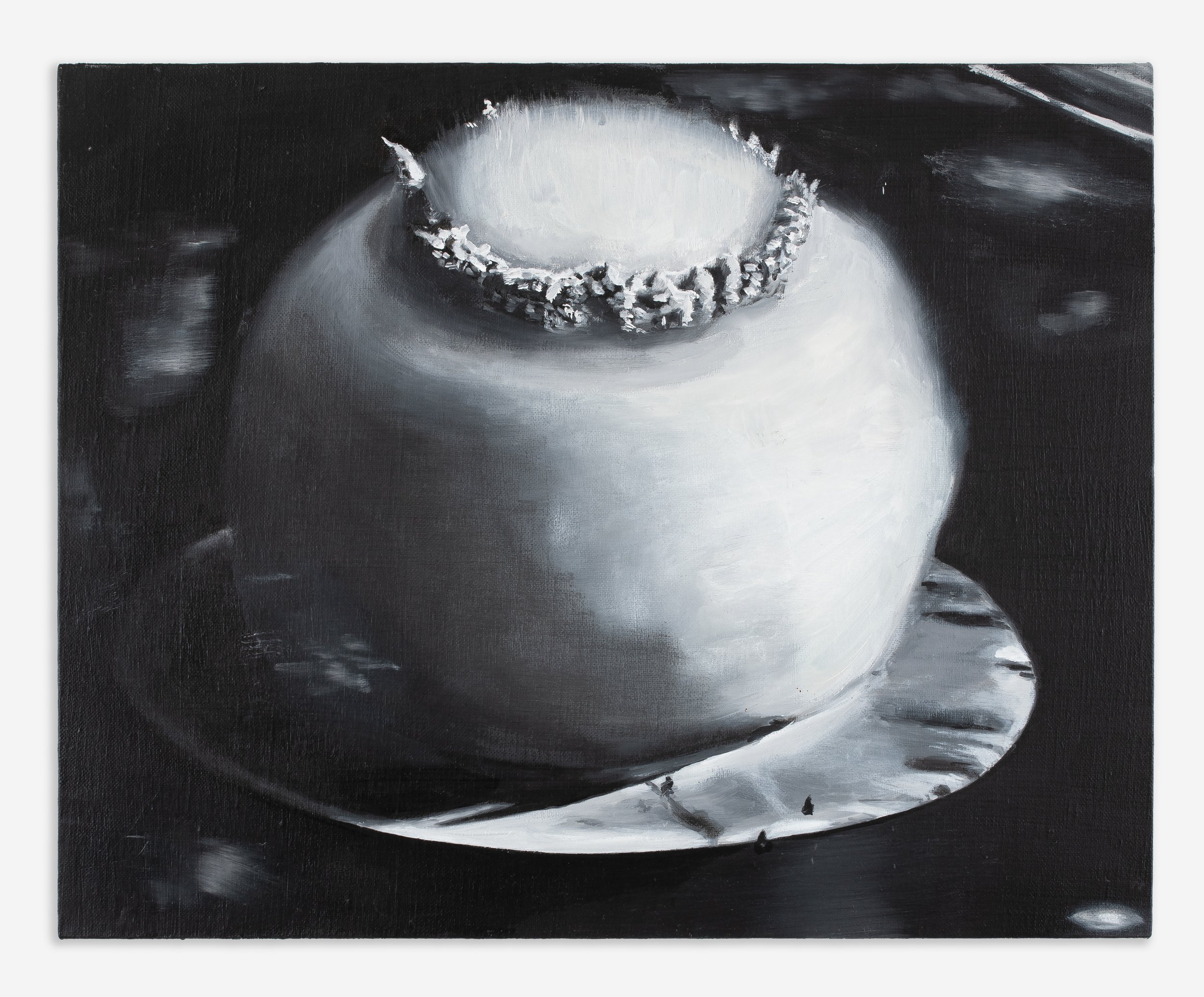
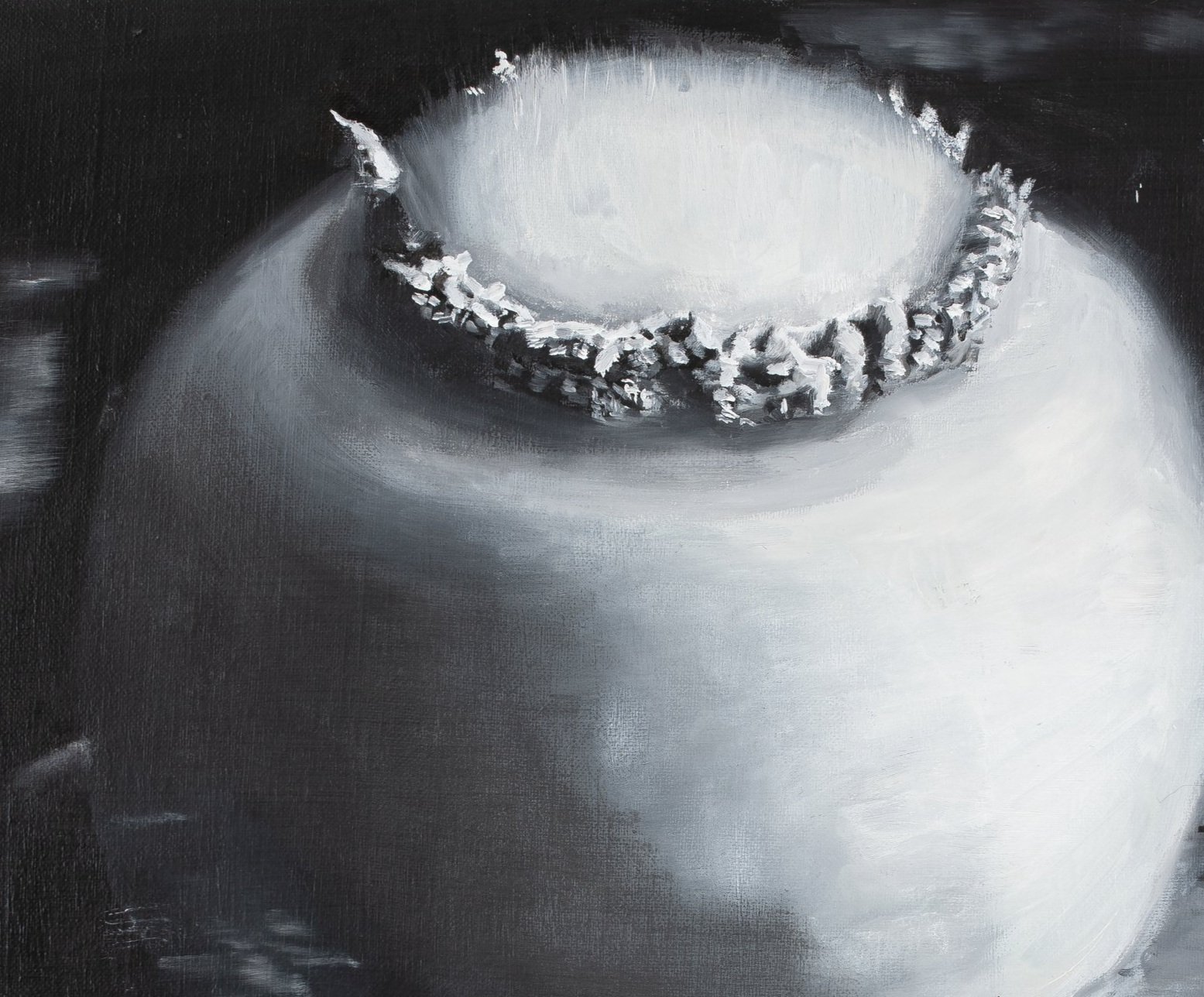
The painting is rendered in black and white. Tan Mu has described this choice as partly determined by the historical photographs that informed the image, the black and white photographs of the nuclear tests that were taken by the military and distributed to the press and that became the primary visual record of the events, and partly determined by the artistic decision to remove color from the composition in order to focus on light, shadow, and form, the three elements that constitute the visual language of the still life, the three elements that allow the viewer to see the cloud as an object rather than as a spectacle, the three elements that reduce the explosion to its essential visual properties, the properties of shape and value and edge, the properties that a painter uses to construct a still life, the properties that allow a mushroom cloud to be painted in the same language that a painter would use to paint a piece of fruit, and the black and white is not a limitation but a precision, a precision that removes the distraction of color and concentrates the attention of the viewer on the form of the cloud, the way that the cloud rises from the column of the stem, the way that the cap expands and rolls and curls at the edges, the way that the surface of the cloud is not smooth but textured, the way that the texture is rendered in oil paint, the way that the paint is layered and blended and accumulated to produce the surface that the viewer sees, and the surface is the subject, the surface of the cloud, the surface of the paint, the surface of the explosion as it is translated into the surface of the canvas, and the translation is the painting.
The layering of the paint is the technical means by which the surface of the cloud is constructed, and the layering is also the metaphorical means by which the historical memory of the event is constructed, because the paint is applied in layers that accumulate and reconstruct the image the way that historical memory accumulates and reconstructs the past, each layer adding information and modifying the information that was applied in the previous layer, each layer building on the previous layer and partially obscuring it and partially revealing it, the way that historical accounts build on previous accounts and partially contradict them and partially confirm them, and the surface that the viewer sees is not a single layer but an accumulation of layers, and the accumulation is the history, the history of the painting and the history of the event, and the two histories are inseparable in the surface of the canvas, and the viewer who examines the surface of the cloud is examining both the surface of the paint and the surface of the history, and the examination is the still life, and the still life is the contemplation of the object, and the object is the mushroom cloud, and the mushroom cloud is the still life, and the still life is the format in which the immense is held in the hand and examined at close range, and the close range is the distance at which the question of control is asked, the question of who has the authority to define and manage and control the energy that the cloud represents, the energy that was released on July 1, 1946, in the lagoon of Bikini Atoll, in the Marshall Islands, the first nuclear test after the end of the Second World War, the test that was called Operation Crossroads, the test that was the first of sixty-seven detonations in the region, the test that began the era of nuclear weapons testing that would continue for decades and that would produce the radioactive contamination that continues to affect the health of the people who live in the Marshall Islands and the people who were displaced from their homes on Bikini Atoll and who have never been able to return, and the test that is the subject of the painting, and the subject is the still life, and the still life is the mushroom cloud, and the mushroom cloud is the object on the table.
Gerhard Richter made a series of paintings in the 1960s that were based on photographs of the Second World War, including aerial views of cities that had been destroyed by bombing, and the paintings were rendered in a style that Richter called the blur, a technique in which the photographic image is painted with precision and then the surface of the paint is dragged with a brush or a squeegee while the paint is still wet, producing a blurred effect that removes the sharp edges of the photographic image and replaces them with a soft focus that makes the image appear to be seen through a veil of atmosphere or memory or distance, and the blur is not a defect but a decision, a decision to represent the historical event not as a document but as a memory, not as a record of what happened but as an impression of what happened, an impression that has been filtered through the consciousness of the painter and the consciousness of the viewer and the consciousness of the culture that produced the event and that has been trying to understand it ever since, and the blur in Richter's work is the visual equivalent of the distance between the event and the representation, the distance between the photograph and the painting, the distance between the archive and the gallery, the distance between the fact and the memory, and the distance is not a loss of information but a transformation of information, a transformation that produces a new kind of understanding, an understanding that is not the understanding of the historian who studies the documents but the understanding of the viewer who stands in front of the painting and sees the blur and knows that the blur is not an accident but a choice, a choice that the painter made in order to represent the event in a way that the document cannot, a way that acknowledges the impossibility of representing the event directly and that represents the impossibility instead, the impossibility of seeing the event clearly, the impossibility of knowing the event completely, the impossibility of understanding the event fully, and the blur is the representation of this impossibility, the representation of the distance that separates the viewer from the event and that cannot be crossed, because the event is in the past and the past cannot be revisited and the photograph is the closest that the viewer can get and the photograph is not close enough, and the painting is the acknowledgment that the photograph is not close enough, and the acknowledgment is the blur.
The connection to Bikini Atoll (2020) is in the compression of the historical event into an intimate format. Richter's blurred paintings compress the panoramic view of the destroyed city into the format of the gallery painting, the format that can be hung on a wall and looked at from a distance of a few feet. Tan Mu's still life compresses the mushroom cloud into the format of the small oil painting, the format that can be held in the hands, and the compression is not a diminishment but a recontextualization, the same kind of recontextualization that Richter performs when he blurs the photographic image, a recontextualization that moves the image from the genre of the document to the genre of the painting, from the genre of the archive to the genre of the contemplation, from the genre of the history to the genre of the still life, and the recontextualization is the argument, the argument that the historical event can be understood not only through the panoramic view but also through the intimate view, not only through the wide angle but also through the close-up, not only through the spectacle but also through the contemplation, and the contemplation is what the still life provides, the contemplation of the object on the table, the contemplation of the mushroom cloud as a snowball, the contemplation of the destruction as an object that can be held in the hand and turned over and examined and understood, and the understanding is the still life, and the still life is the painting, and the painting is 41 by 51 centimeters, and the 41 by 51 centimeters is the distance between the viewer and the explosion, the distance that is also the distance between the present and the past, the distance that is also the distance between the document and the memory, the distance that the painting holds in the same way that the still life holds the fruit and the flower and the skull, as objects that are present and that are also reminders of absence, reminders of the time that has passed and the time that will pass, reminders of the destruction that has already happened and the destruction that might happen again, reminders that the mushroom cloud is not only a historical event but a contemporary possibility, a possibility that is contained in the same technology that produced the event, a technology that has not been dismantled and that has not been abandoned and that has not been forgotten but that has been developed and refined and made more powerful and more precise and more destructive than it was on July 1, 1946, when the first test was conducted at Bikini Atoll, and the painting holds this possibility in the format of the still life, the format of the small and the intimate and the domestic, the format that compresses the immense into the hand-held and the destructive into the contemplative and the historical into the present, and the compression is the painting, and the painting is the still life, and the still life is the mushroom cloud, and the mushroom cloud is the snowball, and the snowball is the object on the table.
Francis Bacon painted Three Studies for Figures at the Base of a Crucifixion in 1944, during the final months of the Second World War, and the three figures that he painted are not figures that can be recognized as human beings. They are distortions, contortions, fleshy masses that have been pulled and stretched and twisted into forms that are organic but that are not the forms of any organism that has ever lived, forms that are the products of a violence that has been applied to the body and that has deformed the body into something that is no longer a body, something that is between the human and the animal, between the living and the dead, between the recognizable and the monstrous, and the three figures are positioned at the base of a crucifixion that is not depicted, a crucifixion that is implied by the title but that is absent from the canvas, and the absence of the crucifixion is the argument of the painting, the argument that the event that has deformed these figures is not present, that the violence is not visible, that the cause of the deformation is not shown, that the figures are the evidence of a crime that is not represented, and the evidence is the body, the body that has been deformed by the violence that is not shown, the body that is the record of the event that is not depicted, and the record is the painting, and the painting is the evidence, and the evidence is the figure, and the figure is what remains when the violence has been removed from the frame, when the cause has been left outside the canvas, when the event has been compressed into the format of the painting and the painting shows only the consequence, only the aftermath, only the body that the violence has produced, and the body is not a body but a distortion of a body, a body that has been so deformed by the violence that it is no longer recognizable as a body, and the unrecognizability is the point, the point that the violence has gone beyond the point of recognition, that the destruction has exceeded the capacity of the form to contain it, that the deformation has produced something that is not a body and not an animal and not a figure but a form that is the form of the violence itself, the form that the violence takes when it is applied to a body and the body cannot contain it and the body is deformed into a new form that is the form of the violence that deformed it.
The connection to Bikini Atoll (2020) is in the compression of violence into a format that is not the format of the history painting but the format of the still life and the study. Bacon compressed the violence of the war into three small canvases that showed only the aftermath of the violence, only the deformed figures that the violence had produced, only the evidence of the crime that was not represented. Tan Mu compresses the violence of the nuclear detonation into a canvas that is 41 by 51 centimeters, the size of a still life, and the compression produces the same effect, the effect of confronting the viewer with the consequence of the violence without the spectacle of the violence, with the body without the event, with the mushroom cloud without the detonation, with the still life without the history, and the absence of the history is the argument, the argument that the mushroom cloud can be understood as an object, as a still life, as something that can be held in the hand and examined at close range, and the examination reveals that the object is not a snowball and not cotton candy but a cloud of radioactive debris that was produced by a detonation that was conducted by a government that made a decision to test a weapon that was designed to destroy cities and that did destroy cities and that continues to threaten the destruction of cities, and the still life is the format in which this examination takes place, the format in which the snowball is turned over and its surface is studied and its weight is felt and its temperature is registered and its fragility is understood, and the understanding is that the snowball is not a snowball, that the still life is not still, that the object on the table is an explosion that has been compressed into a format that makes it look like something that it is not, a format that makes the immense look intimate, a format that makes the destructive look contemplative, a format that makes the mushroom cloud look like a flower or a fruit or a skull, a format that makes the violence of the nuclear age look like a still life, and the format is the painting, and the painting is 41 by 51 centimeters, and the 41 by 51 centimeters is the distance between the viewer and the explosion, the distance that makes the explosion look like a snowball, the distance that makes the destruction look like an object on a table, the distance that the painting holds and that the viewer holds and that the viewer understands is not a distance that can be maintained, because the explosion that the painting compresses is an explosion that can cross any distance, that can destroy any format, that can reduce any still life to ash, and the painting holds this knowledge in the format of the still life, the format of the small and the intimate and the domestic, the format that makes the immense look small, the format that makes the mushroom cloud look like a snowball, the format that makes the destruction look like something that can be held in the hand, and the hand holds the painting, and the painting holds the explosion, and the explosion is held, and the holding is the still life, and the still life is the format, and the format is the question, and the question is who has the authority to define and manage and control the energy that the explosion represents, and the question is asked in the format of the still life, and the still life is the painting, and the painting is black and white, and the black and white is the absence of color, and the absence of color is the focus on form, and the form is the mushroom cloud, and the mushroom cloud is the object on the table.