The Filament That Remembered the Cell: Tan Mu's Illuminate and the Origin That Light and Life Share
On New Year's Eve in 1879, three thousand people traveled to Menlo Park, New Jersey, to see a light. They came by train and by carriage and on foot, through the cold and the dark of the last night of the year, and they arrived at a laboratory that was lit by a kind of light that none of them had ever seen before, a light that was not produced by combustion, a light that had no flame and no wick and no fuel that was being consumed, a light that was produced by an electric current passing through a carbonized cotton thread that was sealed inside a glass bulb from which the air had been removed, a thread that was thinner than a human hair and that was heated by the current to a temperature that was high enough to make it glow, and the glow was the light that the three thousand people had come to see, and the light was the invention of Thomas Edison, who had spent more than a year and had tested more than three thousand materials before he found a filament that would burn long enough to be useful, and the filament that he found was carbonized cotton, and the cotton had been carbonized by heating it in an oven until all the volatile compounds had been driven off and only the carbon remained, and the carbon was the element that conducts electricity and that emits light when it is heated, and the light that the carbon emitted was the light that illuminated the laboratory and that the three thousand people saw and that the newspapers reported and that the world read about the next morning, and the world understood that something had changed, that a new kind of light had been invented, a light that did not require fire and that did not produce smoke and that could be turned on and off with a switch, and the switch was the invention that made the light practical, because a light that cannot be turned off is not useful, and the switch and the filament and the bulb and the vacuum pump and the generator and the wiring and the sockets and the meter were all part of the system that Edison built to make the light bulb into a technology that could be deployed, and the deployment began on the night of December 31, 1879, in Menlo Park, New Jersey, and the light that was deployed that night was the light that Illuminate (2022) depicts, a light that is more than a hundred and forty years old and that is still the basis of the incandescent lamps that are manufactured today, a light that has not changed in its fundamental principle since the night that Edison demonstrated it, a light that is the same light that the three thousand people saw, and the painting holds this light the way the bulb holds the filament, as a source of illumination that is also a record of the moment when the illumination began.
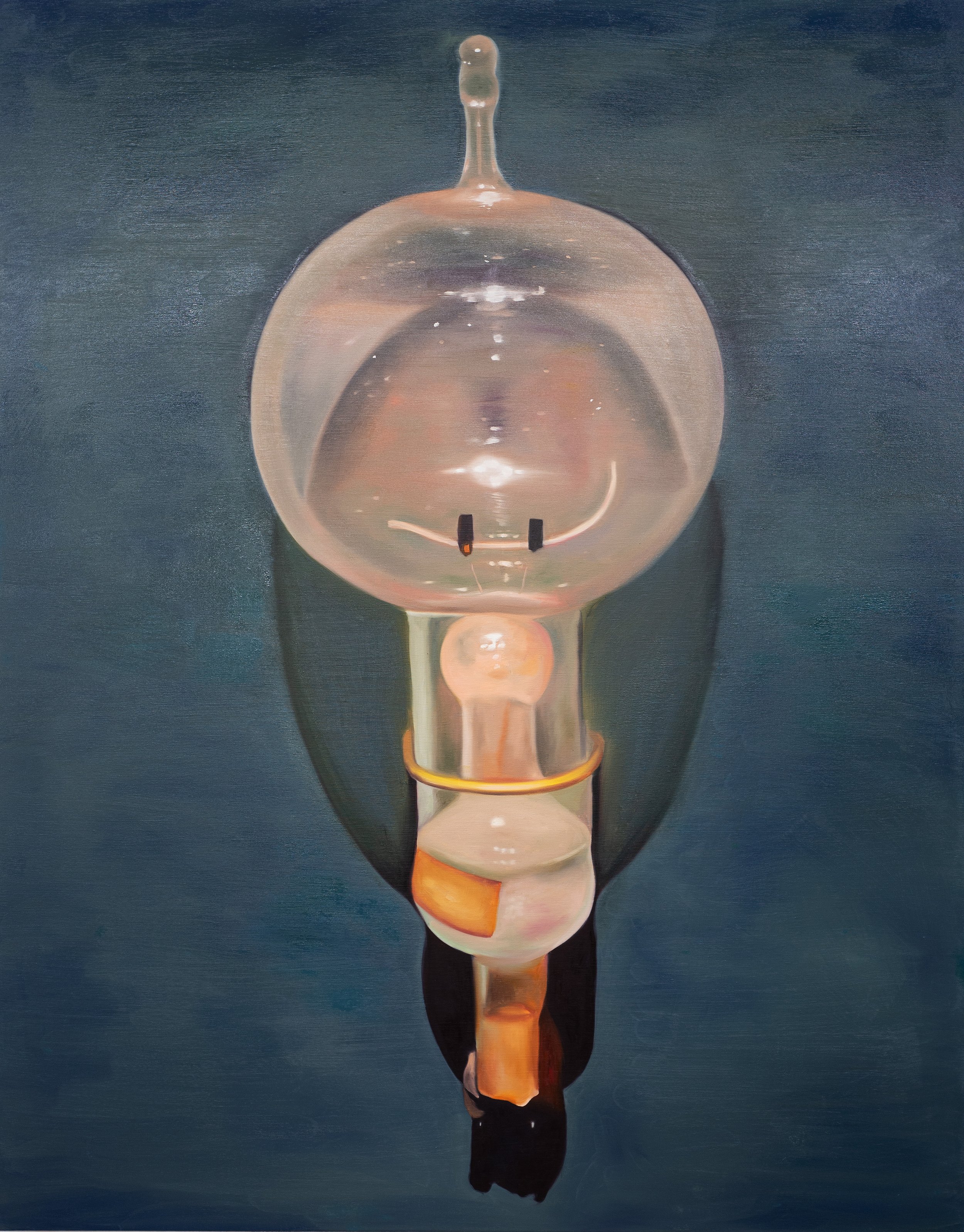
Illuminate (2022) is an oil painting on linen, 152 x 122 cm (60 x 48 in), that depicts a carbon filament light bulb. The canvas is vertical, taller than it is wide, and the bulb occupies most of the field, centered against a dark background that represents the darkness that the light was invented to dispel. The bulb is rendered in what Tan Mu has described as a portrait-like manner, an approach that focuses on the form, materiality, and internal structure of the object rather than on the light that the object produces, and the portrait-like manner is appropriate because the bulb is not represented as a source of radiating light but as a subject with presence, a subject that is depicted the way a portrait depicts a person, with attention to the particular qualities of the individual, the particular curve of the glass envelope and the particular shape of the filament and the particular color of the glow and the particular pattern of the internal supports that hold the filament in place, and the attention to these particulars is what makes the painting a portrait rather than a still life, because a still life depicts the object as a representative of its type, while a portrait depicts the object as an individual, and the individual that the painting depicts is the light bulb that was demonstrated on New Year's Eve in 1879, or a light bulb that is like that light bulb, a light bulb that is the same kind of light bulb, a carbon filament incandescent lamp, a technology that has not changed in its fundamental principle since the night that Edison demonstrated it, and the painting holds this technology as a portrait holds a person, with the specificity of the individual and the generality of the type, the particular filament and the universal principle of incandescence, the particular bulb and the universal condition of artificial light.
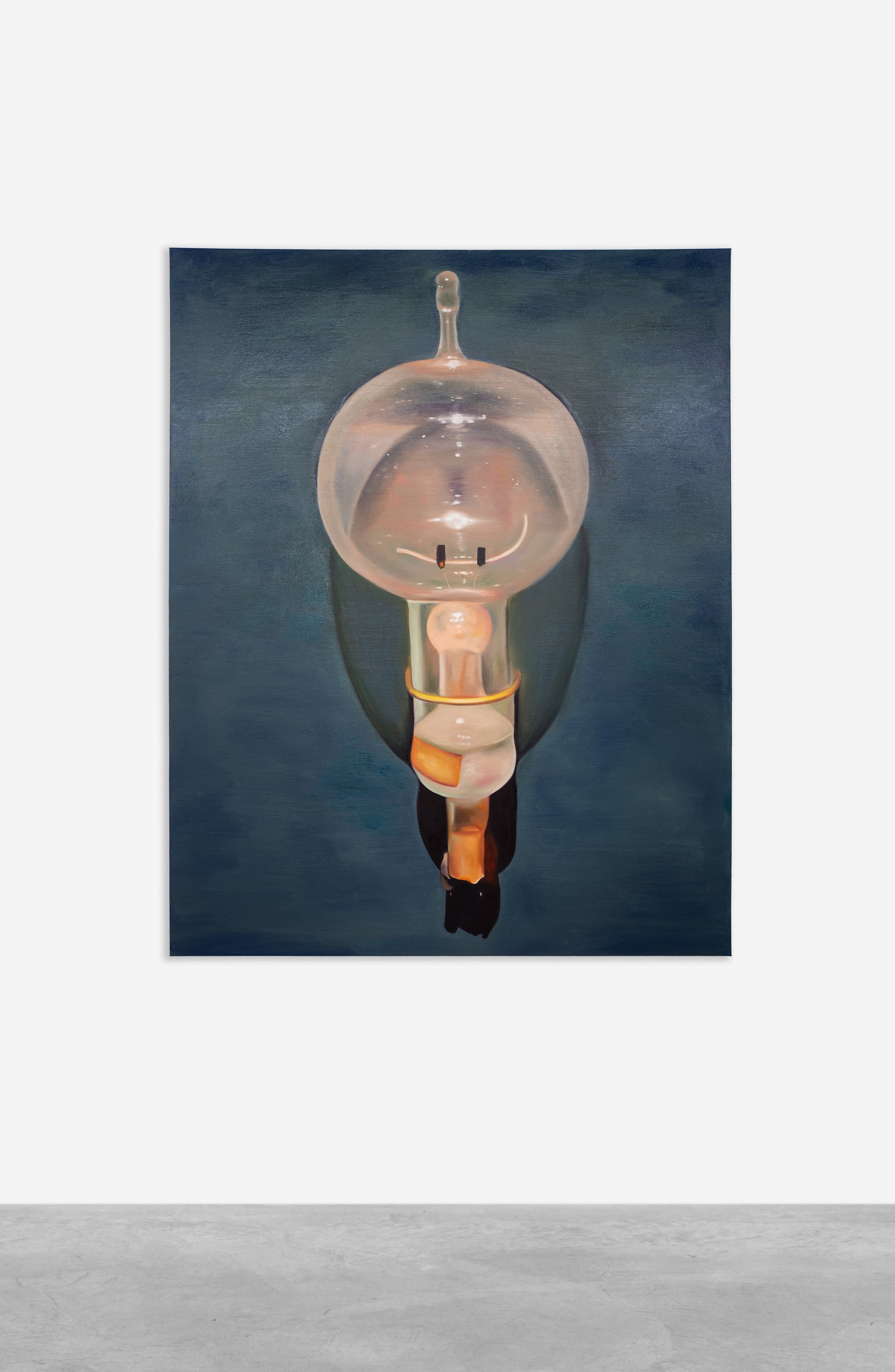
The color of the painting is organized around the warmth of the filament. The filament glows with a warm orange-yellow light, the color of incandescence, the color that a carbon thread emits when it is heated to approximately two thousand seven hundred degrees Celsius by an electric current, and the color is not the white of the modern LED or the blue of the fluorescent tube but the orange-yellow of the carbon arc and the candle flame and the fire that preceded the electric light, and the continuity between the electric light and the fire is not accidental, because the color of incandescence is the color of thermal radiation, the color that any object emits when it is heated to a temperature that is high enough to emit visible light, and the color is determined by the temperature and not by the material, the carbon and the tungsten and the iron and the sun all emit the same spectrum of colors when they are heated to the same temperature, and the color of the filament in the painting is therefore the color of the sun at two thousand seven hundred degrees, which is cooler than the surface of the sun, which is approximately five thousand five hundred degrees, and the filament is therefore a small sun, a sun that was made by a human being, a sun that was invented, and the invention of the artificial sun is the subject of the painting, the invention of a source of light that does not require the sun, the invention of a technology that makes the human independent of the cycle of day and night, the invention that extended the productive hours of the day and that made the night into a time when work could continue and reading could continue and social life could continue and the darkness that had limited human activity for the entire history of the species was no longer a limit but a choice, and the choice was made possible by the filament, and the filament was the invention, and the painting is the portrait of the invention.
The glass envelope of the bulb is rendered with a subtlety that allows the viewer to see both the transparency of the glass and the reflections on its surface, the way that the glass both reveals the filament inside and reflects the room outside, and the double function of the glass, the function of protection and the function of visibility, is the same double function that the epithelium performs in the body, the function of keeping the inside in and the outside out while allowing the inside to be seen from the outside, and the glass is the boundary of the bulb the way the epithelium is the boundary of the body, and the boundary is what the painting renders visible, the boundary between the vacuum inside the bulb and the atmosphere outside, the boundary between the filament and the world, the boundary between the invention and the context that the invention was made to serve, and the glass is both the container and the window, both the wall and the lens, both the protection and the transparency, and the painting holds both functions in the same surface, the surface of the glass that is also the surface of the linen, the surface that separates the filament from the darkness and that allows the filament to be seen.
Joseph Wright of Derby painted A Philosopher Giving a Lecture on the Orrery in 1766. The painting depicts a group of figures gathered around a mechanical model of the solar system, an orrery, that is illuminated by a single source of light that is hidden behind the model and that casts a warm glow on the faces of the figures and on the brass armillary spheres of the orrery, and the light in the painting is not natural light, it is the light of a lamp or a candle that has been placed behind the model to create the illusion that the orrery is illuminated by the sun that it represents, and the illusion is the subject of the painting, the illusion that the mechanical model is the cosmos that it depicts, the illusion that the light that illuminates the model is the light that illuminates the planets, and the illusion is sustained by the technique of chiaroscuro, the contrast between the illuminated figures and the dark background that surrounds them, a contrast that concentrates the attention of the viewer on the circle of light that the orrery defines and on the faces of the figures who are within that circle, and the circle of light is the circle of knowledge, the knowledge that the orrery represents, the knowledge of the structure of the solar system that the mechanical model makes visible, and the visibility is the product of the light, the artificial light that is placed behind the model and that creates the conditions for the understanding of the model, and the light is therefore not merely an illumination but a condition of knowledge, a condition that the painting makes explicit by placing the source of the light inside the composition rather than outside it, by making the light a part of the scene rather than a condition of the painting.
The connection to Illuminate (2022) is in the artificial light that is both the subject of the work and the condition of its visibility. Wright's painting uses artificial light to illuminate the orrery and to create the conditions for understanding the orrery. Tan Mu's painting depicts artificial light as the subject of the portrait, and the portrait is itself made visible by the light that is depicted within it, and the relationship between the light in the painting and the light of the painting is the same relationship that exists in Wright's work, the relationship between the illumination that is represented and the illumination that makes the representation possible, and both paintings are about this relationship, about the light that is both the thing that is seen and the condition of seeing, the light that is both the subject and the medium, the light that is both the content and the form, and the double function of the light is what both paintings hold, the function of illumination and the function of revelation, the function of making things visible and the function of making visibility itself visible, and the holding is the painting, and the painting is the portrait of the light that makes the portrait possible.
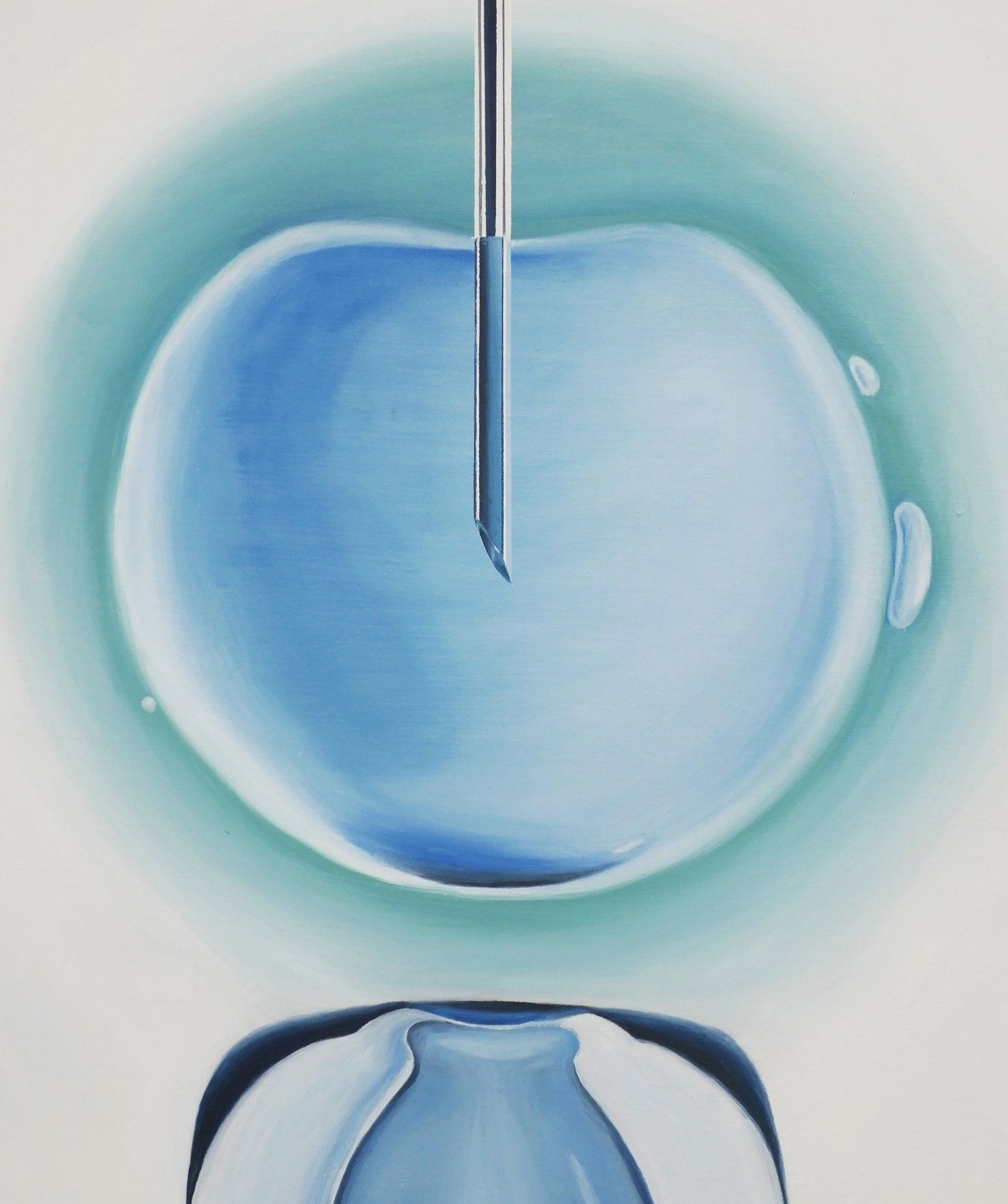
Tan Mu has described the process of painting the filament as unexpectedly reminding her of cell division, a subject she had explored in earlier works, and the association between the filament and the cell is not a metaphor that is imposed on the painting but a perception that emerged from the painting, a perception that arose during the act of rendering the filament in oil paint and that was not anticipated before the painting was begun, and the perception is that the light that emerges from within the bulb is like the life that emerges from within the cell, that the filament that glows with incandescent light is like the cell that divides and multiplies, that the origin of artificial light is like the origin of biological life, and the likeness is not a visual likeness but a structural likeness, a likeness of process, a likeness of the way that something emerges from something else, the way that light emerges from the heated filament and the way that a cell emerges from the division of a parent cell, and the emergence is the connection, the emergence is the bridge between technology and biology, the bridge that the painting builds by rendering the filament in a way that makes the association with cell division visible, not by making the filament look like a cell but by painting the filament with the same attention to the moment of emergence that she would bring to the painting of a dividing cell, the moment when something that was not there before is suddenly there, the moment when the dark becomes light, the moment when one becomes two, the moment of initiation and transformation and beginning, and the beginning is what the painting holds, the beginning of artificial light and the beginning of biological life, the beginning that light and life share, the beginning that is the origin that the filament remembers.
Dan Flavin made the first of his fluorescent light works in 1963. The nominal three (to William of Ockham) consists of six eight-foot fluorescent tubes, three cool white and three daylight, arranged in three vertical pairs on a wall, and the work is not a sculpture and it is not a painting and it is not an installation in the conventional sense, it is a configuration of commercial lighting fixtures that emit light, and the light is the medium, the light is the material, the light is the form, and the form is determined by the standard dimensions of the fluorescent tube, the eight-foot length and the one-and-a-half-inch diameter that the manufacturer specifies, and the configuration is determined by the artist, but the light that the configuration produces is not entirely determined by the artist, because the light fills the room and reflects off the walls and the floor and the ceiling and the viewers, and the light is therefore not contained by the work but distributed by the work, and the distribution is the work, and the work is the light, and the light is the art, and the art is the technology, the commercial lighting technology that was manufactured for the purpose of illuminating offices and factories and warehouses and that Flavin recontextualized as art, and the recontextualization is the argument, the argument that the technology of artificial light is also an aesthetic medium, that the fluorescent tube that was designed to provide efficient illumination is also a source of visual experience, that the light that was invented to make work possible is also the light that makes art possible, and the argument is the same argument that Illuminate makes, the argument that the light bulb is not merely a technology but a subject, not merely a device but a presence, not merely a source of illumination but a source of meaning, and the meaning is the connection between the technology and the life that the technology was invented to serve, the connection between the filament and the cell, the connection between the artificial light and the biological origin, the connection between the invention and the genesis, and the painting holds this connection the way Flavin's work holds the light, as a presence that fills the field and that is not contained by the frame but that extends beyond it, into the room and into the darkness and into the history of the technology that produced it and into the future of the technology that it depicts, the future that began on New Year's Eve in 1879 when three thousand people saw a light that they had never seen before, and the light that they saw is the light that the painting depicts, and the painting holds the light the way the bulb holds the filament, as a source that is also a record, a beginning that is also a memory, an illumination that is also a portrait, and the portrait is of the filament and of the cell and of the origin that light and life share, and the sharing is the painting, and the painting is the light, and the light is still on.