The Body Read by a Machine: Tan Mu's Thermal Imaging and the Temperature That Became Information
An airport security checkpoint in 2020. A thermal camera mounted on a tripod or suspended from the ceiling scans each pedestrian as they pass through the corridor, and the camera does not see the person the way that a person sees a person, it does not see the face or the clothes or the expression or the posture, it sees the heat that the body radiates into the air, the infrared radiation that every living body emits, and it converts the radiation into a color, a color that corresponds to a temperature on a scale that is displayed in the corner of the image, and the color is not the color of the skin, it is the color of the heat, and the heat is not visible to the eye, it is invisible, it is felt, it is the sensation of warmth that one body detects when it is near another body, the sensation that is the most primitive form of human connection, the warmth of the mother's body against the infant's skin, the warmth of the hand that touches the forehead to check for fever, the warmth that is the first language of care, and the thermal camera translates this warmth into information, into a number, into a color on a scale, and the translation is the subject of Thermal Imaging (2022), the translation of the intimate and the physical into the visual and the technological, the translation of the warmth of the body into the data of the machine, and the translation is not neutral, it is a transformation, a transformation that changes what the warmth means, from a sign of connection to a sign of contagion, from a sign of life to a sign of risk, from a sensation that is felt to a datum that is read, and the reading is the painting, and the painting is the record of the reading, and the record is what remains when the checkpoint has closed and the camera has been removed and the pandemic has receded and the warmth of the body has returned to being what it was before the camera saw it, a sensation that is felt and not a datum that is read, except that now it can be both, and the both is the new condition, the condition that the painting holds.
Thermal Imaging (2022) is an oil painting on linen, 76 x 76 cm (30 x 30 in). The format is square, the same square format that Tan Mu has used for her technological and cosmic subjects, the square that treats the vertical and the horizontal with equal weight, the square that does not privilege the landscape over the portrait, the square that is the format of the screen, the format of the monitor, the format of the image that the thermal camera produces, and the square format of the painting matches the square format of the source image, the image that was captured by the thermal camera at the airport security checkpoint, and the match is not a coincidence but a decision, a decision to preserve the format of the technology in the format of the painting, a decision to make the painting the same shape as the image that the machine made, a decision to hold the technological vision in the painterly vision, and the holding is the square, and the square is 76 by 76 centimeters, and the 76 by 76 centimeters is the frame that holds the body that the machine has read.
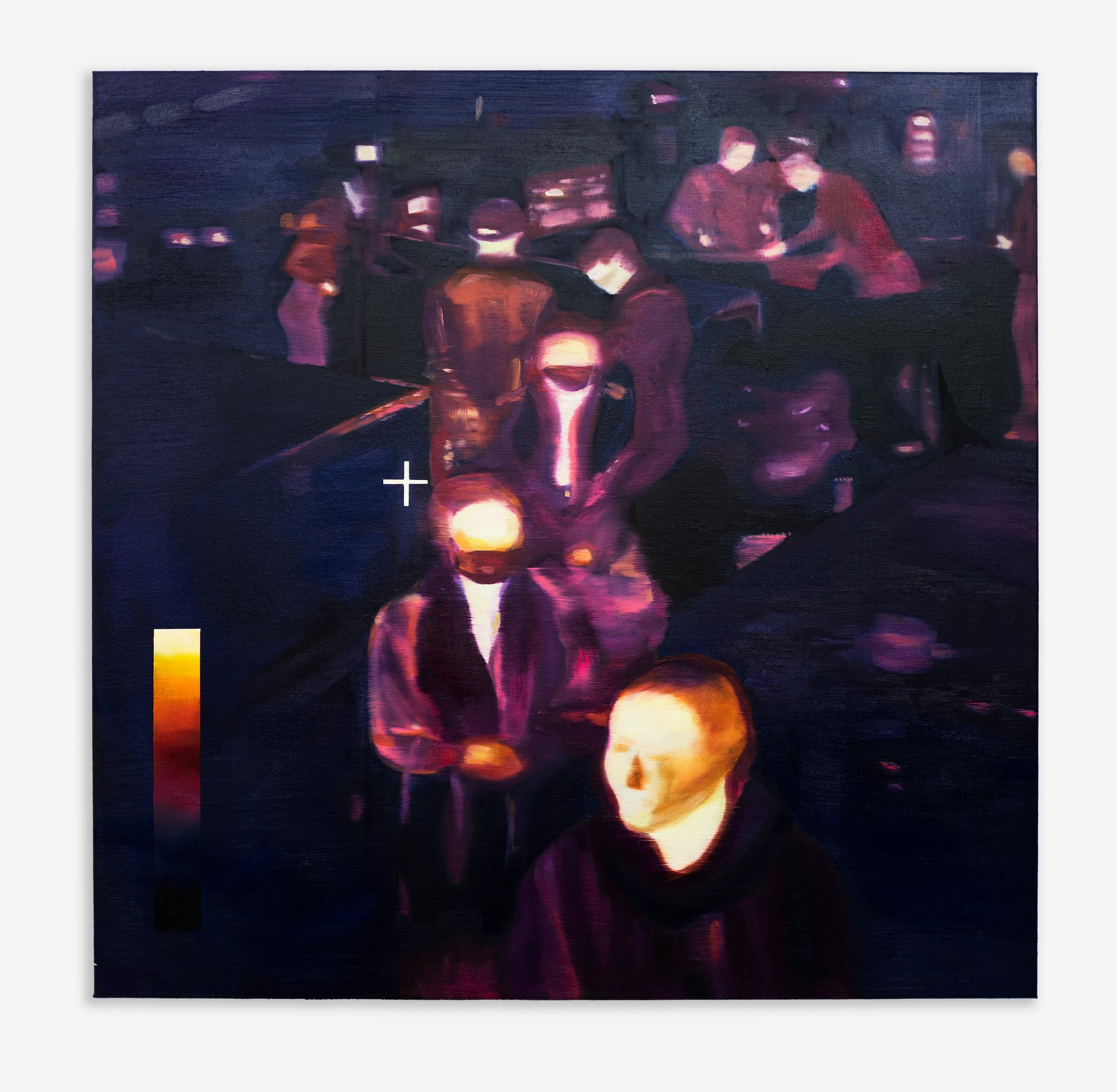
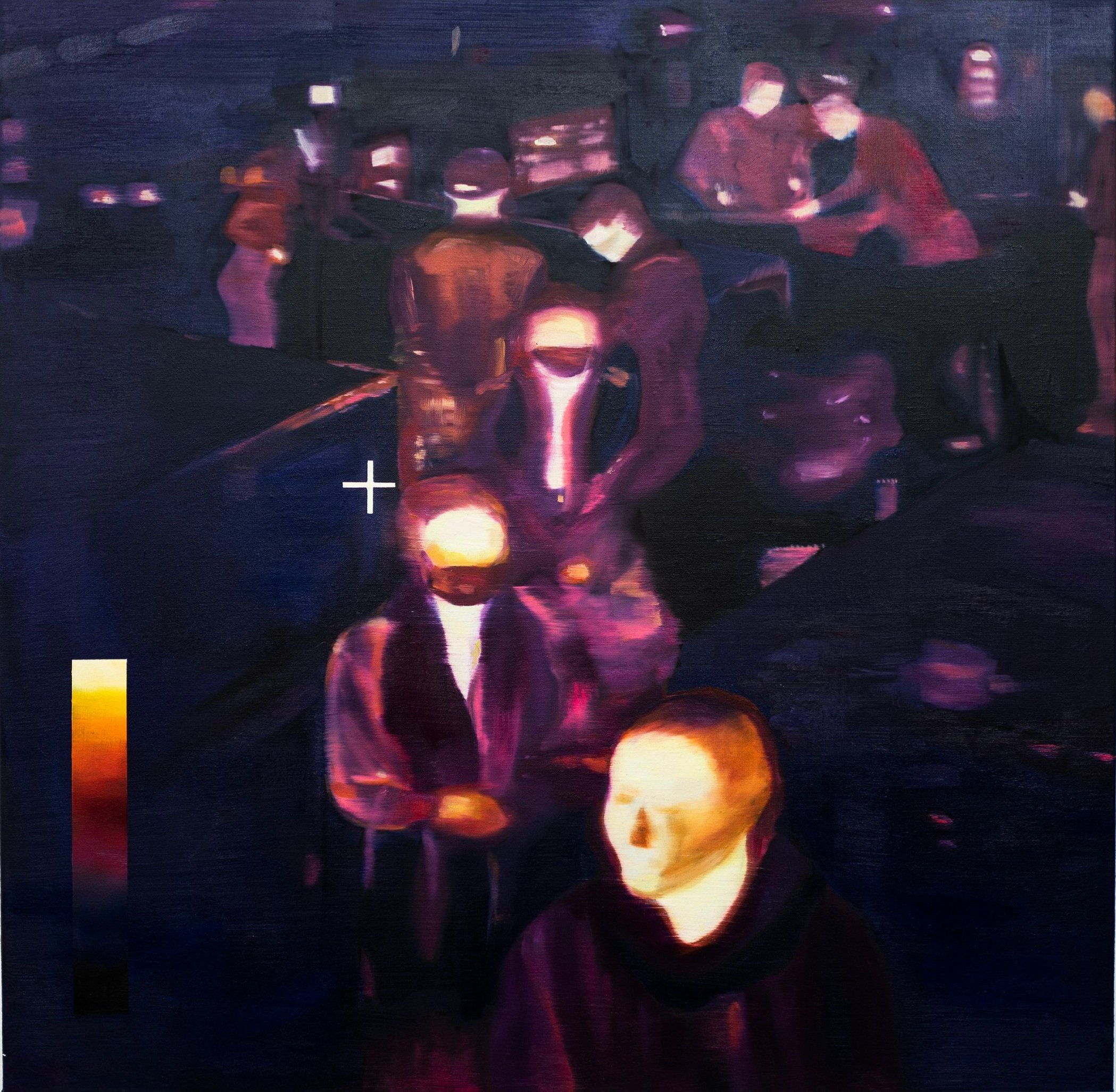
The painting is dominated by dark and cool tones, with purple, blue, and black forming the primary visual field. These are the colors that the thermal camera assigns to the cooler regions of the image, the regions where the heat is low, the regions that correspond to the background and to the parts of the body that are covered by clothing or obscured by the angle of the camera, and the cool colors create a field that is atmospheric and indistinct, a field in which the figures appear to float rather than stand, a field in which the ground beneath the figures is barely visible and the space around them is not a space that a body could occupy but a space that a datum could occupy, a space of information rather than a space of architecture, and the atmospheric quality of the cool field is the quality of the thermal image, the quality that distinguishes the thermal image from the optical photograph, the quality that makes the thermal image look like a vision of another world, a world where the light does not come from the sun or from a lamp but from the heat of the bodies themselves, a world where the bodies are the light sources and the light they emit is the information that the camera reads, and the cool field of the painting holds this other world the way that the thermal camera holds it, as a field of data rather than a field of matter.
Warmer colors appear selectively in the composition, red and orange and yellow concentrated on the faces and the exposed hands of the figures, the areas where the heat is highest and where the thermal camera assigns the warmest colors, and the warm colors create a sharp contrast with the cool field, a contrast that directs the attention of the viewer to the parts of the body that the camera reads most intensely, the face and the hands, the face that is partially concealed by the mask and the hands that are exposed to the air, and the concentration of warm color on these areas is the concentration of the camera's attention, the camera reads the face because the face radiates the most heat, and the mask blocks some of the heat and the camera reads what the mask does not block, and the reading is the red and the orange and the yellow that paint the face in the colors of fever, the colors that the thermal camera uses to indicate the presence of elevated temperature, and the colors are the warning, the warning that the machine issues when it detects a body whose temperature exceeds the threshold that the system has set, and the threshold is the line between the healthy and the sick, between the safe and the dangerous, between the permitted and the prohibited, and the line is the color, and the color is the information, and the information is the reading, and the reading is the painting, and the painting is the body read by a machine.
In 1632, Rembrandt van Rijn painted The Anatomy Lesson of Dr. Nicolaes Tulp. The painting depicts a public dissection, a demonstration in which the anatomist Dr. Tulp exposes the muscles of the forearm of a cadaver to an audience of surgeons and dignitaries, and the cadaver is the body of Aris Kindt, a criminal who had been executed and whose body had been given to the anatomist for the purpose of demonstration, and the demonstration is a public reading of the body, a reading that converts the body into a text that the anatomist interprets for the audience, and the interpretation is the lesson, the lesson that teaches the audience what the body contains beneath the skin, what the muscles look like and how they function and what they enable the hand to do, and the lesson is the painting, because Rembrandt painted the lesson as a scene of instruction, a scene in which the body is the subject and the anatomist is the reader and the audience is the witness, and the reading is a reading of the interior, a reading that reveals what the eye cannot see and what the hand cannot feel, a reading that requires the opening of the body and the exposure of its contents to the light of the dissection theater, and the opening is the violence of the reading, the violence that the anatomist performs on the body in order to make it legible, in order to convert the body from a living person into a text that can be read, and the conversion is the precedent for the thermal camera, because the thermal camera also reads the body, it also converts the body into a text that can be read, but the thermal camera does not open the body, it does not cut the skin, it does not expose the muscles, it reads the body from the outside, it reads the heat that radiates from the surface, it reads the infrared signature that the body emits, and the reading is non-invasive, the reading does not require a scalpel, it requires a lens and a sensor and a computer that converts the radiation into a color and the color into a number and the number into a classification, and the classification is the new anatomy, the anatomy that does not open the body but reads it from a distance, the anatomy that does not require the consent of the subject because the subject does not feel the reading, the anatomy that converts the warmth of the body into a datum without the body knowing that it has been read, and the reading is the crosshair in Tan Mu's painting, the crosshair that represents the AI system that is actively detecting and recording the body temperature of each individual who passes through the checkpoint, and the crosshair is the scalpel of the thermal camera, the instrument that targets the body and extracts the information and converts the body into a datum, and the datum is the temperature, and the temperature is the reading, and the reading is the lesson, and the lesson is the painting, and the painting is the body read by a machine, and the machine is the new anatomist, and the new anatomist does not wear a collar and a hat and stand in a theater, it hangs from the ceiling and reads the body from a distance and converts the warmth into a warning and the warning into a color and the color into a number and the number into a classification, and the classification is healthy or sick, safe or dangerous, permitted or prohibited, and the line between the classifications is the threshold, and the threshold is the color, and the color is the red that appears on the face of the figure in the painting, and the red is the warning, and the warning is the reading, and the reading is the body read by a machine.
The technology of thermal imaging operates by detecting the infrared radiation that all objects emit as a function of their temperature. Every body that is warmer than absolute zero radiates electromagnetic energy in the infrared spectrum, and the wavelength of the radiation is proportional to the temperature of the body, and the thermal camera detects the radiation and converts it into an electrical signal and the signal is processed by a computer that assigns a color to each pixel based on the intensity of the radiation at that point, and the color assignment follows a palette that the camera manufacturer has designed, a palette that maps the range of temperatures in the scene to a range of colors that the human eye can distinguish, and the palette is the gradient color bar that Tan Mu has retained in the lower corner of the painting, the color bar that corresponds to the thermal ranges used for classification and measurement, and the retention of the color bar is a decision to preserve the technological apparatus in the painting, to make the tool visible alongside the image that the tool produces, to hold the camera and the image together in the same frame, and the holding is the painting's acknowledgment of its source, the acknowledgment that the image came from a machine and that the machine left its mark on the image in the form of the color bar and the crosshair and the plus sign that signifies the AI system, and the mark is the signature of the technology, the signature that the thermal camera leaves on every image it produces, the signature that says this image was made by a machine, and the machine was reading the body, and the body was the source of the heat, and the heat was the source of the information, and the information was the source of the painting, and the painting is the record of the chain, the chain that connects the body to the heat to the camera to the image to the painting, and the chain is the subject of the work, the chain that translates the warmth of the body into the color of the painting through the mediation of the machine, and the mediation is what Tan Mu has described as a form of disconnection, the disconnection that occurs when technology mediates the perception of warmth, transforming the tactile sensation of temperature into a purely visual experience, and the transformation is the disconnection, and the disconnection is the painting, and the painting is the body read by a machine, the body that was warm and that the machine converted into a color and that the painter converted into a mark and that the mark preserves as a record of the warmth that the machine saw and that the body felt and that the painting holds.
Jenny Holzer installed the LIVING series in public spaces between 1980 and 1982. The series consisted of bronze plaques and electronic displays that presented short texts, texts that Holzer had written in the voice of a declarative and anonymous authority, texts that stated propositions about the conditions of contemporary life, propositions about power and sex and violence and money and government and the body, and the texts were installed in places where official announcements were typically displayed, on walls and doors and signboards and electronic message boards, and the installation borrowed the authority of the context, the authority of the official announcement, the authority of the public notice, and the borrowing was the strategy, the strategy of using the form of official communication to deliver a content that was not official, a content that questioned the authority that the form conveyed, and the question was the question about who has the right to speak in public, who has the right to display information, who has the right to read the bodies of the people who pass through the public space, and the question is the question of Thermal Imaging, the question of who has the right to read the temperature of the body, who has the right to convert the warmth of the body into a datum and to use the datum to classify the body as healthy or sick, safe or dangerous, and the right is the question, and the question is the color bar and the crosshair and the plus sign in the lower corner of the painting, the technological apparatus that the machine left on the image, the signature of the authority that produced the reading, and the authority is the same authority that Holzer's plaques borrowed and questioned, the authority of the institution that displays information in public, the authority of the airport that installs a thermal camera at the security checkpoint and reads the temperature of every person who passes through, the authority that does not ask for consent and does not provide an alternative, the authority that is necessary because the pandemic made it necessary, because the virus was transmitted through contact and through proximity and the temperature was a sign of infection and the reading was a public health measure, and the necessity is the tension that the painting holds, the tension between the necessity of the surveillance and the alienation of the observed, between the public health requirement and the private right to warmth, between the machine that reads and the body that is read, and the tension is the subject of the work, and the work is the painting, and the painting is 76 by 76 centimeters of oil on linen, and the 76 by 76 centimeters is the frame that holds the tension, and the tension is the body read by a machine, the body that was warm before the machine saw it and will be warm after the machine is gone, the body whose warmth was a sensation and became a datum and remains a sensation beneath the datum, the body that the machine reads and that the painting remembers, remembers as a body, not as a datum, remembers as warmth, not as color, remembers as a sensation that is felt, not as an information that is read, and the remembering is the painting, and the painting is the record of the warmth that the machine converted into information and that the painter converted back into the sensation of warmth, the warmth of the brushstroke and the warmth of the color and the warmth of the hand that made the mark and the warmth of the body that the mark holds, the warmth that is the subject and the subject is the body and the body is the heat and the heat is the color and the color is the painting, and the painting is the body read by a machine, and the machine has read the body, and the body remains.