The Six Drops That Painting Remembered: Tan Mu's The Splash of a Drop 1 and the Moment That Photography Could Not Keep
In 1895, an English physicist named Arthur Mason Worthington published a book called The Splash of a Drop. The book documented a series of experiments that Worthington had conducted over a period of several years, experiments in which he dropped a solid sphere or a liquid drop onto a flat surface and observed the splash that the impact produced, and the observations were made with the aid of an electric spark that illuminated the splash for a fraction of a second, allowing Worthington to see the form of the splash at a specific moment in its development, and the form changed from one moment to the next, the drop hit the surface and produced a crater and then a crown and then a column and then a cascade and then a series of satellite drops that separated from the column and fell back to the surface, and each of these forms existed for only a fraction of a second, and Worthington could observe each form only by repeating the experiment and timing the spark to illuminate the splash at a different point in its development, and the repetition was necessary because the technology of photography in 1895 was not fast enough to capture the entire sequence in a single experiment, and Worthington relied on hand-drawn illustrations for many of the stages, because the photographic technology could not record the finer details with sufficient precision, and the hand-drawn illustrations were then considered a more precise method of recording motion, and the irony of this assessment is the irony that Tan Mu's painting addresses, the irony that the hand was more precise than the camera, that the drawing was more accurate than the photograph, that the painting was more reliable than the technology that was supposed to replace it, and the irony is the subject of the painting, the subject of the six panels that comprise The Splash of a Drop 1 (2022), six paintings of a single splash, six moments in the development of a drop, six stages in the dissolution of a form, six records of a process that is too fast for the eye to see and that was too fast for the camera of 1895 to record and that the painting re-records and amplifies through the tactile qualities of oil paint and the deliberate slowness of the human hand.
The Splash of a Drop 1 (2022) is an oil painting on linen in six parts, each panel 28 x 36 cm (11 x 14 in), with an overall dimension of 28 x 216 cm (11 x 84 in). The six panels are arranged in a horizontal sequence, the same way that the frames of a film strip are arranged in a horizontal sequence, the same way that the pages of Worthington's book are arranged in a sequential order, the same way that the stages of the splash unfold in time, one after another, from the moment of impact to the moment of dissolution, and the horizontal arrangement is the temporal arrangement, the arrangement that converts the temporal sequence of the splash into the spatial sequence of the panels, the arrangement that allows the viewer to see the entire development of the splash in a single glance, the way that a film strip allows the viewer to see the entire motion of a figure in a single strip of images, the way that a book allows the reader to see the entire argument in a single volume, and the format is the argument, the argument that the splash is a process, that the process unfolds in time, that the time can be represented as space, and that the representation is the painting, the painting in six parts, six moments, six stages, six records of a splash that no one has ever seen in its entirety because the splash is too fast for the eye and was too fast for the camera of 1895 and is now too fast for the camera of the present, and the painting holds the splash in six panels the way that the hand holds a moment that the camera cannot keep.
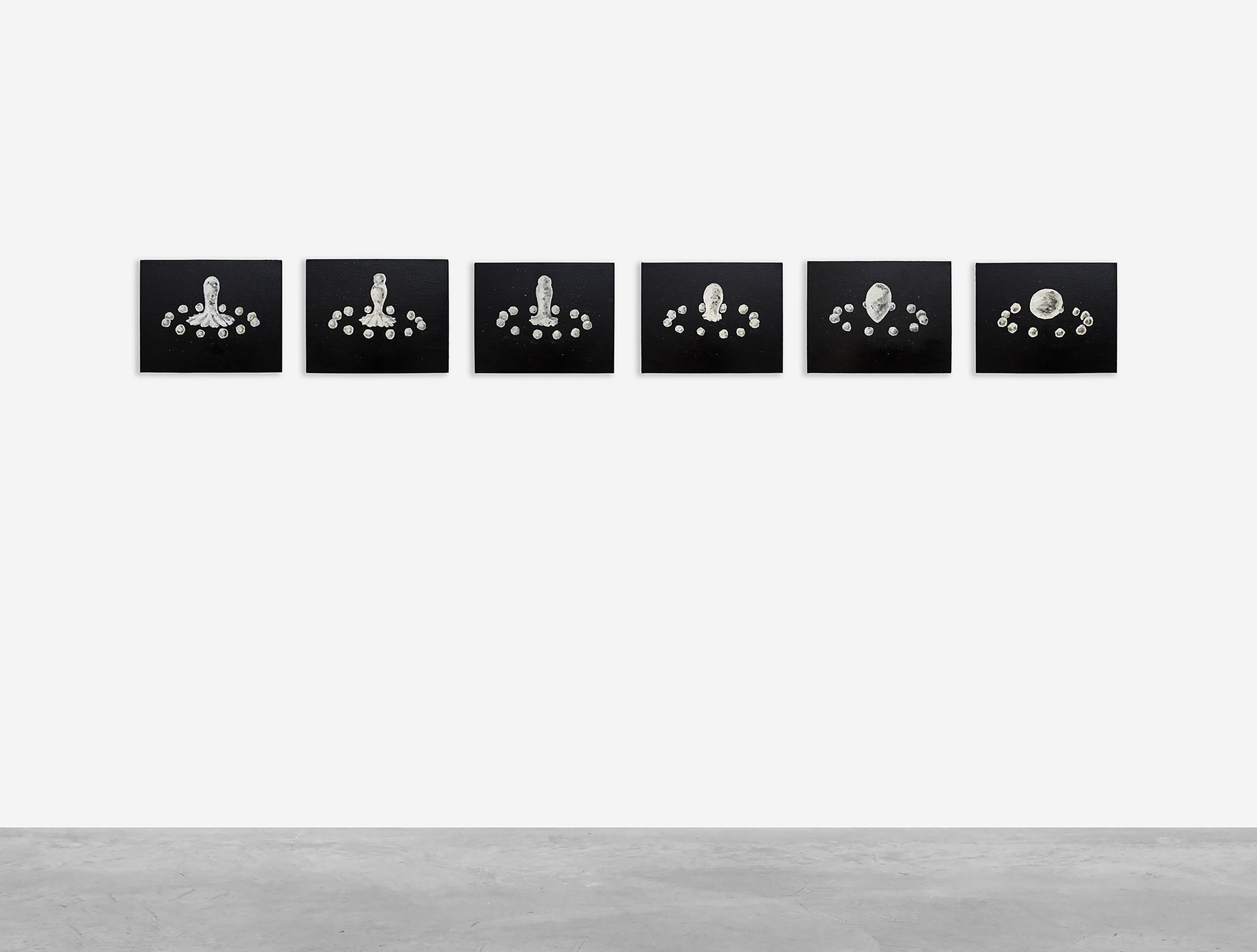
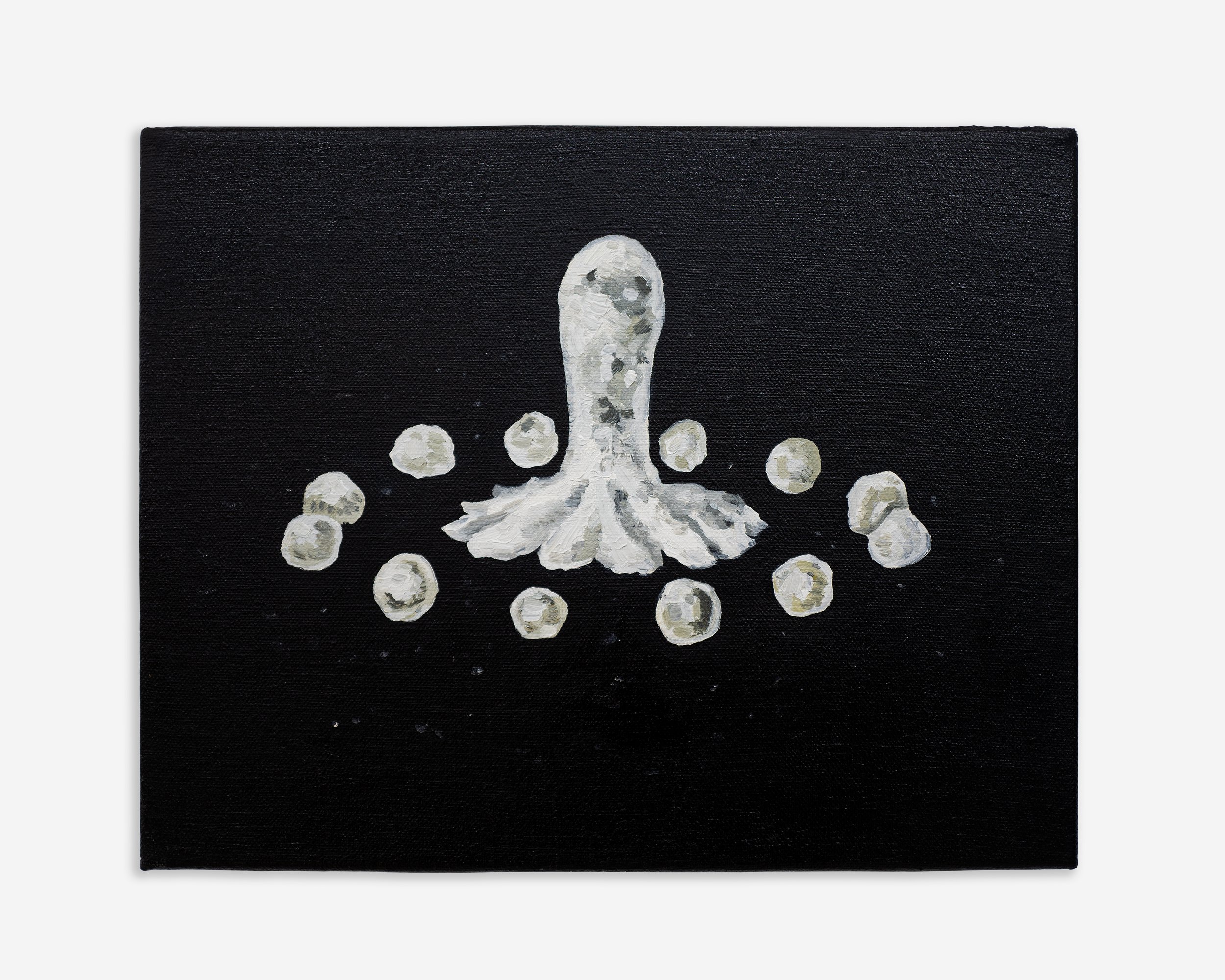
Each panel depicts a different stage of the splash. The first panel shows the moment of impact, the instant when the drop contacts the surface, a moment that is so brief that it can be defined only by the geometry of the contact, the point where the sphere of the drop meets the plane of the surface, and the contact is rendered in oil paint with a precision that is not the precision of the camera but the precision of the hand, the precision that comes from looking at the source image and translating it into the medium of paint, and the translation is not a copy but an interpretation, an interpretation that emphasizes the qualities of the paint, the texture and the opacity and the layering and the color, qualities that the photograph does not possess, qualities that are the product of the hand and the brush and the linseed oil and the pigment, and the emphasis on these qualities is the argument of the painting, the argument that painting can record the splash in a way that photography cannot, not because painting is more accurate but because painting is more present, because the painting is made by a hand that is present in the mark, because the painting unfolds in time the way the splash unfolds in time, because the painting incorporates the bodily movement and the memory and the emotion of the painter, and the incorporation is what the photograph cannot do, the photograph freezes the moment through light and chemical reaction, the painting unfolds the moment through the gesture of the hand, and the gesture is the difference, the difference that the painting preserves and that the photograph eliminates, the difference that is the subject of the six panels and the argument of the sequence.
The colors of the panels are organized around the white of the water and the dark of the background. The water in each panel is rendered in shades of white and pale grey, the color of the drop as it catches the light of the electric spark that Worthington used to illuminate the splash, and the pale colors of the water contrast with the dark background of each panel, the same dark ground that Tan Mu uses for her technological and cosmic subjects, a ground that represents the context from which the splash emerges and the void into which it dissolves, and the contrast between the white water and the dark ground is the same contrast that Worthington observed in his experiments, the contrast that made the splash visible against the background of the laboratory, the contrast that the electric spark produced and that the camera recorded and that the hand drew and that the paint now preserves, and the preservation is the painting, and the painting is the record of the splash that the camera could not keep.
Eadweard Muybridge photographed a horse in motion in 1878. The photographs were made at the request of Leland Stanford, who wanted to know whether all four of a horse's hooves left the ground simultaneously during a gallop, and the question could not be answered by observation alone because the gallop was too fast for the eye to resolve, and Stanford hired Muybridge to answer the question with photography, and Muybridge set up a battery of twelve cameras along a track and arranged for the horse to run past the cameras and trigger them by breaking threads that were stretched across the track, and the cameras fired in sequence and produced twelve photographs of the horse at twelve consecutive moments in its stride, and the photographs showed that all four hooves did leave the ground simultaneously, but not in the way that painters had depicted, not with the legs extended forward and backward as the traditional convention represented them, but with the legs gathered beneath the body in a position that no painter had ever painted, and the discovery was a challenge to the painters, because the photographs revealed a truth that the painters had not seen and could not see, a truth that was visible only to the camera, and the challenge was the challenge that photography posed to painting in the nineteenth century, the challenge that the camera could see what the eye could not, that the camera could record what the hand could not, that the camera could decompose motion into moments that the hand could not capture, and the decomposition was the method, the method of the sequence, the method of the series, the method of the multiple image that records the successive stages of a motion and that arranges them in a spatial sequence that represents the temporal development of the motion, and the method is the method that Tan Mu uses in The Splash of a Drop 1, the method of the six-panel sequence that records the successive stages of the splash and that arranges them in a horizontal sequence that represents the temporal development of the splash, and the method is the same, the method of the serial image, the method that Muybridge used to photograph the horse and that Worthington used to photograph the drop and that Tan Mu uses to paint the splash, and the difference is the medium, the medium of photography in the case of Muybridge and Worthington and the medium of painting in the case of Tan Mu, and the difference in the medium is the argument, the argument that painting can do what photography does, that the hand can decompose motion into moments the way the camera can, that the serial image can be made in paint the way it can be made in silver gelatin, and the making in paint is the reclamation, the reclamation of the serial image from the camera and the return of the serial image to the hand, and the return is the six panels, and the six panels are the splash, and the splash is the moment that the camera could not keep and that the painting remembers.
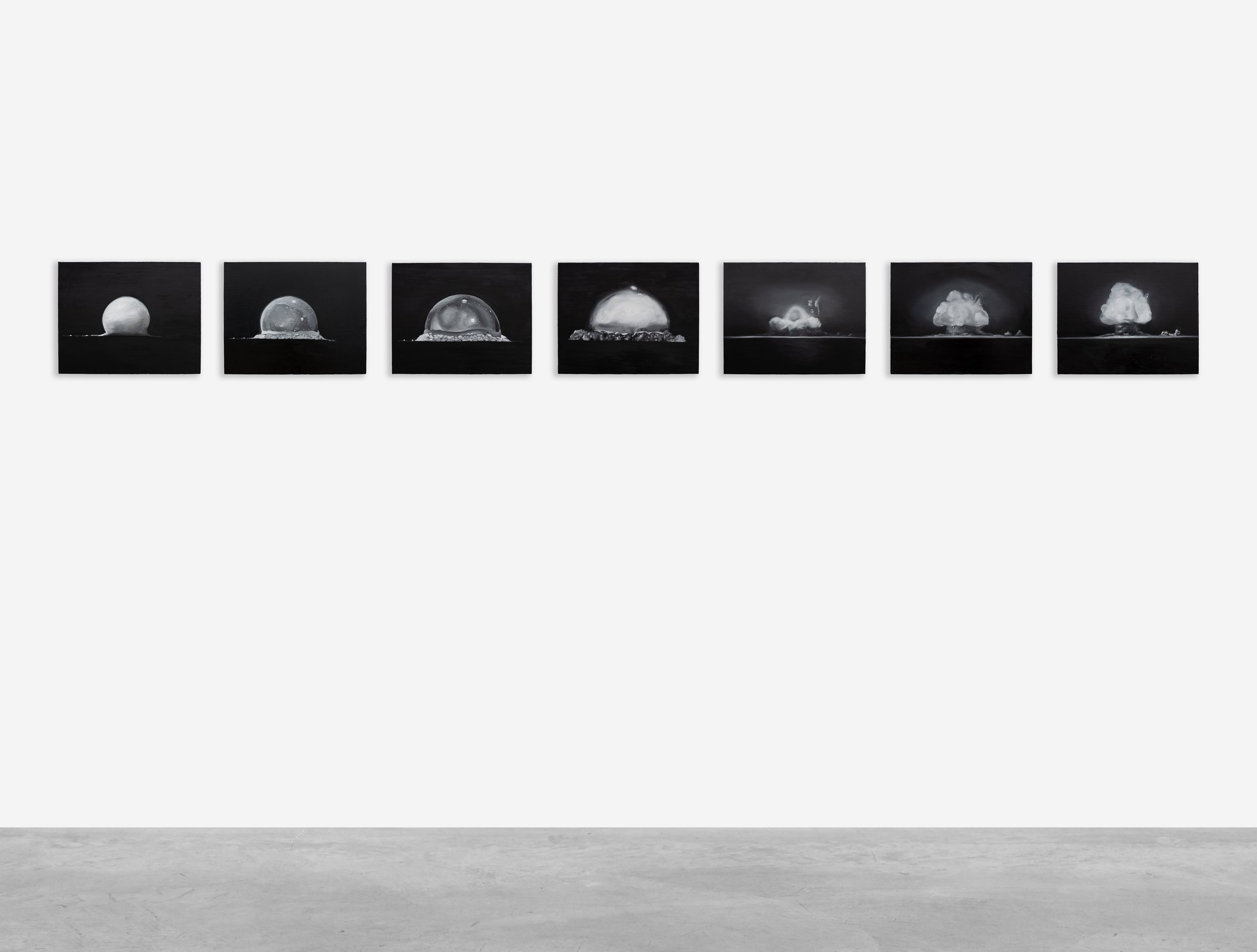
The relationship between The Splash of a Drop 1 and TRINITY TESTING (2020) is a relationship that Tan Mu has described explicitly, and the description is precise: both works document transformations that occur within extremely short spans of time, and they were exhibited together in Berlin and share the same dimensions. TRINITY TESTING captures the immense energy of a nuclear explosion, associated with heat and destruction. The Splash of a Drop 1 focuses on subtle variations within a water droplet's movement. Despite their contrasting subjects, both works examine how technology allows us to observe and archive transient events that would otherwise escape human perception, and the examination is the connection, the connection between the nuclear detonation and the water droplet, the connection between the immense release of energy and the subtle variation of form, the connection between the event that is too fast for the camera of 1945 and the event that is too fast for the camera of 1895, and the camera in both cases is not fast enough, and the painting in both cases is the medium that holds the event when the camera cannot, and the holding is the connection, and the connection is the six panels and the six panels of TRINITY TESTING, and the six panels of both works share the same dimensions, 28 by 36 centimeters each, and the shared dimensions are not a coincidence but a decision, a decision to present both events in the same format, the format of the serial image, the format of the sequence, the format that decomposes the event into moments and arranges them in a spatial order that represents the temporal development of the event, and the format is the argument, the argument that the nuclear detonation and the water droplet are the same kind of event, the kind of event that is too fast for the eye and too fast for the camera and that can be held only by the hand, in the medium of paint, in the format of the sequence, in the six panels that record the stages of the transformation from one state to another, from solid to liquid, from drop to splash, from potential to kinetic, from silence to explosion and back to silence again, and the transformation is the subject, and the subject is the moment, and the moment is the splash, and the splash is the drop, and the drop is the six panels, and the six panels are the painting, and the painting is the record of the moment that photography could not keep.
Saul Appelbaum has written about the concept of arbitration in Tan Mu's work, describing the paintings as unfolding through a process of deciding, judging, mediating between input and output, and the concept is relevant to The Splash of a Drop 1 because the painting is an arbitration between two media, the medium of photography and the medium of painting, an arbitration that decides what to take from the photograph and what to take from the hand, an arbitration that mediates between the precision of the camera and the presence of the gesture, an arbitration that holds both the serial logic of the photographic sequence and the tactile quality of the painted mark, and the arbitration is the six panels, each panel a decision about how to translate the photographic moment into the painted moment, each panel a judgment about what to preserve from the source and what to transform, each panel a mediation between the image that the camera saw and the image that the hand made, and the mediation is the painting, and the painting is the record of the arbitration, the record of the process of deciding and judging and mediating between two ways of seeing, two ways of recording, two ways of preserving the moment that is too fast for the eye and that the camera cannot keep and that the hand can hold, and the holding is the paint, and the paint is the mark, and the mark is the gesture, and the gesture is the time that the painter spent making the mark, the time that the photograph does not contain, the time that is the difference between the camera and the hand, the time that is the reason that the painting exists, the time that is the six panels and the six panels are the splash and the splash is the drop and the drop is the moment that the camera could not keep and that the painting remembers, remembers because the hand was there, because the brush was there, because the painter looked at the source image and translated it into the medium of paint and in the translation preserved not only the form of the splash but the time of the looking, the time of the seeing, the time of the making, the time that the photograph eliminates and that the painting keeps, the time that is the gesture and the gesture is the mark and the mark is the paint and the paint is the record and the record is the six drops that painting remembered when photography could not keep them, and the remembering is the painting, and the painting is six panels wide and twenty-eight centimeters tall and the splash is contained in the twenty-eight centimeters and the six panels and the six panels are the sequence and the sequence is the time and the time is the splash and the splash is the drop and the drop is the moment and the moment is what the painting holds, what the hand keeps, what the camera lost, what Worthington drew because the photograph could not record the finer stages and what Tan Mu painted because the paint can hold what the photograph cannot keep, the moment that is too fast for the light and too brief for the chemical reaction and too fleeting for the sensor and too transient for the technology and too present for anything but the hand, and the hand holds it in six panels of oil on linen, and the six panels are the splash, and the splash is the drop, and the drop is the moment, and the moment is the painting.