Oil and Epoxy: The Material Translation of Logic in Tan Mu's Logic Circuit
The transformation of a silicon wafer into a painting involves a series of translations. First, the physical wafer: a disc of pure silicon crystal, polished to a mirror finish, etched with channels that will carry electrical signals. These channels, cut by photolithography, are microscopic in scale. A human hair is roughly seventy-five micrometers in diameter. The traces on a modern integrated circuit are measured in nanometers. To paint them requires not magnification but interpretation. The painter must decide what matters: the precise geometry of the circuit, the texture of the etched surface, the way light falls across silicon, or the conceptual weight of what the circuit does.
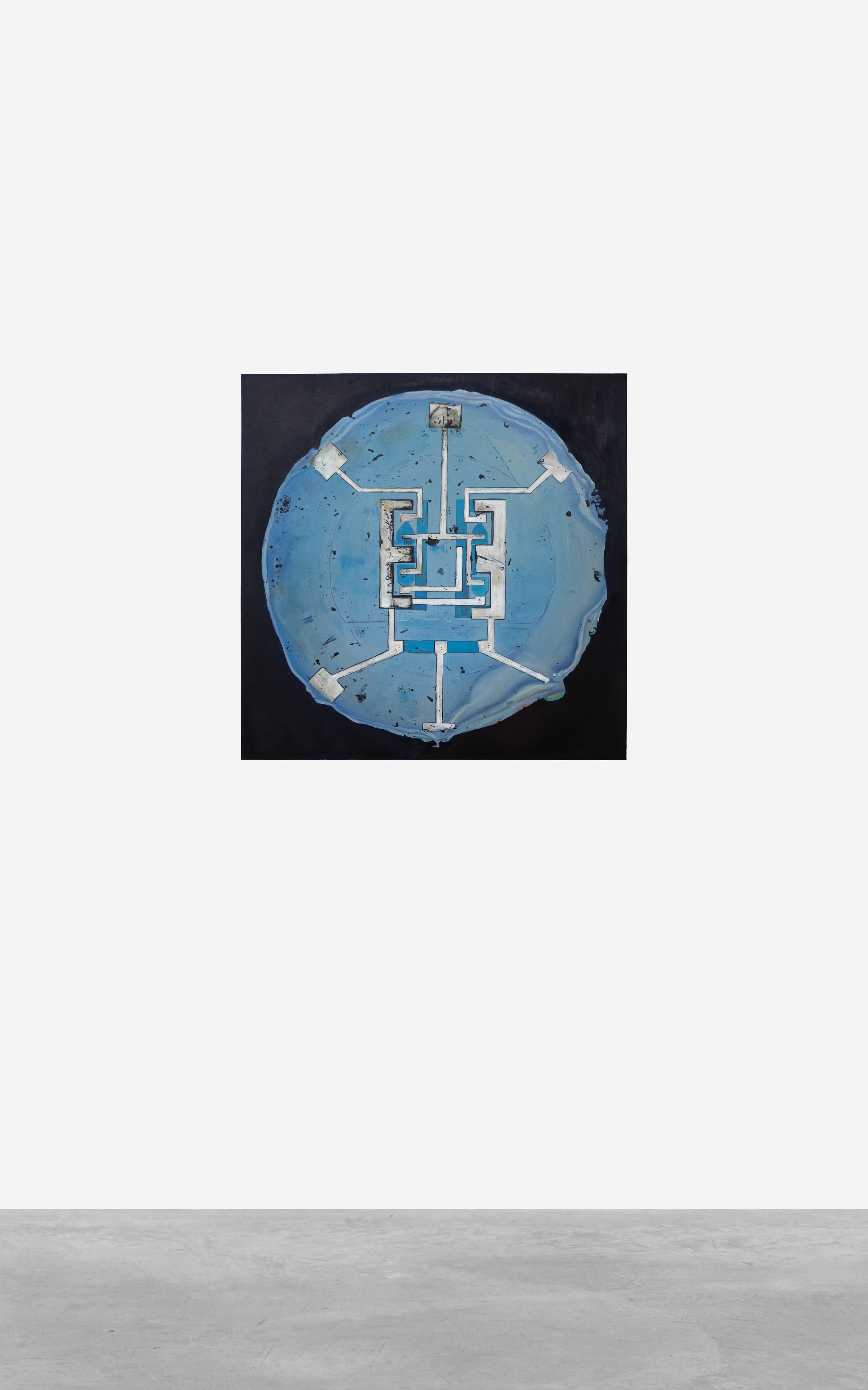
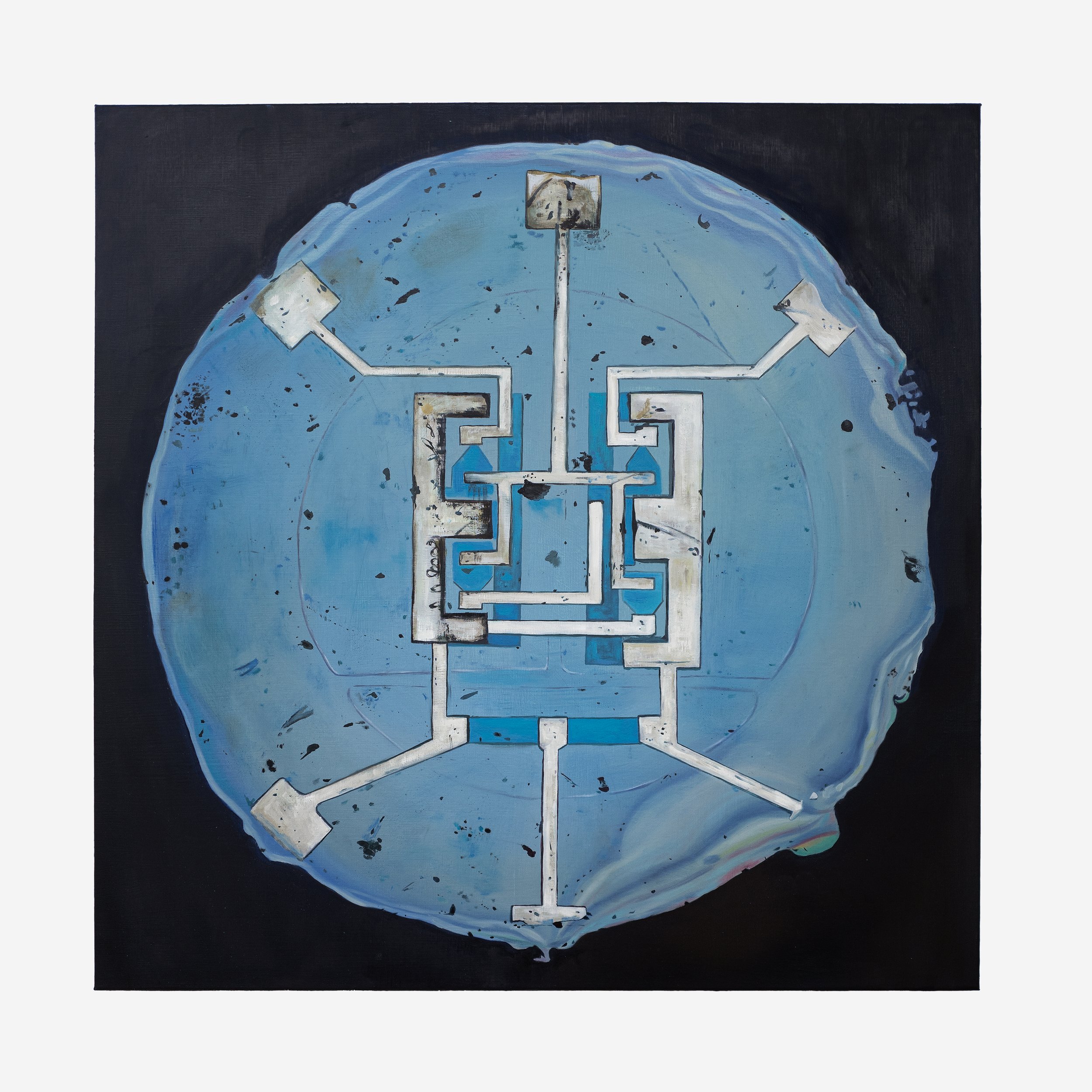
Tan Mu's Logic Circuit (2022) is oil on linen, seventy-six by seventy-six centimeters, a square format that echoes the proportions of a silicon wafer while expanding it to a scale the human eye can comprehend without assistance. The painting does not attempt photorealistic reproduction of circuit diagrams. Instead, it translates the logic of the circuit, its patterns of connection and interruption, into the logic of paint: layers of pigment suspended in linseed oil, applied with brushes, built up over days or weeks of work. This translation is the subject of the painting as much as the circuit itself.
The viewing distance radically alters the painting's impact. At three meters, the image reads as an abstract design, a complex pattern of lines and shapes that suggests a technological origin. But at thirty centimeters, the pattern dissolves into a series of deliberate, hand-painted marks. The "circuit" is revealed to be a construction of paint, a simulation of the very thing it represents. This duality is central to Tan Mu's work: the tension between the digital ideal of the circuit and the material reality of the paint. It asks us to consider the nature of representation itself, and how we translate the invisible world of electrons into the visible world of art.
The color palette is restrained, dominated by the earthy tones of the circuit board itself. Tan Mu uses burnt sienna, raw umber, and ochre to capture the warm, organic feel of the hardware. These are not the cold, metallic colors of the machine, but the colors of the earth from which its components are mined. The gold of the contacts is rendered in yellow ochre and titanium white, a humble substitution that emphasizes the materiality of the paint. The green of the board is a mix of viridian and black, a deep, shadowy hue that suggests the depth of the circuit's logic. This palette is a reminder that our technology is not separate from nature, but a product of it. The circuit board is made of sand, of copper, of gold-all elements of the earth, transformed by human hands into a new kind of nature.
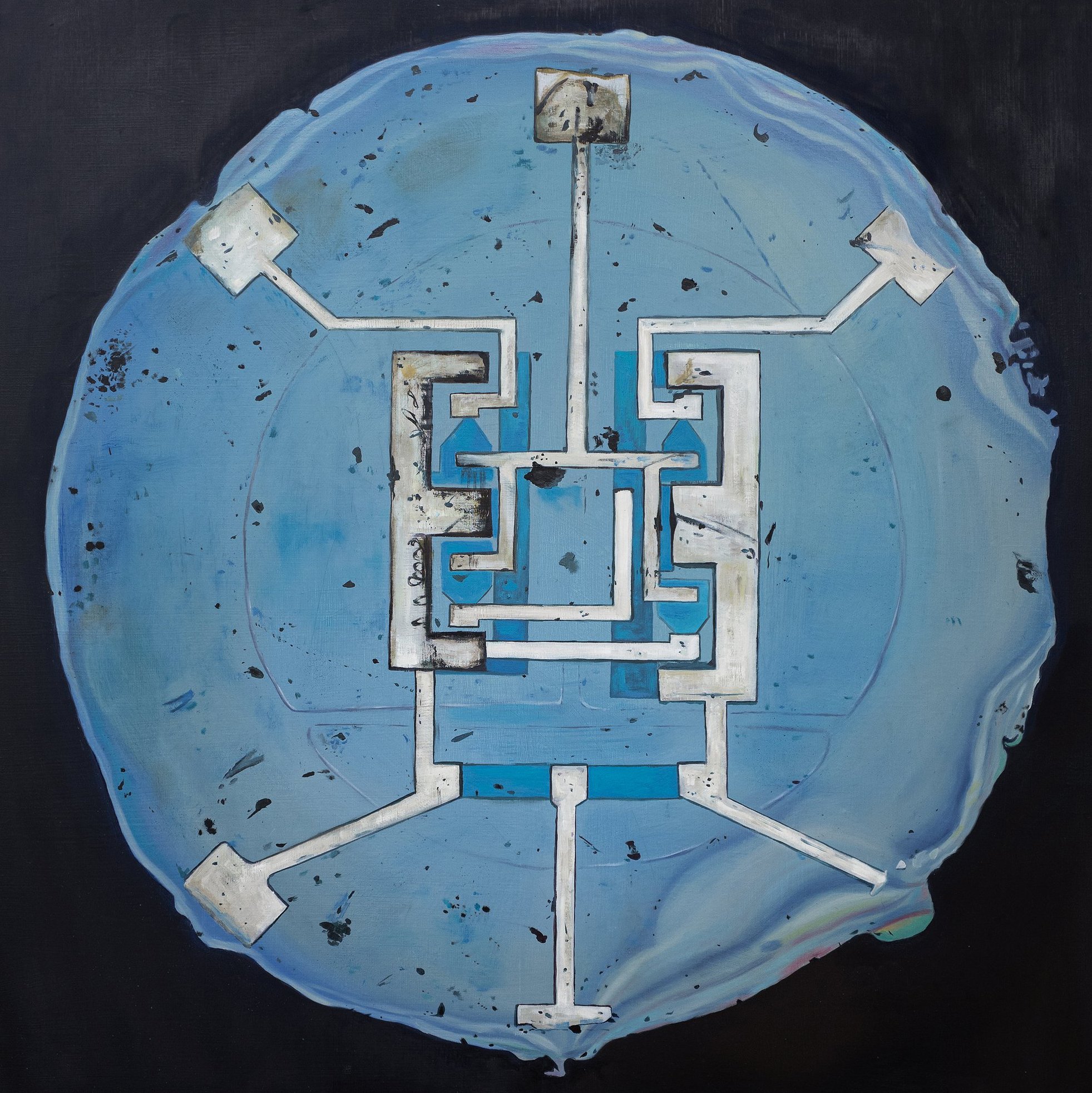
The circuit depicted in Tan Mu's painting is historically specific. It is based on the Micrologic "F" element flip-flop, the first production planar integrated circuit, introduced by Fairchild Semiconductor in September 1960. This device, no larger than a fingernail, contained four transistors and five resistors arranged in a bistable multivibrator circuit. A flip-flop is the fundamental memory element of digital computing: it can store one bit of information, maintaining either a high or low voltage state until instructed to switch. Before integrated circuits, flip-flops were assembled from discrete transistors and resistors wired together by hand. The Micrologic device reduced this assembly to a single chip of silicon.
The significance of this object for Tan Mu's practice is structural. She has described her interest in "the strong visual and structural parallels between these components and the internal architecture of the human brain." The flip-flop's function, storing a binary state, parallels the neuron's function of maintaining an electrical potential until threshold is reached and a signal fires. When silicon wafers age, their surfaces develop irregularities that resemble neural tissue. Tan Mu's painting captures this parallel not through metaphor but through material attention: the way paint settles into the texture of linen, the way brushstrokes record the movement of a hand, the way the circular composition echoes both the wafer and the anatomical diagrams of brain cross-sections.
To understand how Logic Circuit was made, one must consider the properties of the materials involved. Linen, as a painting support, has a pronounced weave that creates a textured surface. Oil paint, applied to this surface, catches on the raised threads and settles into the valleys. The resulting topography is irregular, organic, nothing like the atomic flatness of a polished silicon wafer. This difference is not a failure of representation. It is the point. The painting makes visible the gap between the manufactured precision of the circuit and the hand-worked materiality of the painting.
Geometric constraint has been a fundamental strategy in abstract painting since the 1960s. Agnes Martin's grid paintings, produced from the late 1960s until her death in 2004, use hand-drawn pencil lines on canvases of precise, nearly square proportions to produce surfaces that hover between geometric regularity and perceptible imperfection. Martin described her work as expressing "the innocence of trees," suggesting that systematic constraint could produce transcendental experience. Where Martin's grids are resolutely non-representational, Tan Mu's circular circuit diagrams are derived from actual objects. But the formal strategy is related: both artists use geometric systems that exceed their capacity to be perfectly executed by hand, producing surfaces in which the attempt at precision and the evidence of the hand's limitation create a productive tension.
Tan Mu's process involves research into the physical structure of her subjects. For Logic Circuit, this meant studying not merely circuit diagrams but the actual appearance of etched silicon: the channels cut by acid, filled with epoxy resin to prevent short circuits, the way light refracts through the thin layers of silicon dioxide that form the gate insulators. The painting's palette, dominated by pale blues and whites with subtle variations in tone, registers this research. The colors suggest silicon, metal, the pale gold of epoxy, without attempting to reproduce them exactly.
The circular composition of Logic Circuit imposes a formal constraint that shapes the entire painting. Within this circle, the circuit's rectilinear geometry is adapted to curved space. Straight lines become arcs. Square corners soften. This transformation parallels the translation from digital to analog: the discrete states of the flip-flop (on or off, zero or one) become the continuous gradations of paint (more blue or less, thicker application or thinner). The circle itself, a form that appears throughout Tan Mu's work, operates as a structural motif connecting technological and biological systems.
Every brushstroke in Logic Circuit records a specific movement of the painter's hand. This seems obvious, but its significance becomes clear when contrasted with the manufacturing process of the integrated circuit itself. The Micrologic flip-flop was produced by photolithography: a mask was created photographically, light was projected through this mask onto a photosensitive coating on the silicon, and chemical etching removed material where the light had struck. No human hand touched the surface of the chip during its fabrication. The precision of the circuit is the precision of optics and chemistry, not manual dexterity.
Tan Mu's painting restores the hand to this history. The visible brushstrokes assert the presence of a body in the process of making. This is not nostalgia for a pre-industrial craft tradition. It is a deliberate insertion of human materiality into a technological lineage that tends to erase it. The painting says: this circuit, however precisely manufactured, however minutely etched, exists within a human context. Someone designed it. Someone uses it. Someone, in this case, has spent days or weeks contemplating its form and translating it into another medium.
Scale operates as a fundamental concern in Tan Mu's practice. She consistently chooses subjects that exist at scales inaccessible to direct unaided perception: submarine cable networks at planetary scale, quantum processors at nanometer scale, and in Logic Circuit, integrated circuits at the scale of millimeters. The painting enlarges these subjects to dimensions that the human eye can read, the hand can approach, the body can stand before. At seventy-six centimeters square, Logic Circuit makes visible a technology that would otherwise require a microscope to see.
The materials of the integrated circuit and the painting share a common ancestry in organic chemistry. The epoxy resin that fills the etched channels of the silicon wafer is a polymer, a chain of molecules synthesized from petroleum. The linseed oil that binds Tan Mu's pigments is also derived from organic matter: the seeds of the flax plant, pressed and refined. Both materials undergo transformation. Epoxy cures from liquid to solid through chemical reaction. Linseed oil oxidizes, polymerizing into the tough, flexible film that gives oil paintings their durability.
This material parallel is not coincidental. Tan Mu's practice consistently draws connections between the substances of technology and the substances of art. In her Silicon paintings (2021, 2023), she depicts the purified silicon wafers that form the substrate of microchips. In Quantum Computer (2020), she renders the metallic and glass surfaces of the cryostat. The materials she paints, silicon and metal and epoxy, find their counterparts in the materials she paints with, linen and oil and pigment. This correspondence is not symbolic. It is literal, chemical, a shared grounding in the physical world.
In Logic Circuit, the specific texture of the painting's surface registers this material thinking. The linen weave is visible beneath the paint layers, creating a topography that interrupts the smooth flow of the circuit's lines. Where the actual integrated circuit presents a flat, polished surface, the painting offers depth: layers of ground, underpainting, glazed color, final touches. This depth is temporal as well as spatial. The painting accumulates duration. Each layer must dry before the next is applied. The circuit, manufactured in seconds by photolithography, is stretched across days or weeks of painterly labor.
The fundamental operation of a flip-flop is discrete state change. The circuit sits in one state (zero) until a signal forces it into another (one). There are no intermediate states. This binary logic underlies all digital computation. Painting, by contrast, operates in continuous gradations. A tone can be lighter or darker, warmer or cooler, without fixed thresholds. The translation from circuit to painting thus involves a shift from discrete to continuous, from digital to analog.
Tan Mu's Logic Circuit does not hide this shift. The painting makes it visible. The circuit's sharp edges, where transistor meets resistor, become softened in paint. The precise boundaries between conductive and non-conductive areas blur into tonal gradations. This is not inaccuracy. It is a revelation of what painting can do that integrated circuits cannot. The circuit processes information by maintaining strict distinctions. The painting processes information by allowing flows and continua.
This distinction matters for understanding Tan Mu's broader practice. Her paintings of technology do not serve the same function as the technologies they depict. A submarine cable transmits data across oceans. A painting of a submarine cable transmits something else: attention, duration, the evidence of looking. Similarly, Logic Circuit does not compute. It does not store bits. It stores something less quantifiable: the time spent in its making, the research into its subject, the decision-making that shaped every brushstroke.
Systematic repetition and the accumulation of discrete units over time has characterized several major art practices of the postwar period. Agnes Martin’s grid paintings, executed with meticulous precision from the 1960s onward, use horizontal and vertical lines to create fields of meditative stillness. Each line is a decision, a mark made in time, contributing to a larger architecture of thought. On Kawara's Today series (1966-2013) recorded single dates through paintings made according to strict protocols: the date in the format of the country where the painting was made, executed in a single day, destroyed if not completed by midnight. Both practices use temporal duration as a compositional element, making time itself a visible component of the artwork. Tan Mu's methods share this commitment: the slow accumulation of paint, the extended research period, the long duration between conception and final image. Where Martin and Kawara made time itself their subject, Tan Mu uses duration as a means of investigating technological systems.
Tan Mu's practice is structured by what she calls an atlas: a methodological system for organizing research, archival material, and painting. The atlas functions as a comparative framework, allowing heterogeneous information to be brought into relation. In the case of Logic Circuit, the atlas would include technical documentation of the Micrologic device, photographs of silicon wafers, diagrams of neural architecture, and notes on the properties of oil paint and linen.
This archival dimension shapes the painting's material form. Logic Circuit is not a spontaneous improvisation. It is the result of sustained research, the accumulation of information that finds its way into the work through informed decision-making rather than direct transcription. The painter knows the history of the circuit she depicts: its introduction in 1960, its role in the miniaturization of electronics, its parallels to neural structure. This knowledge informs the handling of paint without necessarily becoming explicit in the image.
The circular format of Logic Circuit operates on multiple levels. Formally, it echoes the shape of a silicon wafer, which is circular because silicon crystals are grown as cylinders and sliced into discs. Conceptually, it evokes the cyclical patterns found in both Eastern philosophy and Western mathematics: the cycles of energy, the topology of flow, the fundamental patterns of connection that recur across scales from neural networks to data centers.
Tan Mu has spoken about the circle as a form that "represents connection, continuity, and the flow of information across systems." In Logic Circuit, this conceptual loading is reinforced by the specific material choices: the pale blue ground suggests both silicon and sky, the etched channels resemble both circuit traces and river systems, the circular boundary encloses a world that is simultaneously technological and organic. The painting does not force a choice between these readings. It allows them to coexist, accumulating meaning through the viewer's attention.
The result is a work that functions as both documentation and meditation. Logic Circuit records a specific technological artifact, the first planar integrated circuit, at a specific moment in its afterlife, more than sixty years after its introduction. But it also records something more personal: the time spent looking, the decisions made about color and surface, the translation of research into material form. This doubleness is characteristic of Tan Mu's practice. Her paintings are always about two things at once: the technology they depict and the process of their own making.
In the end, what Logic Circuit offers is not information about integrated circuits but a way of thinking about them through the specific capabilities of oil paint. The painting slows down perception. It asks the viewer to spend time with an object that, in its original form, would be invisible without magnification. It replaces the circuit's functional precision with the painting's material presence. The flip-flop that could store one bit of information becomes a surface that stores light, attention, and the evidence of human labor. This is not representation. It is transformation.
This transformation is the core of Tan Mu's practice. She is not just a painter of technology; she is a translator of it. Her work takes the language of science and engineering and translates it into the language of art. In doing so, she reveals the hidden beauty of our technological world, the artistry that lies at the heart of our machines. Logic Circuit is a testament to this artistry, a celebration of the human ingenuity that created it. But it is also a reminder of our dependence on these machines, of the ways in which they shape our lives and our perceptions. The painting is a mirror, reflecting our own technological nature back at us. It asks us to consider our place in this digital age, and to recognize the human hand that guides the logic of the circuit.