Operation Crossroads: Tan Mu's Bikini Atoll and the Mushroom Cloud as Still Life
On July 1, 1946, at 9:00 a.m. local time, the United States detonated Able, a 23-kiloton plutonium implosion device suspended 159 meters above the lagoon at Bikini Atoll in the Marshall Islands. The explosion vaporized two unmanned warships positioned within 300 meters of ground zero and damaged nine others. The radioactive plume rose to 44,000 feet. The blast wave circled the earth three times. Operation Crossroads, the first postwar nuclear test series, was intended to assess the effects of atomic weapons on naval targets. Able was the first underwater test in history. Bikini Atoll was chosen because it was remote, sparsely populated, and possessed a lagoon deep enough to sink battleships. The indigenous Bikini people, 167 individuals, were relocated to Rongerik Atoll with the promise of return. They never returned. The atoll remains uninhabitable. Tan Mu painted it in 2020.
The choice to paint this specific moment, the first test of the postwar era, is significant. It was a moment of transition, when the bomb changed from a weapon of war to a tool of statecraft, a symbol of power that could be used to shape the world. The test was not just a scientific experiment; it was a performance, a spectacle of power designed to be seen by the world. The photographers and filmmakers who documented the test created the images that would define the nuclear age, the mushroom cloud becoming the icon of a new era. Tan Mu's painting is a response to those images, a re-reading of the visual history of the nuclear age. She takes the icon and strips it of its power, reducing it to a small, still object, a thing of beauty and terror.
*Bikini Atoll* (2020) is oil on linen, 41 by 51 centimeters. The composition centers a mushroom cloud rising from an expanse of water rendered in tones of Payne's gray and cobalt blue. The cloud itself is built from layers of burnt sienna, raw umber, and titanium white, the base a dense accumulation of cadmium red light that bleeds upward into the stem. The water surface reflects the explosion in a pattern of specular highlights, the ripples described with ultramarine blue and flake white. The painting measures sixteen by twenty inches. It is the size of a standard portrait. The explosion that produced radiation levels that would contaminate the atoll for decades occupies a surface the size of a sheet of letter paper, a monumental event shrunk to a handheld scale to force a moment of private reckoning.
The viewing distance radically alters the painting's impact. At three meters, the image reads as a graphic icon, a stylized representation of a mushroom cloud that is instantly recognizable. The details of the brushwork are lost, and the painting functions as a symbol. But at thirty centimeters, the symbol dissolves into a complex field of paint. The white of the cloud is not a single color but a layering of titanium, zinc, and lead white, each with its own transparency and texture. The gray of the water is not flat but deep, a glazed surface that seems to recede into the canvas. At this proximity, the viewer is no longer looking at a bomb but at the act of painting itself, the material process of capturing an immaterial event.
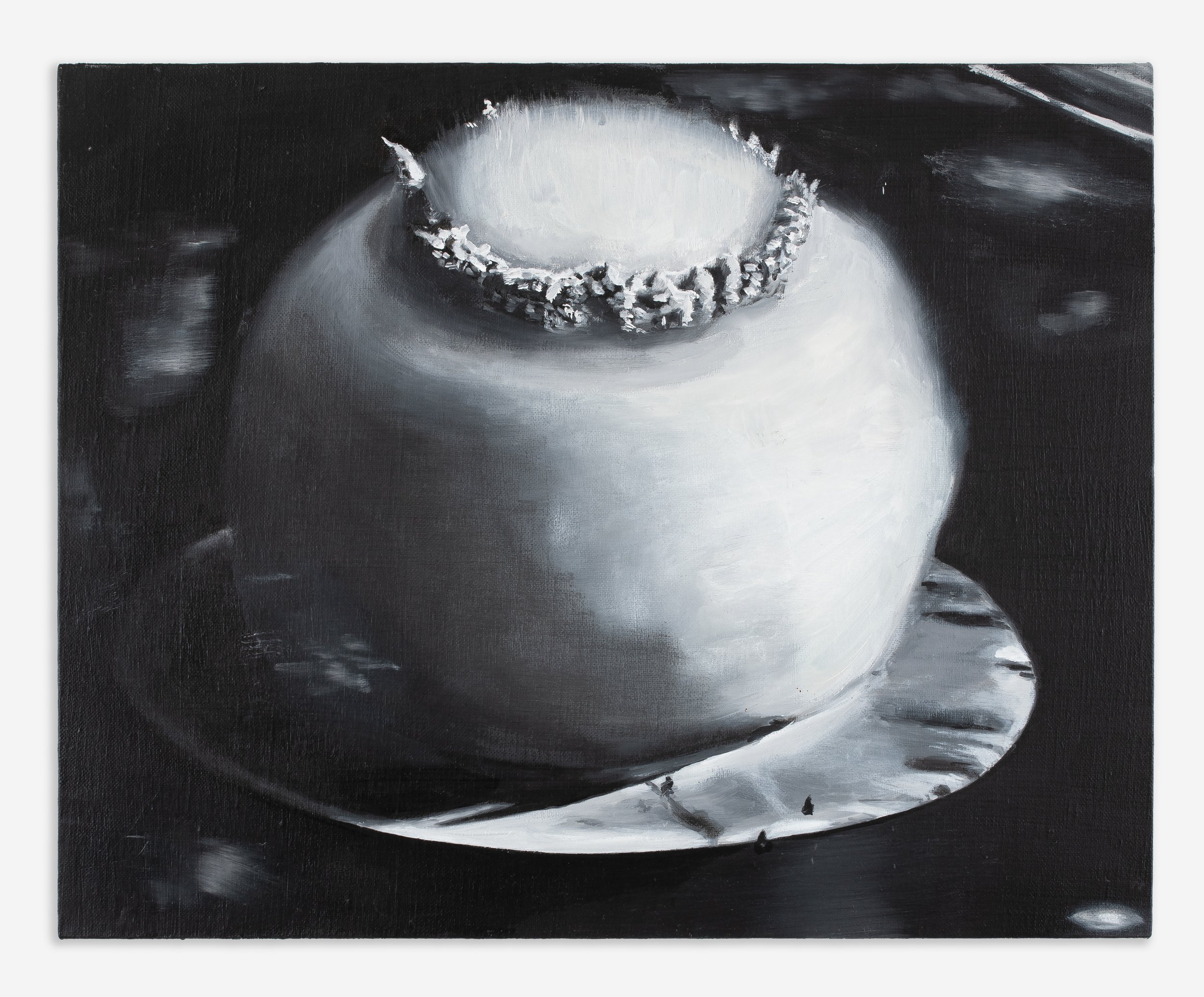
The reduction of scale is the painting's first conceptual move. Operation Able produced a fireball 250 meters in diameter that rose to 18 kilometers before flattening into the characteristic cap. The Baker shot, conducted four weeks later on July 25, produced a column of water and radioactive mist that reached 1.8 kilometers high and a base surge that engulfed target ships within a kilometer of ground zero. The official report documented seventy-eight ships damaged or sunk. The Bikini people were evacuated three days before Able. They watched the explosion from Rongerik, 125 miles away. The shockwave arrived in thirty minutes. The light was visible for hundreds of miles. Tan Mu's painting compresses this event to the scale of a tabletop object. The mushroom cloud is not sublime. It is intimate. It is the size of a bouquet. The painting does not attempt to convey the scale of the explosion. It conveys the scale at which the explosion can be thought about.
The painting's palette reinforces this intimacy. Cadmium red light at the base gives way to burnt sienna and raw umber in the stem, titanium white and Naples yellow in the cap. The lagoon is Payne's gray with accents of cobalt blue and Prussian blue. Flake white highlights describe the water's surface tension. These are the colors of a traditional still life: the red of fruit, the umber of earth, the white of porcelain, the blue of delftware. The explosion, which produced a fireball hot enough to vaporize steel at 6,000 degrees Celsius, is rendered in the colors of a domestic interior. The painting does not historicize the event through spectacle. It domesticates it through color.
The compositional structure completes the transformation. The horizon line sits low in the frame. The mushroom cloud rises from the center, occupying two-thirds of the height. The water surface is described with enough detail to suggest ripples but not enough to convey motion. The entire image reads as a single object: the cloud and its reflection forming a self-contained unit against the blank linen ground. This is still life logic. The painting is not a landscape. It is not a historical scene. It is an arrangement of forms on a tabletop. The atomic bomb has become a vase.
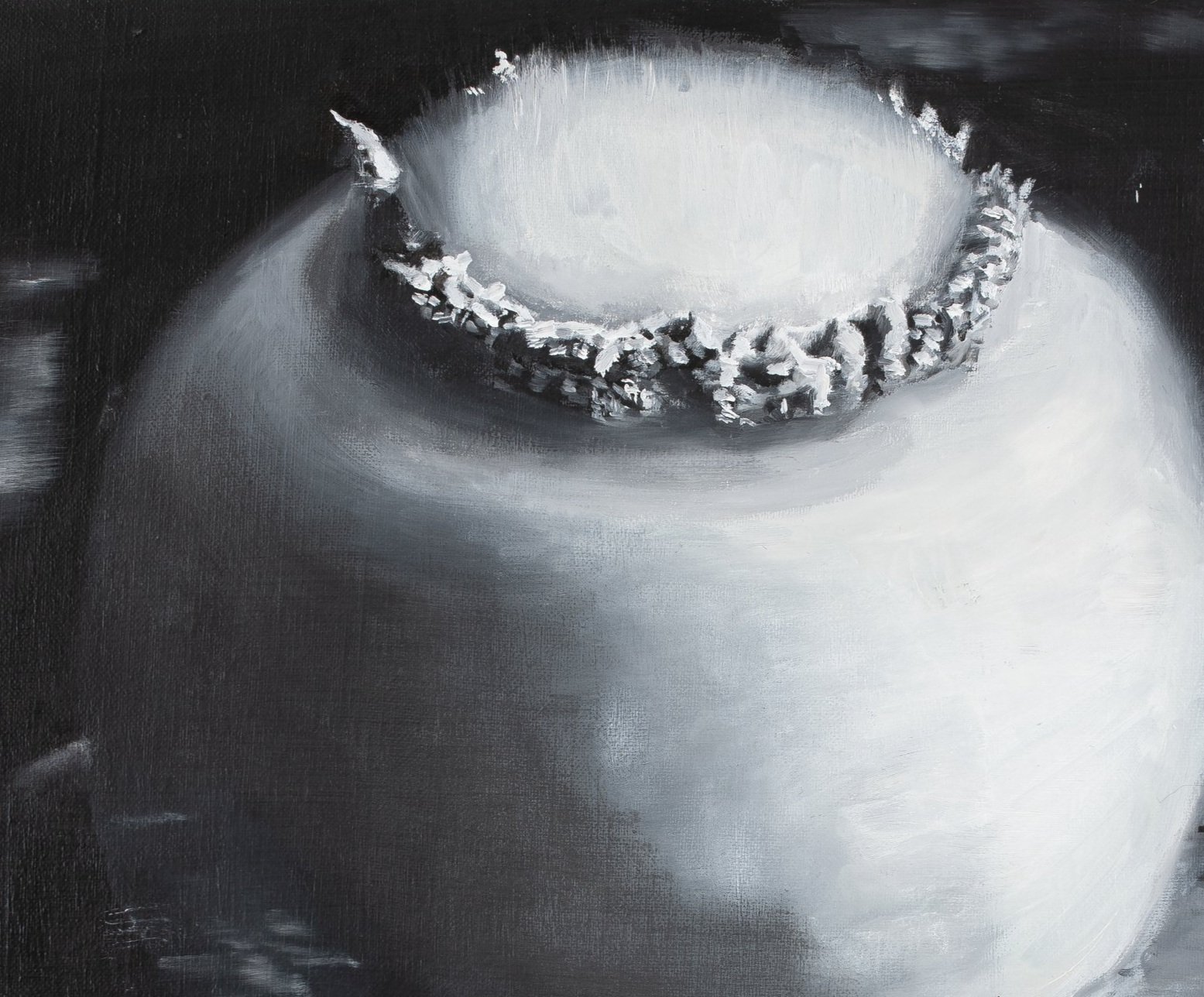
The still life genre has historically served to elevate the ordinary to the status of art. In the seventeenth century, Dutch painters like Willem Kalf and Pieter Claesz used the form to elevate glassware, fruit, and table linens to the status of vanitas symbols: reminders of mortality and transience. The skull, the overturned glass, the wilting flower: objects that remind the viewer of time's passage. Tan Mu's *Bikini Atoll* performs a similar elevation but in reverse. The extraordinary event, the first underwater nuclear test, is reduced to the status of ordinary object. The painting does not elevate the bomb to the sublime. It lowers the sublime to the level of the still life. The result is a painting that forces the viewer to confront the bomb not as spectacle but as artifact.
The formal decision to treat the nuclear explosion as still life has precedents in the way artists have approached catastrophic events. J.M.W. Turner's *The Slave Ship* (1840) depicts the Zong massacre, in which 133 enslaved Africans were thrown overboard to claim insurance, as a seascape in which the drowning figures are nearly invisible against the storm-tossed waves. Turner renders the historical violence as atmospheric effect, the human cost absorbed into the sublime forces of nature. Tan Mu's approach is related but inverted. Where Turner disperses the violence into the vastness of the sea, Tan Mu concentrates it into a single object. The bomb is not lost in the landscape. It is the landscape.
Turner's use of color in *The Slave Ship* is a study in horror, the reds of the sunset merging with the reds of the blood in the water. Tan Mu's use of color is a study in absence. The painting is not a riot of color but a restrained palette of grays and whites, a visual silence that mirrors the silence of the victims. Turner's painting is a scream; Tan Mu's is a whisper. Both, however, are about the failure of the human imagination to grasp the scale of its own cruelty. Turner's storm is a metaphor for the moral chaos of the slave trade. Tan Mu's mushroom cloud is a metaphor for the moral chaos of the nuclear age. Both artists use the sublime to make the unbearable visible, to force the viewer to look at what they would rather ignore. In both works, the human figures are absent or marginalized, lost in the vastness of the forces they have unleashed. This absence is the true subject of the paintings, the void left by human suffering.
The painting's intimacy of scale and color creates a tension with the event's historical weight. Operation Crossroads was not a single test. Able was followed by Baker on July 25, which produced a column of radioactive water 1.8 kilometers high and contaminated the target fleet so thoroughly that most ships were scuttled. The tests displaced 167 Bikini people, who were promised a return that never came. The atoll remains uninhabitable due to cesium-137 in the soil, with a half-life of 30 years. The United States conducted 67 tests at Bikini between 1946 and 1958, totaling 76 megatons, five thousand times the yield of Hiroshima. Tan Mu's painting does not depict this history through accumulation. It depicts a single moment: Able, the first shot, suspended in oil on linen. The historical weight is implied by the image's familiarity. The viewer knows what this image means. The painting asks what it means to know.
The lagoon surface plays a crucial role in this question. Rendered in Payne's gray with cobalt blue undertones, the water reflects the explosion in a pattern of specular highlights that suggest ripples without conveying motion. The reflection is static. The bomb is static. The entire image is frozen. This stillness is not the stillness of photography, which freezes a moment in time. It is the stillness of painting, which holds a moment outside time. The bomb that produced a shockwave that circled the earth three times is rendered motionless. The event that contaminated an atoll for decades is rendered as a still life. The painting does not merely depict the bomb. It neutralizes it.
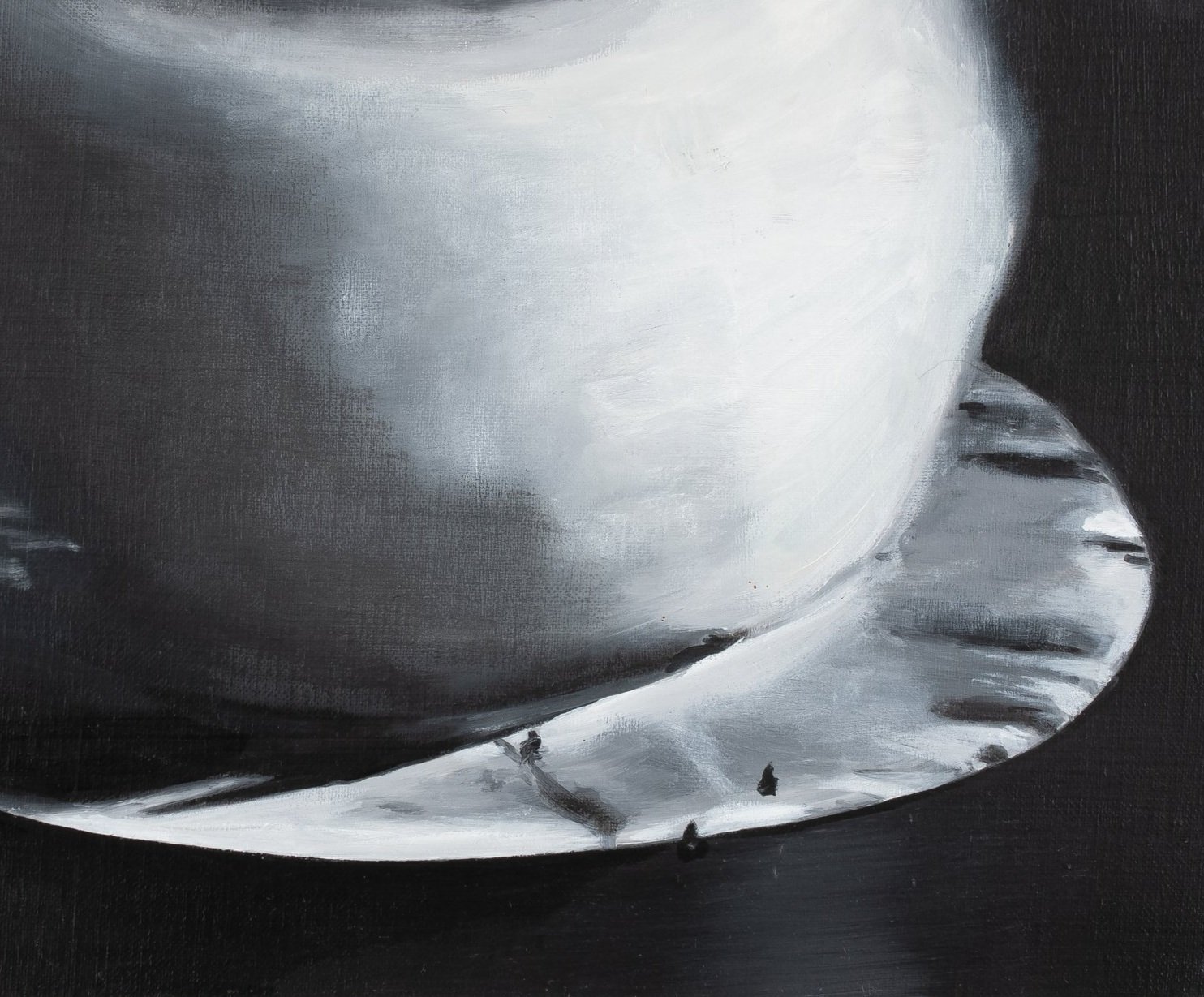
The question of how to represent nuclear catastrophe has been a preoccupation of postwar art. The bomb enters painting through indirection. In *Guernica* (1937), Picasso depicts the aerial bombing of a civilian population not through explosion but through fragmented bodies and screaming heads. The bomb is absent. The aftermath is everything. In Tan Mu's *Bikini Atoll*, the aftermath is also absent. The painting depicts the moment of detonation, but the detonation is treated as object rather than event. The bomb is present but neutralized. The painting does not show destruction. It shows what destruction looks like when it is contemplated at leisure.
The Bikini people's story provides the painting's unspoken context. Evacuated three days before Able, they watched the explosion from Rongerik. The shockwave arrived thirty minutes later. The light was visible for hundreds of miles. They were told they could return after the tests. They were told the radiation would dissipate. Seventy-eight years later, the atoll remains contaminated. Cesium-137 in the soil has a half-life of thirty years. The coconuts are radioactive. The people of Bikini are dispersed across the Marshall Islands and the United States. Tan Mu's painting does not depict this diaspora. It depicts the bomb that caused it. The small scale and still life treatment force the viewer to hold the cause and the effect in the same frame. The bomb is small enough to fit on a table. Its consequences filled an ocean.
The displacement of the Bikini Islanders was not just a physical relocation; it was a cultural unmooring. The atoll was not just their home but the center of their cosmology, the place where their ancestors were buried and where their gods resided. To remove them from the atoll was to remove them from their history. The promise of return was a lie, a necessary fiction to facilitate the testing program. The Islanders were moved from Rongerik to Kwajalein, then to Kili, a small island without a lagoon, where they were unable to practice their traditional fishing methods. Each move was a further erosion of their identity, a further step into the void. Tan Mu's painting, with its stark black and white palette, captures this sense of loss, the void that remains when a people are disconnected from their place.
The painting's finish is matte throughout. No varnish. The surface absorbs light rather than reflecting it. This choice aligns with the painting's conceptual strategy. The bomb that produced a fireball brighter than the sun is rendered in a surface that swallows light. The event that changed the course of history is rendered in a format that invites casual contemplation. The painting does not demand attention. It waits for it. The viewer must approach closely to see the brushwork, the layering of cadmium red into sienna, the way the Payne's gray lagoon meets the linen ground. The bomb rewards looking. The longer the viewer looks, the heavier the painting becomes.
Operation Crossroads was intended to test the bomb's effects on ships. It tested something else as well: the limits of human control over physical forces. The Baker shot produced a base surge that engulfed the target fleet, contaminating ships miles from ground zero. The radiation levels were orders of magnitude higher than expected. The test series was canceled after two shots. The bomb proved uncontainable. Tan Mu's painting contains it. The uncontainable force is given boundaries by the linen rectangle. The historical rupture is given form by pigment and binder. The painting does not explain the bomb. It demonstrates what it means to live with its image.
The Bikini Atoll painting hangs in a room with Tan Mu's other nuclear works: *Trinity Testing* (2020), seven small canvases depicting the first atomic test; *Bikini Atoll* itself; *Stanford Torus* (2020), a space colony design that assumes nuclear propulsion. The nuclear series is not a sequence of disasters. It is a sequence of technologies: the bomb that ends wars, the bomb that powers ships, the bomb that powers interstellar travel. The paintings treat these technologies with the same formal attention. The bomb is not moralized. It is materialized. The painting asks the viewer to look at the bomb the way Tan Mu looked at it: as object, as history, as the thing that changed everything and then became ordinary.
The ordinary is where the painting ends. The bomb that ended World War II, that ushered in the Atomic Age, that contaminated an atoll for generations, is rendered as a still life on a table. The viewer stands before it at leisure. The painting does not hurry. The bomb, which took two seconds to detonate, is given the time of oil paint to dry. The event that changed history is given the scale of a portrait. The uncontainable is contained. The painting holds it there, in oil and linen, until someone looks. The look is the point. The look is the acknowledgment of the cost, the recognition of the loss, the acceptance of the responsibility. The painting does not offer a solution. It offers a presence, a silent witness to a history that is not yet past.
In the end, *Bikini Atoll* is not just about the bomb. It is about the act of looking at the bomb, the way we consume images of destruction without feeling their weight. Tan Mu's painting restores that weight, forcing the viewer to confront the reality of the nuclear age not as a historical abstraction but as a lived experience. The painting is a mirror, reflecting our own complicity in the systems that produce such weapons, our own silence in the face of such destruction. It is a call to remember, to mourn, and to resist. The cloud may be small, but its shadow is vast, and it falls on us all.