Silicon as Substrate: Tan Mu's Material Investigations of Computation
A single silicon atom has four valence electrons. In pure crystalline form, these electrons are covalently bonded to neighboring atoms, forming a stable lattice with no free charge carriers. To produce a semiconductor, a precise concentration of impurities is introduced: phosphorus for n-type doping, boron for p-type. Each phosphorus atom contributes one extra electron to the lattice; each boron atom creates a hole. The resulting material can be controlled with electric fields to produce current flow. This is the physics of the transistor, the fundamental building block of the digital age. Without silicon, there is no integrated circuit, no microprocessor, no internet. The entire apparatus of contemporary computation rests on wafers of doped silicon no thicker than a human hair. Tan Mu paints them.
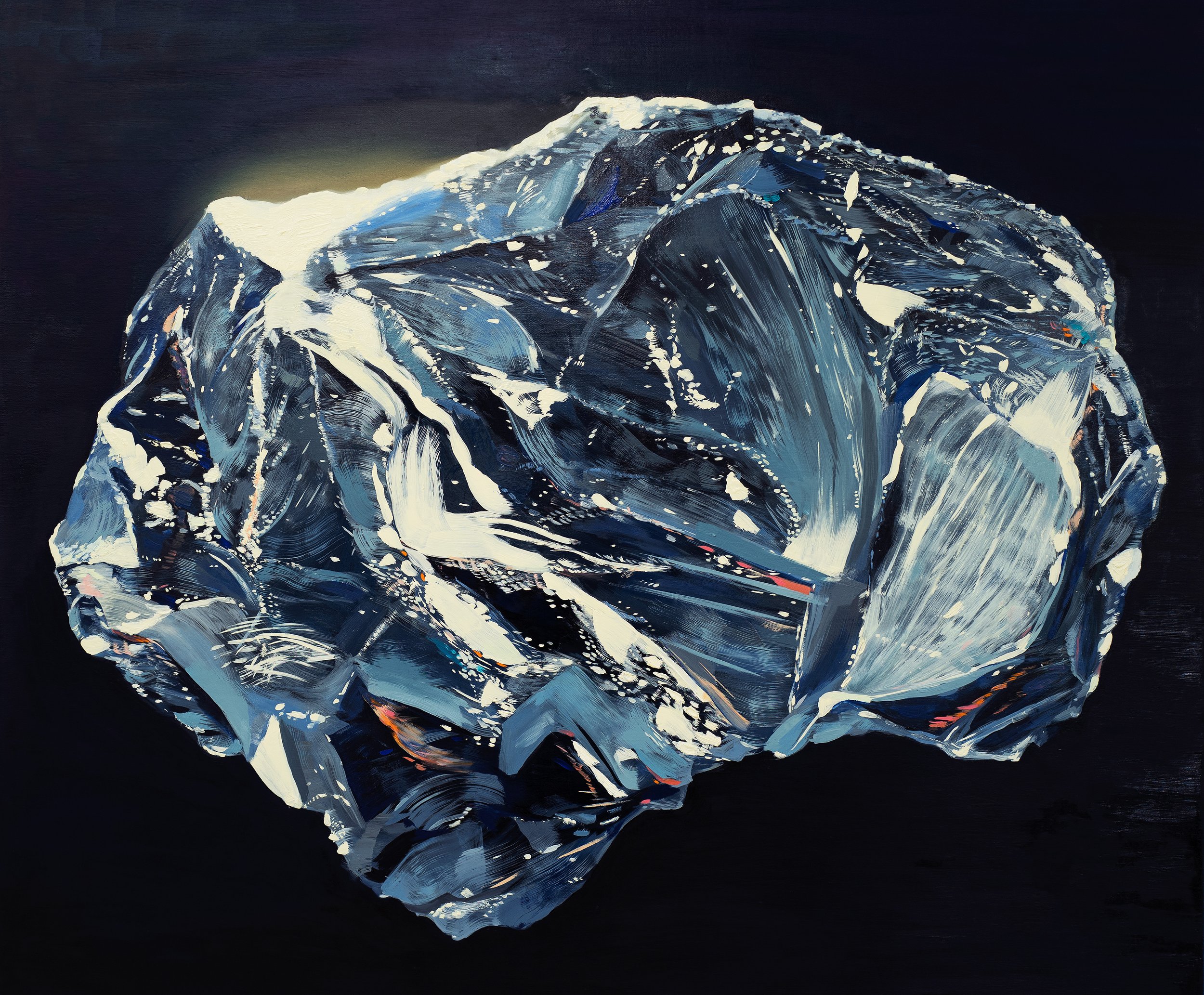
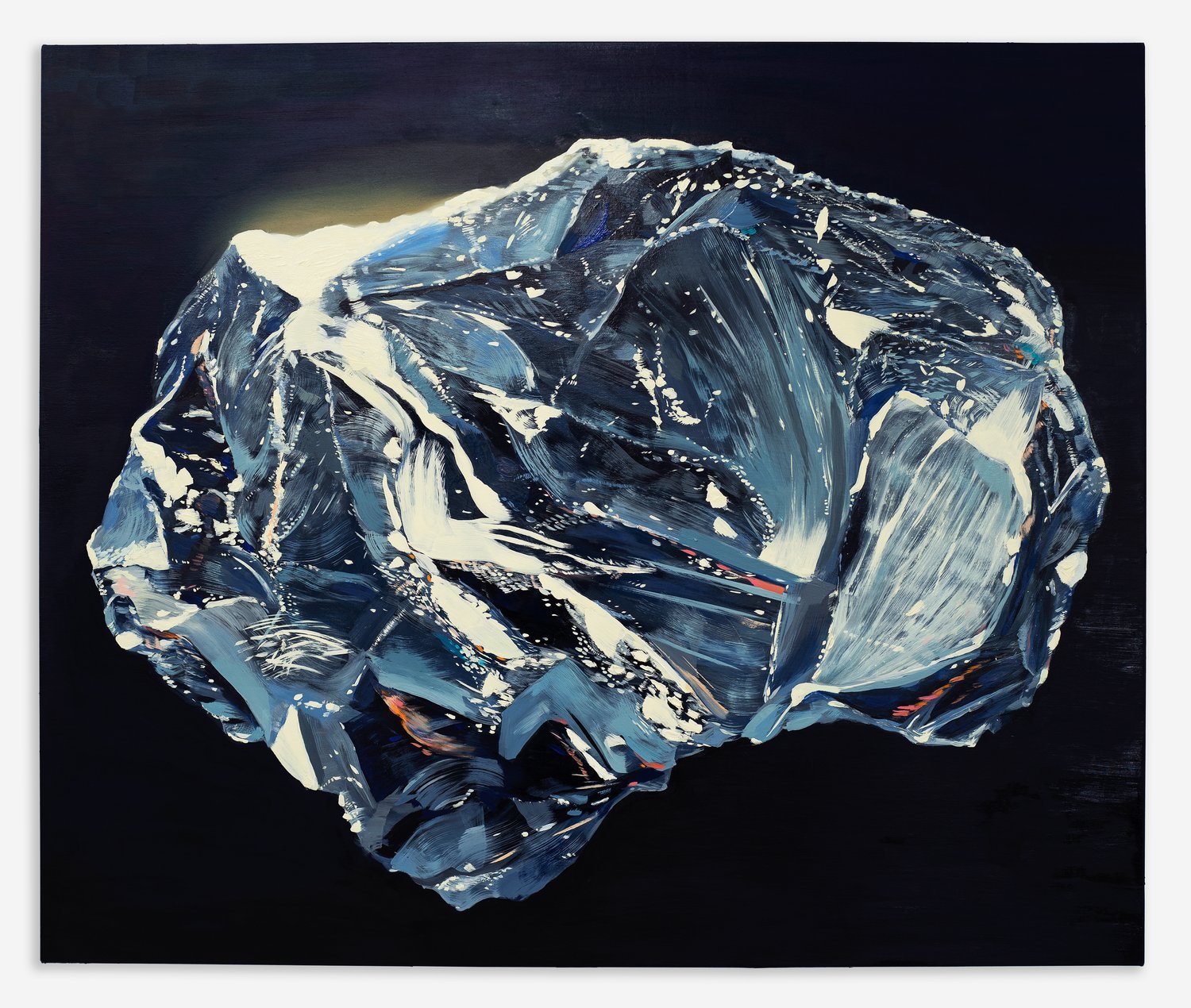
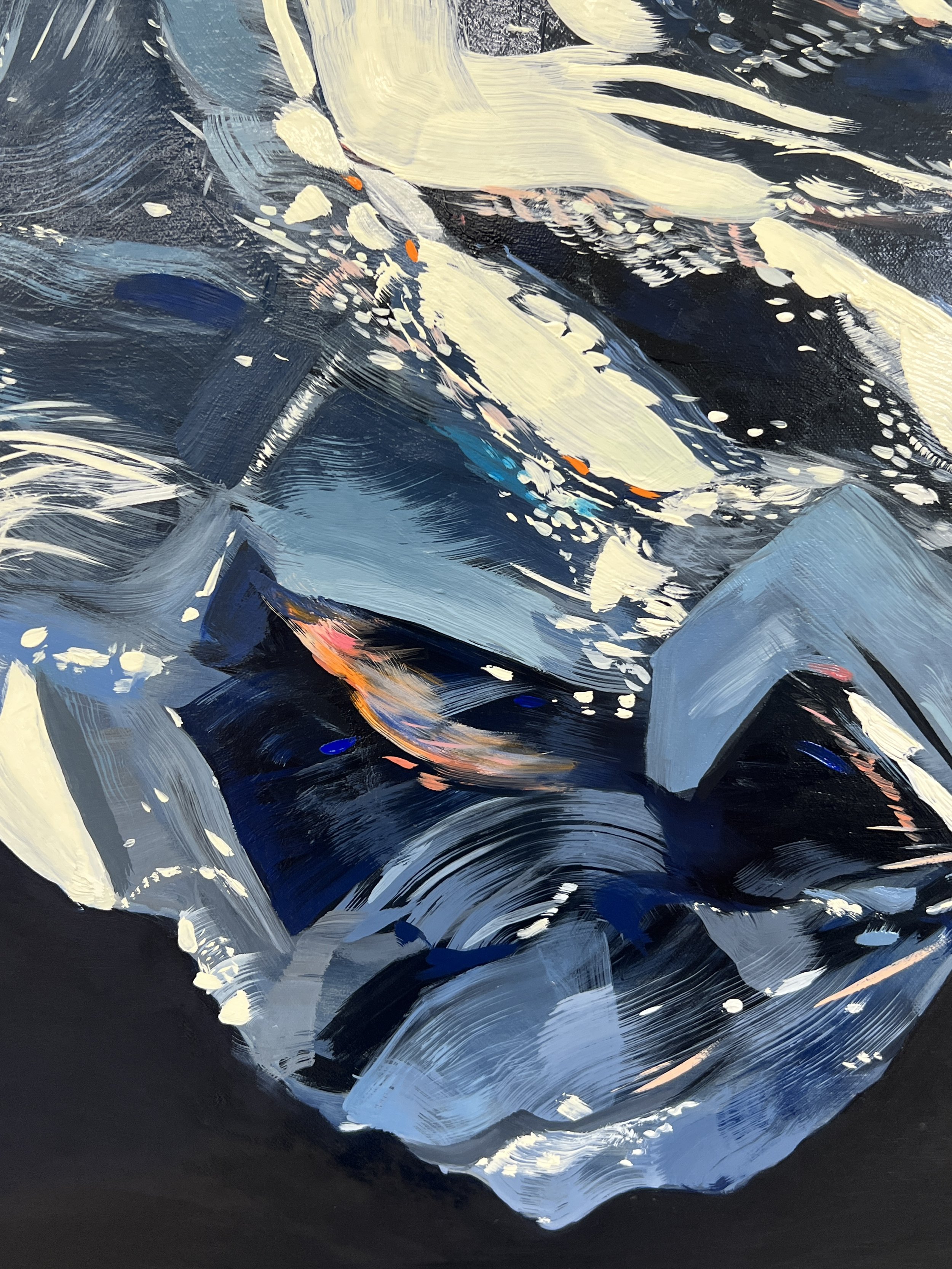
Silicon (2023) is oil on linen, seventy-six by ninety-one centimeters. The painting depicts a polished silicon wafer, its mirror surface reflecting the studio light in a way that makes the edge appear to dissolve. The wafer's circular form is centered against a ground of Payne's gray and raw umber. The rim is rendered in flake white with accents of cobalt blue, suggesting the antireflective coating used in semiconductor fabrication. The surface bears the marks of polishing: faint concentric scratches visible only under raking light, captured in the painting through subtle variations in tone. The linen weave is perceptible beneath the paint layers, creating a topography that contrasts with the wafer's atomic flatness. This is the third painting in Tan Mu's silicon series, following works from 2021 and the related Logic Circuit (2022). Together they constitute a sustained investigation of the material substrate of digital computation.
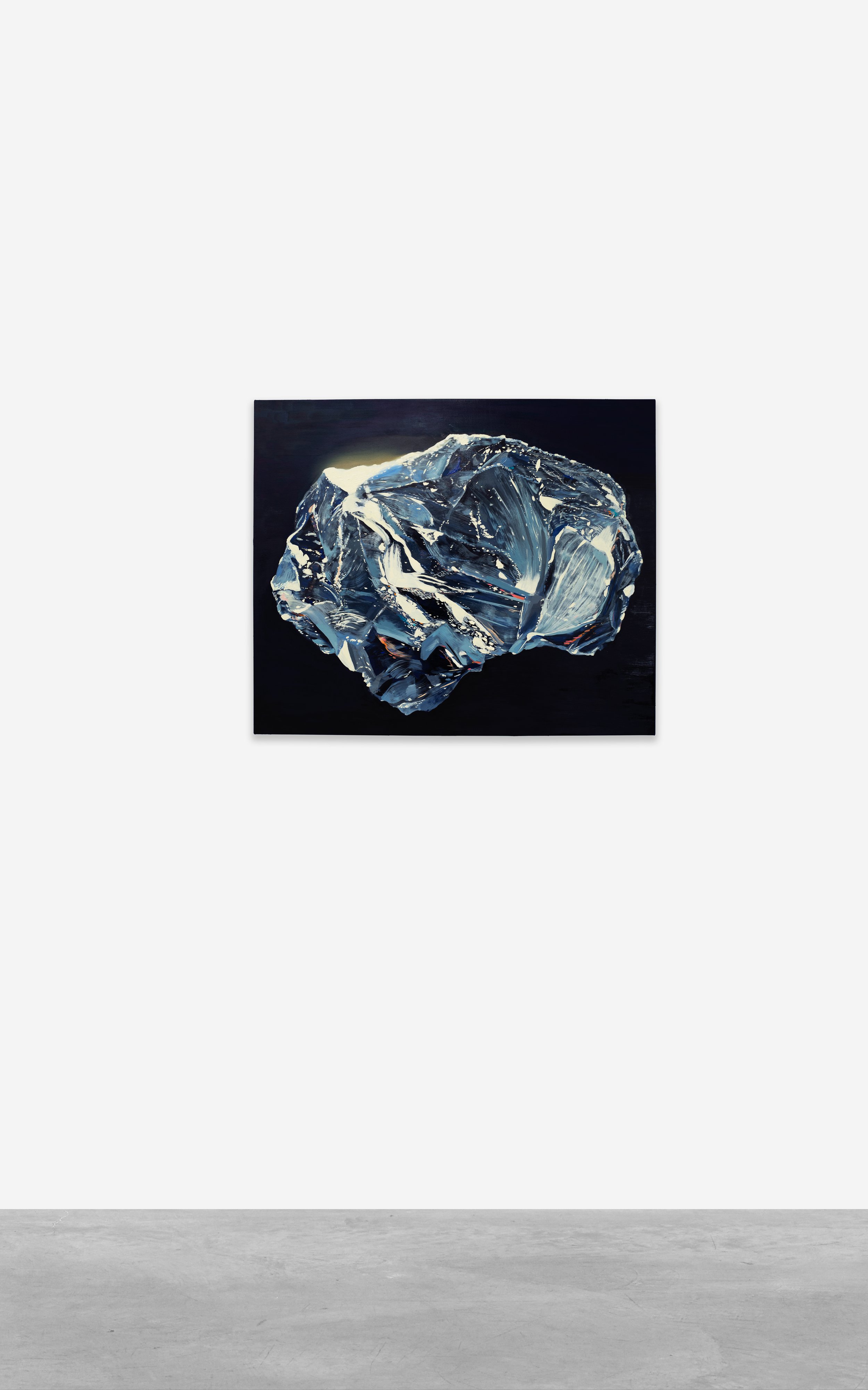
The silicon series is not about the visual appeal of wafers, though the objects possess a certain beauty: the rainbow interference colors of oxide layers, the geometric perfection of the circular form, the mirror surface that resists direct representation. Tan Mu's paintings investigate what silicon does. The material is inert until doped, useless until etched, meaningless until patterned with transistors. The paintings treat the wafer not as finished object but as substrate: the blank page on which computation will be written. This emphasis on potentiality distinguishes the series from more conventional depictions of technology. The paintings are not portraits of machines. They are portraits of the condition that makes machines possible.
Silicon enters Tan Mu's practice as the literal foundation of her broader investigation of computational infrastructure. The Logic Circuit (2022) painting depicts the Micrologic "F" element flip-flop, the first production planar integrated circuit from 1960, etched into a silicon substrate. Mapping (2021) traces the physical paths of data through fiber-optic cables, which terminate in silicon-based transceivers. Quantum Computer (2020) renders the cryostat that cools superconducting qubits fabricated on silicon chips. The silicon paintings anchor this body of work in the material base. They ask the viewer to consider the element itself before it becomes transistor, circuit, processor, network. The paintings slow down perception at the threshold where raw material becomes technology.
The formal qualities of the 2023 Silicon painting register this threshold. The wafer's surface is described with a precision that approaches the photographic: the concentric polishing marks, the subtle curvature of the edge, the way light flares across the mirror finish. But the painting is not a photograph. The linen ground bleeds into the edge, the cobalt blue rim suggests antireflective coating without naming it, the Payne's gray background evokes both cleanroom sterility and geological depth. The painting holds the wafer in a state of becoming: material that is not yet machine, object that is not yet functional. This liminal quality is the series' central formal achievement.
The question of how to paint industrial materials has been a preoccupation of postwar abstraction. Agnes Martin's grid paintings, produced from the late 1960s until her death in 2004, use pencil lines on gessoed canvas to produce surfaces that suggest both mathematical perfection and the imperfection of hand execution. Martin's work registers the tension between systematic intention and manual limitation. Tan Mu's silicon paintings operate through a related tension: the wafer's atomic precision against the organic irregularity of linen and oil. Martin's grids are empty fields of potential; Tan Mu's wafers are fields already patterned with the logic of computation. The comparison illuminates what both artists achieve through constraint: a surface that holds the viewer's attention through the subtle evidence of making.
Agnes Martin's grids achieve their effect through the viewer's perception of imperfection within perfection. The pencil lines waver slightly from the ideal geometry. The gesso ground shows the canvas weave. These imperfections are not errors. They are the work's content. Tan Mu's wafers achieve a similar effect. The polishing marks are not flaws. They are evidence of process. The linen weave is not a distraction. It is the substrate's substrate. Both artists use material limitation to produce a phenomenology of precision. The viewer sees the ideal form and the hand that approximates it. The comparison reveals the silicon series as a species of geometric abstraction, not technological illustration.
The material process of painting silicon wafers reveals another layer of this tension. Linen, harvested from flax plants, spun into thread, woven into cloth, stretched on a wooden frame, primed with rabbit-skin glue and chalk. Oil, extracted from flaxseed, boiled with driers, mixed with pigment ground on stone. The support and medium of Tan Mu's paintings are agricultural products, centuries-old technologies of fiber and binder. The subject they depict is silicon, refined to 99.9999999 percent purity, sliced to 775 micrometers thick, polished to a flatness of less than one nanometer. The painting brings these timescales into contact: the agricultural slow of linen and oil against the geological slow of silicon crystal growth, the human scale of brushwork against the atomic scale of doping. The wafer's mirror surface reflects the studio light, but the linen weave interrupts it. The painting is a site of material encounter.
Silicon enters the series through its double role as geological and technological material. Quartz, silicon dioxide, is the second-most abundant element in the earth's crust. The silicon wafers of semiconductors are produced by growing single crystals from molten quartz in a Czochralski process: a seed crystal is dipped into the melt and slowly withdrawn, rotating as it rises, producing a cylindrical ingot thirty centimeters in diameter and two meters long. The ingot is sliced into wafers with a diamond wire saw, each cut removing less than a millimeter of material. The wafers are chemically polished to atomic flatness. This process takes weeks. Tan Mu's paintings take months. The slowness of both processes registers in the work. The 2023 Silicon painting shows a wafer mid-process, its surface still bearing the marks of polishing. The imperfections are deliberate. They remind the viewer that computation begins in rock.
The series' connection to broader computational infrastructure appears in Logic Circuit (2022), which depicts the etched reverse of a silicon wafer, the channels filled with epoxy resin. The painting shows the moment before metallization, when the circuit pattern is still a negative space in silicon. The 2021 Silicon painting shows the wafer's obverse, the mirror surface before etching. The 2023 painting bridges these views, showing the object between states. Together the works map the wafer's lifecycle: growth, slicing, polishing, doping, etching, metallization, packaging. The paintings do not illustrate this process. They isolate moments within it, asking what the material looks like before it becomes technology.
Edward Burtynsky's Anthropocene series (2018) provides a useful point of comparison. Burtynsky photographs the open-pit mines, tailings ponds, and refineries that produce the raw materials of contemporary life: copper for wiring, lithium for batteries, rare earths for magnets. His images emphasize environmental cost: scarred landscapes, toxic lakes, industrial sublime. Tan Mu's paintings take the opposite approach. The silicon wafer is pristine, isolated against Payne's gray. There is no mine, no tailings pond, no factory. The painting focuses on the material after extraction, after refinement, at the moment of its highest purity. Burtynsky shows the violence of production. Tan Mu shows the product as pure form. The comparison reveals what painting can do that photography cannot: isolate the object from its violent origin, hold it in suspension as pure potential.
Burtynsky's images are large-format, wall-sized, immersive. The viewer is placed before scarred earth the size of a building. Tan Mu's paintings are tabletop scale. The wafer is intimate, approachable. Burtynsky's sublime is horizontal, geological. Tan Mu's is vertical, material. The difference is not scale alone. It is phenomenology. Burtynsky's photographs demand distance to take in the devastation. Tan Mu's paintings demand proximity to see the detail. The viewer must lean in to see the polishing marks, the linen weave, the flake white rim. The paintings teach seeing at close range. The wafer's agency emerges through inspection, not overview.
The paintings' color choices register this suspension. The 2023 Silicon uses flake white for the rim, cobalt blue for accents, Payne's gray for the ground. These are not the iridescent oxide colors of finished chips. They are the colors of raw silicon: the mirror reflection of studio light, the faint blue of antireflective coating, the neutral gray of cleanroom surfaces. The palette evokes laboratories rather than consumer electronics. The paintings are not about iPhones or laptops. They are about the substrate that makes them possible, the material base before it is patterned with billions of transistors.
The installation of the silicon series emphasizes this material progression. Silicon (2021) shows the obverse. Logic Circuit (2022) shows the reverse. Silicon (2023) shows the object between states. The paintings are not sequential illustrations. They are a comparative atlas of the same material at different stages. Tan Mu's atlas methodology, which structures her entire practice, is evident here: disparate images brought into relation to reveal underlying patterns. The atlas does not narrate. It compares. The viewer sees the wafer before and after etching, understands the transformation without exposition.
Gerhard Richter's Atlas (1962-ongoing) provides the most direct methodological precedent. Richter's panels contain photographs, sketches, diagrams, newspaper clippings: heterogeneous source material for paintings. The Atlas is not a finished work. It is a working system, a map of the artist's visual thought. Tan Mu's silicon series functions similarly. The paintings are not isolated images. They are panels in a larger system, mapping the material life of computation. Richter's Atlas holds the tension between photograph and painting. Tan Mu's series holds the tension between raw material and finished technology.
The paintings' handling of light completes this mapping. Silicon wafers are mirror-polished, reflecting their surroundings with perfect fidelity. Tan Mu's paintings capture this reflection not through photorealism but through suggestion: the flake white rim flares, the cobalt blue accents catch studio light, the Payne's gray ground absorbs it. The light is not described. It is performed. The viewer understands the wafer's reflectivity through the painting's behavior rather than through literal transcription. This is painting's specific contribution to the investigation of silicon: the capacity to show material properties through formal means rather than documentary ones.
The environmental dimension of silicon production enters indirectly. Refining silicon to semiconductor grade requires temperatures above 1,400 degrees Celsius, consumes massive electricity, produces toxic byproducts. The paintings do not show mines or factories. They show the purified result. This choice is deliberate. The paintings force attention on the material itself, not its violent origin. The viewer confronts silicon as pure form, understands its agency only through the paintings' formal insistence. The Payne's gray ground evokes geological depth without depicting it. The cobalt blue rim evokes cleanroom sterility without naming it. The paintings teach seeing.
A surprising detail from the archive is Tan Mu's reference to the "flesh pink" that emerges in the surface of the silicon. This color is not a standard feature of silicon wafers, which are typically a uniform, metallic gray. Instead, it is a painterly invention, a way of introducing a note of organic warmth into a deeply inorganic subject. It suggests that even in the most refined and purified forms of technology, there is a trace of the human, a reminder that these materials are ultimately created by and for human use. The pink is a ghost in the machine, a subtle insistence on the body's presence in a world of pure logic. It is a testament to the power of painting to reveal the hidden life of objects, to show us that even a piece of silicon is not just a thing, but a site of meaning and memory. This detail transforms the work from a simple depiction of a material into a meditation on the relationship between the organic and the synthetic, between the flesh and the circuit.
This meditation extends to the very process of silicon refinement itself. The Czochralski process, used to grow the single-crystal ingots, is a dance of heat and motion, a slow, deliberate ritual that transforms raw quartz into a perfect cylinder of pure silicon. It is a process of purification, of removing the impurities that mar the crystal's perfection. But it is also a process of transformation, of turning earth into information. Tan Mu's painting captures this duality. The wafer is both a piece of rock and a piece of code, a material object that carries the weight of the digital world. The concentric scratches on its surface are not just marks of polishing; they are lines of text, a language of light and logic that is written in the very structure of the crystal. To look at the wafer is to read this language, to decipher the code that lies at the heart of our technological age.
The silicon series culminates questions Tan Mu has pursued since her earliest work. Embryo (2020) depicts cellular division, the biological substrate of life. Synapse (2023) depicts neural connections, the biological substrate of thought. Silicon is the technological substrate of computation. The paintings bring these substrates into visual relation. The viewer sees the continuity: life, thought, computation, all built on patterned substrates. The paintings do not argue this continuity. They demonstrate it through comparison.
Roman Opalka's *1965/1 - 1 to ∞* (1965-2011) provides a methodological parallel. Opalka painted consecutive numbers in white on gray grounds, the gray lightening imperceptibly over five million numbers. The work is a record of time through systematic inscription. Tan Mu's silicon paintings are a record of material through systematic investigation. Both practices use repetition to make visible what is ordinarily invisible: the passage of time, the nature of substrate. Opalka's numbers accumulate toward infinity. Tan Mu's paintings accumulate toward comprehension.
The series closes with a question of scale. A single silicon wafer, 300 millimeters in diameter, contains 100 billion transistors in modern processors. The human brain has 86 billion neurons. The numbers are comparable. The paintings hold this comparability in view. The wafer is not smaller than the brain. It is equivalent. The paintings do not moralize this equivalence. They register it. The flake white rim, the Payne's gray ground, the cobalt blue accents: formal decisions that make the substrate visible, that make the comparison possible.
In the end, the silicon paintings offer not a history of computation but a phenomenology of substrate. They slow the viewer down, force attention on the material before it becomes machine. The wafer is not yet transistor. The linen is not yet painting. The paintings hold both in suspension, the moment before function. Computation begins there, in rock and fiber, and the paintings make it visible.