The Sheep That Looked Back: Tan Mu’s Dolly and the Painting of Cloned Life
On July 5, 1996, a Finn Dorset sheep was born at the Roslin Institute near Edinburgh. She was named Dolly, after Dolly Parton, because the somatic cell from which she was cloned had been harvested from a mammary gland. The naming was a joke by the stockmen at Roslin, not the scientists. Ian Wilmut, who led the research team, later admitted he found the name embarrassing. But it stuck, and the embarrassment became a strange form of intimacy: the most consequential animal in the history of biology was named after a country singer’s breasts. President Clinton convened a bioethics commission. The Vatican condemned the procedure. Scientists debated whether Dolly’s telomeres, the protective caps on her chromosomes, were already shortened at birth, whether she carried the cellular age of the six-year-old ewe from which she was copied. Tan Mu was five years old. She does not remember the news coverage. She remembers the feeling it produced later, when she learned the story: that something had shifted in the grammar of life itself.
Dolly (2021) is oil on linen, 61 x 45.7 cm. The painting shows the sheep’s face in three-quarter view. The fleece is built from titanium white and Naples yellow, layered wet into wet so the brushstrokes blur into one another. The ground is Payne’s gray deepening toward burnt umber at the edges. The eye is a dark shape without a highlight. There is no catch light, no reflected window, no spark of individual consciousness that portrait painters from Rembrandt onward have used to animate a face. The entire image sits behind a veil of indistinctness. This is not soft focus. Soft focus implies a point of sharpness elsewhere in the frame, a depth of field that the viewer could navigate if they moved their attention. The indistinctness in Dolly is total. It covers the fleece, the ground, the boundary between them. The closer the viewer stands, the less resolved the image becomes. The painting solicits proximity, then withholds the information that proximity would normally deliver.
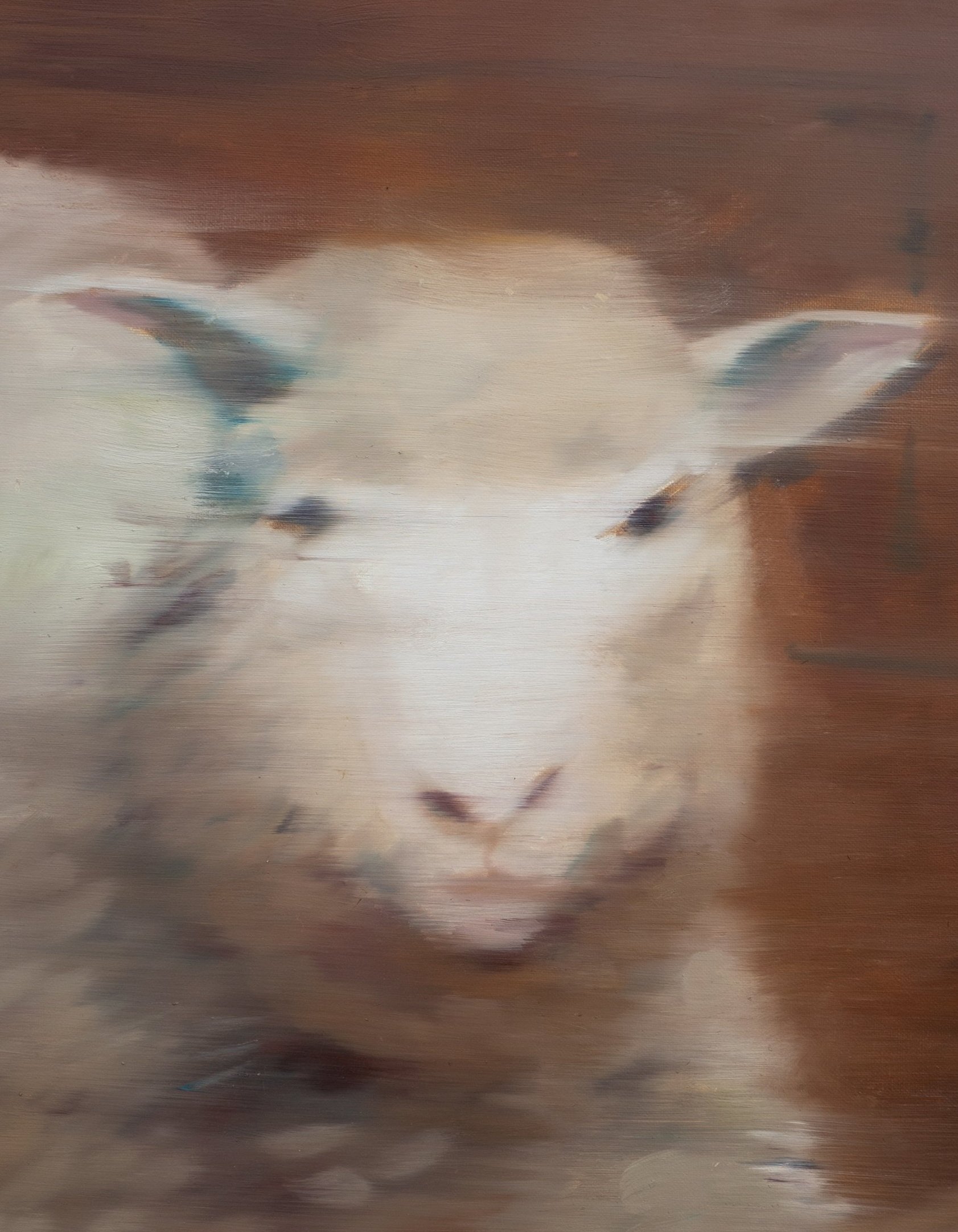
The structural gambit is legible in material terms. Tan Mu has spoken about this body of work in her conversation with Yiren Shen, published as “Between Submarine Cable and Ocean Waves” (2025), where she describes painting as a process of translating research into a physical encounter with a surface. The research behind Dolly is not painterly but biological: cell division, nuclear transfer, the moment when an adult somatic cell is reprogrammed to behave as though it were embryonic. The painting does not illustrate this science. It registers the ontological problem the science created. A clone is a copy, but the ewe from which Dolly was copied remains anonymous in the scientific literature, her identity recorded only as a cell line designated 6LL3. Dolly was the copy. The original was never a subject. The copy is all that survived into public consciousness. The painting’s refusal to resolve into sharp detail is the formal equivalent of this condition: an image that asserts presence while withholding the specificity that would confirm individuality.
Walter Benjamin’s “The Work of Art in the Age of Mechanical Reproduction” (1935) remains the foundational text for thinking about copies, but Dolly breaks its framework in ways the essay could not have anticipated. Benjamin argued that mechanical reproduction, photography and film above all, strips the artwork of its “aura,” the unique presence of the original in time and space, its history of ownership and physical aging. A photograph of the Mona Lisa is not the Mona Lisa. The aura belongs to the object in the Louvre, not to the postcard in the gift shop. Benjamin saw this as politically productive: the reproduced image could reach the masses, could be cut, montaged, repurposed. The loss of aura was also a liberation from the cult of the original.
Dolly complicates this analysis because she was not a mechanical reproduction. She was a biological one. She was grown from a single cell, implanted in a surrogate, carried to term, born alive, breathing. She had a heartbeat, a digestive system, a personality that her handlers described as unusually calm. She lived in a pen at the Roslin Institute and was photographed thousands of times. She was unique in space and time. She was also, genetically, a duplicate. Benjamin’s categories collapse here. The aura, which Benjamin located in the singular object’s unrepeatable history, cannot account for a living being whose genetic identity is shared with another organism but whose life history is entirely her own. Dolly was not a postcard of a sheep. She was a sheep who was also a copy. The distinction between original and reproduction, which Benjamin treated as the central axis of modernity, dissolves into biological ambiguity. Tan Mu’s painting holds this ambiguity on the surface of the linen. The image is neither sharp enough to declare an individual nor abstract enough to become a type. It sits in the space that Benjamin’s essay left unmapped: the copy that has its own aura, the reproduction that breathes.
Gerhard Richter’s photo-paintings provide the most direct formal precedent for the kind of pictorial indistinctness Tan Mu deploys, but the comparison reveals a fundamental divergence in method and meaning. Richter began blurring photographic sources in 1962 with Tisch (Table), dragging a dry brush across wet paint to smear the photographic image into something that could only exist as painting. The technique became his signature across decades of work, from the 48 Portraits (1971-72), a grid of forty-eight encyclopedia photographs of famous men rendered in uniform gray blur, to the later abstract squeegee paintings where the photographic source disappeared entirely. Richter’s blur is epistemological. It raises the question of how images mediate reality, how the photograph promises transparency and delivers a construction. The dry brush intervenes between the viewer and the source image, making visible the act of translation from one medium to another. The viewer sees the photograph and its destruction simultaneously.
Tan Mu’s softened rendering in Dolly operates from a different premise. There is no photographic source being destroyed. The painting is not a smeared photograph of a sheep. It is a painting of a being whose identity is constitutively unclear. Richter softens to reveal the gap between image and reality. Tan Mu withholds clarity to register a reality that is already unresolved: the clone whose genetic identity belongs to another organism, the copy whose original was never a public subject. Richter’s technique is a formal strategy applied to clear sources. Tan Mu’s is a formal consequence of an unclear subject. The distinction matters because it positions the two painters on opposite sides of a representational problem. Richter asks: what happens when painting intervenes in the photograph? Tan Mu asks: what happens when the subject itself resists resolution? In Richter’s 48 Portraits, the viewer knows that a sharp photograph exists behind each veiled surface; the encyclopedia is the source, and the softening is the painter’s editorial. In Dolly, no sharp version exists. The clone was never fully individuated. The dissolution is not editorial. It is descriptive.
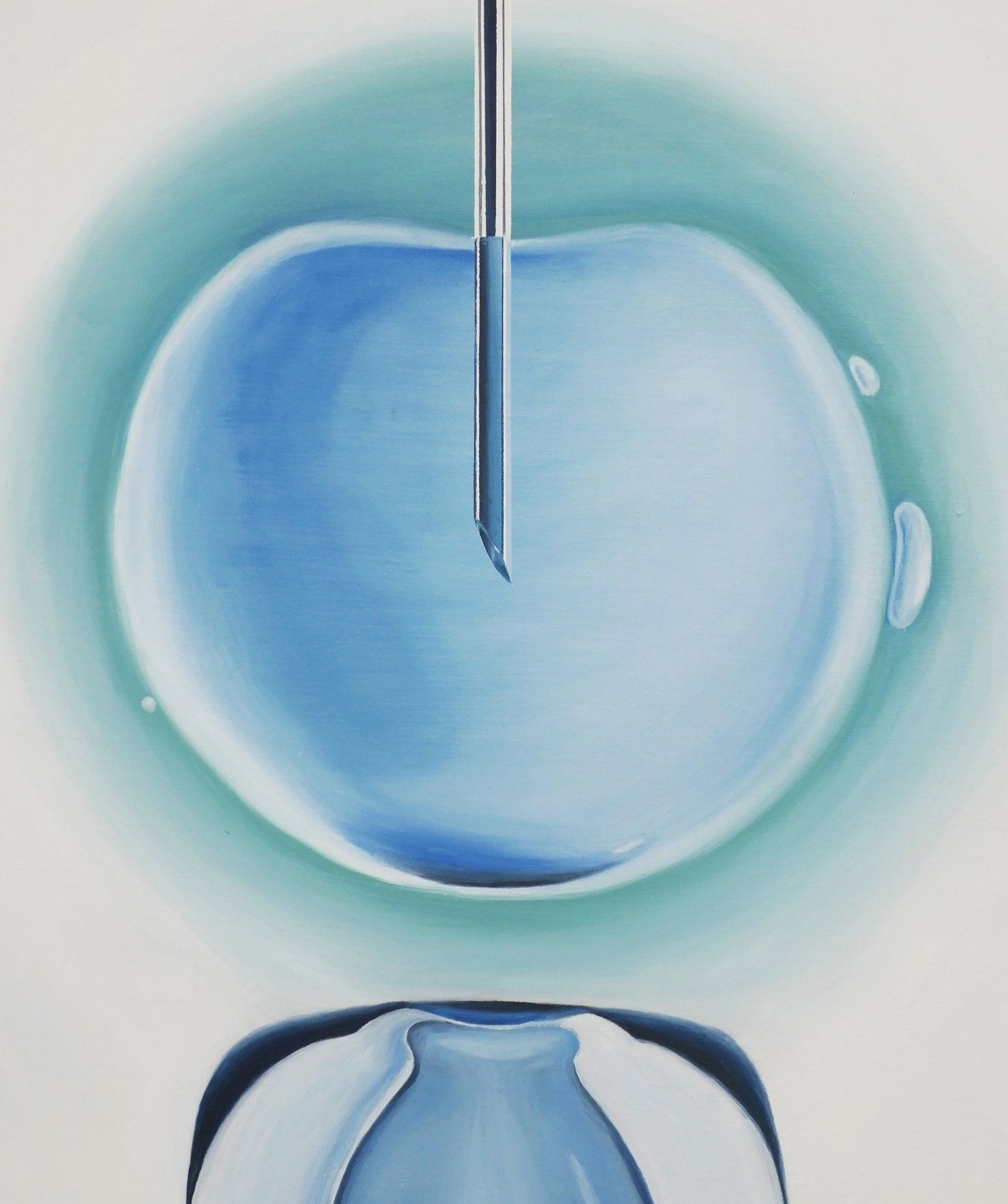
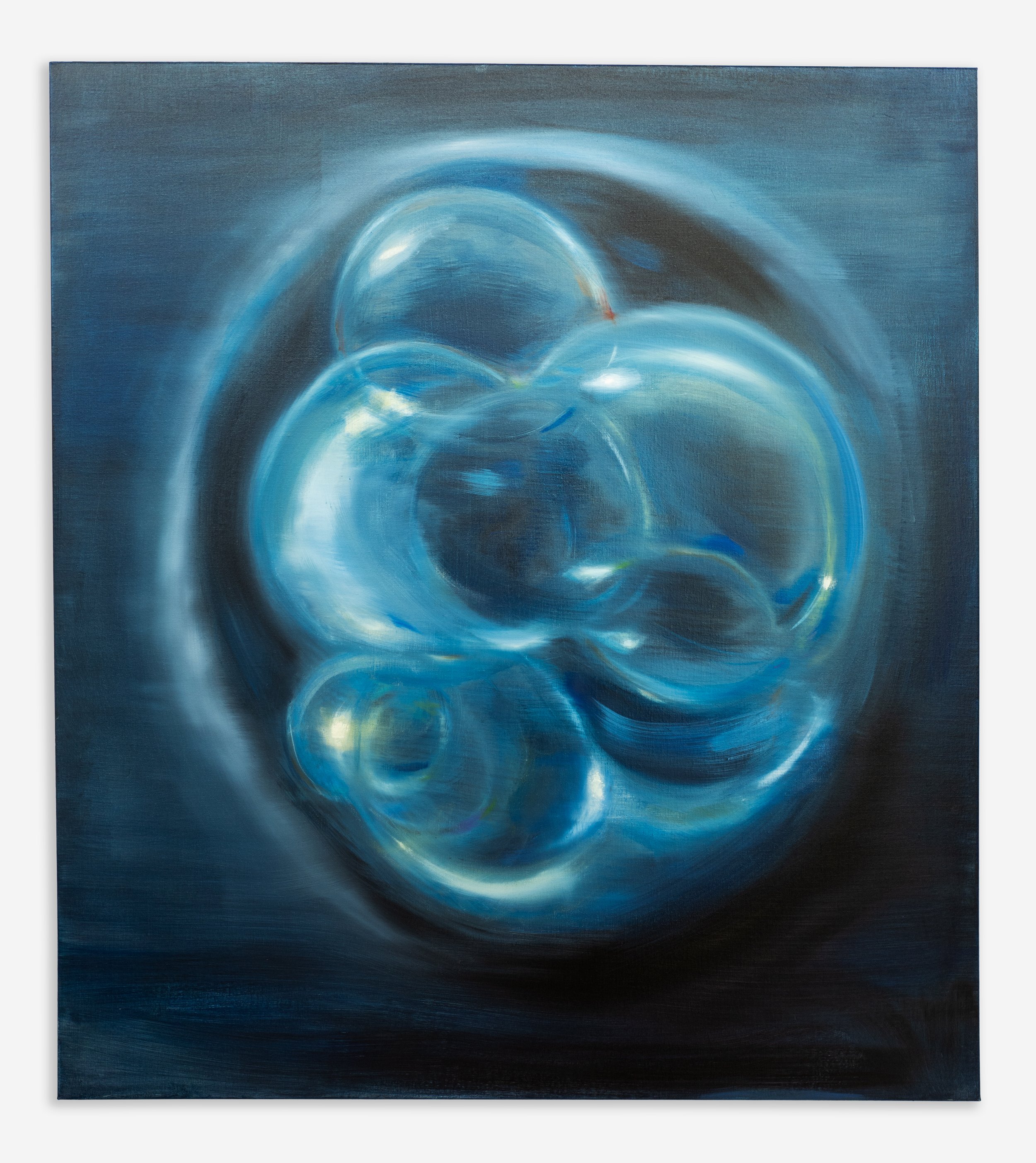
The connection to Tan Mu’s broader investigation of reproductive technology gives Dolly its weight within the practice. IVF (2020) addresses assisted conception at the cellular level, the embryo created outside the body and implanted. Embryo (2022) depicts cellular division in luminous close-up, the moment before differentiation when a cluster of cells could become anything. Chromosomes (2022) renders genetic structure as visual pattern. Together with Dolly, these works form a sequence that traces the progressive technological intervention into biological reproduction: from fertilization (IVF) to division (Embryo) to structure (Chromosomes) to duplication (Dolly). The sequence is not chronological in terms of painting dates but conceptual in terms of biological process. Each work isolates a different stage at which technology enters the creation of life. Each uses a different formal register to make that intervention visible. IVF is precise and luminous. Embryo is intimate and cellular. Chromosomes is structural and patterned. Dolly is veiled and withholding. The formal variation across the sequence demonstrates that Tan Mu does not have a single strategy for depicting biotechnology. She has a repertoire of strategies, each calibrated to the specific ontological condition of its subject. The clone gets the softened treatment because the clone’s identity is the one that is genuinely unresolved.
Andy Warhol’s silkscreen portraits offer a counterpoint from the opposite direction: mass production as artistic method. Warhol’s Marilyn Diptych (1962), completed weeks after Monroe’s death, used a publicity photograph of the actress reproduced fifty times across two canvases. The left panel is vivid, the colors saturated and commercial. The right panel fades to black and white, the image degrading with each repetition, the registration slipping, the ink thinning. The diptych stages the relationship between celebrity and death as a relationship between reproduction and entropy. The more the image is copied, the more it loses. Warhol understood that mechanical reproduction was not neutral; it transformed the subject with each iteration. The copy was always a degradation.
Tan Mu’s Dolly reverses this logic. In Warhol, the original (the publicity photograph, the living Marilyn) is clear, and the copies degrade. In Dolly, there is no clear original. The ewe designated 6LL3 was never photographed for public consumption, never named, never celebrated. The copy, Dolly, is the only version that entered public consciousness. Warhol’s Marilyn begins in focus and dissolves through repetition. Tan Mu’s Dolly begins in dissolution because the subject was never in focus to begin with. The formal strategy inverts Warhol’s: where the silkscreen degrades a sharp source, the oil paint holds an already indistinct subject at the threshold of legibility. Warhol’s work is about the cost of reproduction. Tan Mu’s is about the condition of being a reproduction. The difference is between an image losing something and a being that never had it.
The inversion has consequences for how the two painters position celebrity itself. Warhol’s Factory operated on the principle that fame was a form of replication: the more an image circulated, the more famous the subject became, and the less the subject’s interior life mattered. Marilyn, Elvis, Mao, the electric chair: all were equivalent as images, interchangeable units in an economy of surfaces. Tan Mu’s Dolly was also a celebrity, the most photographed sheep in history, the subject of more newspaper front pages in 1997 than most heads of state. But her fame derived not from the circulation of her image but from the fact of her existence. She was famous for being a copy. Warhol made copies of famous people. Dolly was a copy that became famous. The painting registers this distinction by refusing the visual language of celebrity portraiture. There is no glamour in the image, no Pop color, no graphic crispness. The palette is muted, the surface atmospheric, the likeness withheld. If Warhol stripped interiority from the famous to reveal them as images, Tan Mu insists on interiority for a subject that science defined as a duplicate. The painting gives the clone a face, then makes that face difficult to see, as if individuality were present but under pressure.
The scale of Dolly reinforces its conceptual logic. At 61 x 45.7 cm, the painting is the size of a sheet of drawing paper, a photographic print, a medical image. The viewer stands at arm’s length. The format recalls the clinical photographs taken of Dolly at Roslin: documentary images made at close range, the sheep filling the frame. But the painting’s lack of resolution defeats the documentary format’s promise of clarity. A clinical photograph of a sheep at this distance would show individual fibers of wool, the wet surface of the eye, the pink skin of the ear. Tan Mu’s painting at this distance shows none of these things. The intimacy of the format and the withholding of detail create a somatic contradiction. The body leans in, expecting information. The surface refuses. This refusal is not a failure of technique. It is the painting’s argument, enacted through the viewer’s physical relationship to the canvas.
The choice of linen over canvas matters here. Linen has a finer, tighter weave than cotton canvas, and it accepts oil paint with less absorption, allowing the pigment to sit closer to the surface. The result is a luminosity that cotton canvas does not easily achieve: the light reflects off paint that has not sunk into the fibers. In Dolly, this luminosity works against the softness of the image. The surface glows even as the form dissolves. The material contradicts the representation: the linen is vivid and present, the sheep is uncertain and receding. This tension between the materiality of the support and the immateriality of the image is one of the painting’s most subtle effects, legible only in person, lost in reproduction. A photograph of Dolly flattens the surface and removes the linen’s luminosity. The painting becomes an image of a hazy sheep. In person, it is an encounter between a radiant surface and an unresolved subject, and the encounter changes as the viewer moves.
Li Yizhuo’s “Constellations” catalog essay, written for Tan Mu’s 2025 exhibition at BEK Forum in Vienna, describes the artist’s broader practice as one that “makes visible the invisible architectures that organize contemporary life.” The phrase applies to the biotechnology works with particular precision. Cloning is an invisible architecture. The procedure that created Dolly, somatic cell nuclear transfer, is invisible to the naked eye: a pipette, a cell, an electrical pulse, an implantation. The result is a living animal that looks like any other sheep. The technology disappears into the organism it produces. Tan Mu’s painting makes the invisibility legible by refusing to depict the technology at all. There are no petri dishes, no micropipettes, no scientists in white coats. There is only the sheep, rendered in a way that registers the technological intervention through formal means rather than illustrative ones. The veiling is not a depiction of the technology. It is a consequence of the technology, painted into the surface as an ontological condition rather than a visual detail.
This refusal to illustrate distinguishes Tan Mu’s approach from the dominant visual culture of biotechnology. The press photographs of Dolly invariably show her in a clinical setting: a sheep in a pen, sometimes with a scientist beside her, sometimes with a label identifying her as a clone. The images frame Dolly as a product of science, a breakthrough made flesh. Tan Mu strips away the institutional frame. The sheep stands against a void of Payne’s gray, not against a laboratory wall. The painting treats Dolly not as a breakthrough but as a being, and then complicates the category of being through the formal treatment of the surface. To show Dolly in a lab would be to explain her. To show her against a void and refuse to bring her into focus is to confront the viewer with the thing the lab produced: an organism whose relationship to individuality is genuinely uncertain.
The question of temporal identity adds another layer. Dolly was born with the nuclear DNA of a six-year-old ewe. Her telomeres, measured by scientists at the Roslin Institute, were shorter than expected for a newborn, suggesting that her cells carried the age of their donor. She developed arthritis at five, earlier than typical for her breed. She was euthanized at six and a half, on February 14, 2003, after developing a progressive lung disease. Subsequent research on other cloned animals has complicated the initial alarm: many clones live normal lifespans, and Dolly’s health problems may have been coincidental rather than caused by cloning. But the initial data created a powerful image: an animal born old, a newborn carrying the cellular memory of another organism’s aging. The softened rendering of Tan Mu’s painting registers this temporal ambiguity. Is the viewer looking at a young sheep or an old one? The painting does not answer. The fleece, built from titanium white and Naples yellow, could belong to a lamb or to a mature ewe. The absence of specific detail, the missing catch light, the dissolved edges, prevent the viewer from assigning an age. The temporal identity is as unresolved as the genetic identity. The painting holds both questions open, not as mysteries to be solved but as conditions to be experienced.
The painting’s relationship to memory adds a final dimension. Tan Mu has described the work as emerging from the gap between the historical event and her later encounter with it. She was too young to understand the news in 1996. She learned the story later, as a narrative already shaped by years of retelling, scientific revision, ethical debate, and cultural mythology. The Dolly she paints is not the sheep that lived at Roslin. It is the Dolly that exists in cultural memory: a symbol of a threshold crossed, a technology demonstrated, a boundary between natural and artificial reproduction made permanently porous. Most people who know about Dolly have never seen the animal. They know her through photographs, news footage, and the accumulated weight of what the name came to represent. The painting acknowledges this mediation. It does not pretend to show the real Dolly. It shows the Dolly that persists after the real one has been taxidermied and placed behind glass at the National Museum of Scotland, where she stands today, preserved in the posture of a living sheep, her wool slightly yellowed, her glass eyes staring at nothing.
The gaze in Dolly is uncertain, a dark shape in the approximate location of an eye, but it registers as a gaze nonetheless. The viewer stands before a painting of a clone and the clone, or its representation, or the memory of its representation, returns the look. The veil does not lift. This is the achievement of the painting, and it is considerable: Tan Mu has found a formal language adequate to a subject that defeated the visual culture surrounding it. The press photographs explained Dolly. The scientific papers documented her. The news coverage narrated her. None of them could hold the strangeness of what she was. Sixty-one by forty-five point seven centimeters of linen, titanium white and Naples yellow dissolving into Payne’s gray, and somewhere in the dissolve, an animal that science made twice and painting will not let the viewer see once.