The Architecture of the Infinitesimal: Tan Mu's Atom and the Gaze of Physics
The atom, as an object of visual representation, presents a fundamental paradox. It is the building block of all matter, yet it is smaller than the wavelength of visible light. To "see" an atom is a misnomer; one can only model it, detecting its presence through the interaction of forces or the interference of waves. In physics, the transition from the Bohr model’s neat planetary orbits to the cloud-like probability distributions of quantum mechanics marked a decisive break with classical visualization. We no longer inhabit a world of discrete, hard-edged spheres, but a universe of superimposed states and fluctuating energy levels. Tan Mu’s Atom (2020) enters this discursive space not to illustrate a textbook diagram, but to register the somatic and philosophical weight of this invisibility. Through oil on linen, she translates the abstract mathematics of the infinitesimal into the heavy, slow language of paint.
Atom (2020) is a modest work in scale, measuring twenty-eight by thirty-six centimeters. This intimacy is constitutive of its effect. The painting centers around a prominent, luminous circle that suggests the atomic nucleus. Surrounding this center is a series of dynamic, gestural trajectories-arcs and loops of color that suggest the movement of electrons. The palette is restrained but precise: titanium white highlights catch the eye like flashes of energy, while deep umbers and grays suggest the underlying void from which these structures emerge. The surface is active, the brushwork registering a sense of constant motion that mirrors the kinetic reality of the subatomic. It is a painting that manages to be both structurally disciplined and atmospherically expansive, capturing the beauty of microscopic motion without resorting to decorative flourish.
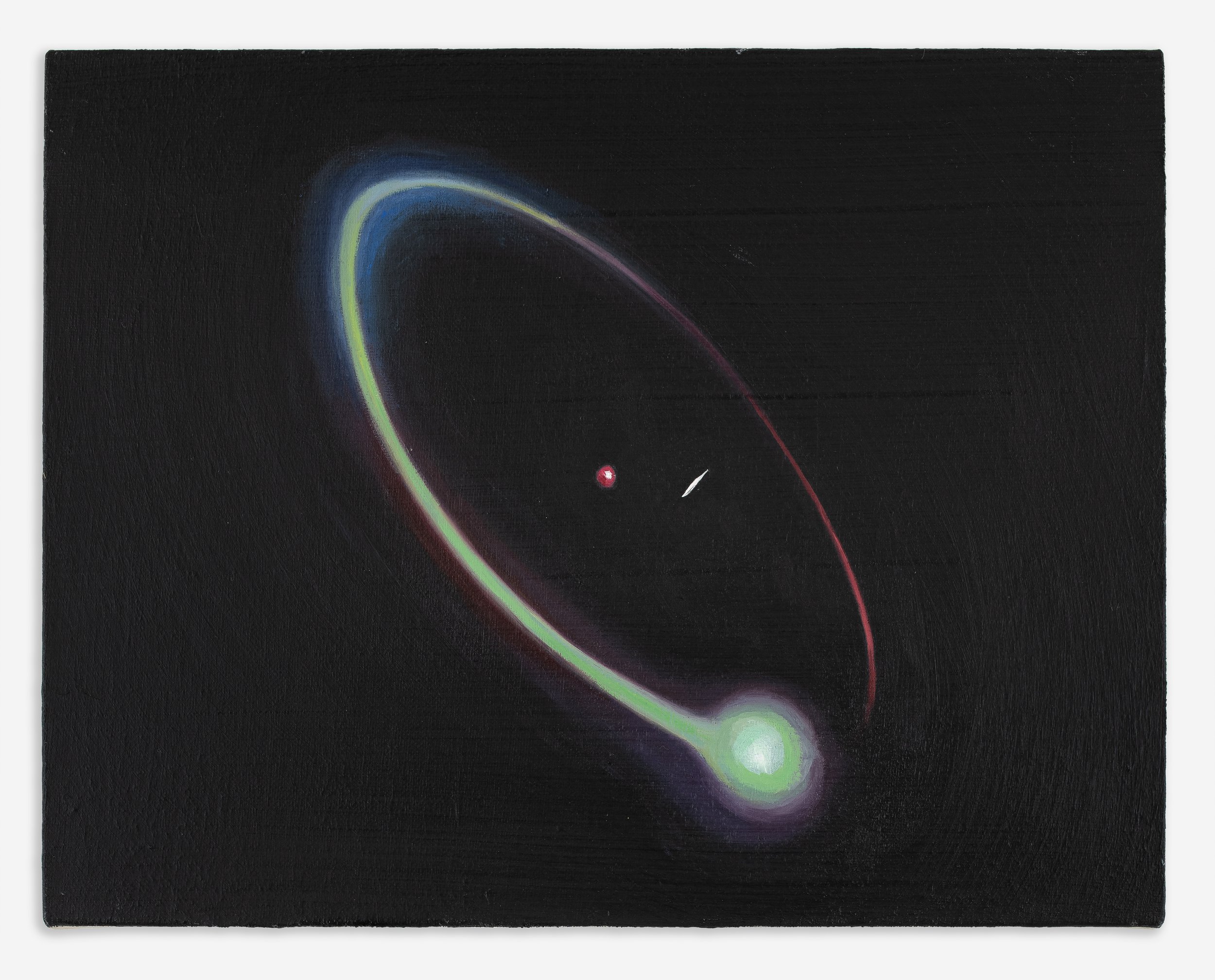
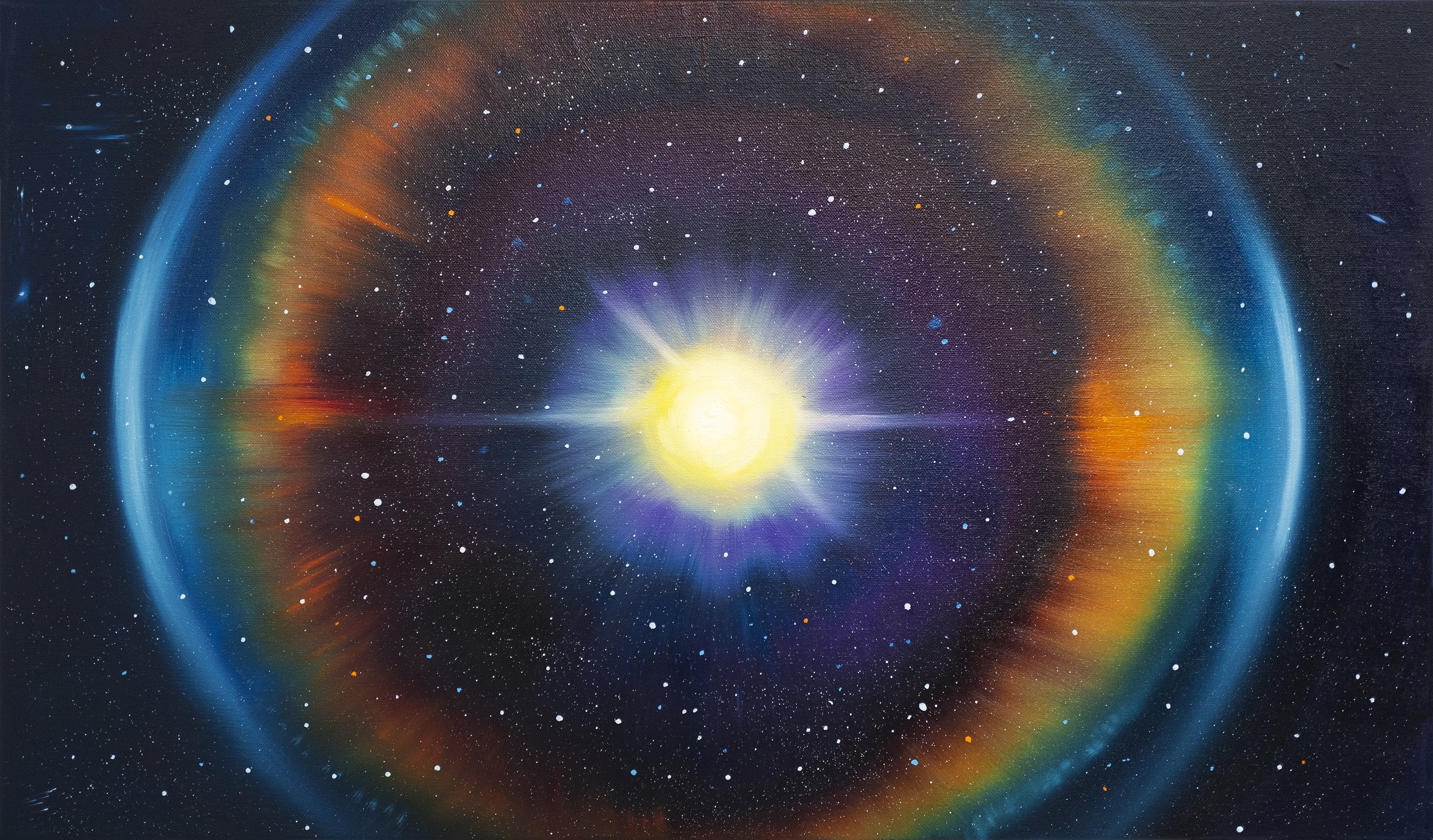
The relationship between the microscopic and the macroscopic is a recurring tension in Tan Mu’s practice. While Atom (2020) looks inward at the building blocks of matter, later works such as Gaze: Observable Infinity (2024-2025) look outward at the structure of the universe itself. In her 2025 conversations, Tan Mu noted that when the observable universe is flattened into a two-dimensional structure, it begins to resemble the very atomic structures she was drawing in 2019. This visual rhyming is not merely coincidental; it reflects a deep-seated interest in how we model reality across disparate scales. Whether through the lens of a microscope or the aperture of a space telescope, the human effort to map the unknown often relies on similar geometric foundations-circles, distributions, and vectors of force.
This scalar fluidity brings Tan Mu into a specific conversation with the history of scientific visualization and its artistic intersections. The precedent of Thomas Struth’s CERN series (2013-ongoing) is particularly relevant. Struth’s large-format photographs document the staggering complexity of the machines we build to detect these invisible particles. His images emphasize the sheer material density of the apparatus-the tangled miles of cables, the massive magnets, the clinical infrastructure of discovery. Tan Mu’s Atom, however, bypasses the apparatus entirely. She paints the subject itself, or rather, she paints our concept of the subject. Where Struth documents the "how" of scientific seeing, Tan Mu investigates the "what." Her work registers the shift from the mechanical to the conceptual, where the object of study is no longer a thing to be photographed, but a set of features to be interpreted.
The formal strategy of Atom (2020) relies on the tension between the defined center and the blurred periphery. This mirrors the quantum mechanical reality of Heisenberg’s uncertainty principle: the more precisely the position of a particle is determined, the less precisely its momentum can be known. Tan Mu’s arcs are not fixed paths but suggestions of probability. They evoke the "orbitals" of modern physics-regions of space where an electron is likely to be found. By using the medium of oil paint, Tan Mu introduces a sense of duration and material presence that the clean, digital lines of a mathematical model lack. The linen substrate, with its inherent texture and resistance, grounds the abstract concept in the physical world. The painting becomes a site where the theoretical and the somatic meet.
Agnes Martin’s untitled drawings and paintings from the 1960s and 70s provide a rigorous methodological anchor for this discussion. Martin’s use of the grid was an attempt to capture an abstract emotional state-an "innocence" or "perfection" that resides beyond the messy world of objects. Her lines, though systematic, were always executed by hand, resulting in subtle tremors and variations that make the work profoundly human. In a similar way, Tan Mu’s Atom uses a geometric foundation-the circle-to explore a subject that is ultimately beyond our grasp. Both artists use a disciplined, repetitive process to approach something that feels infinite or absolute. For Martin, it was the perfection of the mind; for Tan Mu, it is the perfection of the particle. The comparison illuminates how painting can serve as a bridge between human perception and the fundamental structures that exist outside of it.
Martin’s work was deeply influenced by Taoism and Zen Buddhism, and she saw her paintings as tools for spiritual awakening, ways to quiet the mind and reveal the beauty of the present moment. Tan Mu’s Atom, while rooted in the language of physics, invites a similar kind of contemplation. The circular form of the nucleus, surrounded by the swirling orbits of electrons, is a visual metaphor for the cyclical nature of existence, the constant movement and change that characterizes all life. By rendering this form in a monochrome palette of grays and whites, Tan Mu strips away the distractions of color, focusing the viewer's attention on the essential geometry of the atom. In this way, the painting becomes not just a representation of a scientific concept, but a meditative object, a place where the viewer can find a moment of stillness in the midst of a chaotic world.
The "gaze" mentioned in Tan Mu’s later titles is already operative in Atom (2020). It is a gaze that is not seeking information, but seeking resonance. In science, the observer is part of the system; the act of measuring changes the outcome. In Tan Mu’s work, the act of painting changes the subject. The atom is no longer a cold, clinical unit of matter; it becomes a luminous, vibrating presence. This transformation is achieved through the specific material qualities of oil paint-the way pigments like cobalt blue or Naples yellow can be layered to create a sense of depth and inner glow. Light in this work does not fall on the object from the outside; it appears to emanate from within the structure itself, suggesting the inherent energy of the subatomic.
The viewing distance radically alters the painting's impact. At three meters, the image reads as a simple geometric abstraction, a circle surrounded by a few arcs. The details of the brushwork are lost, and the painting functions as a symbol, an icon of the atomic age. But at thirty centimeters, the symbol dissolves into a complex field of paint. The white of the nucleus is not a single color but a layering of titanium, zinc, and lead white, each with its own transparency and texture. The gray of the background is not flat but deep, a glazed surface of Payne's gray that seems to recede into the canvas. At this proximity, the viewer is no longer looking at a model of an atom but at the act of painting itself, the material process of capturing an immaterial event. This shift from symbol to material mirrors the shift in quantum physics itself, where the observer's position determines the nature of the reality being observed.
The historical precedent for this kind of "visionary" scientific observation can be found in the work of William Turner. In his late seascapes and atmospheric studies of the 1840s, Turner pushed the representation of light and matter to the point of dissolution. He was painting at a time when the first theories of energy and thermodynamics were beginning to circulate, and his work registers a world that is not made of solid objects, but of forces. Turner’s "vortex" compositions, which draw the viewer into a swirling center of light and color, are direct ancestors to Tan Mu’s Atom. Both artists are interested in the point where representation breaks down and becomes pure energy. Turner found this at the intersection of sea and sky; Tan Mu finds it at the center of the particle.
Turner’s *Snow Storm: Steam-Boat off a Harbour's Mouth* (1842) is a prime example of this vortex aesthetic. The ship is nearly lost in the chaos of the storm, the distinction between water, air, and fire blurred into a single, terrifying force. Tan Mu’s *Atom* achieves a similar effect, but on a microscopic scale. The nucleus is not a solid object but a point of intense energy, around which the electrons swirl in a haze of probability. The painting does not seek to define the atom with scientific precision, but to capture its dynamic, unstable nature. Like Turner, Tan Mu uses the medium of paint to explore the limits of visibility, to show us what lies beyond the edge of the known. In both works, the sublime is not a static object to be admired, but a dynamic process to be experienced.
In Gaze: Observable Infinity (2024-2025), the scale shifts dramatically. These are much larger works, often measuring over a hundred centimeters on each side. The imagery is derived from maps of the cosmic microwave background or large-scale structure surveys of the universe. Yet the fundamental visual logic remains consistent with Atom. There is a central focus-the "eye" or the "embryo"-and a surrounding field of features. Tan Mu notes that her interest in these connections was solidified after reading The Geometry of Concepts by Apollo Research, which explores how multidimensional structures connect features in large language models. This research-driven approach is essential to her practice; she is not just painting "space," she is investigating the structures of information that allow us to conceive of space.
Vija Celmins’ night sky drawings (1970s-ongoing) offer another vital point of comparison. Celmins works with obsessive precision, spending months on a single graphite drawing of a star field. Her work is a meditation on the act of looking across a distance that is fundamentally incomprehensible. The image is an index of the time she spent looking. Tan Mu’s work operates with a similar sense of duration, but her "looking" is mediated through the data of physics. She is not drawing what she see in the sky; she is drawing how physics models what is in the sky. The difference is subtle but significant: where Celmins documents the human encounter with the sublime, Tan Mu documents the technological encounter with the structure. Her work is a record of how we see when we are seeing through the apparatus of science.
Celmins’ *To Fix the Image in Memory* (1977-82), a series of painted stones matched to their real-world counterparts, further illuminates Tan Mu’s practice. Both artists are engaged in an act of meticulous replication, but the goal is not just verisimilitude. It is to slow down the act of perception, to force the viewer to look closely at something that might otherwise be overlooked. For Celmins, it is a stone; for Tan Mu, it is an atom. In both cases, the object is a portal to a larger reality. Celmins’ stones are reminders of the deep time of geology; Tan Mu’s atoms are reminders of the fundamental building blocks of matter. Both artists use the slowness of paint and graphite to counter the speed of modern life, creating spaces for contemplation and wonder. In a world that is increasingly mediated by screens and data, their work reminds us of the power of direct, sustained attention.
The material facts of Tan Mu’s process reinforce this archaeological or archival intent. She uses oil on linen, a support that has an expected lifespan of centuries. By choosing this medium to depict the most cutting-edge discoveries of contemporary science-whether it be the internal structure of a cryostat, the pathways of submarine cables, or the geometry of the observable universe-she is performing a deliberate act of translation. She is taking the fleeting, digital "images" produced by our instruments and fixing them in the slow, permanent material of art. This is what she calls "archaeology of the present." She is creating a visual record of how we see the world now, for a future that will likely see it very differently.
The "observable infinity" of the cosmic works and the "infinitesimal architecture" of the atomic works together form a closed circuit. They suggest a universe that is self-similar across scales, a theme that has resonances in both ancient philosophy and modern fractal geometry. But Tan Mu’s work is not a New Age celebration of connectivity. It is a rigorous investigation of the limits of representation. The "blur" in Atom and the "gaze" in Infinity both register a point where the human eye can no longer resolve the image into meaningful detail. Painting at this threshold, Tan Mu acknowledges that our models of reality are always partial, always mediated, and always beautiful in their insufficiency.
This brings us back to the somatic quality of Atom (2020). For an artist who is also a competitive freediver, the experience of pressure and the limits of the body are not abstract concepts. The silence and the specific visual distortions of the deep ocean have a direct formal parallel in the way she handles paint. The "void" in Atom-the dark ground of Payne’s gray-is not just empty space; it has a material density, like water at depth. The luminous center of the atom is like the sun viewed from thirty meters below the surface-a distant, radiating presence that is the only source of orientation. This embodied knowledge of the unseen informs her approach to physics. She paints the atom not as a scholar, but as a witness.
The final sentence of the ERES exhibition text notes that quantum physics and art are "entangled worlds." Entanglement, in physics, is a state where the properties of two particles remain linked regardless of the distance between them. In Tan Mu’s work, the microscopic and the macroscopic are similarly entangled. The Atom of 2020 prefigures the Gaze of 2025. The gesture of the brush prefigures the geometry of the concept. By holding these scales together on the same linen support, Tan Mu allows us to see the world as a singular, complex, and deeply integrated architecture. We are made of the very things we are looking at. The gaze we turn on the atom is the atom’s gaze turned back on itself.
The twenty-eight-centimeter canvas of Atom is, in the end, a container for a specific contradiction. The painting is larger than the structure it depicts by a factor the mind cannot hold. The atom has no color, no surface, no edge that light can find. What the painting offers is not the atom but the consequence of decades of human effort to produce an image of it, the scanning tunneling micrographs and electron density maps that gave form to what had been, for most of human history, a philosophical proposition rather than a visual fact. The painting holds that effort on linen. It is a record of what it cost to see this small.